
Mở bài
Chủ đề xây dựng cộng đồng bền vững (sustainable community) đang trở thành một trong những chủ đề phổ biến nhất trong kỳ thi IELTS Reading những năm gần đây. Với xu hướng toàn cầu hóa đặt ra những thách thức mới về môi trường, xã hội và kinh tế, các bài đọc về phát triển bền vững, quy hoạch đô thị xanh và trách nhiệm cộng đồng thường xuyên xuất hiện trong cả ba passage của bài thi.
Bài viết này cung cấp một đề thi IELTS Reading hoàn chỉnh với ba passages từ dễ đến khó, bao gồm 40 câu hỏi đa dạng giống như thi thật. Bạn sẽ được luyện tập với các dạng câu hỏi phổ biến như Multiple Choice, True/False/Not Given, Matching Headings, và Summary Completion. Đặc biệt, mỗi câu hỏi đều có đáp án chi tiết kèm giải thích về vị trí thông tin, cách paraphrase và chiến lược làm bài hiệu quả.
Đề thi này phù hợp cho học viên từ band 5.0 trở lên, giúp bạn làm quen với độ khó tăng dần và rèn luyện kỹ năng quản lý thời gian. Bên cạnh việc làm bài, bạn sẽ học được hơn 100 từ vựng quan trọng về chủ đề phát triển bền vững – một chủ đề không chỉ hữu ích cho IELTS mà còn cho cả Writing Task 2 và Speaking Part 3.
1. Hướng Dẫn Làm Bài IELTS Reading
Tổng Quan Về IELTS Reading Test
IELTS Reading Test kéo dài 60 phút với 3 passages và tổng cộng 40 câu hỏi. Mỗi câu trả lời đúng được 1 điểm, không có điểm âm nếu trả lời sai. Độ khó tăng dần từ Passage 1 đến Passage 3, do đó bạn cần phân bổ thời gian hợp lý:
- Passage 1 (Easy): 15-17 phút – Bài đọc ngắn hơn, từ vựng đơn giản, thông tin rõ ràng
- Passage 2 (Medium): 18-20 phút – Bài đọc dài hơn, yêu cầu kỹ năng paraphrase tốt
- Passage 3 (Hard): 23-25 phút – Bài đọc học thuật, từ vựng phức tạp, cần suy luận
Lưu ý dành 2-3 phút cuối để chuyển đáp án vào Answer Sheet. Trong bài thi thật, bạn không được thời gian thêm để làm việc này.
Các Dạng Câu Hỏi Trong Đề Này
Đề thi mẫu này bao gồm 7 dạng câu hỏi phổ biến nhất:
- Multiple Choice – Chọn đáp án đúng từ A, B, C, D
- True/False/Not Given – Xác định thông tin đúng, sai hay không được đề cập
- Matching Information – Ghép thông tin với đoạn văn tương ứng
- Sentence Completion – Hoàn thành câu với từ trong bài đọc
- Matching Headings – Chọn tiêu đề phù hợp cho mỗi đoạn
- Summary Completion – Điền từ vào đoạn tóm tắt
- Short-answer Questions – Trả lời câu hỏi ngắn trong số từ quy định
2. IELTS Reading Practice Test
PASSAGE 1 – The Rise of Eco-Villages: A New Model for Community Living
Độ khó: Easy (Band 5.0-6.5)
Thời gian đề xuất: 15-17 phút
Over the past two decades, eco-villages have emerged as a practical response to the environmental challenges facing modern society. These intentional communities are designed to minimize ecological impact while maximizing quality of life for residents. Unlike traditional suburban developments, eco-villages prioritize sustainable practices such as renewable energy, organic food production, and shared resources.
The concept of eco-villages originated in the 1970s, but it was not until the 1990s that the movement gained significant momentum. Today, there are over 10,000 eco-villages worldwide, ranging from small rural settlements of fewer than 20 people to larger communities housing several hundred families. What unites these diverse projects is a commitment to creating a harmonious balance between human needs and environmental preservation.
One of the most successful examples is Findhorn Ecovillage in Scotland, established in 1962. This pioneering community has demonstrated that sustainable living is not only possible but can also be economically viable. Findhorn generates most of its electricity from wind turbines and uses a biological wastewater treatment system that returns clean water to the environment. The community grows approximately 40% of its own food in organic gardens, reducing both carbon emissions from transportation and reliance on industrial agriculture.
Social cohesion forms another crucial pillar of eco-village design. Residents typically participate in shared decision-making processes through consensus-based governance, where every member has an equal voice. This approach fosters a strong sense of collective responsibility and helps prevent the isolation that characterizes many modern urban environments. Weekly community meetings, collaborative work projects, and shared meals create opportunities for meaningful social interaction.
The economic model of eco-villages also differs significantly from conventional housing developments. Many communities implement co-housing arrangements where residents own individual homes but share common facilities such as kitchens, workshops, and laundry rooms. This approach reduces construction costs by 15-25% compared to traditional housing while providing access to amenities that individual households might not afford separately. Some eco-villages have developed local currencies or time-banking systems to facilitate internal trade and strengthen community bonds.
Educational initiatives play a vital role in eco-village life. Many communities operate schools based on alternative pedagogies that emphasize environmental awareness and practical skills. Children learn about sustainable agriculture, renewable energy systems, and ecological principles through hands-on experience rather than textbooks alone. These educational programs often extend to the wider public, with eco-villages hosting workshops, guided tours, and volunteer programs that attract thousands of visitors annually.
However, eco-villages face several challenges. Securing land and obtaining planning permission can be difficult, as local authorities may be unfamiliar with or resistant to unconventional community models. Initial capital investment is often substantial, though long-term operating costs are typically lower than traditional communities. Additionally, the consensus-based decision-making that strengthens community bonds can sometimes slow down important decisions, requiring patience and strong communication skills from all members.
Despite these obstacles, eco-villages continue to grow in number and influence. They serve as living laboratories for sustainable practices that can be adapted to larger urban contexts. As concerns about climate change and social fragmentation intensify, these communities offer valuable insights into creating resilient, connected, and environmentally responsible ways of living together.
Questions 1-6
Do the following statements agree with the information given in Reading Passage 1?
Write:
- TRUE if the statement agrees with the information
- FALSE if the statement contradicts the information
- NOT GIVEN if there is no information on this
- Eco-villages first appeared as a significant movement in the 1970s.
- All eco-villages worldwide have fewer than 100 residents.
- Findhorn Ecovillage produces all of its electricity from renewable sources.
- Residents in eco-villages make decisions through a voting system.
- Co-housing arrangements in eco-villages can reduce building costs by up to a quarter.
- Children in eco-village schools perform better academically than those in traditional schools.
Questions 7-10
Complete the sentences below.
Choose NO MORE THAN TWO WORDS from the passage for each answer.
- Findhorn Ecovillage uses a __ to clean wastewater before releasing it back into nature.
- The __ used in some eco-villages helps members exchange goods and services within the community.
- One major difficulty eco-villages face is obtaining __ from local government.
- Eco-villages function as __ where sustainable methods can be tested and developed.
Questions 11-13
Choose the correct letter, A, B, C or D.
-
According to the passage, what is the main purpose of eco-villages?
- A. To increase property values
- B. To balance human needs with environmental protection
- C. To create isolated rural communities
- D. To promote organic farming
-
What percentage of its food does Findhorn Ecovillage produce?
- A. 15-25%
- B. Approximately 40%
- C. Over 50%
- D. All of its food
-
The passage suggests that consensus-based decision-making:
- A. Always leads to faster decisions
- B. Is rejected by most eco-villages
- C. Strengthens community but may slow decisions
- D. Only works in small communities
 Mô hình nhà ở sinh thái trong cộng đồng bền vững với năng lượng tái tạo và vườn hữu cơ
PASSAGE 2 – Urban Planning for Sustainable Communities: Principles and Practices
Độ khó: Medium (Band 6.0-7.5)
Thời gian đề xuất: 18-20 phút
The transformation of cities into sustainable urban ecosystems represents one of the most pressing challenges of the twenty-first century. With more than 55% of the global population now residing in urban areas—a figure projected to reach 68% by 2050—the imperative to develop sustainable community planning strategies has never been more urgent. Urban planners and policymakers are increasingly recognizing that sustainability extends beyond environmental considerations to encompass social equity, economic viability, and cultural vitality.
Contemporary approaches to sustainable urban planning draw upon several foundational principles. The concept of compact development—characterized by higher-density, mixed-use neighborhoods—stands in stark contrast to the sprawling suburbs that dominated twentieth-century planning. By concentrating development, cities can reduce infrastructure costs, preserve surrounding agricultural land and natural habitats, and facilitate more efficient public transportation systems. Copenhagen provides an exemplary model: through deliberate densification policies implemented over four decades, the city has achieved a remarkable 62% modal share for cycling while simultaneously reducing per capita carbon emissions by 42%.
The integration of green infrastructure constitutes another critical element of sustainable community design. Unlike traditional “gray” infrastructure that relies solely on engineered systems, green infrastructure leverages natural processes to manage stormwater, improve air quality, and moderate urban heat island effects. Bioswales, rain gardens, and permeable pavements not only address hydrological challenges but also enhance aesthetic appeal and provide wildlife habitats. Singapore’s transformation into a “city in a garden” demonstrates the multifaceted benefits of this approach: extensive green roofs, vertical gardens, and urban forests have reduced average temperatures by 2-3 degrees Celsius while creating recreational amenities that improve residents’ mental health and social well-being.
Participatory planning processes have emerged as essential mechanisms for ensuring that development aligns with community needs and values. Traditional top-down planning often resulted in projects that failed to address local priorities or, worse, exacerbated existing inequalities. Contemporary best practices emphasize inclusive engagement strategies that actively seek input from marginalized populations, including low-income residents, ethnic minorities, and elderly citizens who are often underrepresented in conventional public consultations. Portland, Oregon’s neighborhood association system exemplifies this approach, providing formal channels through which residents participate in land-use decisions, budget allocation, and policy development.
The economic dimension of sustainable communities extends beyond mere cost-benefit analyses to consider long-term resilience and equitable distribution of resources. Mixed-income housing policies, for instance, promote socioeconomic diversity rather than the residential segregation that characterizes many cities. Inclusionary zoning requirements in cities like Vancouver mandate that new developments include affordable units, ensuring that various income groups can access opportunities in prosperous neighborhoods. Additionally, support for local enterprises and social economies—such as cooperatives, community land trusts, and credit unions—keeps wealth circulating within communities rather than extracting it to distant shareholders.
Transportation planning fundamentally shapes community sustainability. The automobile-centric development patterns that prevailed throughout the late twentieth century have proven environmentally destructive and socially divisive, creating communities accessible only to car owners. Transit-oriented development (TOD) offers an alternative model, clustering residential, commercial, and recreational facilities around high-quality public transportation nodes. This approach not only reduces greenhouse gas emissions but also enhances social equity by improving mobility access for residents who cannot or prefer not to drive. The success of TOD in cities like Curitiba, Brazil, where an innovative bus rapid transit system serves 75% of travelers, demonstrates the potential for transformative change even in resource-constrained contexts.
However, implementing these principles faces considerable obstacles. Entrenched interests—including developers accustomed to conventional models and residents resistant to density increases—often oppose progressive planning initiatives. Regulatory frameworks established decades ago may inhibit innovation, requiring laborious amendment processes. Financing mechanisms remain primarily geared toward traditional development, making it difficult to secure funding for unconventional projects. Furthermore, gentrification presents a paradoxical challenge: as neighborhoods become more sustainable and desirable, rising property values may displace the very communities that initiatives aimed to support.
Despite these challenges, successful examples worldwide demonstrate that creating sustainable communities is not merely aspirational but practically achievable. The key lies in adopting holistic approaches that integrate environmental, social, and economic considerations while ensuring that community members themselves drive the transformation process. As climate change accelerates and urban populations grow, the lessons learned from these pioneering efforts become increasingly vital for shaping livable cities for future generations.
Questions 14-18
Reading Passage 2 has eight paragraphs, A-H.
Which paragraph contains the following information?
Write the correct letter, A-H.
- A description of how natural systems can replace conventional infrastructure
- An explanation of why car-dependent development creates social problems
- Examples of specific design features that manage rainwater
- Reference to future urban population statistics
- Discussion of financial barriers to implementing new planning approaches
Questions 19-23
Complete the summary below.
Choose NO MORE THAN TWO WORDS from the passage for each answer.
Sustainable urban planning requires multiple strategies working together. Compact development creates denser neighborhoods that reduce the need for extensive (19) __ and help preserve natural areas outside cities. Cities like Copenhagen have successfully used this approach, achieving high rates of (20) __ as a form of transportation. Meanwhile, integrating (21) __ into city design helps manage water naturally while providing additional benefits for residents’ health. To ensure these plans meet community needs, (22) __ allow diverse residents to contribute to decision-making. Finally, creating (23) __ prevents wealthy and poor residents from living in completely separate areas.
Questions 24-26
Choose THREE letters, A-G.
Which THREE of the following are mentioned as challenges to implementing sustainable urban planning?
A. Lack of public interest in sustainability
B. Opposition from traditional property developers
C. Outdated legal regulations
D. Insufficient public transportation
E. Difficulty obtaining project funding
F. Shortage of trained urban planners
G. Risk of displacing existing residents through improvements
PASSAGE 3 – The Socio-Ecological Dynamics of Community Resilience and Sustainability
Độ khó: Hard (Band 7.0-9.0)
Thời gian đề xuất: 23-25 phút
The conceptual evolution of community sustainability has undergone a paradigmatic shift from technocentric solutions toward more holistic frameworks that recognize the inextricable linkages between social systems and ecological processes. This epistemological transition reflects growing recognition that durable sustainability cannot be achieved through technological innovation alone but requires fundamental transformations in social organization, economic structures, and cultural narratives. Contemporary scholarship emphasizes resilience theory as a unifying lens through which to understand and foster sustainable communities—an approach that transcends simple equilibrium models to embrace adaptive capacity, self-organization, and transformative potential in the face of perturbations and uncertainties.
Resilience, in this context, denotes not merely the ability to withstand shocks or return to previous states but rather the capacity of socio-ecological systems to absorb disturbances while reorganizing to retain fundamental functions, structures, and feedbacks. This conceptualization draws upon complex adaptive systems theory, which posits that communities exist within nested hierarchies of interacting systems operating across multiple temporal and spatial scales. A resilient community, therefore, exhibits functional redundancy, modularity, and diversity—characteristics that enable flexible responses to both gradual environmental changes and abrupt crises. The polycentric governance structures observed in successfully resilient communities exemplify this principle, distributing decision-making authority across multiple semi-autonomous units rather than concentrating it within centralized hierarchies vulnerable to systemic failures.
The operationalization of resilience principles in community development necessitates attention to what scholars term “social-ecological fit“—the degree of congruence between ecological systems and the governance regimes designed to manage them. Mismatches frequently arise when administrative boundaries fail to correspond to watershed delineations, ecosystem boundaries, or resource flow patterns, resulting in coordination failures and unintended consequences. The polycentric water management system in the Bali subak tradition exemplifies effective social-ecological fit: through ritualized coordination mechanisms embedded in cultural practices, Balinese rice farmers have sustained intricate irrigation networks for over a millennium, optimizing water distribution while maintaining agrobiodiversity and soil fertility.
Social capital—the networks, norms, and trust that facilitate cooperation and collective action—emerges as a critical determinant of community sustainability and resilience. Scholarly work distinguishes between bonding social capital (ties within homogeneous groups), bridging social capital (connections across diverse groups), and linking social capital (relationships spanning power differentials). While bonding capital provides essential support during crises, excessive insularity can foster parochialism and inhibit adaptation to changing circumstances. Sustainable communities require strategic cultivation of all three forms, creating what researchers describe as “redundancy in relational infrastructure” that ensures alternative pathways for information flow, resource mobilization, and problem-solving when primary channels fail.
The relationship between economic systems and community sustainability presents particular analytical complexity. Neoclassical economic models, premised on assumptions of rational utility maximization and infinite substitutability of natural capital, have demonstrably failed to generate sustainable outcomes. Ecological economics offers alternative frameworks that recognize biophysical limits, non-linear dynamics, and the incommensurability of certain ecological values. Complementary currency systems, solidarity economy networks, and commons-based resource governance represent practical manifestations of these alternative economic logics, embedding market transactions within broader social and ecological contexts. The Mondragon Corporation in Spain’s Basque region demonstrates how cooperative ownership structures can achieve economic success while maintaining democratic governance, wage equity, and commitment to community and environmental well-being—outcomes rarely observed in conventional capitalist enterprises.
Knowledge diversity constitutes another underappreciated dimension of community resilience. The hegemony of Western scientific epistemology has often resulted in marginalization of indigenous knowledge systems, traditional ecological knowledge (TEK), and local practical wisdom—despite substantial evidence of their effectiveness in fostering long-term sustainability. Co-production of knowledge, which integrates multiple ways of knowing through iterative dialogue and mutual learning, offers more robust foundations for addressing complex socio-ecological challenges. Studies of community-based natural resource management in contexts ranging from Arctic fisheries to African pastoral systems demonstrate that hybridized knowledge systems consistently outperform technocratic approaches in generating contextually appropriate and socially legitimate solutions.
The temporal dimension of sustainability raises profound intergenerational equity considerations. Intergenerational justice frameworks challenge the temporal discounting prevalent in conventional economic analysis, which systematically devalues future costs and benefits. Constitutional provisions in several nations—including provisions in the German Basic Law and the principle of “guardianship of future generations” in Hungarian law—attempt to institutionalize longer-term thinking by creating legal mechanisms that represent future interests in current decision-making. However, operationalizing such principles remains fraught with difficulties, as democratic systems naturally privilege currently enfranchised populations whose temporal horizons rarely extend beyond electoral cycles.
Transformative adaptation—profound systemic changes that fundamentally alter social-ecological trajectories—may ultimately prove necessary where incremental adjustments prove insufficient to address existential threats such as catastrophic climate change. Such transformations involve not merely technological substitutions but reconfiguration of values, power relations, and institutional arrangements. Historical analysis reveals that transformative change typically emerges through interaction between grassroots innovations (community-level experiments with alternative practices), conducive institutional environments (policy frameworks that enable scaling and diffusion), and crisis moments that create political opportunity windows. Understanding and facilitating these transformation dynamics represents perhaps the most critical challenge for scholars and practitioners committed to fostering genuinely sustainable communities.
Questions 27-30
Choose the correct letter, A, B, C or D.
-
According to the passage, contemporary approaches to community sustainability differ from earlier approaches by:
- A. Focusing exclusively on technological solutions
- B. Recognizing the connections between social and environmental systems
- C. Emphasizing economic growth over environmental protection
- D. Relying primarily on centralized government control
-
The concept of resilience described in the passage emphasizes:
- A. Returning to the same state after disruption
- B. Avoiding all disturbances and changes
- C. Adapting while maintaining essential functions
- D. Prioritizing economic stability above all else
-
The Balinese subak system is presented as an example of:
- A. Failed water management
- B. Effective alignment between ecological and governance systems
- C. Centralized irrigation control
- D. Modern technological water solutions
-
According to the passage, neoclassical economic models fail to generate sustainability because they:
- A. Are too expensive to implement
- B. Assume unlimited substitution of natural resources
- C. Require too much government regulation
- D. Focus too heavily on local communities
Questions 31-36
Complete the table below.
Choose NO MORE THAN THREE WORDS from the passage for each answer.
| Concept | Definition/Characteristics | Example/Application |
|---|---|---|
| Polycentric governance | Decision-making spread across (31) __ rather than centralized | Observed in resilient communities |
| Social-ecological fit | Agreement between ecological systems and (32) __ | Balinese subak irrigation |
| Bonding social capital | Ties within (33) __ | Provides crisis support but may cause insularity |
| (34) __ | Alternative to neoclassical economics recognizing biophysical limits | Includes complementary currencies |
| Traditional ecological knowledge | (35) __ often marginalized by Western science | Effective in community-based resource management |
| (36) __ | Profound systemic changes altering social-ecological paths | May be necessary for existential threats |
Questions 37-40
Do the following statements agree with the claims of the writer in Reading Passage 3?
Write:
- YES if the statement agrees with the claims of the writer
- NO if the statement contradicts the claims of the writer
- NOT GIVEN if it is impossible to say what the writer thinks about this
- Communities with diverse types of social capital are better equipped to handle unexpected problems than those with only one type.
- The Mondragon Corporation proves that cooperative businesses cannot compete economically with conventional corporations.
- Democratic political systems naturally encourage long-term planning beyond election periods.
- Transformative change in communities usually requires a combination of local innovation, supportive policies, and crisis situations.
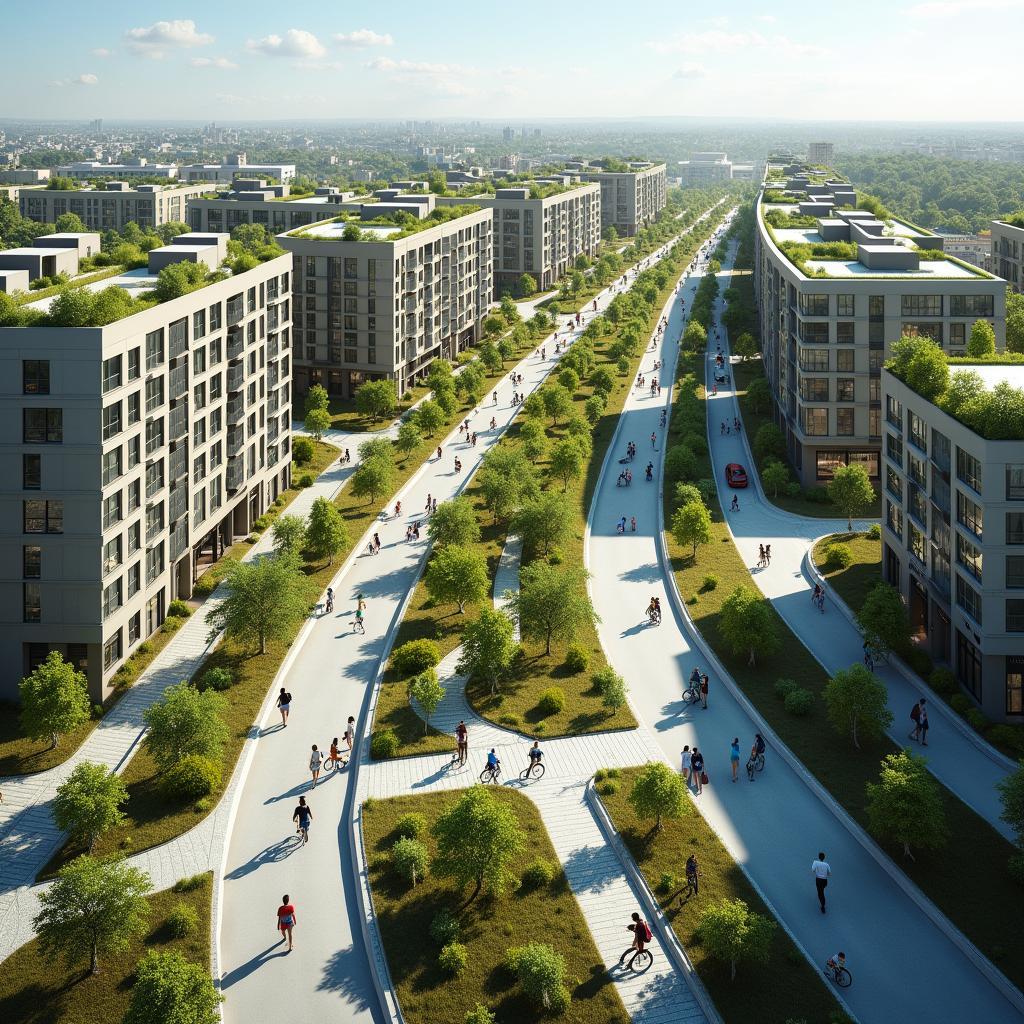 Mô hình quy hoạch đô thị bền vững với giao thông công cộng và không gian xanh tích hợp
3. Answer Keys – Đáp Án
PASSAGE 1: Questions 1-13
- FALSE
- FALSE
- NOT GIVEN
- FALSE
- TRUE
- NOT GIVEN
- biological wastewater treatment system
- local currencies / time-banking systems
- planning permission
- laboratories
- B
- B
- C
PASSAGE 2: Questions 14-26
- C
- F
- C
- A
- G
- infrastructure
- cycling
- green infrastructure
- participatory planning processes / inclusive engagement strategies
- mixed-income housing
- B, C, G (any order)
- (see above)
- (see above)
PASSAGE 3: Questions 27-40
- B
- C
- B
- B
- multiple semi-autonomous units
- governance regimes
- homogeneous groups
- Ecological economics
- Indigenous knowledge systems / Local practical wisdom
- Transformative adaptation
- YES
- NO
- NO
- YES
4. Giải Thích Đáp Án Chi Tiết
Passage 1 – Giải Thích
Câu 1: FALSE
- Dạng câu hỏi: True/False/Not Given
- Từ khóa: eco-villages, first appeared, significant movement, 1970s
- Vị trí trong bài: Đoạn 2, dòng 1-3
- Giải thích: Bài đọc nói “The concept of eco-villages originated in the 1970s, but it was not until the 1990s that the movement gained significant momentum.” Câu hỏi khẳng định phong trào có tầm quan trọng lớn từ thập niên 1970, trong khi bài đọc cho rằng phải đến thập niên 1990 mới thực sự phát triển mạnh. Đây là mâu thuẫn rõ ràng.
Câu 2: FALSE
- Dạng câu hỏi: True/False/Not Given
- Từ khóa: all eco-villages, fewer than 100 residents
- Vị trí trong bài: Đoạn 2, dòng 4-6
- Giải thích: Bài đọc nói “ranging from small rural settlements of fewer than 20 people to larger communities housing several hundred families”. Từ “all” trong câu hỏi làm cho câu phát biểu này sai, vì có những cộng đồng có hàng trăm gia đình (clearly more than 100 people).
Câu 3: NOT GIVEN
- Dạng câu hỏi: True/False/Not Given
- Từ khóa: Findhorn, produces all electricity, renewable sources
- Vị trí trong bài: Đoạn 3, dòng 4-5
- Giải thích: Bài viết chỉ nói “generates most of its electricity from wind turbines” (phần lớn, không phải tất cả). Không có thông tin về việc có sản xuất 100% điện từ năng lượng tái tạo hay không.
Câu 5: TRUE
- Dạng câu hỏi: True/False/Not Given
- Từ khóa: co-housing, reduce building costs, up to a quarter
- Vị trí trong bài: Đoạn 5, dòng 3-5
- Giải thích: Bài đọc nói “reduces construction costs by 15-25%”. “Up to a quarter” (lên đến 1/4 = 25%) khớp với thông tin này.
Câu 7: biological wastewater treatment system
- Dạng câu hỏi: Sentence Completion
- Từ khóa: Findhorn, clean wastewater
- Vị trí trong bài: Đoạn 3, dòng 5-6
- Giải thích: Câu gốc: “uses a biological wastewater treatment system that returns clean water to the environment.”
Câu 11: B
- Dạng câu hỏi: Multiple Choice
- Từ khóa: main purpose of eco-villages
- Vị trí trong bài: Đoạn 2, dòng 7-8
- Giải thích: “What unites these diverse projects is a commitment to creating a harmonious balance between human needs and environmental preservation” – đây chính là đáp án B được paraphrase.
Câu 13: C
- Dạng câu hỏi: Multiple Choice
- Từ khóa: consensus-based decision-making
- Vị trí trong bài: Đoạn 7, dòng 6-8
- Giải thích: “the consensus-based decision-making that strengthens community bonds can sometimes slow down important decisions” – khớp chính xác với đáp án C.
Passage 2 – Giải Thích
Câu 14: C (Paragraph C)
- Dạng câu hỏi: Matching Information
- Từ khóa: natural systems, replace conventional infrastructure
- Vị trí trong bài: Đoạn C, toàn bộ
- Giải thích: Đoạn C mô tả green infrastructure và cách nó “leverages natural processes” thay vì “engineered systems” – đây chính là việc hệ thống tự nhiên thay thế cơ sở hạ tầng thông thường.
Câu 16: C
- Dạng câu hỏi: Matching Information
- Từ khóa: specific design features, manage rainwater
- Vị trí trong bài: Đoạn C, dòng 5-6
- Giải thích: “Bioswales, rain gardens, and permeable pavements” là các ví dụ cụ thể về thiết kế quản lý nước mưa.
Câu 19: infrastructure
- Dạng câu hỏi: Summary Completion
- Từ khóa: reduce the need for extensive
- Vị trí trong bài: Đoạn B, dòng 4-5
- Giải thích: “cities can reduce infrastructure costs” – compact development giảm nhu cầu về cơ sở hạ tầng.
Câu 23: mixed-income housing
- Dạng câu hỏi: Summary Completion
- Từ khóa: prevents wealthy and poor residents, separate areas
- Vị trí trong bài: Đoạn E, dòng 2-3
- Giải thích: “Mixed-income housing policies… promote socioeconomic diversity rather than the residential segregation” – chống lại sự phân tách giàu nghèo.
Câu 24-26: B, C, G
- Dạng câu hỏi: Multiple Choice (chọn 3 đáp án)
- Vị trí trong bài: Đoạn G, toàn bộ
- Giải thích:
- B: “developers accustomed to conventional models… often oppose”
- C: “Regulatory frameworks established decades ago may inhibit innovation”
- G: “gentrification… rising property values may displace the very communities”
Passage 3 – Giải Thích
Câu 27: B
- Dạng câu hỏi: Multiple Choice
- Từ khóa: contemporary approaches differ
- Vị trí trong bài: Đoạn 1, dòng 1-4
- Giải thích: “paradigmatic shift… toward more holistic frameworks that recognize the inextricable linkages between social systems and ecological processes” – tiếp cận hiện đại nhận ra mối liên hệ giữa hệ thống xã hội và môi trường.
Câu 29: B
- Dạng câu hỏi: Multiple Choice
- Từ khóa: Balinese subak system, example of
- Vị trí trong bài: Đoạn 3, dòng 6-10
- Giải thích: Subak được trình bày là ví dụ về “effective social-ecological fit” – sự phù hợp giữa hệ sinh thái và hệ thống quản lý.
Câu 31: multiple semi-autonomous units
- Dạng câu hỏi: Table Completion
- Từ khóa: Polycentric governance
- Vị trí trong bài: Đoạn 2, dòng 9-11
- Giải thích: “distributing decision-making authority across multiple semi-autonomous units rather than concentrating it within centralized hierarchies”
Câu 37: YES
- Dạng câu hỏi: Yes/No/Not Given
- Từ khóa: diverse types of social capital, better equipped
- Vị trí trong bài: Đoạn 4, dòng 6-10
- Giải thích: “Sustainable communities require strategic cultivation of all three forms” và “redundancy in relational infrastructure” chỉ ra rằng đa dạng vốn xã hội giúp cộng đồng xử lý vấn đề tốt hơn.
Câu 38: NO
- Dạng câu hỏi: Yes/No/Not Given
- Từ khóa: Mondragon, cannot compete economically
- Vị trí trong bài: Đoạn 5, dòng 8-11
- Giải thích: Bài viết nói Mondragon “achieve economic success” – mâu thuẫn với phát biểu rằng không thể cạnh tranh kinh tế.
Câu 40: YES
- Dạng câu hỏi: Yes/No/Not Given
- Từ khóa: Transformative change, combination
- Vị trí trong bài: Đoạn 8, dòng 5-9
- Giải thích: “transformative change typically emerges through interaction between grassroots innovations… conducive institutional environments… and crisis moments” – đúng với phát biểu về sự kết hợp các yếu tố.
5. Từ Vựng Quan Trọng Theo Passage
Passage 1 – Essential Vocabulary
| Từ vựng | Loại từ | Phiên âm | Nghĩa tiếng Việt | Ví dụ từ bài | Collocation |
|---|---|---|---|---|---|
| eco-village | n | /ˈiːkəʊ ˈvɪlɪdʒ/ | làng sinh thái | eco-villages have emerged as a practical response | establish an eco-village |
| sustainable practices | n phrase | /səˈsteɪnəbl ˈpræktɪsɪz/ | các thực hành bền vững | eco-villages prioritize sustainable practices | adopt sustainable practices |
| intentional community | n phrase | /ɪnˈtenʃənl kəˈmjuːnəti/ | cộng đồng có chủ ý (được lập ra với mục đích cụ thể) | These intentional communities are designed | form an intentional community |
| ecological impact | n phrase | /ˌiːkəˈlɒdʒɪkl ˈɪmpækt/ | tác động sinh thái | minimize ecological impact | reduce ecological impact |
| renewable energy | n phrase | /rɪˈnjuːəbl ˈenədʒi/ | năng lượng tái tạo | prioritize sustainable practices such as renewable energy | generate renewable energy |
| shared resources | n phrase | /ʃeəd rɪˈsɔːsɪz/ | tài nguyên chia sẻ | renewable energy… and shared resources | manage shared resources |
| carbon emissions | n phrase | /ˈkɑːbən ɪˈmɪʃənz/ | lượng khí thải carbon | reducing both carbon emissions from transportation | cut carbon emissions |
| social cohesion | n phrase | /ˈsəʊʃl kəʊˈhiːʒn/ | sự gắn kết xã hội | Social cohesion forms another crucial pillar | strengthen social cohesion |
| consensus-based | adj | /kənˈsensəs beɪst/ | dựa trên sự đồng thuận | through consensus-based governance | consensus-based decision-making |
| co-housing | n | /kəʊ ˈhaʊzɪŋ/ | mô hình nhà ở chung | implement co-housing arrangements | co-housing arrangement/model |
| planning permission | n phrase | /ˈplænɪŋ pəˈmɪʃn/ | giấy phép quy hoạch | obtaining planning permission can be difficult | apply for planning permission |
| resilient | adj | /rɪˈzɪliənt/ | có khả năng phục hồi, bền vững | creating resilient… ways of living | resilient community/system |
Passage 2 – Essential Vocabulary
| Từ vựng | Loại từ | Phiên âm | Nghĩa tiếng Việt | Ví dụ từ bài | Collocation |
|---|---|---|---|---|---|
| urban ecosystem | n phrase | /ˈɜːbən ˈiːkəʊsɪstəm/ | hệ sinh thái đô thị | transformation of cities into sustainable urban ecosystems | develop an urban ecosystem |
| pressing challenge | n phrase | /ˈpresɪŋ ˈtʃælɪndʒ/ | thách thức cấp bách | one of the most pressing challenges | face a pressing challenge |
| policymaker | n | /ˈpɒləsiˌmeɪkə/ | nhà hoạch định chính sách | Urban planners and policymakers are… recognizing | government policymakers |
| social equity | n phrase | /ˈsəʊʃl ˈekwəti/ | công bằng xã hội | sustainability extends… to encompass social equity | promote social equity |
| compact development | n phrase | /ˈkɒmpækt dɪˈveləpmənt/ | phát triển đô thị tập trung | The concept of compact development | encourage compact development |
| mixed-use neighborhood | n phrase | /mɪkst juːs ˈneɪbəhʊd/ | khu vực kết hợp nhiều chức năng | characterized by higher-density, mixed-use neighborhoods | create mixed-use neighborhoods |
| sprawling suburbs | n phrase | /ˈsprɔːlɪŋ ˈsʌbɜːbz/ | vùng ngoại ô lan rộng | in contrast to the sprawling suburbs | combat sprawling suburbs |
| modal share | n phrase | /ˈməʊdl ʃeə/ | tỷ lệ sử dụng phương tiện | achieved a remarkable 62% modal share for cycling | increase modal share |
| green infrastructure | n phrase | /ɡriːn ˈɪnfrəstrʌktʃə/ | cơ sở hạ tầng xanh | The integration of green infrastructure | implement green infrastructure |
| urban heat island | n phrase | /ˈɜːbən hiːt ˈaɪlənd/ | đảo nhiệt đô thị | moderate urban heat island effects | reduce urban heat island |
| participatory planning | n phrase | /pɑːˌtɪsɪpətri ˈplænɪŋ/ | quy hoạch có sự tham gia | Participatory planning processes have emerged | adopt participatory planning |
| top-down planning | n phrase | /tɒp daʊn ˈplænɪŋ/ | quy hoạch từ trên xuống | Traditional top-down planning often resulted in | move away from top-down planning |
| marginalized population | n phrase | /ˈmɑːdʒɪnəlaɪzd ˌpɒpjuˈleɪʃn/ | nhóm dân cư bị thiệt thòi | seek input from marginalized populations | support marginalized populations |
| inclusionary zoning | n phrase | /ɪnˈkluːʒənri ˈzəʊnɪŋ/ | phân vùng bao gồm nhà ở giá rẻ | Inclusionary zoning requirements | implement inclusionary zoning |
| transit-oriented development | n phrase | /ˈtrænzɪt ˈɔːrientɪd dɪˈveləpmənt/ | phát triển định hướng giao thông công cộng | Transit-oriented development (TOD) offers an alternative | promote transit-oriented development |
Passage 3 – Essential Vocabulary
| Từ vựng | Loại từ | Phiên âm | Nghĩa tiếng Việt | Ví dụ từ bài | Collocation |
|---|---|---|---|---|---|
| paradigmatic shift | n phrase | /ˌpærədɪɡˈmætɪk ʃɪft/ | sự chuyển dịch mô thức/mô hình | undergone a paradigmatic shift | undergo a paradigmatic shift |
| technocentric | adj | /ˌteknəʊˈsentrɪk/ | lấy công nghệ làm trung tâm | from technocentric solutions | technocentric approach |
| holistic framework | n phrase | /həʊˈlɪstɪk ˈfreɪmwɜːk/ | khuôn khổ toàn diện | toward more holistic frameworks | develop a holistic framework |
| inextricable linkage | n phrase | /ˌɪnɪkˈstrɪkəbl ˈlɪŋkɪdʒ/ | mối liên hệ không thể tách rời | recognize the inextricable linkages | identify inextricable linkages |
| resilience theory | n phrase | /rɪˈzɪliəns ˈθɪəri/ | lý thuyết về khả năng phục hồi | emphasizes resilience theory | apply resilience theory |
| adaptive capacity | n phrase | /əˈdæptɪv kəˈpæsəti/ | khả năng thích ứng | embrace adaptive capacity | enhance adaptive capacity |
| socio-ecological system | n phrase | /ˈsəʊʃiəʊ ˌiːkəˈlɒdʒɪkl ˈsɪstəm/ | hệ thống sinh thái-xã hội | capacity of socio-ecological systems | manage socio-ecological systems |
| complex adaptive system | n phrase | /ˈkɒmpleks əˈdæptɪv ˈsɪstəm/ | hệ thống thích ứng phức hợp | draws upon complex adaptive systems theory | study complex adaptive systems |
| functional redundancy | n phrase | /ˈfʌŋkʃənl rɪˈdʌndənsi/ | sự dư thừa chức năng | exhibits functional redundancy | build functional redundancy |
| polycentric governance | n phrase | /ˌpɒliˈsentrɪk ˈɡʌvənəns/ | quản trị đa trung tâm | The polycentric governance structures | establish polycentric governance |
| social-ecological fit | n phrase | /ˈsəʊʃl ˌiːkəˈlɒdʒɪkl fɪt/ | sự phù hợp sinh thái-xã hội | attention to… “social-ecological fit” | achieve social-ecological fit |
| administrative boundary | n phrase | /ədˌmɪnɪˈstreɪtɪv ˈbaʊndri/ | ranh giới hành chính | when administrative boundaries fail to correspond | cross administrative boundaries |
| social capital | n phrase | /ˈsəʊʃl ˈkæpɪtl/ | vốn xã hội | Social capital… emerges as a critical determinant | build social capital |
| bonding social capital | n phrase | /ˈbɒndɪŋ ˈsəʊʃl ˈkæpɪtl/ | vốn xã hội liên kết | distinguishes between bonding social capital | strengthen bonding social capital |
| bridging social capital | n phrase | /ˈbrɪdʒɪŋ ˈsəʊʃl ˈkæpɪtl/ | vốn xã hội bắc cầu | bridging social capital (connections across diverse groups) | develop bridging social capital |
| ecological economics | n phrase | /ˌiːkəˈlɒdʒɪkl ˌiːkəˈnɒmɪks/ | kinh tế học sinh thái | Ecological economics offers alternative frameworks | study ecological economics |
| indigenous knowledge | n phrase | /ɪnˈdɪdʒənəs ˈnɒlɪdʒ/ | tri thức bản địa | marginalization of indigenous knowledge systems | preserve indigenous knowledge |
| transformative adaptation | n phrase | /trænsˈfɔːmətɪv ˌædæpˈteɪʃn/ | thích ứng mang tính biến đổi | Transformative adaptation… may ultimately prove necessary | require transformative adaptation |
Kết bài
Chủ đề xây dựng cộng đồng bền vững không chỉ là một trong những chủ đề quan trọng trong IELTS Reading mà còn phản ánh những thách thức toàn cầu mà nhân loại đang đối mặt. Qua bộ đề thi mẫu với ba passages được thiết kế theo đúng chuẩn Cambridge, bạn đã được trải nghiệm một bài thi hoàn chỉnh với độ khó tăng dần từ band 5.0 đến 9.0.
Ba passages trong đề thi này đã cung cấp góc nhìn đa chiều về cộng đồng bền vững: từ mô hình làng sinh thái cơ bản, qua quy hoạch đô thị hiện đại, đến những lý thuyết phức tạp về hệ thống sinh thái-xã hội. Bạn đã luyện tập với 7 dạng câu hỏi phổ biến nhất, mỗi dạng yêu cầu kỹ năng đọc hiểu và chiến lược làm bài khác nhau. Đối với những bạn đang ôn thi, điều quan trọng là hiểu rằng What are the challenges of achieving global energy access? cũng có mối liên hệ mật thiết với chủ đề cộng đồng bền vững, vì năng lượng là nền tảng cho mọi hoạt động phát triển.
Phần đáp án chi tiết không chỉ cho bạn biết câu trả lời đúng mà còn giải thích tại sao đúng, thông tin nằm ở đâu, và cách paraphrase được sử dụng như thế nào. Đây chính là chìa khóa để nâng cao band điểm Reading – hiểu rõ cách IELTS kiểm tra kỹ năng đọc của bạn thay vì chỉ ghi nhớ đáp án. Tương tự như việc nghiên cứu How does renewable energy adoption affect global power structures?, việc hiểu sâu các cơ chế và mối quan hệ giúp bạn xử lý tốt hơn các câu hỏi phức tạp.
Hơn 100 từ vựng được phân loại theo từng passage giúp bạn xây dựng vốn từ học thuật một cách có hệ thống. Hãy chú ý đến các collocations và cách sử dụng từ trong ngữ cảnh – đây là những gì giám khảo tìm kiếm ở thí sinh band cao. Đặc biệt, nhiều từ vựng này cũng có thể áp dụng cho Writing Task 2 khi viết về các chủ đề môi trường và xã hội.
Hãy nhớ rằng làm một bài test không đủ – bạn cần phân tích kỹ lưỡng từng câu trả lời sai, tìm hiểu tại sao mình hiểu nhầm, và rút ra bài học cho lần sau. Với đề thi này, bạn có đủ tài liệu để tự đánh giá, xác định điểm yếu và cải thiện từng bước. Chúc bạn đạt band điểm mục tiêu trong kỳ thi IELTS sắp tới!



[…] hiểu rõ nguyên nhân và cải thiện kỹ năng. Việc làm quen với các chủ đề How to build a sustainable community cũng sẽ bổ sung kiến thức về phát triển bền vững, có nhiều điểm tương […]