Chủ đề miêu tả một người giỏi ra quyết định (a person who is good at making decisions) là một trong những đề tài phổ biến và thú vị trong IELTS Speaking. Đây là dạng câu hỏi “Describe a person” – một trong những dạng bài xuất hiện với tần suất cao nhất trong Part 2, đồng thời cũng có thể được khai thác ở Part 1 và Part 3 dưới nhiều góc độ khác nhau.
Theo thống kê từ các đề thi thực tế, chủ đề về “decision-making” và “people with special qualities” xuất hiện đều đặn trong các kỳ thi IELTS từ 2020 đến nay, với tần suất trung bình khoảng 15-20% tổng số đề thi. Khả năng xuất hiện trong tương lai được đánh giá ở mức Cao, đặc biệt là các biến thể liên quan đến leadership, problem-solving và personal qualities.
Trong bài viết này, bạn sẽ học được:
- Các câu hỏi thường gặp trong cả 3 Part liên quan đến decision-making và personal qualities
- Bài mẫu chi tiết với 3 mức band điểm khác nhau (6-7, 7.5-8, 8.5-9) để bạn thấy rõ sự khác biệt
- Hơn 50 từ vựng và cụm từ ăn điểm theo chủ đề với phiên âm và ví dụ cụ thể
- Chiến lược trả lời hiệu quả từ góc nhìn của một IELTS Examiner chính thức
- Những lỗi thường gặp của học viên Việt Nam và cách khắc phục
IELTS Speaking Part 1: Introduction and Interview
Tổng Quan Về Part 1
Part 1 của IELTS Speaking kéo dài 4-5 phút với các câu hỏi ngắn về cuộc sống hàng ngày và bản thân thí sinh. Đây là phần “warm-up” để bạn làm quen với examiner và môi trường thi. Mặc dù các câu hỏi tương đối đơn giản, nhưng đây vẫn là cơ hội quan trọng để tạo ấn tượng tốt ngay từ đầu.
Đặc điểm chính:
- Câu hỏi xoay quanh các chủ đề quen thuộc: công việc, học tập, sở thích, quê hương
- Yêu cầu trả lời ngắn gọn nhưng đầy đủ (2-3 câu mỗi câu hỏi)
- Không cần phân tích sâu, chỉ cần trả lời tự nhiên với ví dụ cụ thể
Chiến lược hiệu quả:
- Luôn mở rộng câu trả lời bằng cách thêm lý do hoặc ví dụ
- Sử dụng từ vựng đa dạng nhưng phải tự nhiên
- Tránh trả lời Yes/No đơn thuần
Lỗi thường gặp của học viên Việt Nam:
- Trả lời quá ngắn, chỉ 1 câu đơn (Yes, I do / No, I don’t)
- Dùng từ vựng quá đơn giản, lặp lại (good, nice, interesting)
- Thiếu ví dụ cụ thể từ kinh nghiệm cá nhân
- Ngại mở rộng câu trả lời vì sợ sai ngữ pháp
Các Câu Hỏi Thường Gặp
Dựa trên phân tích các đề thi thực tế, dưới đây là những câu hỏi Part 1 liên quan đến chủ đề decision-making:
Question 1: Do you find it easy to make decisions?
Question 2: Do you usually make decisions quickly or slowly?
Question 3: Who helps you make important decisions in your life?
Question 4: Have you ever made a wrong decision?
Question 5: Do you prefer to make decisions alone or ask others for advice?
Question 6: What was the most difficult decision you’ve made recently?
Question 7: Do you think young people are good at making decisions?
Question 8: Are you good at making decisions under pressure?
Phân Tích và Gợi Ý Trả Lời Chi Tiết
Question: Do you find it easy to make decisions?
🎯 Cách tiếp cận:
- Trả lời trực tiếp (Yes/No hoặc It depends)
- Giải thích lý do (tùy thuộc vào loại quyết định)
- Đưa ra ví dụ cụ thể để minh họa
📝 Sample Answer – Band 6-7:
“Well, it depends on the situation. For small decisions like what to eat or what to wear, I can decide quite easily. But for big decisions like choosing a university or a career path, I need more time to think carefully. Sometimes I ask my parents for advice.”
Phân tích:
- Điểm mạnh: Có cấu trúc rõ ràng (depends → small vs big decisions), có ví dụ cụ thể
- Hạn chế: Từ vựng còn đơn giản (small, big, quite easily), thiếu collocations nâng cao
- Tại sao Band 6-7: Câu trả lời đầy đủ và mạch lạc, nhưng vocabulary và grammar structures chưa đủ sophisticated. Sử dụng “it depends” tốt nhưng chưa khai thác sâu.
📝 Sample Answer – Band 8-9:
“Well, it really depends on the nature of the decision. For day-to-day choices like what to have for lunch or which route to take to work, I’m quite decisive and can make up my mind instantly. However, when it comes to life-changing decisions such as career moves or major purchases, I tend to be more deliberate and weigh up all the pros and cons before committing. I’m actually someone who trusts their gut feeling for minor things but takes a more analytical approach for significant matters.”
Phân tích:
- Điểm mạnh:
- Vocabulary tinh tế: “nature of the decision”, “decisive”, “deliberate”, “weigh up pros and cons”
- Cấu trúc đa dạng: “it depends on…”, “when it comes to…”, “tend to be…”
- Thể hiện sự tự nhận thức rõ ràng về bản thân
- Phân biệt rõ 2 loại quyết định với approach khác nhau
- Tại sao Band 8-9:
- Fluency: Câu trả lời trôi chảy với discourse markers tự nhiên (Well, However, actually)
- Vocabulary: Sử dụng collocations chuẩn (make up my mind, life-changing decisions, gut feeling)
- Grammar: Có sự kết hợp của simple và complex structures một cách tự nhiên
- Content: Cho thấy khả năng critical thinking, phân tích situation
💡 Key Vocabulary & Expressions:
- decisive /dɪˈsaɪsɪv/: quyết đoán, dứt khoát
- deliberate /dɪˈlɪbərət/: thận trọng, cân nhắc kỹ
- weigh up the pros and cons: cân nhắc ưu và nhược điểm
- gut feeling: cảm giác trực giác
- analytical approach: cách tiếp cận phân tích
Question: Do you prefer to make decisions alone or ask others for advice?
🎯 Cách tiếp cận:
- Nêu rõ preference (alone/with advice hoặc combination)
- Giải thích why (personality, experience, importance of decision)
- Có thể nêu exception (khi nào thì khác)
📝 Sample Answer – Band 6-7:
“I usually prefer to make decisions by myself because I’m quite independent. But if it’s a very important decision, I will ask my parents or close friends for their opinions. I think it’s good to hear different ideas before making the final choice.”
Phân tích:
- Điểm mạnh: Có structure (preference → exception), có giải thích logic
- Hạn chế: Vocabulary cơ bản (quite independent, very important, good), thiếu sophistication
- Tại sao Band 6-7: Clear và coherent nhưng language resources còn limited. Chưa có collocations hay idiomatic expressions nào nổi bật.
📝 Sample Answer – Band 8-9:
“I’d say I’m fairly self-reliant when it comes to most decisions, as I like to take ownership of my choices. That said, I’m not someone who makes decisions in a vacuum – I definitely value input from trusted people in my life, particularly for decisions with far-reaching consequences. My approach is typically to gather different perspectives, process them myself, and then trust my own judgment for the final call. I find this strikes a good balance between being independent and benefiting from collective wisdom.”
Phân tích:
- Điểm mạnh:
- Vocabulary nâng cao: “self-reliant”, “take ownership”, “in a vacuum”, “far-reaching consequences”
- Phân tích nuanced: không đơn thuần alone hay with others mà là combination
- Complex ideas: “gather perspectives” → “process” → “make final judgment”
- Natural discourse markers: “That said”, “particularly”, “typically”
- Tại sao Band 8-9:
- Lexical Resource: Paraphrasing xuất sắc (make decisions alone = self-reliant = take ownership)
- Grammatical Range: Complex sentences với subordinate clauses
- Coherence: Ideas flow logically với clear connections
- Content depth: Cho thấy mature thinking về decision-making process
💡 Key Vocabulary & Expressions:
- self-reliant /ˌself rɪˈlaɪənt/: tự lực, không phụ thuộc người khác
- take ownership of: chịu trách nhiệm cho
- make decisions in a vacuum: đưa ra quyết định mà không tham khảo ai
- far-reaching consequences: hậu quả sâu rộng, lâu dài
- strike a good balance: tạo sự cân bằng tốt
- collective wisdom: trí tuệ tập thể
Question: Have you ever made a wrong decision?
🎯 Cách tiếp cận:
- Trả lời trực tiếp: Yes (honest answer)
- Kể một ví dụ cụ thể (không cần quá chi tiết trong Part 1)
- Đề cập đến lesson learned (nếu có thời gian)
📝 Sample Answer – Band 6-7:
“Yes, of course. Everyone makes wrong decisions sometimes. Last year, I decided to buy a cheap laptop online without checking reviews carefully. It broke after just two months. I learned that I should do more research before buying expensive things.”
Phân tích:
- Điểm mạnh: Có ví dụ cụ thể, có lesson learned, honest
- Hạn chế: Story telling còn basic, vocabulary đơn giản (cheap, broke, expensive things)
- Tại sao Band 6-7: Adequate response với clear example nhưng thiếu depth và sophisticated language. Câu cuối về lesson learned hơi formulaic.
📝 Sample Answer – Band 8-9:
“Oh absolutely, I’ve definitely made my fair share of poor decisions! One that springs to mind is when I impulsively quit a stable job without having another one lined up, thinking I’d easily find something better. It turned out to be more challenging than I’d anticipated, and I went through a financially stressful period. Looking back, it taught me the value of thinking things through more carefully and having a backup plan, especially for high-stakes decisions. I now try to sleep on major decisions rather than acting on impulse.”
Phân tích:
- Điểm mạnh:
- Natural expressions: “Oh absolutely”, “springs to mind”, “Looking back”
- Sophisticated vocabulary: “impulsively”, “lined up”, “high-stakes decisions”
- Personal reflection: shows self-awareness và growth
- Idiom usage: “sleep on major decisions” (suy nghĩ kỹ trước khi quyết định)
- Tại sao Band 8-9:
- Fluency: Sounds like natural speech với hesitation markers (Oh, definitely)
- Vocabulary: Topic-specific language về decision-making
- Grammar: Mix of tenses appropriately (past → present perfect → present)
- Development: Clear narrative arc (decision → consequence → lesson)
💡 Key Vocabulary & Expressions:
- make one’s fair share of: có phần của mình trong việc (làm điều gì đó)
- spring to mind: nảy ra trong đầu, nghĩ đến ngay
- impulsively quit: nghỉ việc một cách bốc đồng
- high-stakes decisions: quyết định có mức độ rủi ro cao
- sleep on (a decision): suy nghĩ thêm một đêm trước khi quyết định
- backup plan: kế hoạch dự phòng
 Giáo viên IELTS đang tư vấn học viên về cách miêu tả người giỏi ra quyết định trong bài thi Speaking
IELTS Speaking Part 2: Long Turn (Cue Card)
Tổng Quan Về Part 2
Part 2 là phần thử thách nhất của IELTS Speaking, yêu cầu bạn nói liên tục trong 2-3 phút về một chủ đề cụ thể mà không bị gián đoạn. Đây là lúc examiner đánh giá khả năng organize ideas, maintain fluency và sử dụng variety of language của bạn.
Thời gian và cấu trúc:
- 1 phút chuẩn bị: Ghi chú trên giấy (không viết full sentences)
- 2-3 phút nói: Độc thoại về topic, không có câu hỏi ngắt giữa chừng
- Follow-up questions: 1-2 câu hỏi ngắn sau khi bạn kết thúc
Chiến lược hiệu quả:
- Sử dụng hết 1 phút chuẩn bị: Ghi keywords cho mỗi bullet point, thêm 2-3 từ vựng nâng cao bạn muốn dùng
- Nói đủ 2 phút: Đây là minimum requirement. Nếu nói dưới 1.5 phút, điểm Fluency sẽ bị ảnh hưởng
- Cover tất cả bullet points: Đừng bỏ sót bất kỳ yêu cầu nào, đặc biệt là câu “explain” cuối cùng
- Paraphrase câu hỏi: Đừng repeat y nguyên từ trong đề
- Dùng past tense cho experiences: Nếu đề yêu cầu kể về một lần cụ thể
Lỗi thường gặp của học viên Việt Nam:
- Không sử dụng hết 1 phút chuẩn bị, vội vàng bắt đầu nói
- Nói chưa đến 1.5 phút rồi dừng, ngồi im
- Bỏ qua bullet point “explain why/how you feel”
- Lạc đề, nói về người/sự việc khác ngoài đề bài
- Dùng quá nhiều filler words (um, uh, you know) do thiếu chuẩn bị
- Nói theo template cứng nhắc, thiếu tự nhiên
Cue Card
Describe a person who is good at making decisions
You should say:
- Who this person is
- How you know this person
- What decisions this person usually makes
- And explain why you think this person is good at making decisions
Phân Tích Đề Bài
Dạng câu hỏi: Describe a person – một trong những dạng phổ biến nhất trong IELTS Speaking Part 2
Thì động từ chính: Hiện tại (Present tense) vì đây là mô tả một người hiện tại với quality thường xuyên. Tuy nhiên, bạn có thể dùng Past tense khi kể về specific examples hoặc khi bạn biết người đó.
Bullet points phải cover:
-
Who this person is: Giới thiệu rõ ràng (relationship, occupation, age range nếu phù hợp). Không cần quá chi tiết về personal information.
-
How you know this person: Bối cảnh làm quen (work, family, school). Có thể đề cập thời gian biết nhau để tạo credibility.
-
What decisions this person usually makes: Đây là phần quan trọng – nêu cụ thể types of decisions (work-related, personal, family matters). Nên có ít nhất 2-3 examples.
-
Explain why you think this person is good at making decisions: Đây là bullet point quan trọng nhất, chiếm khoảng 30-40% bài nói. Phân tích qualities, approach, results. Đây là nơi showcase vocabulary và critical thinking.
Lưu ý quan trọng:
- Chọn một người mà bạn thực sự biết rõ để có nhiều details
- Có thể chọn: boss, teacher, parent, mentor, friend
- Tránh chọn celebrity mà bạn không biết rõ decision-making process
- Câu “explain” cần có depth: không chỉ liệt kê qualities mà phải có examples và analysis
📝 Sample Answer – Band 6-7
Thời lượng: Khoảng 1.5-2 phút (240-280 từ)
I’d like to talk about my older brother, Minh, who I think is really good at making decisions. He’s 32 years old and works as a project manager in a big IT company in Ho Chi Minh City.
I’ve known him all my life, of course, since he’s my brother. We grew up together in the same house, and even though he moved out a few years ago after getting married, we still see each other regularly during family gatherings and sometimes meet up for coffee.
As a project manager, he has to make many important decisions every day. He decides which tasks should be prioritized, how to allocate the budget for different projects, and which team members should work on specific assignments. At home, he also makes big decisions for his family, like choosing the right school for his daughter or deciding when to buy a new house.
I think he’s good at making decisions for several reasons. First, he always stays calm under pressure. Even when there’s a crisis at work or a difficult situation at home, he doesn’t panic and can think clearly. Second, he’s very logical and always considers different options before choosing. He makes lists of pros and cons and discusses with relevant people. Third, he learns from his mistakes. When a decision doesn’t work out well, he reflects on what went wrong and tries not to repeat the same error. Finally, he’s quite confident in his choices and doesn’t second-guess himself too much, which I think is important.
Overall, I really admire his decision-making skills and often ask for his advice when I face difficult choices in my own life.
Phân Tích Band Điểm
| Tiêu chí | Band | Nhận xét |
|---|---|---|
| Fluency & Coherence | 6-7 | Mạch lạc, có sequencing (First, Second, Third, Finally). Có một số linking devices nhưng còn basic. Độ dài phù hợp nhưng thiếu sophistication trong transitions. |
| Lexical Resource | 6-7 | Từ vựng adequate và relevant (prioritize, allocate budget, panic, pros and cons). Có một số collocations tốt nhưng còn nhiều từ đơn giản (big decisions, difficult situation, important). Thiếu less common vocabulary. |
| Grammatical Range & Accuracy | 6-7 | Mix of simple và complex sentences. Có relative clauses (who I think, which I think). Tenses chính xác. Nhưng structures còn predictable, thiếu variety. |
| Pronunciation | 6-7 | (Giả định) Clear và understandable, có thể có một số Vietnamese accent nhưng không ảnh hưởng communication. |
Điểm mạnh:
- ✅ Cover đầy đủ tất cả bullet points
- ✅ Có structure rõ ràng với sequencers (First, Second, Third)
- ✅ Examples cụ thể về types of decisions
- ✅ Giải thích why với nhiều reasons
Hạn chế:
- ⚠️ Vocabulary còn common, thiếu sophisticated expressions
- ⚠️ Thiếu personal anecdotes cụ thể về một decision thực tế
- ⚠️ Phần explain chưa có enough depth, còn list-like
- ⚠️ Thiếu emotional language và personal reflection
📝 Sample Answer – Band 7.5-8
Thời lượng: Khoảng 2-2.5 phút (280-320 từ)
I’d like to tell you about my former manager, Sarah, who I consider to be exceptionally skilled at making decisions. She was the operations director at the marketing agency where I worked for three years, and she’s someone who really left a lasting impression on me in terms of leadership and sound judgment.
I got to know Sarah when I joined the company straight after university. She was actually the person who interviewed me and decided to give me a chance despite my limited experience. Over the years, I had the opportunity to work closely with her on various campaigns and witnessed firsthand how she handled high-pressure situations.
In her role, Sarah had to make critical decisions on a daily basis. These ranged from strategic choices about which clients to take on and which projects to prioritize, to more tactical decisions like reallocating resources when campaigns weren’t performing well or mediating conflicts between team members. I particularly remember one instance when a major client threatened to leave due to disappointing results. While everyone was panicking, Sarah calmly analyzed the situation, identified the root cause, and made the tough call to replace the team lead, which ultimately saved the account.
What makes Sarah exceptional at decision-making is her systematic approach. She never makes snap judgments – instead, she gathers all relevant information, consults with the people involved, and weighs different scenarios. She’s also remarkably decisive once she’s evaluated the options; she doesn’t suffer from analysis paralysis like many leaders do. Another quality I admire is her accountability – she owns her decisions completely, whether they succeed or fail, and this creates a culture of trust.
Perhaps most importantly, she has this rare combination of being both data-driven and intuitive. She looks at the numbers but also trusts her gut feeling, which comes from years of experience.
I think her decision-making ability is one of the main reasons she progressed so quickly in her career.
Phân Tích Band Điểm
| Tiêu chí | Band | Nhận xét |
|---|---|---|
| Fluency & Coherence | 7.5-8 | Trôi chảy với minimal hesitation. Cohesive devices varied và natural (actually, over the years, particularly, perhaps most importantly). Ideas develop logically với clear progression. |
| Lexical Resource | 7.5-8 | Wide range of vocabulary với nhiều collocations chuẩn (sound judgment, high-pressure situations, critical decisions, tactical decisions, snap judgments, analysis paralysis). Paraphrasing tốt (good at decisions → skilled at → exceptional at). |
| Grammatical Range & Accuracy | 7.5-8 | Complex structures tự nhiên (relative clauses, conditionals, participle clauses). Mix of tenses appropriate. Few errors nếu có. Sentence variety cao. |
| Pronunciation | 7.5-8 | (Giả định) Smooth delivery với stress và intonation patterns tốt. Easy to follow. |
So Sánh Với Band 6-7
| Khía cạnh | Band 6-7 | Band 7.5-8 |
|---|---|---|
| Vocabulary | “really good at making decisions”, “big decisions”, “important” | “exceptionally skilled at”, “critical decisions”, “strategic choices”, “sound judgment” |
| Grammar | “I think he’s good at making decisions for several reasons” | “What makes Sarah exceptional at decision-making is her systematic approach” (Cleft sentence) |
| Ideas | List reasons một cách general (calm, logical, learns from mistakes) | Có specific anecdote (client situation) + analysis of approach + qualities với depth |
| Coherence | First, Second, Third (mechanical) | Actually, Over the years, Particularly, Perhaps most importantly (natural flow) |
| Development | Explain why với list-like structure | Explain với narrative + analysis + personal reflection |
Điểm nổi bật:
- Có một specific example (client situation) làm bài sống động hơn
- Vocabulary topic-specific và collocations chuẩn
- Structure tự nhiên, không formulaic
- Balance giữa description và personal reflection
 Học viên đang thực hành trả lời IELTS Speaking Part 2 về người giỏi quyết định với cue card
📝 Sample Answer – Band 8.5-9
Thời lượng: 2.5-3 phút đầy đủ (320-360 từ)
I’d like to talk about my mentor, Dr. Nguyen Thanh Long, who I’d say is hands down one of the most astute decision-makers I’ve ever encountered. He’s a senior consultant in healthcare management and has been navigating complex organizational decisions for over two decades.
Our paths crossed about five years ago when I was working on a research project at his hospital. What started as a professional acquaintance gradually evolved into a mentorship relationship, and over the years, I’ve had the privilege of observing how he approaches critical junctures in both his professional and personal life.
Dr. Long’s role entails making decisions with far-reaching implications. On any given day, he might be grappling with budget allocation for new medical equipment worth millions of dollars, mediating between conflicting departments, or making ethically charged calls about patient care protocols. What’s particularly impressive is the breadth of decisions he handles – from high-stakes strategic planning about the hospital’s five-year development roadmap to nuanced personnel decisions about hiring and team restructuring.
What truly sets him apart is his remarkably balanced approach. Unlike many leaders who are either overly analytical or excessively impulsive, Dr. Long has mastered the art of combining rigorous data analysis with emotional intelligence. I remember one instance when he had to decide whether to shut down an underperforming department. Rather than jumping to conclusions based solely on financial metrics, he spent weeks talking to staff, understanding the underlying challenges, and ultimately devised a restructuring plan that saved jobs while improving efficiency.
Another hallmark of his decision-making is his ability to embrace uncertainty. In healthcare, where situations are often inherently ambiguous, he doesn’t agonize over finding the perfect solution – instead, he makes informed decisions with incomplete information and remains agile enough to course-correct if needed. This pragmatic flexibility is something many leaders struggle with.
What I find most admirable is his willingness to involve others in the decision-making process without abdicating his responsibility. He actively seeks diverse perspectives, particularly from those who might be affected by the decision, which not only leads to better outcomes but also fosters buy-in and trust.
Ultimately, I think Dr. Long exemplifies how effective decision-making isn’t just about being right all the time – it’s about having a systematic yet adaptive process, maintaining moral clarity, and taking ownership of the consequences. His approach has fundamentally shaped how I think about making important choices in my own life.
Phân Tích Band Điểm
| Tiêu chí | Band | Nhận xét |
|---|---|---|
| Fluency & Coherence | 8.5-9 | Exceptionally fluent với sophisticated cohesion. Ideas flow seamlessly với varied discourse markers. No noticeable hesitation. Natural progression from introduction → description → analysis → personal impact. |
| Lexical Resource | 8.5-9 | Wide và sophisticated vocabulary với precise meaning (astute, entails, grappling with, hallmark, pragmatic flexibility). Idiomatic usage natural (hands down, sets apart, mastered the art of). Collocations native-like. |
| Grammatical Range & Accuracy | 8.5-9 | Full range of structures với flexibility. Complex sentences natural và accurate (participle clauses, relative clauses, conditional forms, cleft sentences). Zero noticeable errors. |
| Pronunciation | 8.5-9 | (Giả định) Fully intelligible với native-like features. Appropriate stress, rhythm, intonation patterns. |
Tại Sao Bài Này Xuất Sắc
🎯 Fluency Hoàn Hảo:
- Bài nói dài đủ 2.5-3 phút với density của ideas cao
- Không có filler words hay hesitation
- Transitions hoàn toàn tự nhiên giữa các phần
📚 Vocabulary Tinh Vi:
- “hands down one of the most astute decision-makers” – Idiomatic expression kết hợp với sophisticated adjective
- “entails making decisions with far-reaching implications” – Formal register phù hợp với professional context
- “grappling with” thay vì “dealing with” – shows lexical sophistication
- “hallmark of his decision-making” – Precise word choice
- “pragmatic flexibility” – Abstract noun phrase showing conceptual thinking
- “abdicating his responsibility” – Less common verb trong context này
📝 Grammar Đa Dạng:
- “What started as a professional acquaintance gradually evolved into a mentorship relationship” – Noun clause as subject + past tense narrative
- “What truly sets him apart is his remarkably balanced approach” – Cleft sentence for emphasis
- “Rather than jumping to conclusions based solely on financial metrics” – Participle phrase với complex prepositional phrase
- “he makes informed decisions with incomplete information and remains agile enough to course-correct” – Parallel structure với adjective + enough + to-infinitive
- “which not only leads to better outcomes but also fosters buy-in” – Non-defining relative clause với not only…but also structure
💡 Ideas Sâu Sắc:
- Không chỉ describe mà còn analyze decision-making philosophy
- Compare và contrast với other leaders
- Có specific example với narrative arc (underperforming department)
- Personal reflection về impact lên bản thân
- Thể hiện understanding về complexity của decision-making
🎨 Structure Xuất Sắc:
- Introduction: Set up với strong opening (hands down, astute)
- How I know: Brief but với evolution (acquaintance → mentorship)
- What decisions: Varied examples từ different domains
- Why good: Multi-dimensional analysis (balanced approach, embrace uncertainty, involve others)
- Personal impact: Elevate bài nói lên higher level of reflection
Follow-up Questions (Rounding Off Questions)
Sau khi bạn kết thúc Part 2, examiner thường hỏi 1-2 câu ngắn để transition sang Part 3. Đây là câu hỏi “cooling down”, không yêu cầu elaborate answer.
Question 1: Do you often ask this person for advice?
Band 6-7 Answer:
“Yes, quite often. Whenever I face a difficult decision, I usually contact him to get his opinion. His advice is always very helpful and practical.”
Band 8-9 Answer:
“Yes, absolutely. I’d say he’s become my go-to person whenever I’m at a crossroads with important decisions. What I value most is that he doesn’t just tell me what to do – he helps me think through the implications of different options so I can arrive at my own conclusions.”
💡 Key expressions:
- go-to person: người luôn tìm đến khi cần
- at a crossroads: ở ngã ba đường, phải quyết định
- think through the implications: suy nghĩ thấu đáo về hệ quả
- arrive at one’s own conclusions: tự đi đến kết luận của mình
Question 2: Has this person ever made a decision that you disagreed with?
Band 6-7 Answer:
“Not really. Most of the time I agree with his decisions because they are well-thought-out. But even if I don’t agree, I respect his choice because he usually has good reasons.”
Band 8-9 Answer:
“Well, there have been a few occasions when I initially had reservations about his decisions, particularly regarding personnel changes that seemed quite drastic. However, in hindsight, his decisions almost always proved to be sound. I think this actually demonstrates his ability to see the bigger picture that others might miss in the moment.”
💡 Key expressions:
- have reservations about: có sự nghi ngại, không hoàn toàn đồng ý
- in hindsight: khi nhìn lại
- proved to be sound: chứng tỏ là đúng đắn
- see the bigger picture: nhìn thấy bức tranh tổng thể
IELTS Speaking Part 3: Two-way Discussion
Tổng Quan Về Part 3
Part 3 là phần thử thách trí tuệ nhất của IELTS Speaking. Đây không còn là nói về bản thân hay experiences cá nhân nữa, mà là thảo luận về các vấn đề xã hội, xu hướng, và concepts trừu tượng liên quan đến chủ đề của Part 2.
Thời gian: 4-5 phút
Đặc điểm:
- Câu hỏi abstract và philosophical hơn nhiều so với Part 1 và 2
- Yêu cầu critical thinking, analysis, và speculation
- Examiner muốn nghe opinions có lý lẽ, không chỉ là personal preferences
- Thường có các dạng câu hỏi: Compare, Cause-Effect, Problem-Solution, Predict future, Evaluate
Yêu cầu:
- Phân tích nhiều góc độ: Không chỉ đưa ra một quan điểm đơn lẻ
- Evidence và examples: Đưa ra examples từ society, studies, trends (không chỉ “I think”)
- Acknowledge complexity: Thừa nhận vấn đề phức tạp, có nhiều factors
- Balance: Xem xét both sides của issue trước khi conclude
Chiến lược:
- Mở rộng câu trả lời: Mỗi answer nên có 4-6 câu (30-45 giây)
- Structure rõ ràng: Direct answer → Reason 1 + example → Reason 2 + example → Conclusion/Nuance
- Use discourse markers: Well, Actually, Generally speaking, From my perspective, On the one hand…
- Không sợ nói “It depends”: Nhưng phải explain on what it depends
- Paraphrase câu hỏi: Đừng repeat từ examiner dùng
Lỗi thường gặp của học viên Việt Nam:
- Trả lời quá ngắn (1-2 câu), thiếu development
- Chỉ nói về personal experience thay vì social perspective
- Thiếu từ vựng abstract và academic
- Không structure câu trả lời, nói lan man
- Sợ disagree hoặc nói “I don’t know”
- Thiếu examples cụ thể để support opinions
Các Câu Hỏi Thảo Luận Sâu
Dưới đây là các câu hỏi Part 3 thực tế được phân loại theo themes khác nhau liên quan đến decision-making.
Theme 1: Decision-Making in Different Age Groups
Question 1: Do you think young people today are better at making decisions than young people in the past?
🎯 Phân tích câu hỏi:
- Dạng: Compare across time periods
- Key words: young people, today vs past, better at decisions
- Cách tiếp cận:
- Có thể agree/disagree/it depends
- Compare factors affecting decision-making (information access, education, guidance)
- Consider both advantages và disadvantages
- Conclude với balanced view
📝 Sample Answer – Band 6-7:
“I think it depends on the type of decision. Young people today have more access to information through the internet, so they can research before making choices. They can read reviews, watch videos, and ask for opinions online. However, they also face more options and distractions, which can make decision-making harder. In the past, young people had fewer choices but more guidance from their families and communities. So I would say both generations have their own strengths and challenges in making decisions.”
Phân tích:
- Structure: Clear position (it depends) → advantages of today → disadvantages → past comparison → balanced conclusion
- Vocabulary: Adequate (access to information, research, guidance) nhưng còn common
- Tại sao Band 6-7: Answer có structure tốt và covers different aspects, nhưng thiếu specific examples và sophisticated language. Analysis còn surface-level.
📝 Câu trả lời mẫu – Band 8.5-9:
“Well, that’s quite a nuanced question, and I’d say the answer is multifaceted. On one hand, young people today have unprecedented access to information and resources that can inform their choices. They can tap into online reviews, expert opinions, and peer experiences at the click of a button, which theoretically should lead to more well-informed decisions. Moreover, modern education systems increasingly emphasize critical thinking and problem-solving skills, which are fundamental to effective decision-making.
However, I’d argue that this information abundance is actually a double-edged sword. Today’s youth are often paralyzed by choice – a phenomenon psychologists call ‘choice overload’ or ‘analysis paralysis’. When faced with countless options, whether it’s choosing a university major or even deciding what to watch on Netflix, they can become overwhelmed and indecisive. In contrast, previous generations, while having fewer resources, often had clearer pathways and stronger community support systems that guided their decision-making process.
What’s particularly concerning is the instant gratification culture fueled by social media, which can lead to more impulsive rather than deliberate decision-making. Young people today might be swayed by peer pressure and FOMO (fear of missing out) in ways that weren’t as pronounced before.
That said, I think it’s overly simplistic to say one generation is definitively better. It’s more accurate to say they face fundamentally different challenges in their decision-making contexts.”
Phân tích:
-
Structure:
- Opening: Acknowledge complexity
- Point 1: Advantages today (information + education)
- Counter-point: Disadvantages (choice overload)
- Additional concern: Social media impact
- Conclusion: Nuanced view rejecting simple comparison
-
Vocabulary:
- Sophisticated adjectives: nuanced, multifaceted, unprecedented
- Topic-specific terms: critical thinking, choice overload, analysis paralysis, instant gratification
- Academic phrases: theoretically should, phenomenon, fundamentally different
-
Grammar:
- Complex conditionals: “theoretically should lead to”
- Relative clauses: “which are fundamental to”, “that weren’t as pronounced”
- Participle clauses: “fueled by social media”
- Cleft sentence: “What’s particularly concerning is”
-
Critical Thinking:
- Introduces psychological concept (choice overload)
- Considers historical context
- Acknowledges both positive and negative aspects
- Rejects simplistic binary comparison
💡 Key Language Features:
Discourse markers:
- “Well, that’s quite a…” (thoughtful opening)
- “On one hand… However” (contrasting ideas)
- “Moreover” (adding points)
- “In contrast” (comparison)
- “What’s particularly concerning” (emphasis)
- “That said” (introducing counter-argument)
Tentative language:
- “I’d say”, “I’d argue”, “I think it’s…”
- Shows appropriate caution in making claims
Abstract nouns:
- information abundance, analysis paralysis, instant gratification culture, decision-making contexts
Question 2: At what age do you think people start to make their own important decisions?
🎯 Phân tích câu hỏi:
- Dạng: Opinion about specific age/stage
- Key words: what age, start to, important decisions, own
- Cách tiếp cận:
- Có thể mention specific age range hoặc life stage
- Consider cultural factors
- Distinguish types of decisions
- Acknowledge individual differences
📝 Sample Answer – Band 6-7:
“I think most people start making important decisions when they become adults, around 18-20 years old. At this age, they usually go to university and need to choose their major, which affects their future career. They also start making decisions about relationships and where to live. Before this age, parents usually make most important decisions for their children. However, some people might start earlier or later depending on their family situation and personality.”
Phân tích:
- Structure: Direct answer với age → examples of decisions → comparison với earlier age → acknowledgment of variations
- Vocabulary: Functional but basic (important decisions, future career, family situation)
- Tại sao Band 6-7: Clear và logical answer nhưng lacks depth of analysis. Không explore factors affecting this age or cultural perspectives.
📝 Câu trả lời mẫu – Band 8.5-9:
“This is actually quite culturally contingent, but broadly speaking, I’d say the transition typically occurs during late adolescence and early adulthood, roughly between 18 and 22, which coincides with several significant life milestones. This is when most individuals embark on higher education or enter the workforce, both of which necessitate making consequential choices about career paths, living arrangements, and financial independence.
However, I think it’s important to recognize that this is a gradual process rather than a sudden shift. Children and teenagers increasingly make age-appropriate decisions throughout their development – perhaps choosing extracurricular activities around 10-12, making decisions about friend groups and study habits in their mid-teens, and progressively taking on more responsibility. What changes around 18 isn’t necessarily the capacity to decide, but rather the scope and consequences of those decisions, as well as the degree of autonomy parents grant.
Interestingly, there’s considerable cultural variation here. In many Asian cultures, including Vietnam, young people might continue to defer to parental wisdom even into their twenties, particularly for major life decisions like career choice or marriage. This isn’t necessarily a sign of immaturity – rather, it reflects collectivist values that prioritize family harmony and intergenerational wisdom.
The age is also heavily influenced by socioeconomic factors. Those from more privileged backgrounds might have the luxury of extended adolescence, while young people from disadvantaged circumstances often have to make weighty decisions much earlier out of sheer necessity.”
Phân tích:
-
Structure:
- Direct answer với age range và context
- Reframe: gradual process not sudden
- Cultural perspective (Asian vs Western)
- Socioeconomic factors
- Multi-dimensional analysis
-
Vocabulary:
- Academic: culturally contingent, necessitate, progressively, collectivist values
- Precise collocations: life milestones, age-appropriate decisions, defer to parental wisdom, intergenerational wisdom
- Sophisticated phrases: coincides with, embark on, degree of autonomy, sheer necessity
-
Grammar:
- Reduced relative clauses: “roughly between 18 and 22, which coincides with…”
- Gerund phrases as subjects: “making decisions about…”
- Adverbial phrases: “Interestingly”, “Broadly speaking”
- Passive voice for emphasis: “is heavily influenced by”
-
Critical Thinking:
- Challenges simple age-based answer
- Introduces developmental psychology perspective (gradual process)
- Cultural comparison (collectivist vs individualist)
- Socioeconomic analysis
- Avoids value judgment (“isn’t necessarily immaturity”)
💡 Key Language Features:
Hedging language:
- “broadly speaking”, “I’d say”, “roughly”, “typically”
- Shows academic register and avoids overgeneralization
Emphasis structures:
- “This is actually quite…” (highlighting importance)
- “What changes around 18 isn’t… but rather…” (contrasting for clarity)
- “Interestingly” (drawing attention to surprising point)
Abstract concepts:
- capacity vs scope, autonomy, collectivist values, intergenerational wisdom, extended adolescence
 Thí sinh tự tin thảo luận Part 3 về quyết định và lãnh đạo với giám khảo IELTS
Theme 2: Decision-Making in Professional Context
Question 3: What qualities do business leaders need to have to make good decisions?
🎯 Phân tích câu hỏi:
- Dạng: List và explain qualities/characteristics
- Key words: business leaders, qualities, good decisions
- Cách tiếp cận:
- Identify 3-4 key qualities
- Explain why each is important
- Có thể prioritize hoặc rank
- Use business/leadership examples
📝 Sample Answer – Band 6-7:
“Business leaders need several important qualities to make good decisions. First, they need to be confident and not afraid to take risks. Second, they should be good at analyzing information and thinking logically. They also need to understand people well because business decisions affect employees and customers. Another important quality is the ability to stay calm under pressure, especially during a crisis. Finally, good business leaders should be able to learn from their mistakes and adapt their strategies when necessary.”
Phân tích:
- Structure: Clear list of qualities với brief explanation cho mỗi quality
- Vocabulary: Adequate (confident, analyzing, logically, adapt) nhưng thiếu business-specific terminology
- Tại sao Band 6-7: Covers multiple qualities với reasonable explanations, nhưng examples thiếu và language không sophisticated enough cho business context.
📝 Câu trả lời mẫu – Band 8.5-9:
“From my perspective, effective business decision-making requires a unique constellation of qualities that go beyond mere intelligence or education.
Foremost among these is what I’d call strategic foresight – the ability to anticipate market trends, understand long-term implications, and think several moves ahead like a chess player. In today’s volatile business environment, leaders can’t just react to immediate circumstances; they need to envision multiple future scenarios and position their organizations accordingly.
Equally crucial is emotional intelligence, which is often underestimated in business contexts. Leaders must navigate complex interpersonal dynamics, gauge stakeholder sentiments, and understand how their decisions will ripple through the organization. A technically sound decision that alienates your workforce or erodes trust is ultimately a poor decision, regardless of its theoretical merit.
I’d also emphasize the importance of decisiveness paired with humility – and these might seem contradictory but they’re actually complementary. Leaders need the conviction to make tough calls with incomplete information, which is the reality of business. However, they also need the humility to acknowledge when they’re wrong, seek diverse perspectives, and course-correct without ego getting in the way.
Moreover, in our increasingly interconnected world, cultural intelligence and ethical discernment are becoming non-negotiable. Business decisions today have far-reaching social and environmental implications, and leaders who ignore these dimensions are short-sighted at best, and reckless at worst.
What ties all these together is perhaps intellectual curiosity – the relentless drive to stay informed, challenge assumptions, and continuously refine one’s decision-making framework.”
Phân tích:
-
Structure:
- Introduction: Set up with “constellation of qualities”
- Quality 1: Strategic foresight (với detailed explanation)
- Quality 2: Emotional intelligence (với counterpoint về technical soundness)
- Quality 3: Decisiveness + humility (addressing seeming contradiction)
- Quality 4: Cultural intelligence + ethics (modern business context)
- Conclusion: Intellectual curiosity as meta-quality
-
Vocabulary:
- Business-specific: strategic foresight, volatile business environment, stakeholder sentiments, theoretical merit
- Academic: constellation, underestimated, complementary, non-negotiable, intellectual curiosity
- Vivid verbs: navigate, gauge, ripple through, alienate, erode
- Sophisticated adjectives: volatile, reckless, relentless
-
Grammar:
- Complex noun phrases: “a unique constellation of qualities that go beyond”
- Relative clauses for definition: “what I’d call strategic foresight”
- Contrast structures: “not just… they need to”
- Conditional logic: “A technically sound decision that alienates… is ultimately a poor decision”
- Emphasis through inversion: “Foremost among these is”
-
Critical Thinking:
- Prioritizes qualities (Foremost, Equally crucial)
- Addresses apparent contradiction (decisiveness vs humility)
- Modern business context (interconnected world, ethical dimensions)
- Holistic view (technical + human + ethical aspects)
- Meta-cognition (intellectual curiosity as underlying quality)
💡 Key Language Features:
Sophisticated discourse markers:
- “From my perspective” (personal stance)
- “Foremost among these” (priority marker)
- “Equally crucial” (adding equal-weight point)
- “Moreover” (additional point)
- “What ties all these together” (synthesis)
Qualifying language:
- “what I’d call”, “might seem”, “at best… at worst”
- Shows nuanced thinking
Power collocations:
- strategic foresight, volatile environment, emotional intelligence, interpersonal dynamics, stakeholder sentiments, theoretical merit, cultural intelligence, ethical discernment, intellectual curiosity
Theme 3: Technology and Decision-Making
Question 4: How has technology changed the way people make decisions?
🎯 Phân tích câu hỏi:
- Dạng: Change/Development question (past to present)
- Key words: technology, changed, way people make decisions
- Cách tiếp cận:
- Compare before and after technology
- Positive changes và negative changes
- Specific examples of technology (smartphone, AI, data analytics)
- Consider different types of decisions
📝 Sample Answer – Band 7-8:
“Technology has dramatically changed how we make decisions in several ways. Firstly, we now have instant access to vast amounts of information through smartphones and the internet. Before making a purchase, people can easily compare prices, read reviews, and watch product demonstrations, which helps them make more informed choices.
Secondly, technology has introduced data-driven decision-making, especially in business. Companies now use analytics and AI to predict trends and customer behavior, making their decisions more accurate and less reliant on gut feeling.
However, there are downsides too. The overwhelming amount of information can lead to decision fatigue, where people struggle to choose because they have too many options. Social media also influences decisions in ways that aren’t always positive – people might make choices based on what’s trending rather than what’s actually best for them.
Overall, while technology has made decision-making more informed and efficient, it’s also made it more complex and sometimes more stressful.”
Phân tích:
- Structure: Clear organization (positive changes → negative changes → balanced conclusion)
- Vocabulary: Good range (dramatically, instant access, data-driven, analytics, decision fatigue, overwhelming)
- Tại sao Band 7-8: Well-developed answer với specific examples và balanced view. Language is precise và ideas are sophisticated enough, nhưng có thể develop deeper về implications.
📝 Câu trả lời mẫu – Band 8.5-9:
“Technology has fundamentally revolutionized the decision-making landscape in ways that are both empowering and problematic.
Perhaps the most obvious transformation is the democratization of information. In the pre-digital era, making informed decisions often required substantial time and resources – whether that meant consulting experts, visiting libraries, or relying heavily on trusted authorities. Today, we can access comprehensive information instantaneously, from comparative reviews to expert analyses to peer recommendations, all at our fingertips. This has arguably leveled the playing field, enabling ordinary individuals to make decisions with a degree of confidence that was once the preserve of specialists.
However, this information abundance has given rise to what behavioural economists call ‘the paradox of choice’. We’re now grappling with decision-making in an environment of overwhelming options and conflicting information. Rather than making us more decisive, technology can induce analysis paralysis – spending hours agonizing over trivial decisions like which restaurant to book or which product to buy. The cognitive load has actually increased despite technology’s promise of simplification.
What’s particularly fascinating is how algorithmic decision-making is increasingly mediating our choices. Recommendation algorithms on Netflix, Spotify, or Amazon are essentially outsourcing parts of our decision-making process to AI. While this offers unprecedented personalization, it also creates echo chambers and reduces our exposure to serendipitous discoveries. We’re inadvertently ceding some of our decision-making autonomy to systems we don’t fully understand.
Moreover, the real-time feedback loops enabled by technology have shortened our decision horizons. The ability to instantly reverse purchases through easy returns, or constantly adjust plans based on live updates, has made us more impulsive and less committed to our decisions. There’s less weight to choices when they’re easily undone.
On a societal level, big data and predictive analytics have transformed institutional decision-making. Governments, corporations, and organizations now base policies on sophisticated models rather than intuition or limited sampling. This can lead to more evidence-based decisions, but it also raises concerns about algorithmic bias and the reduction of complex human situations to data points.”
Phân tích:
-
Structure:
- Overview: Dual nature (empowering and problematic)
- Point 1: Democratization of information (positive)
- Point 2: Paradox of choice (negative consequence)
- Point 3: Algorithmic mediation (complex implications)
- Point 4: Real-time feedback effects (behavioral change)
- Point 5: Societal/institutional level (broader perspective)
-
Vocabulary:
- Academic: democratization, paradox of choice, algorithmic bias, cognitive load, serendipitous
- Precise verbs: revolutionized, mediating, outsourcing, ceding, inadvertently
- Economic/psychology terms: behavioral economists, analysis paralysis, echo chambers
- Sophisticated collocations: level the playing field, at our fingertips, grappling with
-
Grammar:
- Complex sentences với multiple clauses
- Passive voice cho objectivity: “is increasingly mediating”, “has been transformed”
- Gerund subjects: “making informed decisions”, “spending hours agonizing”
- Present perfect cho changes: “has revolutionized”, “has given rise to”
- Reduced relative clauses: “the ability to instantly reverse”
-
Critical Thinking:
- Multi-dimensional analysis (individual, behavioral, societal levels)
- Introduces academic concepts (paradox of choice, echo chambers, algorithmic bias)
- Acknowledges complexity (both positive and negative)
- Historical comparison (pre-digital vs today)
- Considers unintended consequences (impulsivity, reduced autonomy)
- Forward-looking concerns (privacy, bias)
💡 Key Language Features:
Sophisticated openings for points:
- “Perhaps the most obvious transformation”
- “What’s particularly fascinating”
- “On a societal level”
- Shows varied sentence starters
Hedging and caution:
- “arguably”, “can induce”, “essentially”, “inadvertently”
- Appropriate for academic discussion
Power vocabulary:
- democratization of information, paradox of choice, analysis paralysis, cognitive load, algorithmic mediation, echo chambers, serendipitous discoveries, decision-making autonomy, algorithmic bias
Theme 4: Education and Decision-Making Skills
Question 5: Should schools teach students how to make better decisions? How?
🎯 Phân tích câu hỏi:
- Dạng: Opinion (should) + Suggestion (how)
- Key words: schools, teach, make better decisions, how
- Cách tiếp cận:
- Take position (Yes/No/To some extent)
- Explain why it’s important (or why not)
- Suggest specific methods/approaches
- Acknowledge challenges in implementation
📝 Sample Answer – Band 7-8:
“Absolutely, I think decision-making should definitely be part of the school curriculum. Currently, most education systems focus heavily on academic knowledge but neglect these crucial life skills.
Schools could teach decision-making through several approaches. Firstly, they could introduce critical thinking courses that teach students how to evaluate information, identify biases, and consider consequences. This could involve analyzing case studies and real-world scenarios where students debate different options and their implications.
Secondly, project-based learning is excellent for developing decision-making skills. When students work on group projects, they naturally face decisions about task allocation, time management, and problem-solving, which gives them practical experience.
Additionally, schools could incorporate financial literacy programs where students make decisions about budgeting, saving, and investing. These practical skills are incredibly valuable for adult life but rarely taught in traditional curricula.
However, the challenge is that decision-making is quite subjective and culturally influenced, so teachers would need careful training to facilitate these lessons without imposing their own values. Despite this challenge, I believe the benefits far outweigh the difficulties.”
Phân tích:
- Structure: Clear position → Methods (with 3 specific approaches) → Challenge acknowledgment
- Vocabulary: Good academic language (curriculum, critical thinking, case studies, implications, task allocation)
- Tại sao Band 7-8: Well-organized với multiple specific suggestions. Shows awareness of implementation challenges. Language sophisticated enough but có thể deeper về implications.
📝 Câu trả lời mẫu – Band 8.5-9:
“I’d strongly advocate for the systematic integration of decision-making skills into school curricula, though I think this needs to be done thoughtfully rather than as simply another standalone subject to memorize.
The rationale is compelling: traditional education systems are remarkably adept at transferring knowledge but conspicuously inadequate at preparing students for the practical challenges of autonomous decision-making in complex, ambiguous real-world contexts. Students can recite formulas and regurgitate facts, but many struggle profoundly when faced with open-ended problems that require weighing trade-offs, managing uncertainty, and accepting responsibility for outcomes. This disconnect between academic performance and real-world competence is, frankly, a critical failing of modern education.
As for implementation, I’d propose several pedagogical approaches. First, we should embed decision-making frameworks across existing subjects rather than creating isolated courses. For instance, in history classes, rather than just memorizing dates and events, students could analyze the decisions of historical figures, evaluate alternatives, and debate whether different choices would have yielded better outcomes. This contextualizes abstract principles in concrete scenarios.
Second, schools should embrace experiential learning through structured simulations and real-world projects. Imagine students running mock businesses, managing budgets, navigating ethical dilemmas, and experiencing the consequences of their choices in safe, controlled environments. The key is that stakes need to feel real enough to matter, but not so high as to paralyze students.
Critically, we need to teach meta-cognitive skills – essentially, teaching students to reflect on their own thinking processes. This includes recognizing cognitive biases (like confirmation bias or sunk cost fallacy), understanding emotional influences on decisions, and developing strategies for systematic analysis. Research in behavioral psychology suggests these metacognitive capabilities are among the most transferable skills.
However, I’d caution against a prescriptive approach that suggests there’s always one ‘right’ decision. The nuance we need to impart is that good decision-making isn’t about achieving perfection but about having a robust process – gathering relevant information, considering stakeholder impacts, thinking probabilistically, and maintaining ethical grounding.
The elephant in the room, of course, is teacher capacity. This would require substantial professional development for educators who themselves may not have been taught these skills systematically. But I’d argue this is an investment worth making, as the ripple effects of producing generations of more thoughtful, autonomous decision-makers would be transformative for society.”
Phân tích:
-
Structure:
- Strong position with rationale
- Critique of current education system
- Multiple implementation methods:
- Embed in existing subjects
- Experiential learning
- Meta-cognitive skills
- Important nuance (not about ‘right’ answers)
- Acknowledge major challenge (teacher capacity)
- Conclude with broader societal impact
-
Vocabulary:
- Academic: systematic integration, pedagogical approaches, metacognitive capabilities, probabilistically
- Educational: standalone subject, recite formulas, regurgitate facts, experiential learning
- Psychology: cognitive biases, confirmation bias, sunk cost fallacy, behavioral psychology
- Sophisticated: conspicuously inadequate, disconnect, embed, contextualize, prescriptive
-
Grammar:
- Parallel structures: “recite… and regurgitate”, “gathering… considering… thinking… maintaining”
- Complex conditionals: “would have yielded”, “would require”
- Emphatic structures: “The key is that”, “What’s critical is”
- Contrast structures: “not about… but about”
- Cleft sentences: “What’s critical is”, “The elephant in the room”
-
Critical Thinking:
- Critiques current system (disconnect between knowledge and competence)
- Multiple implementation strategies at different levels
- Introduces academic concepts (meta-cognition, cognitive biases)
- Important nuance (process vs right answer)
- Honest about challenges (teacher capacity)
- Societal perspective (ripple effects)
- Evidence-based (references behavioral psychology research)
💡 Key Language Features:
Strong positions:
- “I’d strongly advocate for”
- “The rationale is compelling”
- “frankly, a critical failing”
- Shows conviction appropriately
Hedging where needed:
- “I think this needs to be done thoughtfully”
- “I’d caution against”
- “I’d argue”
- Balances certainty with academic caution
Academic discourse:
- “As for implementation”
- “Critically”
- “The elephant in the room”
- “The nuance we need to impart”
- Professional register throughout
Power expressions:
- systematic integration, pedagogical approaches, experiential learning, meta-cognitive skills, confirmation bias, sunk cost fallacy, prescriptive approach, robust process, stakeholder impacts, ripple effects, transformative for society
 Học viên phân tích từ vựng chủ đề decision-making cho IELTS Speaking Part 3
Theme 5: Gender and Decision-Making
Question 6: Do you think men and women make decisions differently?
🎯 Phân tích câu hỏi:
- Dạng: Opinion về gender differences (potentially sensitive topic)
- Key words: men and women, make decisions differently
- Cách tiếp cận:
- Be careful to avoid stereotypes
- Acknowledge research findings vs cultural conditioning
- Consider nature vs nurture debate
- Use tentative language
- Emphasize individual differences matter more than gender
📝 Sample Answer – Band 7-8:
“This is a sensitive topic, and I think we need to be careful about stereotyping. Some research suggests there might be minor differences in decision-making approaches between genders. For example, studies have found that women might be slightly more collaborative in decision-making, seeking input from others, while men might be more inclined to decide independently.
However, I believe these differences, if they exist, are largely due to social conditioning rather than biological factors. Different cultures socialize boys and girls differently, encouraging certain behaviors that then influence their decision-making styles.
More importantly, individual personality differences are far more significant than gender. I’ve known men who are very collaborative and women who are extremely decisive and independent. So while there might be statistical trends, it would be wrong to assume that all men or all women make decisions in a particular way.
In professional contexts especially, I think competence and experience matter much more than gender when it comes to decision-making quality.”
Phân tích:
- Structure: Acknowledge sensitivity → Research findings (with caution) → Nature vs nurture → Emphasize individual differences → Context matters
- Vocabulary: Appropriate (stereotyping, collaborative, social conditioning, statistical trends, competence)
- Tại sao Band 7-8: Handles sensitive topic diplomatically với tentative language. Balanced view acknowledging research while avoiding stereotypes. Có thể develop more về implications hoặc examples.
📝 Câu trả lời mẫu – Band 8.5-9:
“This is a minefield of a question, honestly, because any attempt to generalize along gender lines risks perpetuating stereotypes that have historically been used to marginalize women in decision-making roles. So let me tread carefully here.
From a purely empirical standpoint, some peer-reviewed research suggests there are statistical tendencies – not absolutes – in how different genders might approach decision-making. For instance, some studies indicate that women, on average, might take a more consultative approach, actively seeking diverse perspectives before deciding, while men might demonstrate more confidence (some would say overconfidence) and decisiveness. Women might be more risk-averse in certain contexts, particularly financial decisions, while men show higher propensity for risk-taking.
However, and this is absolutely critical, these are modest statistical trends with enormous overlap between groups. The variation within genders is far greater than the variation between them. In other words, gender explains very little of the actual difference in how individuals make decisions – personality traits, cultural background, education, and experience are far more predictive.
Moreover, we must consider the role of socialization. From early childhood, societies often implicitly and explicitly condition boys to be assertive and girls to be accommodating and relationship-focused. These gendered expectations can become self-fulfilling prophecies where people internalize these norms and behave accordingly, not because of innate biological differences but because of learned social scripts.
What’s particularly problematic is when these perceived differences are used to justify exclusion. The notion that women are “too emotional” or “not decisive enough” for leadership positions has been thoroughly debunked by decades of organizational research showing that gender diversity in decision-making bodies actually leads to better outcomes – more thorough deliberation, less groupthink, and more innovative solutions.
In my view, we should be shifting the conversation from “Do men and women decide differently?” to “How can we ensure diverse perspectives – including but not limited to gender – are integrated into decision-making processes?” Because the real issue isn’t about gender per se, but about avoiding homogeneity in thinking, which happens when any group is systematically excluded.”
Phân tích:
-
Structure:
- Acknowledge sensitivity immediately
- Research findings (with heavy caveats)
- Emphasize statistical overlap and individual variation
- Social conditioning explanation
- Critique of how differences are used
- Reframe the question
-
Vocabulary:
- Academic: empirical standpoint, peer-reviewed research, statistical tendencies, risk-averse, propensity, self-fulfilling prophecies
- Sophisticated: minefield, marginalize, tread carefully, consultative approach, overconfidence, innate
- Critical: perpetuating stereotypes, gendered expectations, thoroughly debunked, systematic exclusion
-
Grammar:
- Hedging throughout: “might demonstrate”, “some studies indicate”, “tends to be”
- Emphatic structures: “This is absolutely critical”, “What’s particularly problematic”
- Contrast: “not because of… but because of”
- Cleft: “What’s particularly problematic is”
-
Critical Thinking:
- Acknowledges complexity and sensitivity upfront
- Distinguishes statistical trends from individual reality
- Nature vs nurture analysis
- Critiques misuse of research
- Evidence-based (references organizational research)
- Reframes question to more productive angle
- Avoids reinforcing stereotypes while acknowledging research exists
- Shows awareness of social justice issues
💡 Key Language Features:
Hedging and caution:
- “a minefield of a question”
- “let me tread carefully”
- “statistical tendencies – not absolutes”
- “on average”, “might”, “some studies suggest”
- Essential for sensitive topics
Critical language:
- “risks perpetuating stereotypes”
- “thoroughly debunked”
- “self-fulfilling prophecies”
- Shows intellectual critique
Nuanced expressions:
- “modest statistical trends with enormous overlap”
- “variation within genders far greater than variation between”
- “gender explains very little”
- Shows sophisticated understanding of statistics
Powerful academic vocabulary:
- peer-reviewed research, statistical tendencies, risk-averse, propensity for risk-taking, gendered expectations, self-fulfilling prophecies, innate biological differences, learned social scripts, organizational research, gender diversity, groupthink, homogeneity in thinking, systematic exclusion
Từ vựng và cụm từ quan trọng
Topic-Specific Vocabulary
| Từ vựng/Cụm từ | Loại từ | Phiên âm | Nghĩa tiếng Việt | Ví dụ | Collocation |
|---|---|---|---|---|---|
| decisive | adj | /dɪˈsaɪsɪv/ | quyết đoán, dứt khoát | She’s very decisive and rarely second-guesses herself. | be decisive, decisive action, decisive moment, decisive leadership |
| deliberate | adj | /dɪˈlɪbərət/ | thận trọng, cân nhắc kỹ | He took a deliberate approach, weighing all options carefully. | deliberate consideration, deliberate choice, deliberate process, deliberate manner |
| sound judgment | noun phrase | /saʊnd ˈdʒʌdʒmənt/ | sự phán đoán đúng đắn | His sound judgment saved the company during the crisis. | exercise sound judgment, demonstrate sound judgment, rely on sound judgment |
| weigh up (the pros and cons) | phrasal verb | /weɪ ʌp/ | cân nhắc (ưu và nhược điểm) | Before accepting the offer, I need to weigh up the pros and cons. | weigh up options, weigh up alternatives, weigh up carefully |
| impulsive | adj | /ɪmˈpʌlsɪv/ | bốc đồng, hấp tấp | He tends to be quite impulsive and often regrets his decisions. | impulsive decision, impulsive behavior, impulsive buying, overly impulsive |
| calculated risk | noun phrase | /ˈkælkjuleɪtɪd rɪsk/ | rủi ro tính toán kỹ | Successful entrepreneurs take calculated risks, not reckless ones. | take a calculated risk, assess calculated risk, involve calculated risk |
| analysis paralysis | noun phrase | /əˈnæləsɪs pəˈræləsɪs/ | tình trạng phân tích quá mức không quyết định được | She suffers from analysis paralysis when faced with too many options. | suffer from analysis paralysis, avoid analysis paralysis, lead to analysis paralysis |
| gut feeling/instinct | noun phrase | /ɡʌt ˈfiːlɪŋ/ | cảm giác trực giác | Sometimes you have to trust your gut feeling rather than overthinking. | trust your gut feeling, follow gut instinct, rely on gut feeling |
| far-reaching consequences | noun phrase | /fɑːr ˈriːtʃɪŋ ˈkɒnsɪkwənsɪz/ | hậu quả sâu rộng | This policy will have far-reaching consequences for education. | have far-reaching consequences, far-reaching implications, far-reaching effects, far-reaching impact |
| think things through | phrasal verb | /θɪŋk θɪŋz θruː/ | suy nghĩ kỹ càng | He always thinks things through before making commitments. | think something through carefully, think it through properly, fail to think through |
| sleep on (a decision) | idiom | /sliːp ɒn/ | suy nghĩ thêm một đêm trước khi quyết định | Let me sleep on it and give you my answer tomorrow. | sleep on a decision, sleep on it overnight, should sleep on |
| make up one’s mind | idiom | /meɪk ʌp wʌnz maɪnd/ | quyết định, đưa ra quyết định | Once she makes up her mind, nothing can change it. | make up your mind, can’t make up mind, finally make up mind |
| second-guess | verb | /ˈsekənd ɡes/ | nghi ngờ lại quyết định của mình | He tends to second-guess himself even after making decisions. | second-guess yourself, second-guess decisions, constantly second-guess |
| critical juncture | noun phrase | /ˈkrɪtɪkəl ˈdʒʌŋktʃər/ | thời điểm quan trọng | The company is at a critical juncture and needs strong leadership. | at a critical juncture, reach a critical juncture, face critical juncture |
| high-stakes decision | noun phrase | /haɪ steɪks dɪˈsɪʒən/ | quyết định có mức độ rủi ro cao | He’s experienced in making high-stakes decisions under pressure. | high-stakes decision-making, involve high-stakes decisions, face high-stakes decisions |
| strategic foresight | noun phrase | /strəˈtiːdʒɪk ˈfɔːsaɪt/ | tầm nhìn chiến lược | Her strategic foresight helped the company navigate the crisis. | demonstrate strategic foresight, require strategic foresight, lack strategic foresight |
| consultative approach | noun phrase | /kənˈsʌltətɪv əˈprəʊtʃ/ | cách tiếp cận tham vấn | He takes a consultative approach, always seeking team input. | take consultative approach, adopt consultative approach, consultative decision-making |
| informed decision | noun phrase | /ɪnˈfɔːmd dɪˈsɪʒən/ | quyết định có thông tin đầy đủ | Consumers can make informed decisions with access to reviews. | make informed decision, well-informed decision, fully informed decision |
| choice overload | noun phrase | /tʃɔɪs ˈəʊvələʊd/ | tình trạng quá tải lựa chọn | Choice overload in supermarkets can lead to decision fatigue. | suffer from choice overload, experience choice overload, paradox of choice overload |
| course-correct | verb | /kɔːs kəˈrekt/ | điều chỉnh lại hướng đi | Good leaders know when to course-correct their strategies. | able to course-correct, need to course-correct, quickly course-correct |
Idiomatic Expressions & Advanced Phrases
| Cụm từ | Nghĩa | Ví dụ sử dụng | Band điểm |
|---|---|---|---|
| at a crossroads | ở ngã ba đường, phải đưa ra quyết định quan trọng | I’m at a crossroads in my career and need to decide whether to stay or move abroad. | 7.5-9 |
| on the fence | do dự, chưa quyết định | Many voters are still on the fence about which candidate to support. | 7-8 |
| call the shots | là người ra quyết định | As CEO, she’s the one who calls the shots in the company. | 7.5-8.5 |
| have the final say | có quyền quyết định cuối cùng | The board of directors has the final say on major investments. | 7-8 |
| sit on the fence | ngồi trên hàng rào (không chọn bên nào) | Politicians can’t sit on the fence forever; they need to take a position. | 7-8 |
| jump the gun | hành động quá vội vàng, trước khi có đủ thông tin | Don’t jump the gun – wait until we have all the facts before deciding. | 7.5-8.5 |
| go with your gut | tin vào trực giác | Sometimes in business, you just have to go with your gut. | 7-8 |
| play it safe | chọn cách an toàn | He tends to play it safe rather than taking bold risks. | 7-8 |
| burn your bridges | đốt cầu (làm điều không thể quay lại) | Quitting without notice would burn your bridges with the company. | 7.5-8.5 |
| bite the bullet | chấp nhận làm điều khó khăn nhưng cần thiết | We need to bite the bullet and invest in new technology. | 7.5-8.5 |
| hedge your bets | giữ nhiều lựa chọn mở để giảm rủi ro | Smart investors hedge their bets by diversifying portfolios. | 8-9 |
| make a judgment call | đưa ra quyết định dựa trên phán đoán cá nhân | The referee had to make a judgment call in that controversial moment. | 7.5-8.5 |
Discourse Markers (Từ Nối Ý Trong Speaking)
Để bắt đầu câu trả lời:
- 📝 Well,… – Dùng khi cần thời gian suy nghĩ ngắn
- “Well, that’s quite a complex question…”
- 📝 Actually,… – Khi muốn đưa ra góc nhìn khác hoặc correct một assumption
- “Actually, I think the situation is more nuanced than that…”
- 📝 To be honest,… – Khi nói thật, thành thật
- “To be honest, I don’t think there’s a simple answer to that.”
- 📝 From my perspective,… – Khi đưa ra quan điểm cá nhân
- “From my perspective, both approaches have merit.”
- 📝 Generally speaking,… – Khi nói chung
- “Generally speaking, experience improves decision-making skills.”
Để bổ sung ý:
- 📝 On top of that,… – Thêm vào đó
- “On top of that, social media influences decisions in subtle ways.”
- 📝 What’s more,… – Hơn nữa
- “What’s more, young people today face unprecedented information overload.”
- 📝 Not to mention… – Chưa kể đến
- “Not to mention the psychological pressure of making perfect choices.”
- 📝 Moreover,… / Furthermore,… – Hơn nữa (formal)
- “Moreover, technology has changed how we evaluate options.”
Để đưa ra quan điểm cân bằng:
- 📝 On the one hand,… On the other hand,…
- “On the one hand, data can inform decisions. On the other hand, it can lead to analysis paralysis.”
- 📝 While it’s true that…, we also need to consider…
- “While it’s true that experience matters, we also need to consider that fresh perspectives bring value.”
- 📝 Having said that,… – Tuy nhiên, mặc dù vậy
- “Experience is valuable. Having said that, being too experienced can make you resistant to change.”
Để nhấn mạnh:
- 📝 What’s particularly important/interesting is…
- “What’s particularly interesting is how young entrepreneurs make bold decisions.”
- 📝 The key point is…
- “The key point is that good decisions require both logic and intuition.”
- 📝 Perhaps most importantly,…
- “Perhaps most importantly, we need to teach decision-making in schools.”
Để kết luận:
- 📝 All in all,… – Tóm lại
- “All in all, I believe decision-making is a skill that can be learned.”
- 📝 At the end of the day,… – Cuối cùng thì
- “At the end of the day, you’re responsible for your own choices.”
- 📝 Ultimately,… – Cuối cùng, xét cho cùng
- “Ultimately, good decisions come from experience, which comes from bad decisions.”
Grammatical Structures Ấn Tượng
1. Conditional Sentences (Câu điều kiện):
Mixed conditional:
- Formula: If + Past Perfect, would + base verb (hiện tại)
- Ví dụ: “If he had made better decisions early in his career, he would be in a leadership position now.”
- Khi nào dùng: Nói về hậu quả hiện tại của một quyết định trong quá khứ
Inversion for emphasis:
- Formula: Had + subject + past participle, would have…
- Ví dụ: “Had she known the consequences, she would have chosen differently.”
- Khi nào dùng: Formal register, tạo emphasis
2. Relative Clauses (Mệnh đề quan hệ):
Non-defining relative clauses:
- Formula: , which/who + verb…
- Ví dụ: “My mentor, who has over 20 years of experience, taught me that decisions require both logic and intuition.”
- Lưu ý: Có dấu phẩy, cung cấp thông tin bổ sung
Reduced relative clauses:
- Formula: người/vật + V-ing/V-ed…
- Ví dụ: “People making important decisions need to consider multiple perspectives.” (= People who make important decisions…)
3. Passive Voice (Câu bị động):
It is thought/believed/said that…
- Ví dụ: “It is widely believed that women are more collaborative in decision-making, though evidence for this is mixed.”
- Khi nào dùng: Để nói về general beliefs mà không specify who believes
Decisions are made/influenced by…
- Ví dụ: “Major corporate decisions are increasingly influenced by data analytics rather than gut feeling.”
4. Cleft Sentences (Câu chẻ) – Rất ấn tượng cho Band 8+:
What + subject + verb + is/was…
- Ví dụ: “What makes him exceptional is his ability to remain calm under pressure.”
- Tác dụng: Nhấn mạnh phần sau “is/was”
The thing that/The reason why…
- Ví dụ: “The reason why she’s so good at decisions is that she always considers long-term consequences.”
It is/was… that/who…
- Ví dụ: “It was his mentor who taught him the importance of strategic thinking.”
5. Inversion for emphasis:
Not only… but also…
- Ví dụ: “Not only does he make quick decisions, but he also takes full responsibility for the outcomes.”
Rarely/Seldom + auxiliary + subject + verb
- Ví dụ: “Rarely do we see leaders who combine decisiveness with humility.”
6. Advanced conjunctions:
While/Whereas (contrast):
- Ví dụ: “While younger generations have more information, they also face more decision fatigue.”
Given that/Considering that:
- Ví dụ: “Given that technology provides instant information, one might expect better decisions, yet the opposite often occurs.”
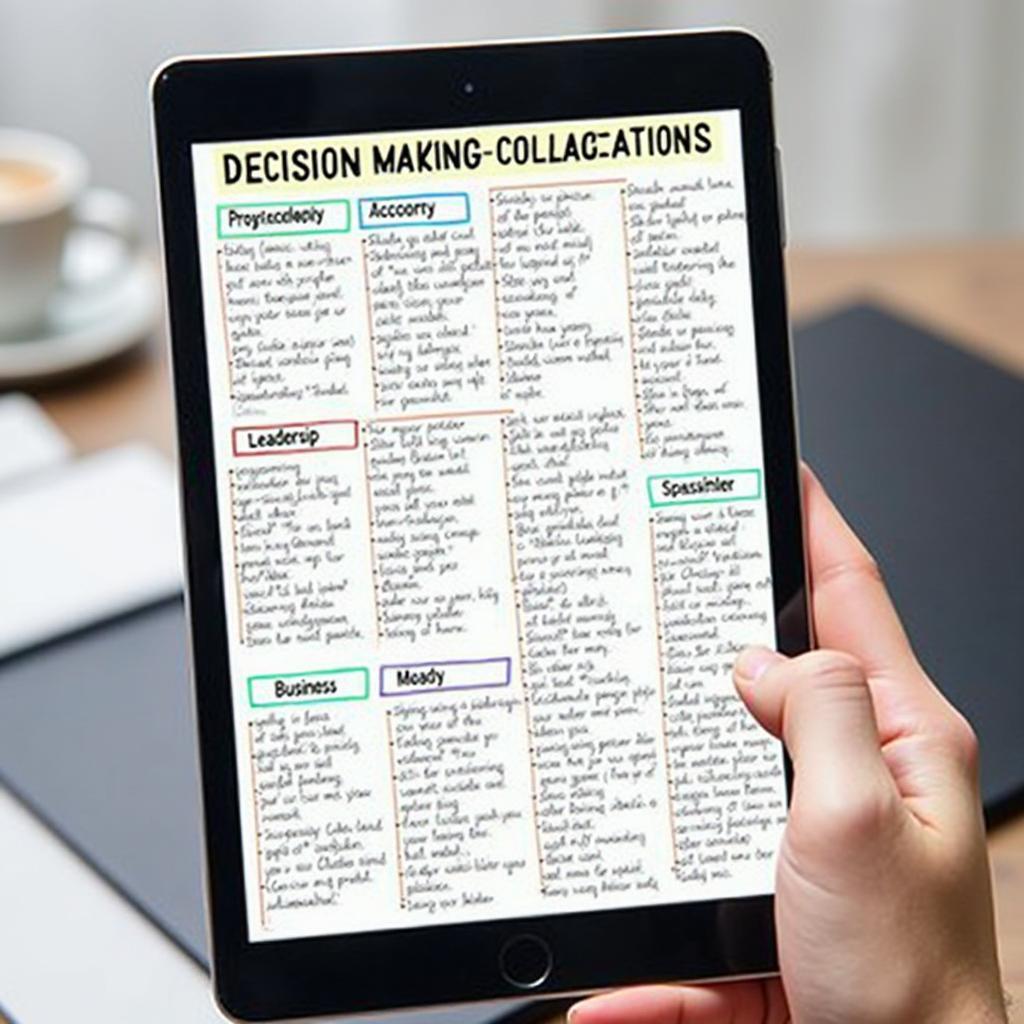 Bảng từ vựng và collocations chủ đề decision-making được tổ chức khoa học
Chiến Lược Tổng Thể Để Đạt Điểm Cao
Fluency & Coherence (Độ Trôi Chảy và Mạch Lạc)
Band 6-7:
- Nói với tốc độ hợp lý, có một số hesitation tự nhiên
- Sử dụng basic linking words (and, but, because, so)
- Có thể self-correct mà không ảnh hưởng nhiều đến flow
Band 8-9:
- Nói trôi chảy với minimal hesitation
- Sử dụng sophisticated discourse markers (Moreover, Nevertheless, Having said that)
- Ideas develop logically với clear progression
- Self-correction smooth và natural
Tips để cải thiện:
- Practice speaking for 2 minutes continuously về bất kỳ topic nào
- Record yourself và nghe lại để identify filler words (um, uh, like)
- Learn discourse markers và practice sử dụng tự nhiên
- Don’t memorize answers – nói từ understanding, không recite
Lexical Resource (Từ Vựng)
Band 6-7:
- Sufficient vocabulary cho most topics
- Có một số collocations đúng
- Có thể paraphrase với reasonable success
- Một số lỗi word choice nhưng không ảnh hưởng meaning
Band 8-9:
- Wide và sophisticated vocabulary
- Precise word choice
- Natural collocations và idiomatic language
- Effective paraphrasing
- Rare errors chỉ là slips
Tips để cải thiện:
- Learn vocabulary in chunks, không học từ riêng lẻ
- Không học “decision” → Học “make an informed decision”, “high-stakes decision”
- Create topic-based vocabulary lists với collocations
- Use new vocabulary in sentences ngay khi học
- Read widely – especially IELTS-style articles về diverse topics
- Keep a vocabulary journal với examples từ native sources
Grammatical Range & Accuracy (Ngữ Pháp)
Band 6-7:
- Mix of simple và complex sentences
- Good control of common structures
- Some errors nhưng rarely impede communication
Band 8-9:
- Full range of structures
- Majority của sentences error-free
- Flexibly uses structures for effect
- Errors rare và minor
Tips để cải thiện:
- Master complex structures:
- Relative clauses
- Conditional sentences (especially mixed conditionals)
- Cleft sentences
- Passive voice for appropriate contexts
- Practice variety – đừng lặp lại cùng một structure
- Self-correct naturally khi nhận ra lỗi
- Focus on accuracy hơn là chỉ complexity
Pronunciation (Phát Âm)
Band 6-7:
- Generally clear và intelligible
- Some mispronunciation không ảnh hưởng hiểu
- Appropriate word stress most of the time
Band 8-9:
- Fully intelligible
- Native-like features của pronunciation
- Appropriate intonation patterns
- Effective use of stress và rhythm
Tips để cải thiện:
- Focus on word stress hơn là individual sounds
- Practice sentence stress và intonation patterns
- Shadowing technique: lặp lại sau native speakers
- Record yourself và compare với native pronunciation
- Pay attention to connected speech (linking, elision)
Những Lỗi Thường Gặp Của Học Viên Việt Nam
1. Trả lời quá ngắn:
- ❌ “Yes, I think so.” (dừng lại)
- ✅ “Yes, I think so. The reason is that… For example…”
2. Thiếu examples cụ thể:
- ❌ “He’s good at making decisions because he’s smart and experienced.”
- ✅ “He’s good at making decisions. For instance, when our team faced a budget crisis last year, he calmly analyzed options and devised a restructuring plan that saved jobs.”
3. Lặp lại từ trong câu hỏi:
- ❌ Q: “Do you think decision-making is important?” A: “Yes, decision-making is very important because decision-making affects our life…”
- ✅ “Yes, absolutely. The ability to make sound choices is crucial because it shapes our life trajectory…”
4. Dùng từ vựng không tự nhiên:
- ❌ “He is very excellent at making decisions.”
- ✅ “He’s exceptionally skilled at making decisions.” / “He excels at decision-making.”
5. Thiếu discourse markers:
- ❌ “I think… I believe… I feel…” (chỉ dùng I think)
- ✅ “From my perspective,… / Having said that,… / What’s particularly interesting is…”
6. Không structure câu trả lời Part 3:
- ❌ Nói lan man, không có clear points
- ✅ “Well, there are several reasons. Firstly,… Secondly,… However, we also need to consider…”
7. Sợ pause để suy nghĩ:
- ❌ Nói liên tục với nhiều “um, uh, like”
- ✅ “Well, that’s an interesting question. Let me think… I’d say…” (Natural thinking time)
8. Memorize và recite templates:
- ❌ Nghe cứng nhắc, không tự nhiên
- ✅ Understand ideas và express theo own words
Lộ Trình Chuẩn Bị Hiệu Quả
4-6 tuần trước thi:
Tuần 1-2: Foundation
- Làm quen với format và tiêu chí chấm điểm
- Xây dựng topic vocabulary bank cho 10-12 common topics
- Practice recording answers và listening back
- Identify weaknesses (fluency/vocabulary/grammar/pronunciation)
Tuần 3-4: Skill Building
- Practice với real IELTS questions từ các nguồn authentic
- Focus vào weak areas
- Expand vocabulary với collocations và idioms
- Practice timing (Part 2: 2 minutes, Part 3: 30-45 seconds per answer)
Tuần 5-6: Mock Tests & Refinement
- Full mock tests với examiner hoặc study partner
- Fine-tune answers dựa trên feedback
- Work on confidence và naturalness
- Review common topics và prepare flexible ideas (không memorize)
1 tuần trước thi:
- Light practice, không học quá nhiều từ mới
- Review key vocabulary và expressions
- Do 1-2 mock tests để maintain timing
- Focus on confidence và staying calm
Lời Khuyên Từ Examiner
During the test:
- Be natural và conversational – IELTS Speaking là conversation, không phải presentation
- Don’t panic if you don’t know a word – paraphrase hoặc explain concept
- It’s OK to ask for clarification nếu không hiểu câu hỏi (nhưng không nên quá thường xuyên)
- Extend your answers nhưng don’t go off-topic
- Show enthusiasm – body language và tone of voice matter
- If you make a mistake, self-correct naturally – shows language awareness
What examiners look for:
- ✅ Ability to communicate effectively
- ✅ Range và accuracy of language
- ✅ Natural flow của speech
- ✅ Appropriate responses to questions
- ✅ Development of ideas với examples
What examiners DON’T want:
- ❌ Memorized answers (rất dễ nhận ra)
- ❌ One-word answers
- ❌ Going completely off-topic
- ❌ Asking “Can you repeat?” after every question
- ❌ Long silences
Tài Nguyên Học Tập Hữu Ích
Websites:
- IELTS-Simon.com – Sample answers và tips từ former examiner
- IELTS Liz – Comprehensive materials cho all parts
- IELTS Speaking Success – Recent exam questions
Practice Partners:
- iTalki – Book lessons với native speakers
- IELTS Speaking practice groups trên Facebook
- Language exchange apps (HelloTalk, Tandem)
Self-study:
- BBC Learning English – Pronunciation và natural expressions
- TED Talks – Practice shadowing và note advanced vocabulary
- Podcasts – Train your ear for natural speech patterns
Kết Luận
Chủ đề “người giỏi ra quyết định” trong IELTS Speaking không chỉ test khả năng ngôn ngữ mà còn test critical thinking và depth of ideas của bạn. Để đạt điểm cao, bạn cần:
1. Master topic vocabulary: Không chỉ biết từ cơ bản mà phải biết collocations, idioms và topic-specific terms
2. Develop structured answers: Đặc biệt quan trọng trong Part 2 và 3, ideas phải organized logically
3. Use sophisticated language naturally: Advanced vocabulary và grammar structures phải sound natural, không forced
4. Provide specific examples: Generic statements không đủ – cần concrete examples để support ideas
5. Show critical thinking: Đặc biệt trong Part 3, acknowledge complexity và consider multiple perspectives
6. Practice consistently: Recording yourself, getting feedback, và refining based on mistakes
Nhớ rằng IELTS Speaking đánh giá communication skills, không phải perfection. Một vài small errors hoàn toàn acceptable nếu overall communication effective và fluent. Focus vào expressing ideas clearly, using appropriate language, và maintaining natural conversation flow.
Chủ đề decision-making rất practical và relevant cho daily life, nên bạn có plenty of personal experiences để draw from. Use this advantage để create authentic, engaging answers thay vì rely on memorized templates.
Chúc bạn ôn thi hiệu quả và đạt band điểm mục tiêu trong IELTS Speaking test!