Chủ đề “describe a place you go to get away from it all” là một trong những đề bài phổ biến và được yêu thích trong IELTS Speaking. Với tư cách là một examiner có hơn 20 năm kinh nghiệm chấm thi, tôi nhận thấy chủ đề này xuất hiện thường xuyên trong các kỳ thi từ năm 2018 đến nay, với tần suất trung bình 3-4 lần mỗi quý. Dự đoán khả năng xuất hiện trong tương lai vẫn ở mức cao, đặc biệt khi xu hướng quan tâm đến sức khỏe tinh thần và work-life balance ngày càng được đề cao.
Chủ đề này thường xoay quanh các góc độ như: nơi thư giãn cá nhân, không gian yên tĩnh, địa điểm gần gũi thiên nhiên, hoặc bất kỳ nơi nào giúp bạn thoát khỏi áp lực cuộc sống. Điểm đặc biệt là examiner không chỉ muốn nghe về địa điểm mà còn muốn hiểu cảm xúc, lý do và ý nghĩa của nơi đó đối với bạn.
Qua bài viết này, bạn sẽ học được:
- 10+ câu hỏi thực tế trong cả 3 phần thi Speaking
- Bài mẫu chi tiết theo 3 band điểm khác nhau (6-7, 7.5-8, 8.5-9)
- Hơn 50 từ vựng và cụm từ ăn điểm với phiên âm và ví dụ cụ thể
- Chiến lược trả lời hiệu quả từ góc nhìn examiner
- Phân tích chi tiết về sự khác biệt giữa các band điểm
- Lời khuyên về những lỗi thường gặp của học viên Việt Nam
IELTS Speaking Part 1: Introduction and Interview
Tổng Quan Về Part 1
Phần thi Part 1 kéo dài 4-5 phút với các câu hỏi ngắn về đời sống hàng ngày. Đặc điểm của phần này là câu hỏi thân thiện, dễ tiếp cận, nhưng yêu cầu bạn phải trả lời tự nhiên và mở rộng ý trong 2-3 câu, không chỉ dừng lại ở Yes/No.
Chiến lược hiệu quả là áp dụng công thức: Trả lời trực tiếp + Lý do/Giải thích + Ví dụ cụ thể. Tuy nhiên, nhiều học viên Việt Nam thường mắc phải những lỗi sau:
- Trả lời quá ngắn (Yes/No) mà không mở rộng
- Dùng từ vựng quá đơn giản như “good”, “nice”, “beautiful”
- Thiếu ví dụ cụ thể từ kinh nghiệm bản thân
- Nói quá nhanh hoặc quá chậm, mất tự nhiên
Các Câu Hỏi Thường Gặp
Question 1: Do you like spending time alone?
Question 2: Where do you usually go when you want to relax?
Question 3: How often do you take time away from your daily routine?
Question 4: Is it important to have a place to escape to?
Question 5: Do you prefer the countryside or the city for relaxation?
Question 6: What do you usually do to relieve stress?
Question 7: Do you think people today are busier than in the past?
Question 8: How do you feel when you’re in a quiet place?
Phân Tích và Gợi Ý Trả Lời Chi Tiết
Question: Do you like spending time alone?
🎯 Cách tiếp cận:
- Trả lời Yes/No rõ ràng ngay từ đầu
- Giải thích lý do tại sao thích/không thích
- Đưa ra ví dụ cụ thể về việc bạn thường làm khi ở một mình
📝 Sample Answer – Band 6-7:
Yes, I do like spending time alone. It helps me relax after a busy day at work. I usually stay in my room, listen to music or read books when I want to be alone.
Phân tích:
- Điểm mạnh: Trả lời trực tiếp, có lý do cơ bản, đưa ra ví dụ về hoạt động cụ thể
- Hạn chế: Từ vựng đơn giản (relax, busy, read books), thiếu chi tiết về cảm xúc, cấu trúc câu chưa đa dạng
- Tại sao Band 6-7: Trả lời đầy đủ yêu cầu nhưng thiếu độ sâu. Vocabulary adequate nhưng chưa sophisticated. Grammar chính xác nhưng đơn giản.
📝 Sample Answer – Band 8-9:
Absolutely, I really value my alone time. Living in a bustling city like this, I find that having moments of solitude helps me recharge my batteries and clear my head. I’m quite an introvert by nature, so I actually find it therapeutic to spend an evening by myself, perhaps immersed in a good novel or simply unwinding with some calming music.
Phân tích:
- Điểm mạnh: Vocabulary sophisticated (bustling, solitude, recharge batteries, therapeutic, immersed in), cấu trúc phức tạp với mệnh đề quan hệ và gerund phrases, ý tưởng sâu sắc về tính cách introvert, tone tự nhiên với “Absolutely”
- Tại sao Band 8-9:
- Fluency: Natural discourse markers (Absolutely, actually), không hesitation
- Vocabulary: Precise collocations (value alone time, clear my head, recharge batteries)
- Grammar: Complex structures (find it therapeutic to spend…, perhaps immersed in…)
- Pronunciation: Stress đúng trên các từ quan trọng, intonation phù hợp
💡 Key Vocabulary & Expressions:
- alone time: thời gian riêng tư, độc thân
- bustling city: thành phố nhộn nhịp, hối hả
- solitude: /ˈsɒlɪtjuːd/ sự cô đơn, yên tĩnh (mang nghĩa tích cực)
- recharge one’s batteries: nạp lại năng lượng
- clear one’s head: làm đầu óc tỉnh táo, sảng khoái
- introvert: người hướng nội
- therapeutic: /ˌθerəˈpjuːtɪk/ mang tính trị liệu, chữa lành
- immersed in: /ɪˈmɜːst/ đắm chìm, mải mê vào cái gì
- unwind: thư giãn, xả stress
Question: Where do you usually go when you want to relax?
🎯 Cách tiếp cận:
- Nêu rõ địa điểm cụ thể
- Giải thích tại sao chọn địa điểm đó
- Mô tả ngắn gọn không khí hoặc hoạt động ở đó
📝 Sample Answer – Band 6-7:
I usually go to a coffee shop near my house. It’s a quiet place with comfortable seats. I can sit there for hours, drink coffee and use my laptop. The atmosphere is peaceful and helps me feel better.
Phân tích:
- Điểm mạnh: Địa điểm cụ thể, có mô tả về không gian và hoạt động
- Hạn chế: Từ vựng cơ bản (quiet, comfortable, peaceful), thiếu detail về cảm xúc, cấu trúc câu đơn giản (I can…, The atmosphere is…)
- Tại sao Band 6-7: Adequate answer với basic vocabulary và simple grammar. Thiếu sophistication và personal touch.
📝 Sample Answer – Band 8-9:
My go-to place for relaxation is actually a small secluded beach about 30 minutes from my home. What I love about it is that it’s off the beaten track, so there are rarely many people around. I find the rhythmic sound of waves incredibly soothing, and there’s something liberating about gazing out at the vast ocean. It’s my sanctuary where I can tune out all the noise and pressures of daily life.
Phân tích:
- Điểm mạnh:
- Vocabulary: Collocation cao cấp (go-to place, off the beaten track, rhythmic sound, tune out)
- Grammar: Relative clause (where I can tune out), gerund phrase (gazing out at), inversion emphasis (What I love about it is…)
- Ideas: Detailed sensory description (sound of waves), emotional connection (sanctuary, liberating)
- Personality: Shows deeper reflection về ý nghĩa của địa điểm
- Tại sao Band 8-9:
- Fluency: Natural flow với discourse marker “actually”
- Vocabulary: Precise và idiomatic (off the beaten track, tune out)
- Grammar: Variety of complex structures
- Pronunciation: Stress patterns phù hợp với meaning (SAnctuary, LIberating)
💡 Key Vocabulary & Expressions:
- go-to place: địa điểm quen thuộc, ưa thích
- secluded: /sɪˈkluːdɪd/ hẻo lánh, riêng tư
- off the beaten track: ngoài con đường thông thường, ít người biết đến
- rhythmic: /ˈrɪðmɪk/ có nhịp điệu
- soothing: /ˈsuːðɪŋ/ xoa dịu, êm dịu
- liberating: /ˈlɪbəreɪtɪŋ/ giải phóng, tự do
- gaze out at: nhìn chăm chú ra
- sanctuary: /ˈsæŋktʃuəri/ nơi trú ẩn, thánh đường
- tune out: ngắt kết nối, không chú ý đến
Question: How often do you take time away from your daily routine?
🎯 Cách tiếp cận:
- Nêu tần suất cụ thể (daily, weekly, monthly)
- Giải thích lý do cho tần suất đó
- Có thể so sánh với quá khứ hoặc mong muốn tương lai
📝 Sample Answer – Band 6-7:
I try to take time away from my routine every weekend. During the week, I’m very busy with work, so weekends are important for me. I usually go to the park or visit my family to relax.
Phân tích:
- Điểm mạnh: Tần suất rõ ràng (every weekend), có lý do (busy with work), đưa ra hoạt động cụ thể
- Hạn chế: Vocabulary basic, grammar đơn giản, thiếu depth về ý nghĩa của việc “escape”
- Tại sao Band 6-7: Clear communication nhưng lacks sophistication trong cả vocabulary lẫn ideas.
📝 Sample Answer – Band 8-9:
To be honest, I make it a priority to carve out some time for myself at least once or twice a week. I’ve learned the hard way that if you don’t intentionally schedule these mental breaks, you can easily get burnt out. Usually, I’ll dedicate my Saturday mornings to doing something completely detached from work – whether that’s hiking, reading at a café, or simply having a leisurely breakfast without rushing. I find this deliberate disconnection absolutely essential for maintaining my mental equilibrium.
Phân tích:
- Điểm mạnh:
- Vocabulary: Sophisticated expressions (carve out time, burnt out, mental equilibrium, deliberate disconnection)
- Grammar: Perfect tense (I’ve learned), conditional (if you don’t schedule), gerund phrases
- Ideas: Reflective và mature – acknowledges learning from experience, importance of intentional rest
- Personality: Conversational opener “To be honest” tạo natural tone
- Tại sao Band 8-9:
- Fluency: Cohesive với linking (To be honest, Usually, whether)
- Vocabulary: Precise collocations (carve out time, mental breaks, leisurely breakfast)
- Grammar: Range of structures với accuracy cao
- Critical thinking: Shows understanding of work-life balance concepts
💡 Key Vocabulary & Expressions:
- make it a priority: đặt làm ưu tiên
- carve out time: tạo ra thời gian (từ lịch bận rộn)
- intentionally schedule: cố ý sắp xếp lịch
- mental break: nghỉ ngơi về mặt tinh thần
- burnt out: kiệt sức, căng thẳng quá mức
- dedicate: /ˈdedɪkeɪt/ dành riêng cho
- detached from: tách biệt khỏi
- leisurely: /ˈleʒəli/ thong thả, không vội vã
- deliberate disconnection: sự ngắt kết nối có chủ ý
- mental equilibrium: /ˌiːkwɪˈlɪbriəm/ sự cân bằng tinh thần
 Học viên luyện tập IELTS Speaking Part 1 về chủ đề nơi thư giãn thoát khỏi cuộc sống bận rộn
IELTS Speaking Part 2: Long Turn (Cue Card)
Tổng Quan Về Part 2
Phần thi Part 2 là phần độc thoại kéo dài 2-3 phút, trong đó bạn có 1 phút chuẩn bị. Đây là phần quan trọng nhất để thể hiện khả năng nói liên tục và có tổ chức. Một số điểm quan trọng:
- Thời gian chuẩn bị: Sử dụng đủ 1 phút để ghi chú keywords, không viết câu hoàn chỉnh
- Thời gian nói: Nói đủ 2 phút (tối thiểu 1.5 phút) để tránh bị hỏi thêm
- Yêu cầu: Trả lời đầy đủ tất cả bullet points trong cue card
- Thì động từ: Thường dùng quá khứ khi miêu tả trải nghiệm hoặc hiện tại khi nói về thói quen
Chiến lược hiệu quả:
- Ghi chú theo từng bullet point với keywords
- Bắt đầu bằng câu giới thiệu chung về địa điểm
- Dành nhiều thời gian nhất cho phần “explain” (30-40 giây)
- Sử dụng linking words để kết nối ý mượt mà
- Thêm chi tiết cảm xúc và ấn tượng cá nhân
Lỗi thường gặp của học viên Việt Nam:
- Không sử dụng hết thời gian chuẩn bị (chỉ ghi 2-3 từ rồi ngồi chờ)
- Nói dưới 1.5 phút vì sợ hết ý
- Bỏ sót bullet points, đặc biệt là phần “explain”
- Nói theo template cứng nhắc, thiếu tự nhiên
- Không có câu kết luận
Cue Card
Describe a place you go to get away from it all
You should say:
- Where this place is
- How often you go there
- What you do there
- And explain why you like to go to this place to relax
Phân Tích Đề Bài
- Dạng câu hỏi: Describe a place – miêu tả địa điểm
- Thì động từ: Hiện tại (vì nói về thói quen hiện tại), có thể dùng quá khứ khi kể về lần đầu hoặc một trải nghiệm cụ thể
- Bullet points phải cover:
- Where: Địa điểm cụ thể với mô tả ngắn về location
- How often: Tần suất + lý do cho tần suất đó
- What you do: Activities cụ thể, chi tiết
- Explain why: Phần QUAN TRỌNG nhất – giải thích cảm xúc, ý nghĩa, tác động
- Câu “explain” quan trọng: Đây là phần ghi điểm cao nhất. Examiner muốn nghe về feelings, personal significance, impact on wellbeing. Đừng chỉ nói “because it’s beautiful” mà phải đi sâu vào emotional connection và deeper meaning.
📝 Sample Answer – Band 6-7
Thời lượng: Khoảng 1.5-2 phút
Well, I’d like to talk about a small coffee shop near my apartment that I often visit when I want to escape from my busy life. It’s called “Quiet Corner” and it’s located on a quiet street, about 10 minutes from where I live.
I go there quite regularly, maybe two or three times a week, especially after work or on weekend mornings. It’s not too crowded, which is perfect for me because I don’t like noisy places.
When I’m there, I usually order a cappuccino and find a seat by the window. Sometimes I bring a book to read, or I just sit and watch people walking by on the street. The cafe has comfortable chairs and soft music, so it’s easy to relax. I also use my laptop there sometimes to do some personal work or browse the internet.
The reason I like going to this place is that it helps me feel calm. After a stressful day at work, I need somewhere quiet to clear my mind. The atmosphere is peaceful and the staff are friendly. I feel like I can just be myself there without any pressure. It’s become my personal space where I can recharge and forget about my problems for a while. The coffee is good too, which is important for me. Overall, this coffee shop is my little escape from the busy city life.
Phân Tích Band Điểm
| Tiêu chí | Band | Nhận xét |
|---|---|---|
| Fluency & Coherence | 6-7 | Nói khá trôi chảy, có linking words cơ bản (Well, especially, sometimes, overall). Tuy nhiên thiếu variety trong discourse markers và một số chỗ còn mechanical. |
| Lexical Resource | 6-7 | Vocabulary adequate với các từ như “escape from busy life”, “crowded”, “peaceful”. Tuy nhiên còn lặp từ (quiet xuất hiện 3 lần), thiếu collocations phức tạp và paraphrasing. |
| Grammatical Range & Accuracy | 6-7 | Mix of simple và complex structures (which is perfect, where I can recharge). Một số lỗi nhỏ nhưng không ảnh hưởng communication. Present simple được dùng đúng. |
| Pronunciation | 6-7 | Phát âm rõ ràng, stress từ cơ bản đúng. Tuy nhiên thiếu intonation variety và natural pausing. |
Điểm mạnh:
- ✅ Cover đầy đủ tất cả bullet points
- ✅ Structure rõ ràng, theo đúng thứ tự đề bài
- ✅ Có ví dụ cụ thể về activities (order cappuccino, read, watch people)
- ✅ Giải thích lý do với some emotional connection (feel calm, recharge)
Hạn chế:
- ⚠️ Vocabulary còn basic và repetitive (quiet 3 lần, busy 2 lần)
- ⚠️ Thiếu sensory details (sounds, smells, visuals)
- ⚠️ Phần explain chưa đủ deep – chỉ nói surface level (helps me feel calm, forget problems)
- ⚠️ Grammar structures chưa đa dạng, nhiều câu simple
📝 Sample Answer – Band 7.5-8
Thời lượng: Khoảng 2-2.5 phút
I’d like to describe a tranquil lakeside park that I frequently visit whenever I need to disconnect from the hustle and bustle of city life. It’s located on the outskirts of my city, about a 30-minute drive from my home, which makes it just accessible enough to be convenient but remote enough to feel like a genuine escape.
I make it a point to visit this place at least once a fortnight, usually on Sunday mornings when the park is at its most serene. The timing is deliberate – early mornings mean fewer visitors and a more intimate connection with nature. During particularly stressful periods at work, I might find myself heading there even more frequently, perhaps once a week.
As for what I do there, my routine has become almost ritualistic. I typically arrive around 7 AM and start with a leisurely walk along the tree-lined path that encircles the lake. The fresh air and gentle rustling of leaves really help me decompress. After about 30 minutes of walking, I find a bench overlooking the water and simply sit there, sometimes meditating, sometimes just observing the ducks and the occasional jogger. What I particularly enjoy is bringing a thermos of coffee and a notebook, where I jot down my thoughts or sketch the landscape. There’s something incredibly therapeutic about this unhurried pace of life.
The reason this place has become my sanctuary is multifaceted. Firstly, there’s the obvious contrast with my daily environment. I work in a high-pressure corporate job with constant deadlines, so being surrounded by nature’s calmness provides a much-needed counterbalance. But more than that, this park represents a space where I can reconnect with myself. In our hyper-connected world, we’re constantly bombarded with information and demands on our attention. Here, I can tune out all that noise and simply exist in the moment. I’ve noticed that after spending time there, I return home feeling mentally refreshed and more centered, ready to face the week ahead with renewed energy. It’s essentially my reset button.
Phân Tích Band Điểm
| Tiêu chí | Band | Nhận xét |
|---|---|---|
| Fluency & Coherence | 7.5-8 | Nói mượt mà với natural hesitation markers (I’d like to describe, As for). Cohesion tốt với variety of linking devices (Firstly, But more than that, essentially). Ideas develop logically. |
| Lexical Resource | 7.5-8 | Wide range of vocabulary với numerous collocations (hustle and bustle, disconnect from, tree-lined path, multifaceted, hyper-connected). Paraphrasing tốt (escape → disconnect, calm → serene). Less common vocabulary được dùng phù hợp (encircles, ritualistic, counterbalance). |
| Grammatical Range & Accuracy | 7.5-8 | Good range of complex structures (which makes it…, where I jot down, after spending time there). Mix of tenses chính xác. Relative clauses, conditionals, participle phrases. Một số lỗi nhỏ không đáng kể. |
| Pronunciation | 7.5-8 | Clear pronunciation với good stress và intonation patterns. Natural pausing. Word/sentence stress phù hợp với meaning. |
So Sánh Với Band 6-7
| Khía cạnh | Band 6-7 | Band 7.5-8 |
|---|---|---|
| Vocabulary | “escape from busy life”, “quiet”, “peaceful” | “disconnect from the hustle and bustle”, “tranquil”, “serene”, “sanctuary” |
| Grammar | “It’s located on a quiet street” (simple) | “It’s located on the outskirts of my city, about a 30-minute drive from my home, which makes it just accessible enough…” (complex với relative clause và comparative) |
| Ideas | “helps me feel calm, forget problems” (surface level) | “reconnect with myself”, “much-needed counterbalance”, “reset button” (deeper, metaphorical) |
| Details | “comfortable chairs and soft music” (generic) | “tree-lined path that encircles the lake”, “gentle rustling of leaves”, “thermos of coffee” (specific, sensory) |
| Depth | Explains what they do (activities) | Explains emotional significance và broader life impact |
📝 Sample Answer – Band 8.5-9
Thời lượng: 2.5-3 phút đầy đủ
The place I’d like to talk about is actually quite a hidden gem – it’s a secluded beach cove nestled between two rocky headlands about an hour’s drive north of where I live. What makes it so special is that it’s off the radar for most tourists and even many locals, which means it’s blissfully unspoiled and remarkably peaceful, even during peak season. You have to navigate a rather winding coastal path to reach it, which, while requiring some effort, acts as a natural filter, ensuring that only those who are genuinely seeking tranquility make the journey.
I’ve made it a sacred ritual to visit this beach at least once a month, though I have to confess that during particularly overwhelming periods – and we all have those, don’t we? – I might steal away there as often as twice a week. There’s something almost magnetic about the place that draws me back. I’m particularly drawn to visiting during the early evening, around what photographers call the golden hour, when the light has this ethereal quality and the beach takes on this almost otherworldly atmosphere.
My time there follows what I can only describe as an intrinsically personal routine. I usually arrive with nothing more than a blanket and perhaps a book, though truth be told, the book often remains unopened. I find a spot near these weathered rocks that jut out into the sea, and I simply immerse myself in the environment. There’s the hypnotic rhythm of the waves – not the aggressive crashing you get on some beaches, but this gentle, almost lullaby-like sound that seems to slow down time itself. I watch the interplay of light on water, the way the dying sun casts long shadows across the sand, the occasional seabird making its lazy arc across the sky. Sometimes I wade into the shallows, feeling the cool water lapping at my feet. What I find most restorative is this meditative state I slip into – it’s not formal meditation, more of a profound presence, a complete absorption in the moment where thoughts and worries seem to dissolve into the vastness around me.
Now, as for why this place has become so integral to my wellbeing, it’s quite nuanced. On the surface level, yes, it’s beautiful and peaceful, but the deeper significance lies in what it represents for me psychologically. Living in our relentlessly connected modern world, where we’re expected to be perpetually available and constantly productive, this beach serves as my antidote to that collective madness. It’s the one place where I’ve given myself unconditional permission to simply be, without agenda or achievement. There’s something profoundly healing about reconnecting with nature’s rhythms – the timeless ebb and flow of tides, the cyclical patterns of light – that puts our human concerns into perspective. I’ve come to realize that these visits aren’t just leisure time; they’re actually essential maintenance for my mental health, like recalibrating a compass that’s been thrown off course by daily stress. The solitude isn’t lonely; it’s nourishing. It’s where I do my deepest thinking, my most honest self-reflection. I leave there feeling not just relaxed, but somehow restored to myself, reconnected with what actually matters. In a sense, this beach has become a metaphor for the kind of life I aspire to live – more intentional, more present, less encumbered by the unnecessary noise that so often dominates our existence.
Phân Tích Band Điểm
| Tiêu chí | Band | Nhận xét |
|---|---|---|
| Fluency & Coherence | 8.5-9 | Fully coherent với sophisticated linking và progression of ideas. Natural discourse markers (actually, truth be told, Now as for, In a sense). Self-correction tự nhiên (though I have to confess). Rhetorical questions (and we all have those, don’t we?). Không hesitation, speaks at length easily. |
| Lexical Resource | 8.5-9 | Wide range of sophisticated vocabulary với precise meaning (secluded, nestled, ethereal, hypnotic, lullaby-like, restorative, nuanced, perpetually, recalibrating). Natural idiomatic language (hidden gem, off the radar, steal away, thrown off course). Collocations xuất sắc (dying sun casts long shadows, interplay of light, timeless ebb and flow). Skillful paraphrasing và metaphorical language. |
| Grammatical Range & Accuracy | 8.5-9 | Full range of structures với high degree of accuracy. Complex sentences với multiple clauses (What makes it so special is that…, though truth be told…, where we’re expected to be…). Perfect và continuous aspects. Reduced relative clauses (weathered rocks that jut out). Inversion (Not formal meditation, more of…). Cleft sentences (It’s the one place where…, What I find most restorative is…). |
| Pronunciation | 8.5-9 | Sustained natural delivery với appropriate rhythm, stress, và intonation. Features của connected speech. Pronunciation enhances meaning. |
Tại Sao Bài Này Xuất Sắc
🎯 Fluency Hoàn Hảo:
Bài nói flow cực kỳ tự nhiên với các discourse markers tinh tế như “truth be told”, “I have to confess”, “Now, as for why”. Có rhetorical question “and we all have those, don’t we?” tạo connection với listener. Self-correction tự nhiên (not formal meditation, more of…) cho thấy spontaneous thinking.
📚 Vocabulary Tinh Vi:
- hidden gem / off the radar / blissfully unspoiled: Tránh từ đơn giản “not many people know”
- magnetic / ethereal / otherworldly: Tạo imagery mạnh mẽ
- hypnotic rhythm / lullaby-like sound: Sensory vocabulary đặc sắc
- antidote to collective madness / essential maintenance / recalibrating a compass: Metaphorical language cho thấy depth of thinking
- encumbered by unnecessary noise: Sophisticated way to say “bothered by unimportant things”
📝 Grammar Đa Dạng:
- Cleft sentence: “What makes it so special is that…” (nhấn mạnh)
- Reduced relative: “weathered rocks that jut out” → “weathered rocks jutting out”
- Present perfect: “I’ve made it a sacred ritual” (connection to present)
- Gerund phrases: “feeling the cool water lapping at my feet” (descriptive action)
- Complex conditionals: “though truth be told, the book often remains unopened” (concession)
💡 Ideas Sâu Sắc:
Không chỉ describe địa điểm mà còn analyze psychological significance. Discusses broader themes: modern life’s connectivity, need for solitude, mental health maintenance, self-reflection, living intentionally. Uses metaphor (beach as metaphor for desired lifestyle, compass being recalibrated). Shows philosophical depth với “nourishing solitude” vs “lonely”, “essential maintenance” for mental health.
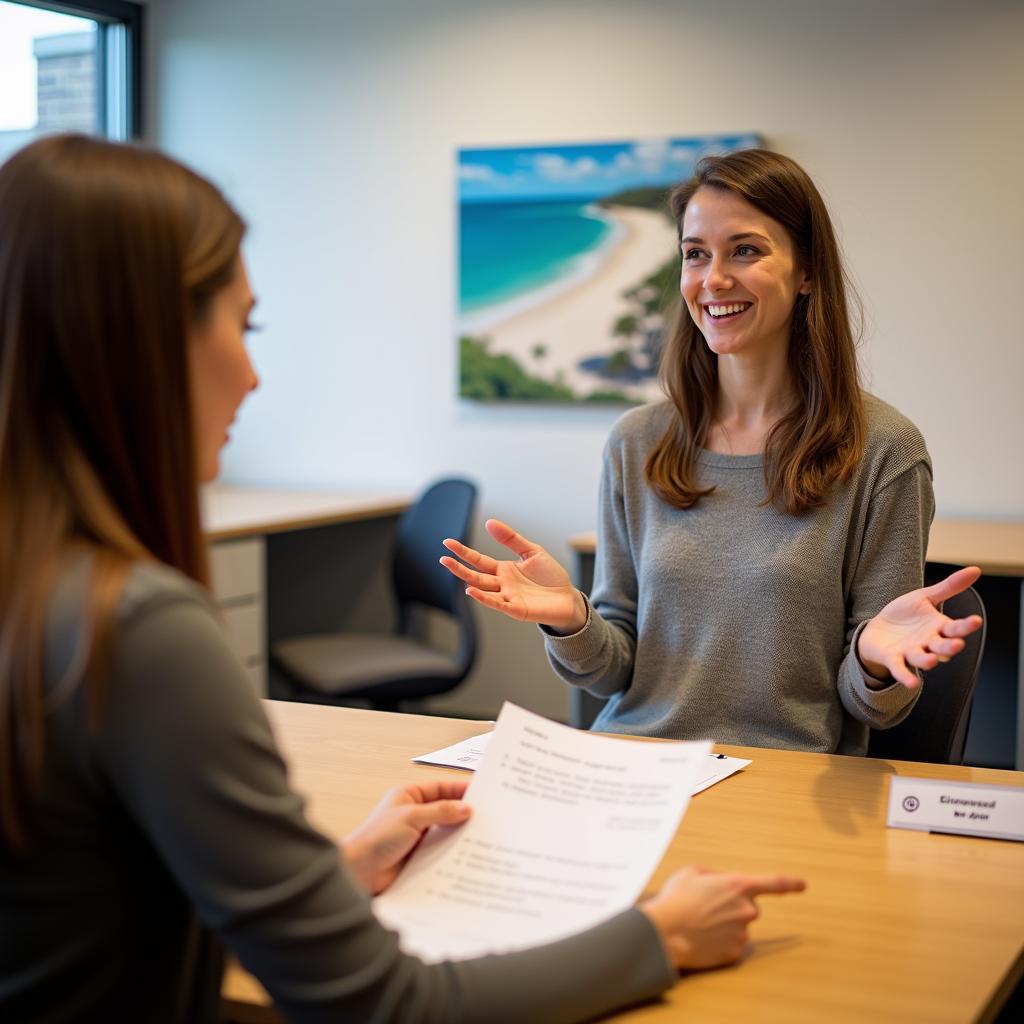 Thí sinh tự tin trình bày IELTS Speaking Part 2 về bãi biển yên tĩnh để thư giãn
Follow-up Questions (Rounding Off Questions)
Examiner có thể hỏi thêm 1-2 câu ngắn sau Part 2 để transition sang Part 3:
Question 1: Do you think you’ll continue visiting this place in the future?
Band 6-7 Answer:
Yes, definitely. I really enjoy going there and it helps me a lot. I hope I can visit even more often in the future when I have more free time.
Band 8-9 Answer:
Absolutely, I can’t imagine not making the effort to visit regularly. If anything, I think it’s become even more integral to my routine as life gets busier. I’ve actually been contemplating finding similar spots in other areas so I can have multiple sanctuaries depending on where I am. It’s become such an anchor in my life that I’d go out of my way to maintain this practice.
Question 2: Have you recommended this place to friends?
Band 6-7 Answer:
Yes, I have told some of my close friends about it. But I don’t tell many people because I want to keep it quiet and peaceful.
Band 8-9 Answer:
That’s an interesting question because I’ve been quite selective about sharing this secret spot. I’ve let a few kindred spirits in on it – friends who I know would appreciate and respect its tranquility. But I’m admittedly protective of it, perhaps selfishly so. There’s a fine line between wanting to share something beautiful and wanting to preserve its unspoiled nature. I suppose I’m guilty of being a bit of a gatekeeper in that sense.
IELTS Speaking Part 3: Two-way Discussion
Tổng Quan Về Part 3
Phần thi Part 3 kéo dài 4-5 phút với các câu hỏi trừu tượng và sâu sắc hơn, mở rộng từ chủ đề Part 2. Đây là phần thử thách nhất vì yêu cầu critical thinking và khả năng phân tích vấn đề ở level cao hơn.
Yêu cầu:
- Phân tích, so sánh, đánh giá các quan điểm khác nhau
- Đưa ra quan điểm cá nhân có lý lẽ chặt chẽ
- Xem xét nhiều góc độ của vấn đề (pros/cons, past/present/future)
- Sử dụng examples từ society, không chỉ personal experience
Chiến lược:
- Mở rộng câu trả lời (3-5 câu tối thiểu)
- Sử dụng discourse markers (Well, Actually, I think, From my perspective)
- Đưa ra examples từ xã hội hoặc general trends
- Thừa nhận complexity của vấn đề (It depends, There are different views)
- Structure rõ ràng: Opinion → Reason 1 + example → Reason 2 + example → Conclusion/Nuance
Lỗi thường gặp của học viên Việt Nam:
- Trả lời quá ngắn (1-2 câu) và thiếu phân tích
- Không đưa ra lý lẽ rõ ràng, chỉ nói general statements
- Thiếu từ vựng trừu tượng (concepts, issues, trends)
- Không acknowledge alternative viewpoints
- Quá focus vào personal experience thay vì societal perspective
- Sợ disagree với examiner hoặc nói controversial views
Các Câu Hỏi Thảo Luận Sâu
Theme 1: Modern Life and Stress
Question 1: Why do you think more people today need to escape from their daily routines compared to the past?
🎯 Phân tích câu hỏi:
- Dạng: Compare (past vs present) + Cause/Reason
- Key words: more people, need to escape, compared to the past
- Cách tiếp cận:
- Acknowledge the premise (Yes, it’s true that…)
- Explain 2-3 main reasons với modern life factors
- Use examples from society
- Có thể mention counter-argument (though some might say…)
📝 Sample Answer – Band 6-7:
I think this is true because modern life is very stressful. People work longer hours now and they use technology all the time, which makes them tired. In the past, life was simpler and people didn’t have smartphones, so they had more free time. Also, cities are more crowded now, so people want to find quiet places. Everyone is busy with work and study, so they need time to relax and escape from pressure.
Phân tích:
- Structure: Has basic comparison (now vs past) và reasons, but organization is loose
- Vocabulary: Basic words (stressful, tired, busy, crowded, quiet) without sophisticated expressions
- Examples: General statements without specific examples
- Tại sao Band 6-7: Communicates main ideas adequately nhưng lacks depth, sophisticated vocabulary, và detailed development of arguments.
📝 Câu trả lời mẫu – Band 8-9:
Well, I think this is a multifaceted issue, but there are several compelling reasons why the need to escape has become more pronounced in contemporary society.
Firstly, and perhaps most significantly, we’re living in what many sociologists call the “always-on” culture. Unlike previous generations who could clock out at the end of the workday and genuinely disconnect, today’s professionals are tethered to their devices 24/7. The boundaries between work and personal life have become increasingly blurred, with emails and messages demanding immediate attention regardless of the hour. This perpetual connectivity, while beneficial in some ways, creates a relentless pressure that our grandparents simply never experienced.
Secondly, there’s the issue of information overload. We’re constantly bombarded with news, social media updates, and competing demands for our attention. Research suggests that the average person today processes more information in a single day than someone in the 15th century would have encountered in their entire lifetime. This cognitive burden is genuinely exhausting and creates a pressing need for mental space and quiet.
Additionally, I’d argue that urbanization plays a significant role. More people are living in densely populated cities with minimal access to nature. In contrast to the past, when even city dwellers might have had gardens or nearby countryside, today’s urban residents often find themselves surrounded by concrete and divorced from natural environments, making the craving for escape more acute.
That said, it’s worth noting that people in the past certainly faced their own pressures – physical labor, economic hardship, and so on. However, the nature of stress has changed from predominantly physical to primarily psychological and emotional, which, in many ways, is harder to switch off from.
Phân tích:
- Structure: Highly organized với clear signposting (Firstly, Secondly, Additionally, That said). Each point fully developed với explanation + example/evidence. Concludes with nuanced counter-perspective.
- Vocabulary: Sophisticated và precise (multifaceted, pronounced, tethered to, blurred boundaries, perpetual connectivity, cognitive burden, acute, divorced from). Academic collocations (compelling reasons, competing demands, densely populated).
- Grammar: Complex structures (Unlike previous generations who…, while beneficial in some ways…, Research suggests that…, making the craving for escape more acute). Mix of tenses. Relative clauses, participle phrases.
- Critical Thinking: Acknowledges complexity (multifaceted issue), provides societal examples (sociologists’ term, research data, historical comparison), considers counter-argument (That said…), distinguishes types of stress (physical vs psychological).
💡 Key Language Features:
- Discourse markers: Well (softener), Firstly/Secondly (organizing), Additionally (adding), That said (contrasting)
- Tentative language: I think, I’d argue, it’s worth noting, in many ways
- Academic style: many sociologists call, Research suggests, the average person today
- Abstract nouns: perpetual connectivity, information overload, cognitive burden, urbanization, the nature of stress
Question 2: Do you think it’s selfish to want time alone when you have family responsibilities?
🎯 Phân tích câu hỏi:
- Dạng: Opinion + Ethical judgment
- Key words: selfish, time alone, family responsibilities
- Cách tiếp cận:
- This is sensitive question – acknowledge both perspectives
- Don’t be too absolute (It depends on…)
- Use phrases like “strike a balance”, “it’s a matter of…”
- Give examples showing understanding of family dynamics
📝 Sample Answer – Band 6-7:
I don’t think it’s selfish. Everyone needs time for themselves, even parents. If people don’t rest, they will be stressed and can’t take care of their family well. However, they should not spend too much time alone and forget their responsibilities. It’s important to find balance between personal time and family time. For example, parents can take a few hours on weekend to relax while other family members help.
Phân tích:
- Structure: Direct answer + basic reasoning + example, but lacks depth
- Vocabulary: Simple words (selfish, rest, stressed, balance, relax)
- Tại sao Band 6-7: Clear opinion and basic reasoning, but doesn’t explore the complexity of the issue. Lacks sophisticated vocabulary and nuanced perspective.
📝 Câu trả lời mẫu – Band 8-9:
That’s quite a loaded question, isn’t it? I’d say the answer is far from straightforward because it really depends on how we conceptualize both self-care and responsibility.
On the one hand, I firmly believe that taking time for oneself is not only not selfish, but actually essential for being an effective parent or family member. There’s that oft-quoted airline safety instruction – you have to put on your own oxygen mask before helping others. The same principle applies here. If someone is constantly running on empty, depleted both physically and emotionally, they simply can’t show up as their best self for their family. They might be physically present but emotionally absent, which arguably does more harm than taking scheduled time away to recharge.
I think what’s crucial here is the distinction between necessary self-care and avoidance of responsibility. Someone taking a few hours each week to maintain their mental equilibrium – whether through exercise, meditation, or simply solitude – is investing in their ability to be present and engaged when with their family. That’s fundamentally different from someone who’s perpetually absent or using “me time” as an excuse to shirk their responsibilities.
From another angle, there’s also a valuable lesson being modeled for children when parents prioritize their wellbeing. It teaches kids that self-care isn’t indulgent but rather an important component of a healthy life. Children who grow up seeing parents who martyr themselves, never taking time for themselves, often internalize the message that their own needs don’t matter, which can lead to long-term issues with boundaries and self-worth.
That being said, I acknowledge that there are legitimate criticisms of certain individualistic tendencies in modern parenting culture, where self-care sometimes becomes an excuse for excessive personal pursuits at the expense of family bonds. It’s about striking a balance and being honest with oneself about whether you’re meeting your core responsibilities or not.
So to sum up, I’d argue it’s not inherently selfish, but like most things, it requires thoughtful consideration and balance.
Phân tích:
- Structure: Sophisticated organization: Acknowledges question complexity → Main argument (not selfish) with airline metaphor → Key distinction (self-care vs avoidance) → Alternative perspective (benefit for children) → Counter-argument acknowledgment → Conclusion. Shows multi-dimensional thinking.
- Vocabulary: Advanced và precise (loaded question, conceptualize, oft-quoted, running on empty, depleted, show up, shirk, martyr themselves, internalize, legitimate criticisms, individualistic tendencies, striking a balance). Mix of formal và conversational style.
- Grammar: Complex structures với conditionals (If someone is constantly running…), relative clauses (Children who grow up seeing…), participle phrases (taking scheduled time away to recharge). Cleft sentence (What’s crucial here is…).
- Critical Thinking:
- Uses analogy (oxygen mask) effectively
- Makes important distinctions (self-care vs avoidance, physical presence vs emotional presence)
- Considers child development perspective
- Acknowledges legitimate counter-arguments
- Avoids absolute statements, shows nuanced understanding
- Demonstrates ethical reasoning about parenting
💡 Key Language Features:
- Discourse markers: On the one hand, I think, From another angle, That being said, So to sum up
- Tentative language: I’d say, arguably, I think, I acknowledge
- Hedging: far from straightforward, it really depends on, not inherently
- Contrasting: fundamentally different from, rather than
- Academic references: There’s that oft-quoted…, research shows…
Theme 2: Places and Spaces
Question 3: How have public spaces for relaxation changed in your country over the years?
🎯 Phân tích câu hỏi:
- Dạng: Describe change (past → present)
- Key words: public spaces, relaxation, changed, over the years
- Cách tiếp cận:
- Describe past situation
- Describe current situation
- Explain reasons for changes
- Evaluate whether changes are positive/negative
📝 Sample Answer – Band 6-7:
Public spaces have changed a lot in my country. In the past, there were fewer parks and cafes for people to relax. Now, there are more green spaces in cities and many new coffee shops. The government has built more parks and recreation areas. Also, many shopping malls have rest areas now. These changes are good because people have more places to go. However, some places are too crowded, especially on weekends. Overall, I think the changes are positive because people need places to relax in busy cities.
Phân tích:
- Structure: Basic comparison structure (past vs now) with brief evaluation
- Vocabulary: Simple descriptive words (fewer, more, new, good, crowded, busy)
- Examples: Generic (parks, cafes, malls) without specific details
- Tại sao Band 6-7: Adequate description of changes but lacks specific examples, sophisticated vocabulary, và detailed analysis of societal factors.
📝 Câu trả lời mẫu – Band 8-9:
This is a fascinating area to reflect on because the transformation has been quite dramatic, particularly over the last two decades.
If we rewind to, say, the early 2000s, public spaces for relaxation in Vietnam were relatively limited and often quite utilitarian in nature. Parks existed, certainly, but they were often poorly maintained, with minimal facilities, and weren’t really designed with relaxation in mind – they were more just open spaces. The concept of a curated relaxation environment was largely absent. Coffee culture existed but was more rudimentary – you’d have traditional sidewalk cafes with small plastic stools, which, while charming in their own way, didn’t really cater to extended relaxation.
Fast forward to today, and the landscape has changed dramatically. We’ve seen a proliferation of what I’d call “third spaces” – environments that are neither home nor work but are specifically designed for leisure and socializing. Modern parks now feature dedicated quiet zones, well-maintained pathways, sometimes even outdoor fitness equipment. But perhaps more significantly, there’s been an explosion of specialty coffee shops, co-working spaces, and themed cafes that serve as pseudo-public spaces where people can spend hours reading, working, or simply unwinding. Shopping malls have evolved too – many now incorporate tranquil zones with indoor plants and comfortable seating, moving beyond their original purely commercial function.
Several factors have driven these changes. Economically, Vietnam’s rapid development has meant both increased disposable income and greater awareness of lifestyle and wellbeing concepts. Socially, there’s been a growing recognition of mental health and work-life balance, influenced partly by global trends. Urbanization has also played a role – as cities become more congested, there’s heightened demand for respite spaces. Additionally, I think entrepreneurial innovation has been key – business owners have recognized there’s a market for spaces that offer refuge from urban chaos.
However, it’s not all unequivocally positive. These newer spaces are often commercialized – you typically need to purchase something to stay, which excludes those who can’t afford it. Traditional free public spaces are sometimes neglected in favor of these commercial alternatives. There’s also a homogenization happening, where everything starts to look the same – the same Instagram-worthy aesthetic, the same international chain feel – and we’re at risk of losing some of that unique local character.
So while I’d say the changes have generally expanded options and elevated standards, there are legitimate concerns about accessibility and preservation of authentic public spaces.
Phân tích:
- Structure: Exceptionally well-organized: Historical context (early 2000s) → Present situation → Factors driving changes → Critical evaluation. Shows sophisticated discourse management.
- Vocabulary: Highly sophisticated (utilitarian, curated, rudimentary, proliferation, pseudo-public spaces, incorporate, respite spaces, unequivocally, homogenization, Instagram-worthy aesthetic). Domain-specific terms (third spaces, mental health, work-life balance, entrepreneurial innovation).
- Grammar: Full range of structures (If we rewind to…, environments that are neither… nor…, many now incorporate…, which excludes…, there’s a market for spaces that offer…). Perfect tenses cho time references. Passive voice (are neglected, has been driven).
- Critical Thinking:
- Provides specific time references (early 2000s, last two decades)
- Detailed description of both past và present
- Multi-factor analysis (economic, social, urbanization, entrepreneurial)
- Balanced evaluation (positive aspects + concerns)
- Uses sociological concepts (third spaces)
- Shows awareness of global vs local issues (homogenization)
💡 Key Language Features:
- Temporal markers: If we rewind to, Fast forward to, over the last two decades
- Discourse organizers: Several factors have driven, However, So while
- Academic tone: This is a fascinating area to reflect on, It’s not all unequivocally positive
- Hedging và qualifying: relatively, largely, perhaps more significantly, partly
- Contrasting: moving beyond, in favor of, at risk of losing
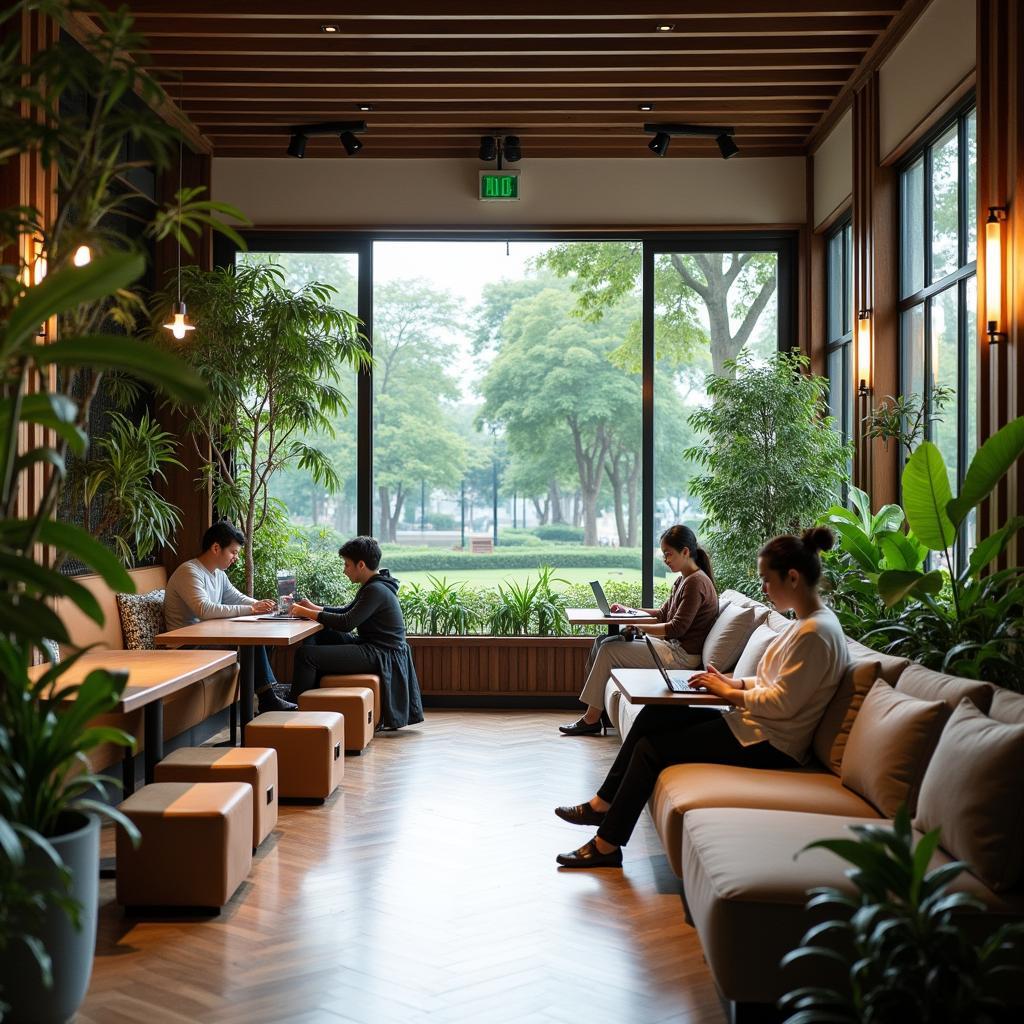 Không gian thư giãn công cộng hiện đại tại Việt Nam với quán cà phê và công viên
Question 4: Do you think natural environments are more effective for relaxation than man-made spaces?
🎯 Phân tích câu hỏi:
- Dạng: Compare and evaluate (natural vs man-made)
- Key words: natural environments, more effective, man-made spaces, relaxation
- Cách tiếp cận:
- Acknowledge both have merits
- Discuss benefits of natural spaces (scientific evidence if possible)
- Discuss benefits of man-made spaces
- Consider personal preferences và context
- Conclude with balanced view
📝 Sample Answer – Band 6-7:
I think natural environments are better for relaxation than man-made spaces. When people are in nature, like forests or beaches, they feel more peaceful because it’s quiet and has fresh air. Natural places don’t have noise or pollution like cities. However, man-made spaces like parks or libraries are also useful because they are closer and easier to access. Some people don’t have time to go to natural places far away. Both types of spaces are important, but I prefer natural environments because they make me feel more relaxed and healthy.
Phân tích:
- Structure: Basic comparison với preference stated
- Vocabulary: Simple adjectives (better, peaceful, quiet, useful, closer, healthy)
- Reasoning: Surface level (quiet, fresh air, closer) without deeper analysis
- Tại sao Band 6-7: Clear communication of preference với basic reasons, but lacks scientific references, sophisticated analysis, và nuanced understanding of different people’s needs.
📝 Câu trả lời mẫu – Band 8-9:
This is quite an interesting question, and I think the answer is more nuanced than a simple yes or no. There’s actually compelling scientific evidence suggesting that natural environments do offer distinct psychological benefits, but that doesn’t necessarily diminish the value of well-designed man-made spaces.
From a biological perspective, there’s research showing that exposure to natural environments triggers what scientists call the “relaxation response” – measurable decreases in cortisol levels, heart rate, and blood pressure. There’s even a Japanese practice called “forest bathing” or shinrin-yoku, which has been shown to boost immune function and reduce stress. The theory is that humans evolved in natural settings, so our bodies and minds are intrinsically wired to find them restorative. Natural environments provide sensory richness – the rustling of leaves, birdsong, dappled sunlight through trees – that engage us without overwhelming our cognitive capacity, allowing the mind to rest in what researchers call “soft fascination”.
That said, I think we need to be careful not to romanticize nature or dismiss the value of urban spaces. Man-made relaxation spaces – when thoughtfully designed – can be remarkably effective. A well-designed library, for instance, offers quiet, temperature control, comfortable seating, and intellectual stimulation that might actually be more conducive to certain types of relaxation than a hot, mosquito-filled forest. Urban parks can provide a compromise – the benefits of greenery and open space while remaining accessible to city dwellers. Some people might find a minimalist gallery or a quiet museum more relaxing than a crowded beach.
Moreover, I think effectiveness depends greatly on individual preferences and context. An introvert might find solitude in nature profoundly restorative, while someone else might find it isolating and prefer the gentle social presence of a café. Someone grappling with physical challenges might find natural terrains difficult to navigate and prefer the accessibility features of built environments.
Interestingly, I think the optimal scenario might be hybrid spaces that incorporate natural elements into built environments – what’s sometimes called “biophilic design”. This might include indoor plants, natural materials, water features, and abundant natural light in urban structures. These spaces attempt to harness the psychological benefits of nature while maintaining the conveniences and comforts of human design.
So to circle back to your question, while natural environments likely have an evolutionary edge in promoting relaxation, the most effective space for any individual is probably the one that aligns with their personal preferences, is readily accessible, and meets their specific needs in that moment. Context is everything.
Phân tích:
- Structure: Exceptionally sophisticated: Introduces nuance → Scientific evidence for nature → Counter-argument for man-made spaces → Individual differences → Hybrid solution → Nuanced conclusion. Shows expert-level discourse management.
- Vocabulary: Highly academic và precise (nuanced, compelling scientific evidence, triggers, cortisol levels, intrinsically wired, restorative, sensory richness, cognitive capacity, soft fascination, romanticize, conducive to, biophilic design, evolutionary edge). Scientific terminology used appropriately.
- Grammar: Full range with high accuracy (There’s research showing that…, when thoughtfully designed…, while someone else might find it…, what’s sometimes called…, the one that aligns with…). Conditional structures, relative clauses, participle phrases, cleft sentences.
- Critical Thinking:
- References scientific research (cortisol levels, forest bathing, soft fascination)
- Acknowledges evolutionary psychology
- Balances nature romanticism with practical considerations
- Considers individual differences (introvert vs others)
- Proposes hybrid solution (biophilic design)
- Concludes with sophisticated relativism (context is everything)
- Shows awareness of accessibility issues
💡 Key Language Features:
- Discourse markers: From a biological perspective, That said, Moreover, Interestingly, So to circle back
- Academic hedging: I think, likely, probably, might be
- Scientific references: There’s research showing, scientists call, researchers call, what’s sometimes called
- Qualifying: more nuanced than, doesn’t necessarily diminish, when thoughtfully designed
- Contrasting devices: while, whereas, on the other hand
Theme 3: Social and Cultural Aspects
Question 5: Is the concept of “getting away from it all” the same across different cultures?
🎯 Phân tích câu hỏi:
- Dạng: Compare cultures + Conceptual analysis
- Key words: concept, getting away, same, different cultures
- Cách tiếp cận:
- Acknowledge cultural diversity
- Give examples from different cultures
- Discuss underlying reasons (values, traditions, geography)
- Consider both similarities và differences
📝 Sample Answer – Band 6-7:
I don’t think it’s the same in all cultures. Different countries have different ways to relax. For example, in Asian countries, people might go to temples or hot springs. In Western countries, people prefer camping or hiking. This is because of different traditions and geography. However, I think all cultures understand that people need to rest and have time away from work. The way they do it might be different, but the need is the same. Culture affects how people think about relaxation and where they go.
Phân tích:
- Structure: Direct answer với basic examples và brief explanation
- Vocabulary: Simple words (different, relax, prefer, traditions, understand, need)
- Examples: Generic cultural references without depth
- Tại sao Band 6-7: Communicates basic idea of cultural differences but lacks sophisticated cultural analysis, specific examples, và nuanced understanding of values systems.
📝 Câu trả lời mẫu – Band 8-9:
That’s a really thought-provoking question because it touches on some fundamental cultural differences in how we conceptualize both work and rest, community and solitude.
I’d argue that while the underlying need for respite from daily pressures is universal, the manifestation of this need is deeply culturally contingent. Let me unpack that a bit.
In many Western individualistic cultures, particularly in North America and Northern Europe, “getting away from it all” often connotes physical separation and solitude – think of the quintessential image of a lone hiker in the wilderness or someone renting an isolated cabin. There’s an emphasis on self-reliance and introspection, and relaxation is often framed as a personal, individual pursuit. This reflects broader cultural values of independence and personal autonomy.
In contrast, in more collectivist Asian societies, the concept might look quite different. In Japan, for instance, communal bathing in onsen (hot springs) serves as a form of escape, but it’s a fundamentally social experience. In Vietnam, people might escape to their ancestral villages, which is less about solitude and more about reconnecting with roots and community. The relaxation comes not from being alone, but from being in familiar, low-pressure social contexts with extended family or close community members.
Mediterranean cultures offer yet another model – the afternoon siesta, the leisurely multi-course meals with family. Here, “escape” is woven into the fabric of daily life rather than requiring physical separation. It’s about shifting the pace within your existing environment.
Geographically, culture often reflects environment. Nordic countries with vast wilderness areas and low population density naturally gravitate toward nature-based solitude. Densely populated countries like Singapore or Hong Kong might conceptualize escape differently – perhaps a few hours in a meticulously designed garden or spa, because extended wilderness experiences aren’t readily available.
Economically, too, there’s variation. In affluent societies, “getting away” might involve expensive retreats, wellness resorts, or international travel. In less privileged contexts, it might simply mean finding a moment of peace in a local park or a rooftop terrace.
Philosophically, Eastern traditions with Buddhist or Taoist influences might conceptualize escape as an internal state rather than a physical location – the idea that you can find tranquility through meditation regardless of external circumstances. This contrasts with more Western approaches that often equate escape with literal physical departure.
That said, globalization is creating some convergence. The wellness industry, social media, and travel culture are spreading certain concepts – like the Scandinavian “hygge” or Japanese “ikigai” – across cultural boundaries, creating a more hybridized global understanding of relaxation.
So to answer your question, while the fundamental human need for respite is cross-cultural, the specific practices, values, and conceptual frameworks through which different societies understand and enact “getting away from it all” vary considerably and reflect deeper cultural worldviews about the individual, community, nature, and the purpose of rest itself.
Phân tích:
- Structure: Masterfully organized: States thesis (universal need, culturally specific expression) → Western individualistic model → Asian collectivist model → Mediterranean model → Geographic factors → Economic factors → Philosophical factors → Globalization’s impact → Sophisticated conclusion. Shows exceptional discourse management và multi-dimensional analysis.
- Vocabulary: Highly sophisticated academic vocabulary (thought-provoking, fundamental, conceptualize, culturally contingent, unpack, connotes, quintessential, introspection, collectivist, woven into the fabric of, gravitate toward, meticulously designed, affluent, convergence, hybridized, enact, worldviews). Cultural terminology used precisely (individualistic, collectivist, onsen, hygge, ikigai).
- Grammar: Full range of complex structures (while the underlying need is universal…, which is less about… and more about…, Here escape is woven into…, Philosophically Eastern traditions might…, the specific practices through which different societies…). Sophisticated use of relative clauses, participle phrases, cleft sentences, nominalizations.
- Critical Thinking:
- Multi-factor analysis (cultural values, geography, economy, philosophy, globalization)
- Specific cultural examples with explanation (Japanese onsen, Nordic hiking, Mediterranean siesta)
- Distinguishes between universal needs và cultural expressions
- Shows awareness of cultural psychology (individualism vs collectivism)
- Considers impact of globalization
- Uses anthropological lens
- Connects practices to underlying values systems
- Acknowledges complexity without oversimplifying
💡 Key Language Features:
- Discourse markers: Let me unpack that, In contrast, Yet another, That said, So to answer your question
- Academic framing: I’d argue that, This reflects, This contrasts with
- Cultural analysis language: culturally contingent, collectivist, individualistic, worldviews
- Hedging: might look, often connotes, tends to
- Comparative structures: In contrast, whereas, while, compared to
Question 6: Do you think future generations will find it harder or easier to find places to escape to?
🎯 Phân tích câu hỏi:
- Dạng: Prediction (future trends) + Opinion
- Key words: future generations, harder or easier, find places, escape
- Cách tiếp cận:
- Acknowledge uncertainty of predictions
- Discuss trends suggesting “harder” (urbanization, population, technology)
- Discuss trends suggesting “easier” (awareness, technology solutions)
- Provide balanced conclusion
📝 Sample Answer – Band 6-7:
I think it might be harder for future generations. The world population is growing, so there will be more people everywhere. Cities are getting bigger and natural places are getting smaller. Also, technology is everywhere, so it’s difficult to really escape. However, maybe technology can also help people find new places to relax. People are also more aware about mental health now, so maybe they will create more spaces for relaxation. It’s hard to predict, but I think it will be more challenging overall.
Phân tích:
- Structure: Basic prediction với some supporting points
- Vocabulary: Simple words (growing, bigger, smaller, difficult, aware, challenging)
- Analysis: Surface-level trends without depth
- Tại sao Band 6-7: Addresses question với basic reasoning but lacks sophisticated trend analysis, specific examples, và nuanced consideration of multiple factors.
📝 Câu trả lời mẫu – Band 8-9:
This is quite a speculative question, but I think the answer is probably “both” – and that might sound like a cop-out, but hear me out, because I think there are countervailing forces at work that will create a more complex and paradoxical situation.
On the “harder” side, there are some quite concerning trends. Continued urbanization means fewer truly remote or untouched natural spaces. By 2050, it’s projected that nearly 70% of the global population will live in urban areas. Climate change is already making some traditional escape destinations – beaches, mountains, forests – less accessible or appealing due to extreme weather, wildfires, flooding, and so on. There’s the relentless encroachment of technology – it’s becoming harder to find places without Wi-Fi or cell coverage, and I suspect future generations might find it even more difficult to digitally detox when they’re tethered to even more pervasive technologies. Augmented reality and metaverse developments might mean we’re never truly alone with our thoughts. Economic inequality could also mean that the best escape spaces become increasingly commodified and accessible only to the wealthy, while overcrowding makes free public spaces less restorative.
However, there are counterpoints worth considering. Growing awareness of mental health and wellbeing might spur more intentional urban planning that incorporates refuge spaces. We’re already seeing this with the “15-minute city” concept, where essential amenities including green spaces are within a short walk. Technological innovation might actually provide solutions – virtual reality could offer simulated escape experiences, which, while not equivalent to nature, might be better than nothing for those without access. Paradoxically, the same technology that tethers us might also help us find hidden escapes through apps or facilitate remote work, allowing people to live in less crowded areas.
There’s also a generational shift in values. Younger generations seem more attuned to environmental and wellbeing issues, which might translate into political pressure for preservation of natural spaces and creation of urban sanctuaries. The pushback against constant connectivity we’re already seeing – movements toward digital minimalism, slow living – might intensify.
From another angle, what constitutes “escape” might evolve. Perhaps future generations will redefine escape not as physical distance from crowds but as psychological distance achieved through meditation, mindfulness practices, or even pharmaceutical interventions that induce relaxation states. The concept itself might transform.
My best guess – and it really is just a guess – is that there will be increased stratification. Those with resources will find it relatively easy, perhaps even easier with technology, to access escape experiences, whether authentic or simulated. Those without might find it considerably harder as privatization and degradation of public spaces continue. The middle ground might see the most dramatic change – people who currently can access some escape might find their options squeezed between these two extremes.
So it’s not so much a question of universally harder or easier, but rather more unequal and more mediated by technology and economic status.
Phân tích:
- Structure: Exceptionally sophisticated: Acknowledges speculation → “Harder” scenario với multiple factors → “Easier” scenario với counterpoints → Generational values shift → Conceptual evolution → Nuanced prediction về stratification → Sophisticated conclusion. Shows expert-level analytical thinking.
- Vocabulary: Highly advanced (speculative, cop-out, countervailing forces, paradoxical, encroachment, digitally detox, pervasive, commodified, restorative, counterpoints, spur, attuned to, pushback against, stratification, mediated). Forecasting language (projected, I suspect, might translate into, best guess).
- Grammar: Full range với accuracy (it’s projected that…, might mean we’re never truly…, which while not equivalent…, movements toward digital minimalism, those with resources will find it…). Complex conditionals, relative clauses, participle phrases, nominalizations.
- Critical Thinking:
- Multi-factor future trend analysis (urbanization, climate, technology, economics, values)
- Statistical reference (70% by 2050)
- Acknowledges both positive and negative scenarios
- Considers evolution of the concept itself
- Sophisticated conclusion về inequality rather than simple harder/easier
- Shows awareness of social stratification
- Recognizes paradoxes (technology as problem and solution)
- Distinguishes authentic vs simulated experiences
- Considers generational differences
💡 Key Language Features:
- Speculative language: I think, probably, might, perhaps, My best guess
- Future projection: by 2050, future generations will, we’re already seeing
- Contrasting: However, On the other hand, Paradoxically, From another angle
- Hedging: quite concerning, might mean, seem to
- Academic analysis: There are counterpoints, This translates into, The concept itself might transform
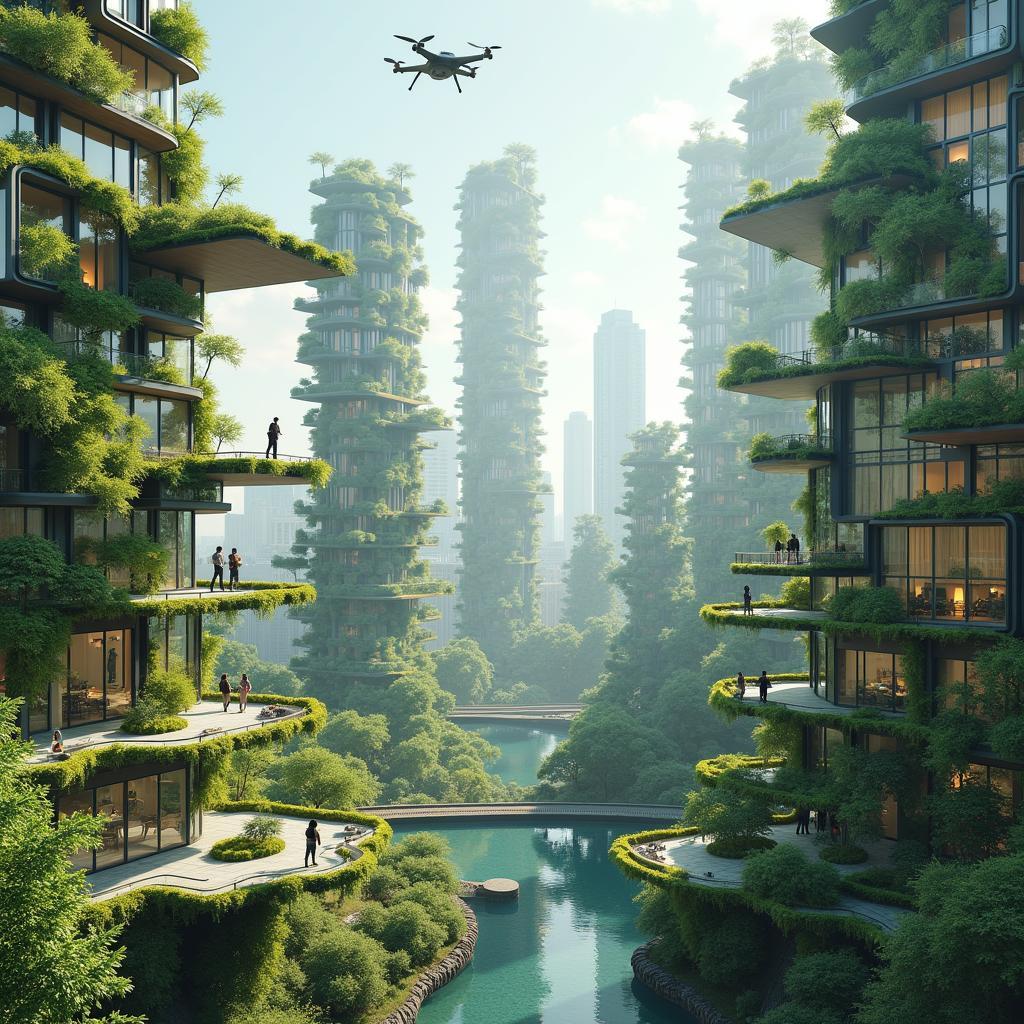 Đô thị tương lai kết hợp không gian xanh và công nghệ cho thư giãn
Từ vựng và cụm từ quan trọng
Topic-Specific Vocabulary
| Từ vựng/Cụm từ | Loại từ | Phiên âm | Nghĩa tiếng Việt | Ví dụ | Collocation |
|---|---|---|---|---|---|
| get away from it all | phrasal verb | /ɡet əˈweɪ frɒm ɪt ɔːl/ | thoát khỏi mọi thứ, rời xa cuộc sống thường ngày | I need to get away from it all for a few days. | desperate to get away, manage to get away, place to get away |
| sanctuary | n | /ˈsæŋktʃuəri/ | nơi trú ẩn, nơi thanh bình | This beach has become my personal sanctuary. | personal sanctuary, peaceful sanctuary, provide sanctuary, seek sanctuary |
| secluded | adj | /sɪˈkluːdɪd/ | hẻo lánh, riêng tư, ít người | We found a secluded spot by the lake. | secluded beach, secluded corner, secluded spot, secluded area |
| bustling | adj | /ˈbʌslɪŋ/ | nhộn nhịp, hối hả | Living in a bustling city can be exhausting. | bustling city, bustling streets, bustling atmosphere, bustling metropolis |
| tranquil | adj | /ˈtræŋkwɪl/ | yên tĩnh, thanh bình | The garden provides a tranquil environment. | tranquil setting, tranquil atmosphere, tranquil surroundings, remain tranquil |
| decompress | v | /ˌdiːkəmˈpres/ | giải tỏa căng thẳng, thư giãn | I need time to decompress after work. | need to decompress, help decompress, chance to decompress |
| recharge one’s batteries | idiom | /ˌriːˈtʃɑːdʒ wʌnz ˈbætəriz/ | nạp lại năng lượng | I spent the weekend recharging my batteries. | need to recharge, time to recharge, help recharge batteries |
| solitude | n | /ˈsɒlɪtjuːd/ | sự cô đơn, yên tĩnh (tích cực) | I value moments of solitude. | seek solitude, enjoy solitude, peaceful solitude, crave solitude |
| therapeutic | adj | /ˌθerəˈpjuːtɪk/ | có tính trị liệu, chữa lành | Walking in nature is therapeutic for me. | therapeutic effect, therapeutic benefits, therapeutic value, highly therapeutic |
| off the beaten track | idiom | /ɒf ðə ˈbiːtən træk/ | ngoài con đường thông thường | This cafe is off the beaten track. | well off the beaten track, completely off the beaten track |
| hustle and bustle | idiom | /ˈhʌsl ənd ˈbʌsl/ | sự hối hả, náo nhiệt | I need to escape the hustle and bustle. | escape the hustle and bustle, away from the hustle and bustle |
| unwind | v | /ʌnˈwaɪnd/ | thư giãn, xả stress | I like to unwind with a good book. | help unwind, chance to unwind, way to unwind |
| serene | adj | /səˈriːn/ | thanh thản, tĩnh lặng | The lake looks serene in the morning. | serene atmosphere, serene environment, serene beauty, remain serene |
| disconnect from | phrasal verb | /ˌdɪskəˈnekt frɒm/ | ngắt kết nối khỏi | I need to disconnect from technology. | need to disconnect, completely disconnect, disconnect from work |
| restorative | adj | /rɪˈstɔːrətɪv/ | phục hồi, hồi phục | Nature has a restorative effect on mental health. | restorative power, restorative benefits, restorative experience |
| respite | n | /ˈrespaɪt/ | sự tạm nghỉ, giải lao | This place offers respite from daily stress. | provide respite, brief respite, much-needed respite, offer respite |
| immerse oneself in | phrasal verb | /ɪˈmɜːs wʌnˈself ɪn/ | đắm mình vào | I like to immerse myself in nature. | completely immerse, fully immerse, immerse oneself in nature |
| retreat | n | /rɪˈtriːt/ | nơi ẩn náu, nơi nghỉ dưỡng | This cottage is my weekend retreat. | peaceful retreat, perfect retreat, mountain retreat, weekend retreat |
| rejuvenate | v | /rɪˈdʒuːvəneɪt/ | làm trẻ lại, phục hồi | The spa trip helped rejuvenate me. | help rejuvenate, feel rejuvenated, completely rejuvenate |
| tune out | phrasal verb | /tjuːn aʊt/ | ngắt kết nối, không chú ý | I go there to tune out all the noise. | need to tune out, able to tune out, tune out distractions |
Idiomatic Expressions & Advanced Phrases
| Cụm từ | Nghĩa | Ví dụ sử dụng | Band điểm |
|---|---|---|---|
| clear one’s head | làm đầu óc tỉnh táo | A walk in the park helps me clear my head. | 7.5-8 |
| running on empty | kiệt sức, cạn năng lượng | I’ve been running on empty lately and need a break. | 7.5-8 |
| burn out / burnt out | kiệt sức hoàn toàn | If you don’t rest, you’ll burn out eventually. | 7-8 |
| steal away | lẻn đi, trốn đi (một cách bí mật) | I sometimes steal away to the library during lunch. | 8-9 |
| reset button | nút khởi động lại (ẩn dụ) | This beach is my reset button when life gets stressful. | 7.5-8 |
| mental equilibrium | sự cân bằng tinh thần | Meditation helps maintain my mental equilibrium. | 8-9 |
| deliberate disconnection | sự ngắt kết nối có chủ ý | I practice deliberate disconnection from social media. | 8-9 |
| carve out time | tạo ra thời gian (từ lịch bận) | I carve out time every week for solitude. | 7.5-8 |
| perpetually available | luôn sẵn sàng, không bao giờ nghỉ | Modern workers are expected to be perpetually available. | 8-9 |
| antidote to | thuốc giải độc cho (ẩn dụ) | Nature is an antidote to urban stress. | 8-9 |
| reconnect with oneself | kết nối lại với bản thân | Solitude helps me reconnect with myself. | 7.5-8 |
| put on one’s oxygen mask | chăm sóc bản thân trước (ẩn dụ) | You need to put on your own oxygen mask before helping others. | 8-9 |
| strike a balance | đạt được sự cân bằng | It’s important to strike a balance between work and rest. | 7-8 |
| at risk of losing | có nguy cơ mất | We’re at risk of losing these natural spaces. | 7.5-8 |
| move beyond | vượt qua, đi xa hơn | Modern spaces move beyond traditional designs. | 7.5-8 |
| circle back to | quay trở lại (một chủ đề) | To circle back to your question, I think… | 8-9 |
Discourse Markers (Từ Nối Ý Trong Speaking)
Để bắt đầu câu trả lời:
- 📝 Well,… – Khi cần suy nghĩ hoặc softener
- 📝 Actually,… – Khi đưa ra góc nhìn khác hoặc correct
- 📝 To be honest,… – Khi nói thật, thẳng thắn
- 📝 I’d say that… – Khi đưa ra quan điểm cá nhân
- 📝 From my perspective,… – Theo quan điểm của tôi
- 📝 The way I see it,… – Theo cách tôi nhìn nhận
Để bổ sung ý:
- 📝 On top of that,… – Thêm vào đó
- 📝 What’s more,… – Hơn nữa
- 📝 Not to mention… – Chưa kể đến
- 📝 Additionally,… – Thêm vào đó (formal)
- 📝 Furthermore,… – Hơn nữa (formal)
- 📝 Another point worth mentioning is… – Một điểm đáng nói khác là
Để đưa ra quan điểm cân bằng:
- 📝 On the one hand,… On the other hand,… – Một mặt… mặt khác
- 📝 While it’s true that…, we also need to consider… – Mặc dù đúng là… nhưng ta cũng cần xem xét
- 📝 That said,… – Tuy nhiên, dù vậy
- 📝 Having said that,… – Mặc dù đã nói vậy
- 📝 From another angle,… – Từ một góc độ khác
Để kết luận:
- 📝 All in all,… – Tóm lại, nhìn chung
- 📝 At the end of the day,… – Cuối cùng thì, xét cho cùng
- 📝 To sum up,… – Tóm lại
- 📝 In a nutshell,… – Nói ngắn gọn
- 📝 So to answer your question,… – Vậy để trả lời câu hỏi của bạn
Để làm rõ hoặc giải thích:
- 📝 What I mean is… – Ý tôi là
- 📝 In other words,… – Nói cách khác
- 📝 Let me put it this way… – Để tôi nói theo cách này
- 📝 To clarify,… – Để làm rõ
- 📝 Let me unpack that… – Để tôi phân tích điều đó
Grammatical Structures Ấn Tượng
1. Conditional Sentences (Câu điều kiện):
Mixed conditional:
- Formula: If + Past Perfect, would/could + V (present result of past condition)
- Ví dụ: “If I hadn’t discovered this beach years ago, I wouldn’t have anywhere to escape to now.”
Inversion for emphasis:
- Formula: Had/Were/Should + S + V, S + would/could…
- Ví dụ: “Were I to live in a more remote area, I wouldn’t need to travel far to find peace.”
- Ví dụ: “Had I known about this place earlier, I would have visited much more often.”
2. Relative Clauses (Mệnh đề quan hệ):
Non-defining relative clauses:
- Formula: S, which/who/where + clause, V
- Ví dụ: “This park, which is tucked away from the main roads, has become my sanctuary.”
- Ví dụ: “My friend’s cottage, where I spent last summer, offers complete tranquility.”
Reduced relative clauses:
- Formula: S + V-ing/V-ed phrase
- Ví dụ: “The path leading to the beach is quite secluded.” (instead of “that leads to”)
- Ví dụ: “People seeking solitude often come here.” (instead of “who seek”)
3. Passive Voice (Câu bị động):
It is thought/believed/said that:
- Ví dụ: “It is widely believed that spending time in nature reduces stress levels.”
- Ví dụ: “It has been proven that disconnecting from technology improves mental health.”
Modal passives:
- Ví dụ: “These spaces can be accessed by anyone seeking peace.”
- Ví dụ: “Relaxation should not be seen as a luxury but as a necessity.”
4. Cleft Sentences (Câu chẻ):
What I find most… is:
- Ví dụ: “What I find most restorative about this place is the complete absence of noise.”
- Ví dụ: “What makes this spot special is its accessibility combined with tranquility.”
The thing/reason that… is:
- Ví dụ: “The thing that draws me back repeatedly is the sense of timelessness there.”
- Ví dụ: “The reason I chose this particular location is its perfect balance of solitude and safety.”
It is… that:
- Ví dụ: “It is the psychological distance rather than physical distance that provides relief.”
- Ví dụ: “It was during my first visit that I realized the importance of such spaces.”
5. Inversion for Emphasis:
Not only… but also:
- Ví dụ: “Not only does this place offer peace, but it also provides inspiration for creative work.”
Rarely/Seldom/Never:
- Ví dụ: “Rarely have I felt so at peace as when I’m sitting by that lake.”
- Ví dụ: “Never before had I understood the value of solitude until I discovered this retreat.”
6. Participle Clauses:
Present participle (-ing):
- Ví dụ: “Sitting by the water, I can feel my stress melting away.”
- Ví dụ: “Walking along the path, I notice details I usually miss in daily life.”
Past participle (-ed):
- Ví dụ: “Located far from the city center, this spot remains relatively undiscovered.”
- Ví dụ: “Surrounded by nature, I find it easier to practice mindfulness.”
7. Subjunctive Mood:
It’s essential/important/crucial that:
- Ví dụ: “It’s essential that everyone have access to spaces for mental recovery.”
- Ví dụ: “It’s important that we preserve these natural sanctuaries for future generations.”
I suggest/recommend that:
- Ví dụ: “I’d recommend that people visit during off-peak hours to fully appreciate the tranquility.”
Với những kiến thức và chiến lược trên, bạn đã có đủ công cụ để tự tin trả lời chủ đề “describe a place you go to get away from it all” trong IELTS Speaking. Hãy nhớ rằng examiner không chỉ đánh giá khả năng ngôn ngữ mà còn muốn nghe câu chuyện chân thực, cảm xúc thực của bạn. Đừng học thuộc lòng mẫu câu – hãy sử dụng vocabulary và structures một cách tự nhiên, phản ánh đúng trải nghiệm cá nhân. Practice regularly, record yourself, và học từ feedback để cải thiện liên tục. Good luck với kỳ thi IELTS của bạn!