
Chủ đề “Describe a time you were very proud of yourself” là một trong những đề bài phổ biến và đầy cảm xúc trong IELTS Speaking. Đây là cơ hội tuyệt vời để bạn chia sẻ thành tựu cá nhân và thể hiện khả năng diễn đạt cảm xúc một cách tự nhiên bằng tiếng Anh. Từ góc nhìn của một examiner với hơn 20 năm kinh nghiệm chấm thi, tôi nhận thấy nhiều thí sinh Việt Nam thường gặp khó khăn trong việc mô tả cảm xúc một cách sâu sắc và sử dụng từ vựng đa dạng để diễn tả sự tự hào.
Chủ đề này xuất hiện với tần suất cao trong các kỳ thi IELTS từ 2020 đến nay, đặc biệt trong Part 2. Theo thống kê từ các nguồn đề thi thực tế, đề tài liên quan đến personal achievement và feelings of pride xuất hiện khoảng 15-20% trong tổng số đề thi Speaking. Dự đoán khả năng xuất hiện trong tương lai vẫn ở mức cao do tính universal và khả năng đánh giá toàn diện các tiêu chí chấm điểm.
Trong bài viết này, bạn sẽ học được câu hỏi thường gặp trong cả 3 Part của IELTS Speaking về chủ đề này, bài mẫu chi tiết theo nhiều band điểm từ 6 đến 9, kho từ vựng và cụm từ ăn điểm để miêu tả cảm xúc tự hào, chiến lược trả lời hiệu quả từng phần thi, và những lời khuyên quý báu từ góc nhìn của examiner. Bạn cũng sẽ hiểu rõ sự khác biệt giữa các band điểm và cách nâng cao điểm số của mình một cách có hệ thống.
IELTS Speaking Part 1: Introduction and Interview
Tổng Quan Về Part 1
Part 1 của IELTS Speaking kéo dài 4-5 phút với các câu hỏi ngắn về đời sống hàng ngày và bản thân. Đây là phần “làm quen” giúp bạn cảm thấy thoải mái trước khi chuyển sang các phần khó hơn. Examiner sẽ đánh giá khả năng trả lời tự nhiên, mở rộng ý tưởng và sử dụng từ vựng cơ bản đến trung cấp của bạn.
Chiến lược quan trọng nhất cho Part 1 là trả lời trực tiếp câu hỏi trong 1-2 câu đầu, sau đó mở rộng bằng lý do hoặc ví dụ cụ thể. Mỗi câu trả lời nên dài khoảng 2-3 câu, không quá ngắn nhưng cũng không quá dài.
Lỗi thường gặp của học viên Việt Nam trong Part 1:
- Trả lời quá ngắn chỉ với “Yes” hoặc “No” mà không giải thích
- Dùng từ vựng quá đơn giản như “good”, “bad”, “happy” lặp đi lặp lại
- Thiếu ví dụ cụ thể từ kinh nghiệm cá nhân
- Ngập ngừng quá nhiều do sợ sai ngữ pháp
- Không maintain eye contact với examiner
Các Câu Hỏi Thường Gặp
Question 1: Do you often feel proud of yourself?
Question 2: What kind of achievements make you feel proud?
Question 3: Did your parents praise you often when you were a child?
Question 4: How do you usually celebrate your personal achievements?
Question 5: Do you think it’s important to recognize your own accomplishments?
Question 6: What was the last thing you felt proud about?
Question 7: Do you prefer to share your achievements with others or keep them private?
Question 8: How do you react when someone compliments you on your success?
Phân Tích và Gợi Ý Trả Lời Chi Tiết
Question: Do you often feel proud of yourself?
Cách tiếp cận:
- Trả lời trực tiếp Yes/No với frequency adverb
- Đưa ra lý do tại sao thường hoặc không thường cảm thấy tự hào
- Thêm ví dụ ngắn gọn về loại việc khiến bạn tự hào
Sample Answer – Band 6-7:
“Yes, I feel proud of myself quite often, especially when I complete difficult tasks at work. For example, last month I finished a big project before the deadline, which made me really happy. I think it’s important to appreciate our own efforts.”
Phân tích:
- Điểm mạnh: Trả lời trực tiếp câu hỏi, có ví dụ cụ thể, cấu trúc câu rõ ràng
- Hạn chế: Từ vựng còn đơn giản (really happy, big project), thiếu collocations mạnh, ý tưởng chưa sâu sắc
- Tại sao Band 6-7: Vocabulary adequate nhưng chưa precise, grammar đúng nhưng structures khá basic, ideas đủ nhưng chưa developed fully
Sample Answer – Band 8-9:
“I’d say I experience feelings of pride fairly regularly, particularly when I overcome personal challenges or achieve milestones I’ve been working towards. Just recently, I felt a genuine sense of accomplishment after completing a professional certification that required months of dedicated preparation. I believe acknowledging our own progress is essential for maintaining motivation and building self-confidence.”
Phân tích:
- Điểm mạnh: Từ vựng sophisticated (genuine sense of accomplishment, dedicated preparation, acknowledging our own progress), grammar range đa dạng (relative clauses, gerunds), ý tưởng deeper với lý do về motivation và confidence
- Tại sao Band 8-9: Fluency tự nhiên với discourse marker “I’d say”, lexical resource precise và collocational, grammatical structures varied, pronunciation features như word stress tốt với các cụm từ dài
Key Vocabulary & Expressions:
- fairly regularly: thường xuyên, khá đều đặn
- overcome personal challenges: vượt qua thử thách cá nhân
- achieve milestones: đạt được cột mốc quan trọng
- genuine sense of accomplishment: cảm giác thành tựu chân thực
- dedicated preparation: sự chuẩn bị chuyên tâm
- acknowledge one’s own progress: công nhận tiến bộ của bản thân
- build self-confidence: xây dựng sự tự tin
Question: What kind of achievements make you feel proud?
Cách tiếp cận:
- Xác định 1-2 loại thành tựu cụ thể
- Giải thích tại sao những thành tựu này quan trọng với bạn
- Có thể đưa ra ví dụ ngắn
Sample Answer – Band 6-7:
“I feel most proud when I help other people or learn something new. For instance, when I teach my younger sister English and she improves, I feel very satisfied. Also, mastering a new skill like playing guitar makes me proud because it takes a lot of time and effort.”
Phân tích:
- Điểm mạnh: Đưa ra hai loại achievement rõ ràng, có examples cụ thể, structure logical
- Hạn chế: Từ “very satisfied” và “very proud” quá generic, thiếu emotional depth, grammar structures khá đơn giản
- Tại sao Band 6-7: Ideas clear và relevant nhưng development còn superficial, vocabulary functional nhưng thiếu sophistication
Sample Answer – Band 8-9:
“The achievements that resonate most deeply with me are those involving personal growth rather than external recognition. I take immense pride in moments when I’ve pushed beyond my comfort zone – for example, when I delivered a presentation in English to an international audience despite my initial nervousness. Similarly, making a tangible difference in someone else’s life, like mentoring a junior colleague through a difficult project, gives me a profound sense of fulfillment that surpasses any material reward.”
Phân tích:
- Điểm mạnh: Vocabulary highly precise (resonate deeply, immense pride, profound sense of fulfillment, surpasses material reward), complex ideas về internal vs external achievement, grammatical range với participle phrases và relative clauses
- Tại sao Band 8-9: Shows sophisticated thinking với contrast giữa personal growth và external recognition, lexical resource với strong collocations, fluency với natural discourse markers và clause linking
Key Vocabulary & Expressions:
- resonate most deeply: chạm đến sâu sắc nhất
- personal growth: sự phát triển cá nhân
- take immense pride in: cực kỳ tự hào về
- push beyond one’s comfort zone: vượt ra ngoài vùng an toàn
- deliver a presentation: thuyết trình
- make a tangible difference: tạo ra sự khác biệt rõ ràng
- mentor someone: hướng dẫn, dạy dỗ ai đó
- profound sense of fulfillment: cảm giác mãn nguyện sâu sắc
- surpass material reward: vượt qua phần thưởng vật chất
Question: Did your parents praise you often when you were a child?
Cách tiếp cận:
- Trả lời Yes/No với frequency
- Giải thích phong cách nuôi dạy của cha mẹ
- Có thể nói về impact của việc này đến bạn hiện tại
Sample Answer – Band 6-7:
“Not very often, actually. My parents were quite strict and they believed that too much praise would make children lazy. They only praised me when I got really excellent results in school. Looking back, I think this made me work harder to get their attention.”
Phân tích:
- Điểm mạnh: Honest answer với “not very often”, có explanation về parenting style, có reflection về past
- Hạn chế: Vocabulary khá basic (really excellent, work harder), thiếu specific examples, grammar structures đơn giản
- Tại sao Band 6-7: Ideas coherent và relevant, nhưng lexical resource và grammatical range chưa impressive
Sample Answer – Band 8-9:
“To be honest, expressions of praise were relatively sparse in my household. My parents subscribed to a more traditional parenting approach where they believed that excessive compliments might breed complacency. They would acknowledge my achievements mainly when I excelled academically or demonstrated significant improvement in a particular area. While this somewhat reserved approach may seem harsh by today’s standards, I believe it actually instilled in me a strong work ethic and the ability to find intrinsic motivation rather than relying on external validation.”
Phân tích:
- Điểm mạnh: Sophisticated vocabulary (expressions of praise, relatively sparse, breed complacency, instilled in me, intrinsic motivation, external validation), complex grammatical structures với clauses, balanced perspective về traditional parenting, demonstrates critical thinking
- Tại sao Band 8-9: Exceptional fluency với natural phrasing, lexical resource với precise academic collocations, wide range of grammar với complex and compound sentences, shows maturity in discussing cultural parenting differences
Key Vocabulary & Expressions:
- expressions of praise: lời khen ngợi
- relatively sparse: tương đối ít ỏi
- subscribe to an approach: theo một phương pháp
- excessive compliments: lời khen quá mức
- breed complacency: nuôi dưỡng sự tự mãn
- acknowledge achievements: công nhận thành tựu
- excel academically: xuất sắc về mặt học thuật
- significant improvement: tiến bộ đáng kể
- somewhat reserved approach: cách tiếp cận khá dè dặt
- instill in someone: thấm nhuần vào ai đó
- strong work ethic: đạo đức làm việc tốt
- intrinsic motivation: động lực nội tại
- rely on external validation: dựa vào sự công nhận từ bên ngoài
 Học viên đang luyện tập IELTS Speaking Part 1 về chủ đề tự hào với giáo viên
IELTS Speaking Part 2: Long Turn (Cue Card)
Tổng Quan Về Part 2
Part 2 là phần độc thoại kéo dài 2-3 phút, được coi là phần thách thức nhất của IELTS Speaking. Bạn có 1 phút chuẩn bị với giấy và bút để ghi chú, sau đó phải nói liên tục về chủ đề được đưa ra. Examiner sẽ không ngắt lời bạn trong suốt thời gian này.
Chiến lược hiệu quả cho Part 2:
- Sử dụng hết 1 phút chuẩn bị: Đừng bỏ qua thời gian vàng này. Ghi chú keywords cho mỗi bullet point, không viết câu hoàn chỉnh
- Nói đủ 2 phút: Đây là mục tiêu quan trọng. Nếu nói dưới 1.5 phút, điểm Fluency sẽ bị ảnh hưởng
- Cover tất cả bullet points: Mỗi bullet point nên được nói khoảng 20-30 giây
- Bullet point cuối “explain” là quan trọng nhất: Đây là nơi bạn ghi điểm cao với emotional depth và personal reflection
- Sử dụng đúng thì động từ: Với “describe a time”, bạn cần dùng past tenses chủ yếu
Lỗi thường gặp:
- Không sử dụng hết thời gian chuẩn bị, bắt đầu nói ngay
- Nói dưới 1.5 phút do thiếu ý tưởng mở rộng
- Bỏ sót bullet points hoặc nói không đủ về bullet point “explain”
- Kể chuyện quá đơn giản như viết nhật ký thay vì storytelling
- Thiếu emotional language khi miêu tả cảm xúc tự hào
Cue Card
Describe a time when you were very proud of yourself
You should say:
- When and where it happened
- What you did
- Why it was important to you
- And explain why you felt so proud
Phân Tích Đề Bài
- Dạng câu hỏi: Describe an experience/event (kể về một trải nghiệm cụ thể trong quá khứ)
- Thì động từ: Past tenses chủ yếu (Past Simple, Past Continuous, Past Perfect) khi kể chuyện, Present Perfect khi nói về impact đến hiện tại
- Bullet points phải cover:
- When and where: Cần specific time và place, không nói chung chung
- What you did: Mô tả chi tiết hành động, quá trình, challenges
- Why it was important: Giải thích significance cá nhân hoặc professional
- And explain why you felt so proud: Đây là trọng tâm – cần emotional depth và personal reflection
- Câu “explain” quan trọng: Đây là bullet point ghi điểm cao nhất. Bạn cần đi sâu vào cảm xúc, không chỉ nói “I felt happy” mà phải analyze tại sao tự hào, cảm xúc phức tạp như thế nào, impact đến confidence và future goals
Sample Answer – Band 6-7
Thời lượng: Khoảng 1.5-2 phút
“I’d like to talk about a time when I felt really proud of myself. It happened about two years ago when I was studying at university.
At that time, I participated in an English speaking competition at my university. It was held in the main auditorium in November. I decided to join this competition because I wanted to improve my English speaking skills and challenge myself.
Before the competition, I prepared for about two months. I practiced speaking every day, learned new vocabulary, and asked my teacher to help me. The competition day was very stressful. There were about 50 participants and the topics were quite difficult. When it was my turn, I felt very nervous but I tried my best to speak clearly and confidently.
This was important to me because I used to be very shy and afraid of speaking in front of people. I always got nervous when I had to present in class. So joining this competition was a big challenge for me.
When the results came out, I won third place. I was so surprised and happy. I felt very proud because I overcame my fear and achieved something I never thought I could do. My family and friends were also proud of me. This experience taught me that if I work hard and believe in myself, I can achieve my goals. It really boosted my confidence and now I’m not afraid of public speaking anymore.”
Phân Tích Band Điểm
| Tiêu chí | Band | Nhận xét |
|---|---|---|
| Fluency & Coherence | 6-7 | Nói tương đối trôi chảy với một số hesitation nhẹ, có sequencing rõ ràng (before, when, after), sử dụng basic connectors (because, so, and), coherence tốt nhưng thiếu sophisticated linking |
| Lexical Resource | 6-7 | Từ vựng adequate và relevant (participate, auditorium, boost confidence), có một số collocations đúng (overcome fear, achieve goals) nhưng còn nhiều từ basic (very nervous, very happy, really proud), paraphrasing hạn chế |
| Grammatical Range & Accuracy | 6-7 | Sử dụng đúng past tenses, có một số complex sentences với “when”, “because”, nhưng structures còn đơn giản, thiếu variety như conditionals, passives hay relative clauses nâng cao |
| Pronunciation | 6-7 | Phát âm rõ ràng và dễ hiểu, word stress cơ bản đúng, có thể có một số lỗi nhỏ về intonation nhưng không ảnh hưởng communication |
Điểm mạnh:
- Đáp ứng đầy đủ tất cả bullet points của đề bài
- Có structure rõ ràng với beginning, middle, end
- Story coherent và easy to follow
- Có personal reflection về impact đến bản thân
Hạn chế:
- Vocabulary khá repetitive với “very” xuất hiện nhiều lần
- Thiếu sophisticated expressions để mô tả emotions
- Grammar structures còn basic, ít complex sentences
- Thiếu descriptive details về feelings và atmosphere
- Emotional depth chưa sâu, chưa explore complexity của pride
Sample Answer – Band 7.5-8
Thời lượng: Khoảng 2-2.5 phút
“I’d like to share an experience that filled me with immense pride – the time I successfully organized a charity fundraising event for underprivileged children in my community about 18 months ago.
It all started in March 2023 when I noticed that a local orphanage was struggling financially to provide educational materials for the children. I decided to take the initiative and organize a charity concert at a community center in my neighborhood. The event took place on a Saturday afternoon in May, and the whole process from planning to execution took roughly two months.
What made this particularly challenging was that I had never organized such a large-scale event before. I had to coordinate with multiple stakeholders – from recruiting volunteer performers and securing sponsors to handling logistics like sound equipment and seating arrangements. There were numerous obstacles along the way. For instance, one sponsor pulled out at the last minute, and I had to quickly find a replacement. I also had to manage a team of about 15 volunteers, which required strong communication and problem-solving skills.
This event was deeply meaningful to me because education has always been something I’m passionate about. Having grown up in a family that valued learning, I understood how crucial educational resources are for children’s development. I wanted to make a tangible contribution rather than just talking about social issues.
The reason I felt so proud wasn’t just because we raised a substantial amount of money – about 50 million dong – but because of the personal growth I experienced throughout the process. I stepped far outside my comfort zone, dealing with challenges I’d never faced before. Seeing the genuine gratitude on the orphanage director’s face and knowing that these funds would directly benefit dozens of children gave me an overwhelming sense of fulfillment. It reinforced my belief that one person can indeed make a difference, and it motivated me to continue engaging in community service. This experience fundamentally changed how I view my own capabilities and sparked a passion for social entrepreneurship that continues to this day.”
Phân Tích Band Điểm
| Tiêu chí | Band | Nhận xét |
|---|---|---|
| Fluency & Coherence | 7.5-8 | Speaks fluently với minimal hesitation, excellent use of discourse markers (for instance, rather than, throughout), sophisticated cohesive devices, well-developed ideas với clear progression |
| Lexical Resource | 7.5-8 | Wide range của vocabulary (immense pride, underprivileged, substantial amount, overwhelming sense of fulfillment), strong collocations (take the initiative, pulled out, sparked a passion), effective paraphrasing, precise word choice |
| Grammatical Range & Accuracy | 7.5-8 | Wide range of structures (participle clauses, relative clauses, complex sentences), accurate use of past perfect và past continuous, variety của sentence types, minimal errors |
| Pronunciation | 7.5-8 | Clear pronunciation với good stress và intonation patterns, effective use of pausing, natural rhythm, occasionally demonstrates features of native speech |
So Sánh Với Band 6-7
| Khía cạnh | Band 6-7 | Band 7.5-8 |
|---|---|---|
| Vocabulary | “very nervous”, “very happy”, “really proud” | “filled me with immense pride”, “overwhelming sense of fulfillment”, “sparked a passion” |
| Grammar | “I practiced speaking every day” (simple past) | “Having grown up in a family that valued learning” (perfect participle clause) |
| Ideas | “This was important because I used to be shy” | “What made this particularly challenging was that I had never organized such a large-scale event before” (cleft sentence với embedded clause) |
| Details | “I won third place. I was so happy.” | “Seeing the genuine gratitude on the orphanage director’s face and knowing that these funds would directly benefit dozens of children” (vivid, specific imagery) |
 Thí sinh tự tin trình bày bài nói IELTS Speaking Part 2 về khoảnh khắc tự hào
Sample Answer – Band 8.5-9
Thời lượng: 2.5-3 phút đầy đủ
“I’d like to recount an experience that stands out as a defining moment in my personal development – the time I successfully completed my first full marathon in Hanoi back in October 2022, despite having no prior experience in long-distance running.
The journey leading up to this achievement actually began six months earlier, in April, when I found myself at a crossroads both physically and mentally. I’d been leading a sedentary lifestyle for years, caught up in the demands of my corporate job, and I’d hit rock bottom in terms of health and self-esteem. One day, quite impulsively, I signed up for the Hanoi International Marathon, committing myself to something that seemed utterly impossible at the time – running 42 kilometers.
What ensued was arguably the most grueling yet transformative six-month period of my life. I embarked on a rigorous training regimen, waking up at 5 AM every single day, rain or shine. The training itself was physically punishing – I battled through muscle injuries, dealt with excruciating pain during long runs, and there were countless moments when I questioned my sanity for taking this on. Beyond the physical challenges, there was an immense mental component. I had to develop unprecedented levels of discipline, learning to push through discomfort when every fiber of my being was screaming at me to stop.
The significance of this endeavor went far beyond just completing a race. For me, it represented breaking free from self-imposed limitations I’d unknowingly placed on myself over the years. I’d always been the person who shied away from physical challenges, convinced that athletic pursuits simply weren’t in my DNA. This marathon became a symbolic confrontation with all those limiting beliefs.
Now, as for why I felt such profound pride – it’s rather complex. Of course, there was the immediate rush of accomplishment when I crossed that finish line after 4 hours and 23 minutes, battered and exhausted but exhilarated beyond measure. However, what resonated most deeply was the recognition of how fundamentally I’d transformed as a person. Throughout those six months, I’d cultivated a resilience I never knew I possessed. I’d learned that the barriers we perceive are often far more psychological than physical.
What truly amplified this sense of pride was witnessing the ripple effect it had. Several friends and colleagues, inspired by my journey, embarked on their own fitness transformations. My parents, who’d always worried about my health, couldn’t conceal their joy and relief. But more profoundly, I’d proven to myself that with unwavering commitment and systematic effort, I could achieve things that once seemed unthinkable.
This experience has permanently altered my perspective on personal capability. It’s become my reference point whenever I face daunting challenges, serving as concrete evidence that I’m capable of far more than I imagine. The pride I felt wasn’t merely about the achievement itself but about the person I’d become in the pursuit of it – more disciplined, more resilient, and fundamentally more confident in my ability to tackle whatever life throws at me.”
Phân Tích Band Điểm
| Tiêu chí | Band | Nhận xét |
|---|---|---|
| Fluency & Coherence | 8.5-9 | Exceptional fluency với natural speech patterns, sophisticated use of discourse markers (arguably, as for, however, more profoundly), seamless transitions between ideas, complex arguments well-developed và interconnected |
| Lexical Resource | 8.5-9 | Sophisticated và precise vocabulary (at a crossroads, hit rock bottom, embark on, excruciating, unwavering commitment), natural idiomatic language (rain or shine, questioned my sanity, beyond measure), skillful use of collocations (ripple effect, limiting beliefs, symbolic confrontation), wide range of less common words used naturally |
| Grammatical Range & Accuracy | 8.5-9 | Full range of structures với consistent accuracy, complex sentences với multiple embedded clauses, perfect use of participle constructions, advanced passive structures, variety of conditional forms, virtually error-free với only occasional slips |
| Pronunciation | 8.5-9 | Pronunciation features closely approximate native speech, excellent stress và intonation throughout, effective use of pausing for emphasis, varied pace for dramatic effect, completely effortless delivery |
Tại Sao Bài Này Xuất Sắc
Fluency Hoàn Hảo:
Bài nói demonstrates natural spoken English với sophisticated phrasing như “What ensued was arguably…”, “as for why…”, “what truly amplified…”. Không có hesitation hay awkward pauses. Candidate sử dụng discourse markers masterfully để guide listener through complex narrative.
Vocabulary Tinh Vi:
- “stands out as a defining moment” – thay vì “was very important”
- “battered and exhausted but exhilarated beyond measure” – vivid imagery với multiple adjectives
- “the barriers we perceive are often far more psychological than physical” – abstract, philosophical expression
- “with unwavering commitment” – collocation mạnh hơn “strong determination”
- “permanently altered my perspective” – precise verb choice thay vì “changed my thinking”
Grammar Đa Dạng:
- Perfect participle: “despite having no prior experience”
- Cleft sentence: “What ensued was arguably…”
- Passive with agent: “was screaming at me to stop”
- Complex relative clause: “I’d unknowingly placed on myself over the years”
- Embedded clauses: “I’d proven to myself that with unwavering commitment and systematic effort, I could achieve…”
Ideas Sâu Sắc:
Bài nói không chỉ kể story mà còn deeply analyzes psychological aspects của pride. Candidate explores complexity của emotion (immediate vs profound pride), discusses personal transformation, và reflects on broader impact. Demonstrates mature thinking về self-imposed limitations và personal growth.
Storytelling Techniques:
Uses vivid imagery (“battered and exhausted”, “every fiber of my being”), builds suspense, creates emotional arc, và concludes với meaningful reflection. Structure hoàn hảo: setup → challenge → transformation → reflection → lasting impact.
Follow-up Questions (Rounding Off Questions)
Sau Part 2, examiner thường hỏi 1-2 câu ngắn liên quan trực tiếp đến story bạn vừa kể để transition sang Part 3.
Question 1: Would you like to run another marathon in the future?
Band 6-7 Answer:
“Yes, definitely. I’m actually planning to join another marathon next year. I want to improve my time and maybe try a different location.”
Band 8-9 Answer:
“Absolutely, I’m already eyeing several upcoming races. In fact, I’ve set my sights on attempting an ultramarathon within the next year or so. Having conquered the marathon distance, I’m eager to push my boundaries even further and see what else I’m capable of achieving.”
Key differences: Band 8-9 uses sophisticated expressions (eyeing, set my sights on, conquered, push boundaries), shows ambition và forward planning, demonstrates natural use of present perfect.
Question 2: How did your friends react when you told them about this achievement?
Band 6-7 Answer:
“They were very surprised and happy for me. Some of them said they also wanted to try running. A few friends even asked me to help them start training.”
Band 8-9 Answer:
“Their reactions were overwhelmingly positive, which was quite touching. Many were genuinely astonished since they’d known me as the least athletic person in our circle. What was particularly gratifying was that several friends were inspired to embark on their own fitness journeys – I’ve since become somewhat of an unofficial coach for a few of them, which has been immensely rewarding in its own right.”
Key differences: Band 8-9 shows emotional intelligence (quite touching, immensely rewarding), uses precise vocabulary (overwhelmingly positive, genuinely astonished), demonstrates complex ideas about impact on others, natural discourse markers.
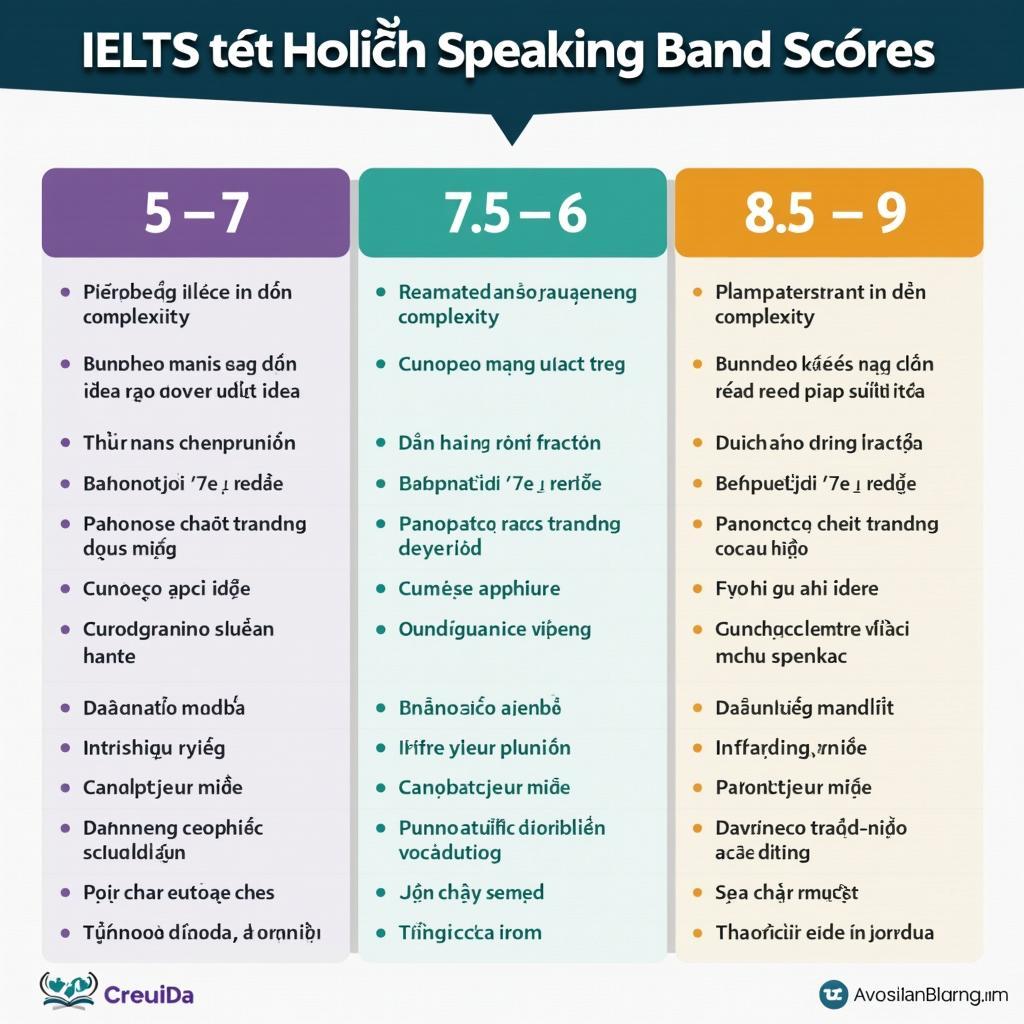 So sánh các mức band điểm IELTS Speaking từ 6 đến 9 với minh họa chi tiết
IELTS Speaking Part 3: Two-way Discussion
Tổng Quan Về Part 3
Part 3 là phần thảo luận sâu kéo dài 4-5 phút, where examiner và candidate engage trong discussion về các issues trừu tượng liên quan đến topic của Part 2. Đây là phần khó nhất và discriminating nhất của Speaking test, nơi candidates ở band 7+ thực sự shine.
Yêu cầu của Part 3:
- Phân tích và evaluate ideas từ multiple perspectives
- Đưa ra opinions có supporting reasons và evidence
- Compare và contrast different viewpoints
- Discuss causes, effects, solutions của social issues
- Speculate về future trends và possibilities
Chiến lược hiệu quả:
- Mở rộng câu trả lời: Mỗi answer nên dài 3-5 câu với full development
- Sử dụng discourse markers: Well, Actually, To be honest, From my perspective
- Đưa ra societal examples: Không chỉ personal experience mà refer đến broader context
- Acknowledge complexity: Show critical thinking bằng cách recognize nhiều sides của issue
- Structure answers: Direct answer → Reason 1 + example → Reason 2 + example → Conclusion/Nuance
Lỗi thường gặp của học viên Việt Nam:
- Trả lời quá ngắn, chỉ 1-2 câu rồi dừng
- Không phát triển ideas với reasons và examples
- Thiếu từ vựng abstract và academic
- Chỉ nói về personal opinion mà không consider broader perspectives
- Không demonstrate critical thinking hay nuanced views
- Over-generalize mà không qualify statements
Các Câu Hỏi Thảo Luận Sâu
Theme 1: Personal Achievement and Success
Question 1: Why do you think some people are more driven to achieve than others?
Phân tích câu hỏi:
- Dạng: Cause/Reason question – giải thích nguyên nhân differences
- Key words: driven to achieve, some people more than others
- Cách tiếp cận: Identify 2-3 factors (upbringing, personality traits, social environment), explain each với examples, có thể acknowledge complexity
Sample Answer – Band 6-7:
“I think there are several reasons for this. First, family background plays an important role. People who grow up in families that value success usually become more ambitious. Second, personality also matters. Some people are naturally more competitive and want to be the best at everything they do. Finally, education can influence how driven someone is because good teachers can inspire students to work harder and achieve their goals.”
Phân tích:
- Structure: Lists three reasons clearly với sequencing (first, second, finally)
- Vocabulary: Adequate với basic collocations (family background, plays an important role, value success) nhưng lacks sophistication
- Tại sao Band 6-7: Ideas clear và relevant, grammar mostly accurate, nhưng lacks depth và sophisticated language. Không có nuanced view hay acknowledgment của complexity.
Sample Answer – Band 8-9:
“Well, I’d say the drive to achieve is shaped by a complex interplay of factors, and it’s rarely attributable to just one cause. From my observation, upbringing tends to be particularly influential. Children raised in environments where effort is consistently recognized and rewarded often internalize a strong achievement orientation. However, it’s more nuanced than simply having ambitious parents – it’s about the specific messages children receive about the value of persistence and the nature of success.
Beyond family influence, there’s undoubtedly an innate personality component. Some individuals seem to possess what psychologists call a high need for achievement – they derive intrinsic satisfaction from overcoming challenges and setting progressively higher goals for themselves. This might be partly genetic, though I’d hesitate to say it’s entirely predetermined.
That said, we can’t overlook the societal context. In highly competitive cultures or socioeconomic environments where advancement seems achievable, people are often more motivated to strive for success. Conversely, when individuals perceive systemic barriers or lack role models who’ve achieved upward mobility, their drive may be understandably diminished.
What’s fascinating is that these factors are deeply interconnected – someone’s personality traits might be amplified or suppressed depending on their environment, and early experiences can literally reshape neural pathways related to motivation. So rather than viewing it as some having drive and others lacking it, it’s more accurate to see achievement motivation as existing on a spectrum, influenced by this multifaceted combination of nature, nurture, and circumstance.”
Phân tích:
- Structure: Exceptionally well-organized với clear progression: upbringing → personality → societal factors → interconnection/conclusion
- Vocabulary: Highly sophisticated (complex interplay, internalize, intrinsic satisfaction, systemic barriers, multifaceted combination, neural pathways)
- Grammar: Wide range với conditionals, relative clauses, passive constructions, tentative language
- Critical Thinking: Shows nuanced understanding, acknowledges complexity, considers multiple perspectives, qualifies statements, demonstrates academic thinking
Key Language Features:
- Discourse markers: “Well, I’d say”, “From my observation”, “Beyond”, “That said”, “What’s fascinating”, “Rather than viewing”
- Tentative language: “tends to be”, “often”, “might be”, “I’d hesitate to say”, “seems”, “more accurate to see”
- Abstract nouns: “drive to achieve”, “complex interplay”, “achievement orientation”, “intrinsic satisfaction”, “upward mobility”, “spectrum”
- Academic expressions: “attributable to”, “internalize”, “derive satisfaction from”, “perceive barriers”, “amplified or suppressed”
Question 2: Do you think society puts too much pressure on people to achieve?
Phân tích câu hỏi:
- Dạng: Opinion question (agree/disagree) với evaluation
- Key words: too much pressure, society, achieve
- Cách tiếp cận: State opinion → explain with reasons → give examples → acknowledge other viewpoint → conclude với balanced view
Sample Answer – Band 6-7:
“Yes, I believe society puts too much pressure on people nowadays. Social media makes this worse because people always compare themselves with others. Everyone wants to show they are successful, which creates a lot of stress. Young people especially feel this pressure to get good grades, find high-paying jobs, and achieve many things quickly. This can lead to mental health problems like anxiety and depression. I think we should focus more on personal happiness rather than just achievements.”
Phân tích:
- Structure: Clear opinion với supporting points
- Vocabulary: Functional vocabulary (compare themselves, high-paying jobs, mental health problems) nhưng lacks precision
- Ideas: Relevant points về social media và young people nhưng development còn superficial
- Tại sao Band 6-7: Communicates main ideas effectively nhưng lacks sophistication trong language và depth trong analysis
Sample Answer – Band 8.5-9:
“I’d say this is quite a contentious issue, and my view is somewhat ambivalent. On the one hand, there’s compelling evidence that modern society, particularly in achievement-oriented cultures, does place excessive emphasis on external markers of success – wealth accumulation, professional status, academic credentials. This relentless pressure has demonstrably contributed to what some researchers call an epidemic of anxiety and burnout, especially among younger generations who feel they must constantly perform and curate perfect online personas.
The ubiquity of social media has undoubtedly exacerbated this phenomenon. We’re now perpetually exposed to carefully crafted narratives of others’ achievements, creating a distorted benchmark against which we measure ourselves. This can be psychologically devastating, fostering feelings of inadequacy even when we’re objectively doing well. Moreover, the goalposts keep shifting – what constituted success a generation ago is now seen as merely baseline expectation.
However, I’d offer a counterpoint. A certain degree of societal expectation and healthy competition can actually be catalytic for growth and innovation. Throughout human history, societies that encouraged achievement and valued excellence have tended to make remarkable advances. The challenge is striking the right balance between motivating people to reach their potential and allowing space for different definitions of success and wellbeing.
What concerns me more than achievement pressure per se is the narrow definition of what counts as achievement. If society broadened its conception of success to include things like emotional intelligence, community contribution, artistic expression, or environmental stewardship, rather than fixating predominantly on material and professional accomplishments, the pressure might become more constructive than destructive.
Ultimately, I believe the issue isn’t whether we encourage achievement but how we do so, and whether we’re simultaneously cultivating the resilience and self-worth people need to handle setbacks and define success on their own terms.”
Phân tích:
- Structure: Masterful organization với balanced argument: pressure exists → social media impact → counterargument → nuanced solution → thoughtful conclusion
- Vocabulary: Exceptional range (contentious issue, ambivalent, wealth accumulation, relentless pressure, curate personas, exacerbated, catalytic for growth, resilience)
- Grammar: Full range với complex structures perfectly controlled, inversion, conditionals, relative clauses seamlessly integrated
- Critical Thinking: Highly sophisticated với balanced view, acknowledges complexity, proposes nuanced solution, demonstrates philosophical thinking về definition of success
Key Language Features:
- Balancing expressions: “On the one hand”, “However, I’d offer a counterpoint”, “Ultimately”
- Hedging/Tentative: “quite a contentious”, “somewhat ambivalent”, “can be”, “might become”, “I believe”
- Abstract vocabulary: “contentious issue”, “external markers”, “epidemic of anxiety”, “distorted benchmark”, “catalytic for growth”
- Academic phrases: “compelling evidence”, “demonstrably contributed to”, “constituted success”, “striking the right balance”, “simultaneously cultivating”
Theme 2: Recognition and Validation
Question 3: Is it better to be motivated by internal satisfaction or external recognition?
Phân tích câu hỏi:
- Dạng: Compare/Contrast với evaluation
- Key words: internal satisfaction vs external recognition, better
- Cách tiếp cận: Acknowledge both have value → explain benefits of each → potential drawbacks → personal view with nuance
Sample Answer – Band 6-7:
“I think internal satisfaction is more important than external recognition. When you do something because you enjoy it, you feel happier and more motivated to continue. External recognition like awards or praise is good, but it doesn’t last long. If you only work for other people’s approval, you might feel disappointed when you don’t get it. However, some external recognition is necessary because it can encourage people and show them their work is valuable. So I believe the best approach is to have internal satisfaction as your main motivation, but also appreciate external recognition when it comes.”
Phân tích:
- Structure: Clear comparison với personal opinion
- Ideas: Relevant points về sustainability của intrinsic motivation
- Vocabulary: Basic expressions (more important than, feel happier, last long, main motivation)
- Tại sây Band 6-7: Ideas adequately developed nhưng lacks sophistication và depth. Grammar mostly correct nhưng limited complexity.
Sample Answer – Band 8.5-9:
“This is a fascinating question that touches on fundamental aspects of human psychology. From an ideal standpoint, I’d argue that intrinsic motivation – deriving satisfaction from the activity itself rather than external rewards – is ultimately more sustainable and conducive to wellbeing. Research in positive psychology consistently shows that people who are intrinsically motivated tend to experience deeper fulfillment, greater persistence in the face of challenges, and higher quality output because they’re genuinely engaged rather than merely going through the motions.
The danger of relying predominantly on external validation is that it creates a perpetual dependency on others’ approval. You’re essentially placing your sense of worth in someone else’s hands, which is inherently precarious. Moreover, external recognition is often arbitrary and inconsistent – what garners praise in one context might be overlooked in another. This can lead to what psychologists term an external locus of control, where individuals feel their outcomes are dictated by external forces rather than their own efforts and choices.
That said, I’d caution against dismissing external recognition entirely. We’re fundamentally social creatures, and validation from others serves important functions. It provides feedback on whether we’re meeting societal standards, helps us calibrate our self-assessment, and can offer encouragement during periods when our own motivation wanes. Furthermore, in professional contexts, external recognition often translates into tangible opportunities – promotions, collaborations, resources – that enable us to pursue our passions more effectively.
The optimal approach, in my view, is cultivating what might be called an integrated motivation – where we maintain a strong foundation of internal satisfaction while remaining open to and appropriately valuing external recognition. It’s about developing sufficient self-awareness to know when we’re doing something solely for approval versus when external validation is genuinely aligned with our intrinsic values and goals.
Interestingly, I’ve observed that those who are most genuinely driven by internal passion often end up receiving the most meaningful external recognition anyway, because their authentic engagement produces exceptional work. So perhaps the question isn’t really which is better, but rather which should be primary and which complementary in our motivational hierarchy.”
Phân tích:
- Structure: Exceptionally sophisticated với nuanced argument flow: ideal view → dangers of external focus → important counterargument → integrated solution → insightful conclusion
- Vocabulary: Outstanding precision (intrinsic motivation, conducive to wellbeing, perpetual dependency, external locus of control, calibrate self-assessment, integrated motivation, motivational hierarchy)
- Grammar: Full range với flawless control, complex embedded structures, academic style
- Critical Thinking: Demonstrates psychological knowledge, balanced sophisticated analysis, proposes integrated solution, shows philosophical depth
Theme 3: Cultural Perspectives on Achievement
Question 4: How do attitudes toward personal achievement differ between cultures?
Phân tích câu hỏi:
- Dạng: Compare cultures – requires cultural awareness và examples
- Key words: attitudes, personal achievement, differ, cultures
- Cách tiếp cận: Identify key cultural dimensions (individualism vs collectivism) → give specific examples → explain implications → acknowledge generalizations
Sample Answer – Band 7-8:
“Cultural attitudes toward achievement vary considerably, and I think one of the most fundamental distinctions is between individualistic and collectivistic cultures. In Western societies, particularly the United States, there’s typically a strong emphasis on individual accomplishment and standing out from the crowd. Personal success is celebrated openly, and people are encouraged to promote their achievements without much reservation.
In contrast, many Asian cultures, including Vietnamese culture, traditionally place greater value on collective harmony and family honor. Achievement is often seen through the lens of how it reflects on or benefits one’s family or community rather than purely individual glory. There’s often more modesty in discussing personal success, as excessive self-promotion can be viewed negatively.
These different attitudes have practical implications. For instance, in job interviews, candidates from individualistic backgrounds might feel comfortable highlighting their unique contributions, while those from collectivistic cultures might frame achievements in terms of team efforts, even when they played a central role. Neither approach is inherently better – they simply reflect different cultural values about the relationship between individual and group.”
Phân tích:
- Vocabulary: Strong collocations (vary considerably, fundamental distinctions, celebrated openly, collective harmony, practical implications)
- Structure: Well-organized comparison với clear examples
- Cultural awareness: Demonstrates understanding của cultural dimensions
- Tại sao Band 7-8: Good depth và sophistication, natural language, balanced view. Could push to 8+ với more nuanced examples và deeper implications.
Question 5: Do you think the pressure to achieve has increased or decreased in recent years?
Phân tích câu hỏi:
- Dạng: Trend analysis – requires comparing past vs present with evidence
- Key words: pressure to achieve, increased or decreased, recent years
- Cách tiếp cận: State clear position → identify factors driving change → give evidence/examples → discuss consequences → potentially speculate về future
Sample Answer – Band 8-9:
“I’d unequivocally argue that achievement pressure has intensified dramatically, particularly over the past decade or so, and I can point to several converging factors that have driven this escalation.
Perhaps most significantly, the advent and proliferation of social media has fundamentally transformed how we perceive and measure achievement. We’re now subject to constant comparison with not just our immediate social circle but potentially millions of people curating their highlight reels online. This has created an unprecedented psychological burden – previous generations might compare themselves to neighbors or classmates, but today’s young people are comparing themselves to influencers, celebrities, and seemingly successful peers across the globe, all day, every day.
Compounding this, we’re experiencing what economists call winner-take-all dynamics in many fields. Technology and globalization have created scenarios where the top performers in any domain reap disproportionate rewards, while those just below receive significantly less. This heightens the stakes – there’s less room for being good enough; you need to be exceptional, which naturally amplifies pressure.
From an educational standpoint, competition for limited spots at prestigious universities or desirable jobs has become fiercer. Credentials that were once sufficient – a bachelor’s degree, for instance – are now baseline expectations, pushing people toward multiple advanced degrees, internships, and an ever-growing list of accomplishments just to remain competitive.
The economic context matters too. In an era of increasing income inequality and less certain employment prospects, achievement is increasingly seen as not just desirable but essential for economic security. The margin for error feels smaller, and falling behind seems to carry greater consequences than in previous, more economically stable times.
What’s particularly concerning is that this pressure disproportionately affects younger generations who are simultaneously grappling with other challenges – climate anxiety, housing affordability crises, student debt – all while being told they need to hustle harder and achieve more than their parents did, often with fewer resources and support systems.
Looking forward, I’m cautiously concerned this trend will continue unless we collectively reassess what we value and how we structure opportunities. Some signs are encouraging – growing conversations around work-life balance, mental health, and alternative definitions of success – but whether these translate into systemic change remains to be seen.”
Phán tích:
- Structure: Masterfully organized với clear thesis → multiple well-developed supporting arguments → forward-looking conclusion
- Vocabulary: Exceptional precision và range (unequivocally argue, proliferation, curating highlight reels, winner-take-all dynamics, disproportionate rewards, baseline expectations, margin for error, disproportionately affects, systemically reassess)
- Evidence: Multiple types – technological, economic, educational, sociological – woven together coherently
- Critical thinking: Sophisticated analysis connecting multiple societal trends, demonstrates awareness of nuance và complexity, forward-thinking với cautious speculation
- Grammar: Full range flawlessly controlled – complex sentences, embedded clauses, participles, passives integrated naturally
 Chiến lược trả lời hiệu quả cho IELTS Speaking Part 3 với mind map chi tiết
Từ vựng và cụm từ quan trọng
Topic-Specific Vocabulary
| Từ vựng/Cụm từ | Loại từ | Phiên âm | Nghĩa tiếng Việt | Ví dụ | Collocation |
|---|---|---|---|---|---|
| immense pride | n | /ɪˈmens praɪd/ | niềm tự hào to lớn | I felt immense pride when I graduated with honors. | take immense pride in, fill with immense pride, sense of immense pride |
| genuine sense of accomplishment | n | /ˈdʒenjuɪn sens əv əˈkʌmplɪʃmənt/ | cảm giác thành tựu chân thực | Completing the project gave me a genuine sense of accomplishment. | experience/feel a genuine sense, bring a genuine sense, derive a genuine sense |
| overcome challenges | v | /ˌəʊvəˈkʌm ˈtʃælɪndʒɪz/ | vượt qua thử thách | She overcame many challenges to reach her goals. | successfully overcome, struggle to overcome, help overcome challenges |
| push beyond comfort zone | v | /pʊʃ bɪˈjɒnd ˈkʌmfət zəʊn/ | vượt ra ngoài vùng an toàn | I had to push beyond my comfort zone to speak publicly. | willing to push, need to push, encourage to push beyond |
| personal growth | n | /ˈpɜːsənl grəʊθ/ | sự phát triển cá nhân | The experience contributed significantly to my personal growth. | foster personal growth, experience personal growth, journey of personal growth |
| profound sense of fulfillment | n | /prəˈfaʊnd sens əv fʊlˈfɪlmənt/ | cảm giác mãn nguyện sâu sắc | Helping others gives me a profound sense of fulfillment. | provide a profound sense, experience a profound sense, bring a profound sense |
| defining moment | n | /dɪˈfaɪnɪŋ ˈməʊmənt/ | khoảnh khắc định nghĩa, quan trọng | Winning that competition was a defining moment in my career. | represent a defining moment, prove a defining moment, become a defining moment |
| intrinsic motivation | n | /ɪnˈtrɪnsɪk ˌməʊtɪˈveɪʃən/ | động lực nội tại | Success driven by intrinsic motivation is more sustainable. | driven by intrinsic motivation, develop intrinsic motivation, source of intrinsic motivation |
| external validation | n | /ɪkˈstɜːnl ˌvælɪˈdeɪʃən/ | sự công nhận từ bên ngoài | He relies too much on external validation for happiness. | seek external validation, depend on external validation, need external validation |
| achievement orientation | n | /əˈtʃiːvmənt ˌɔːrienˈteɪʃən/ | định hướng thành tích | Some cultures have a stronger achievement orientation than others. | strong achievement orientation, develop achievement orientation, emphasize achievement orientation |
| make a tangible difference | v | /meɪk ə ˈtændʒəbl ˈdɪfrəns/ | tạo ra sự khác biệt rõ ràng | I want to make a tangible difference in my community. | strive to make, able to make, opportunity to make a tangible difference |
| step outside comfort zone | v | /step ˌaʊtˈsaɪd ˈkʌmfət zəʊn/ | bước ra khỏi vùng an toàn | Taking this job required me to step outside my comfort zone. | willing to step, encourage to step, force to step outside comfort zone |
| cultivate resilience | v | /ˈkʌltɪveɪt rɪˈzɪliəns/ | nuôi dưỡng khả năng phục hồi | Facing challenges helps cultivate resilience. | help cultivate, work to cultivate, important to cultivate resilience |
| self-imposed limitations | n | /self ɪmˈpəʊzd ˌlɪmɪˈteɪʃənz/ | giới hạn tự đặt ra | Many of our barriers are self-imposed limitations. | break free from, overcome self-imposed, recognize self-imposed limitations |
| unwavering commitment | n | /ʌnˈweɪvərɪŋ kəˈmɪtmənt/ | cam kết kiên định | Success requires unwavering commitment to your goals. | demonstrate unwavering, show unwavering, maintain unwavering commitment |
| ripple effect | n | /ˈrɪpl ɪˌfekt/ | hiệu ứng lan tỏa | Her achievement had a ripple effect on the entire team. | create a ripple effect, have a ripple effect, cause a ripple effect |
| milestone achievement | n | /ˈmaɪlstəʊn əˈtʃiːvmənt/ | thành tựu cột mốc | Graduating was a milestone achievement in my life. | represent a milestone, celebrate a milestone, mark a milestone achievement |
| breakthrough moment | n | /ˈbreɪkθruː ˈməʊmənt/ | khoảnh khắc đột phá | When I finally understood the concept, it was a breakthrough moment. | experience a breakthrough, represent a breakthrough, lead to a breakthrough moment |
| exceed expectations | v | /ɪkˈsiːd ˌekspekˈteɪʃənz/ | vượt quá mong đợi | The results exceeded everyone’s expectations. | manage to exceed, consistently exceed, far exceed expectations |
| rise to the challenge | v | /raɪz tə ðə ˈtʃælɪndʒ/ | đối mặt và vượt qua thử thách | Despite difficulties, she rose to the challenge admirably. | manage to rise, willing to rise, ability to rise to the challenge |
Idiomatic Expressions & Advanced Phrases
| Cụm từ | Nghĩa | Ví dụ sử dụng | Band điểm |
|---|---|---|---|
| be on cloud nine | cực kỳ vui sướng, hạnh phúc tột độ | When I received my exam results, I was on cloud nine for days. | 7-8 |
| pat oneself on the back | tự khen ngợi, tự hào về bản thân | After completing the marathon, I gave myself a pat on the back. | 7-8 |
| a feather in one’s cap | thành tích đáng tự hào | Winning that award was a real feather in my cap. | 7.5-8.5 |
| punch above one’s weight | làm được việc vượt quá khả năng thông thường | Getting accepted to that university meant I was really punching above my weight. | 8-9 |
| come out on top | thành công, chiến thắng | Despite the competition, I managed to come out on top. | 7-7.5 |
| reach a milestone | đạt được cột mốc quan trọng | Learning to drive was an important milestone I reached at 18. | 7-8 |
| turn over a new leaf | bắt đầu lại, thay đổi tích cực | After that achievement, I felt ready to turn over a new leaf. | 7.5-8 |
| go the extra mile | nỗ lực thêm, làm nhiều hơn yêu cầu | I had to go the extra mile to achieve that level of success. | 7-8 |
| move mountains | làm được điều tưởng chừng không thể | With determination, you can move mountains and achieve anything. | 8-8.5 |
| break new ground | tạo ra điều mới, tiên phong | My research project broke new ground in our field. | 8-9 |
| set the bar high | đặt tiêu chuẩn cao | That initial success set the bar high for all my future endeavors. | 7.5-8 |
| stand out from the crowd | nổi bật, khác biệt so với người khác | My achievement helped me stand out from the crowd of applicants. | 7-7.5 |
Discourse Markers (Từ Nối Ý Trong Speaking)
Để bắt đầu câu trả lời:
- Well,… – Sử dụng khi cần một chút thời gian suy nghĩ hoặc để soften statement. “Well, I’d say that personal pride is quite complex…”
- Actually,… – Khi đưa ra perspective hơi bất ngờ hoặc correct misconception. “Actually, I didn’t feel proud immediately…”
- To be honest,… – Khi muốn nói thật lòng, authentic. “To be honest, I was surprised by my own achievement…”
- I’d say that… – Cách tự tin đưa ra opinion. “I’d say that the most rewarding aspect was…”
- From my perspective,… – Nhấn mạnh đây là personal view. “From my perspective, intrinsic motivation matters more…”
- In my view,… – Tương tự nhưng formal hơn một chút. “In my view, society places too much emphasis on…”
Để bổ sung ý:
- On top of that,… – Thêm point bổ sung. “On top of that, the experience boosted my confidence significantly…”
- What’s more,… – Emphasize additional important point. “What’s more, it inspired others around me…”
- Not to mention… – Thêm point như afterthought. “Not to mention the financial benefits it brought…”
- Additionally,… – Formal way to add information. “Additionally, this achievement opened new opportunities…”
- Furthermore,… – Academic tone. “Furthermore, the skills I gained proved invaluable…”
- Beyond that,… – Going deeper. “Beyond that, it fundamentally changed my self-perception…”
Để đưa ra quan điểm cân bằng:
- On the one hand,… On the other hand,… – Classic balanced argument structure
- While it’s true that…, we also need to consider… – Acknowledge one view while introducing another
- That said,… – Pivot to contrasting or nuancing point. “That said, external recognition does play a role…”
- However,… – Standard contrast marker
- Having said that,… – More sophisticated than “but”
- Nevertheless,… – Despite previous point, introducing contradiction
Để kết luận:
- All in all,… – Summarizing overall view. “All in all, it was a life-changing experience…”
- At the end of the day,… – What really matters ultimately. “At the end of the day, personal growth mattered most…”
- Ultimately,… – Getting to the core conclusion. “Ultimately, I believe intrinsic motivation is more sustainable…”
- In the final analysis,… – Very formal conclusion. “In the final analysis, the achievement reshaped my entire outlook…”
- Looking back,… – Reflective conclusion. “Looking back, that moment defined who I am today…”
Grammatical Structures Ấn Tượng
1. Conditional Sentences (Câu điều kiện):
Mixed conditional:
- Formula: If + past perfect, would/could + base verb (mixing time references)
- Ví dụ: “If I hadn’t pushed myself beyond my comfort zone, I wouldn’t be the confident person I am today.”
- Khi nào dùng: Express how past actions/decisions affect present situation
Inversion for emphasis:
- Formula: Had I + past participle,… / Were I to + base verb,…
- Ví dụ: “Had I known how challenging it would be, I might have hesitated, but I’m glad I didn’t.”
- Khi nào dùng: Add sophistication và emphasis to hypothetical situations
2. Relative Clauses (Mệnh đề quan hệ):
Non-defining relative clauses:
- Formula: …, which/who + clause, …
- Ví dụ: “The marathon, which I completed in just over four hours, was the most challenging thing I’d ever done.”
- Khi nào dùng: Add extra information về noun, making speech more flowing và detailed
Reduced relative clauses:
- Formula: Noun + present/past participle
- Ví dụ: “The achievement, marking a turning point in my life, gave me immense confidence.”
- Khi nào dùng: Sound more sophisticated và concise
3. Passive Voice (Câu bị động):
It is thought/believed/said that…:
- Formula: It is + past participle + that clause
- Ví dụ: “It is widely believed that personal achievements boost self-esteem more than external rewards.”
- Khi nào dùng: Present general opinions hoặc research findings, sounding more academic
Get passive for personal experience:
- Formula: get + past participle
- Ví dụ: “I got selected for the national team, which was completely unexpected.”
- Khi nào dùng: More informal, conversational passive for things happening to you
4. Cleft Sentences (Câu chẻ):
What-clauses:
- Formula: What + subject + verb + is/was…
- Ví dụ: “What I found most rewarding was not the trophy but the personal growth I experienced.”
- Khi nào dùng: Emphasize particular aspect of experience
It-clauses:
- Formula: It was + noun/adjective + that…
- Ví dụ: “It was the support from my family that kept me motivated throughout the challenge.”
- Khi nào dùng: Draw attention to specific element you want to highlight
5. Perfect Participle Clauses:
Having + past participle:
- Formula: Having + past participle, main clause
- Ví dụ: “Having overcome my initial fears, I found the rest of the journey much easier.”
- Khi nào dùng: Show one action completed before another, sounds very sophisticated
6. Advanced Linking với Participles:
Present participle:
- Formula: …verb + -ing, subject + verb…
- Ví dụ: “Seeing the impact my work had on others, I realized the true meaning of achievement.”
- Khi nào dùng: Show simultaneous actions hoặc cause-effect relationship
7. Inversion with Negative Adverbials:
Rarely/Seldom/Never + auxiliary + subject:
- Formula: Negative adverb + auxiliary + subject + verb
- Ví dụ: “Rarely have I felt such a profound sense of accomplishment.”
- Khi nào dùng: Add dramatic emphasis và sophistication, particularly in Part 3
8. Subjunctive Mood:
It’s essential/important/vital that:
- Formula: It’s + adjective + that + subject + base verb
- Ví dụ: “It’s essential that people recognize their own achievements rather than constantly seeking validation.”
- Khi nào dùng: Express necessity hoặc importance, sounds formal và educated
Những cấu trúc này giúp bạn demonstrate grammatical range và accuracy – hai tiêu chí quan trọng trong band descriptors từ 7 trở lên. Tuy nhiên, remember: đừng force structures vào câu trả lời một cách unnatural. Chỉ sử dụng khi chúng genuinely fit với ý bạn muốn express. Quality và naturalness luôn quan trọng hơn complexity.
 Bảng từ vựng nâng cao miêu tả cảm xúc tự hào trong IELTS Speaking
Chiến Lược và Lời Khuyên Từ Examiner
Understanding Band Descriptors
Để đạt điểm cao trong IELTS Speaking, bạn cần hiểu rõ examiner đánh giá gì qua bốn tiêu chí chấm điểm. Đây là perspective từ someone who đã chấm hàng nghìn bài thi:
Fluency and Coherence (25% điểm):
Band 6-7: Speaks at length nhưng có noticeable hesitations, repetitions, self-correction. Uses basic connectors adequately.
Band 8-9: Speaks fluently với minimal hesitation. Any pauses are content-related rather than language-searching. Coherence is maintained throughout với sophisticated linking và logical development của ideas.
Lexical Resource (25% điểm):
Band 6-7: Uses adequate vocabulary cho topic, attempts less common words nhưng có inaccuracies. Can paraphrase but not always successfully.
Band 8-9: Uses wide vocabulary naturally và flexibly. Rare minor errors only. Uses idiomatic language naturally. Sophisticated collocations và precise word choice.
Grammatical Range and Accuracy (25% điểm):
Band 6-7: Mix of simple và complex structures. Makes errors but they rarely impede communication. Good control của common structures.
Band 8-9: Wide range of structures với flexibility và accuracy. Rare errors, usually slips only. Consistently accurate complex language.
Pronunciation (25% điểm):
Band 6-7: Generally clear và understandable. Some mispronunciations. L1 accent doesn’t affect intelligibility much.
Band 8-9: Pronunciation features closely approximate native speech. Flexible use of features (stress, intonation, rhythm). Easy to understand với minimal L1 influence.
Common Mistakes Vietnamese Students Make
Sau 20 năm chấm thi, tôi nhận thấy học viên Việt Nam thường gặp những lỗi sau:
Over-preparing và memorizing:
Nhiều thí sinh học thuộc entire answers. Examiners nhận ra ngay và sẽ interrupt hoặc ask follow-up questions khó hơn. Authentic communication luôn được đánh giá cao hơn perfect but memorized answers.
Using overly complex vocabulary inappropriately:
Thí sinh thường cố nhồi nhét advanced words không phù hợp context. Ví dụ: “I was flabbergasted” khi “surprised” would be more natural. Simple, accurate language tốt hơn impressive but wrong vocabulary.
Translating directly from Vietnamese:
Many structures không translate well. “I feel very proud with myself” thay vì “proud of myself.” Think in English rather than translating.
Lack of specific examples:
Vietnamese students often give general statements without concrete examples. “I like reading” doesn’t score well. “I particularly enjoy historical fiction – I recently finished ‘The Remains of the Day,’ which gave me fascinating insights into post-war British society” scores much higher.
Fear of making mistakes leading to hesitation:
Quá sợ sai khiến speaking choppy và unnatural. Examiners expect some minor errors even at Band 9. Fluency và communication matter more than perfect accuracy.
Insufficient development of ideas:
Particularly in Part 3, many students give short answers. One sentence isn’t enough. Develop với reasons, examples, consequences.
Practical Tips for Improving
For Fluency:
- Practice speaking alone for 2 minutes on random topics daily
- Record yourself và listen back – you’ll catch hesitations you didn’t notice
- Don’t translate – think in English directly
- Use fillers naturally: “Well,” “Let me think,” “That’s an interesting question”
- If you don’t know a word, paraphrase: “I don’t know the exact word, but it’s like…”
For Vocabulary:
- Learn phrases, not just individual words
- Study collocations – what words naturally go together
- Keep a speaking vocabulary journal – words you can actually use, not just recognize
- Practice using new vocabulary in sentences immediately
- Quality over quantity – 10 phrases used correctly beat 50 words used wrongly
For Grammar:
- Don’t try to use every structure you know in one answer
- Master a few complex structures và use them naturally
- Record và transcribe your speaking – you’ll see grammar patterns
- Past tense accuracy is crucial for Part 2 stories
- Present Perfect for life experiences: “I’ve always been interested in…”
For Pronunciation:
- Work on word stress more than individual sounds
- Practice sentence stress và intonation – they carry meaning
- Listen to English podcasts at normal speed – BBC, TED talks
- Shadow native speakers – repeat immediately after them
- Don’t aim for perfect accent – aim for clear, intelligible speech
Test Day Strategy:
Before the test:
- Arrive 15 minutes early to calm nerves
- Don’t cram vocabulary last minute – it’ll stress you
- Speak English for 30 minutes before test to “warm up”
- Remember examiner wants you to do well – they’re not adversaries
During Part 1:
- Build rapport với examiner – smile, maintain eye contact
- Extend answers to 2-3 sentences naturally
- Show personality – don’t be a robot
- If nervous, acknowledge it briefly: “I’m a bit nervous, but excited to show my English”
During Part 2:
- Use full 1 minute preparation – jot keywords for each bullet point
- Speak clearly và at moderate pace – rushing causes errors
- If you finish early, expand on the “explain” point
- Don’t worry if examiner stops you at 2 minutes – that’s good, means you spoke enough
During Part 3:
- Take a moment to think before answering
- Structure answers: Direct response → Reason → Example → Conclusion
- If you don’t understand question, ask: “Do you mean…?” or “Could you rephrase that?”
- It’s OK to say “That’s a difficult question” – shows you understand complexity
- Engage in discussion – you can even respectfully disagree với examiner if done well
Managing Nervousness:
Everyone gets nervous – even examiners when they first started. Remember:
- One mistake won’t ruin your score
- Examiner has heard thousands of candidates – yours won’t be the worst
- Focus on communicating your ideas, not on being perfect
- Brief pause to think is better than rushed, unclear speech
- Your English is better than you think when stressed
Final Insider Advice:
As an examiner, what impresses me most isn’t perfect English but authentic communication. Thí sinh who engage naturally, show personality, develop ideas thoughtfully, và communicate effectively always score well even with some grammatical errors.
Practice không phải để memorize perfect answers mà để build confidence và flexibility. The best candidates can adapt to any question because they’ve developed genuine speaking ability, not just learned scripts.
Remember: IELTS Speaking tests your ability to communicate in English in real-life situations. Approach it như a conversation, not an interrogation. Show the examiner the best version of your English ability, và trust that your preparation will shine through naturally.
Cuối cùng, đừng so sánh yourself với others. Your journey là của bạn. Whether you need Band 6.5 or 8.0, focus on consistent improvement. With right practice và mindset, you’ll achieve your target score. I’ve seen countless Vietnamese students transform their speaking ability – you can too.
Good luck, và remember: the examiner is on your side, hoping to see you succeed!


