
Mở bài
Chủ đề công nghệ giáo dục, đặc biệt là ứng dụng của thực tế ảo (Virtual Reality – VR) trong học tập, đang ngày càng trở nên phổ biến trong các đề thi IELTS Reading gần đây. Theo thống kê từ Cambridge IELTS và British Council, khoảng 15-20% các bài đọc liên quan đến công nghệ và đổi mới trong giáo dục, với VR là một trong những chủ đề được ưa chuộng nhất.
Bài viết này cung cấp cho bạn một bộ đề thi IELTS Reading hoàn chỉnh với 3 passages về chủ đề “How Virtual Reality Is Creating New Pathways For Experiential Learning”. Bạn sẽ được trải nghiệm:
- Ba bài đọc với độ khó tăng dần (Easy → Medium → Hard) giống thi thật 100%
- 40 câu hỏi đa dạng với 7 dạng câu hỏi phổ biến trong IELTS
- Đáp án chi tiết kèm giải thích vị trí và kỹ thuật paraphrase
- Hơn 40 từ vựng quan trọng về công nghệ giáo dục và thực tế ảo
- Chiến lược làm bài cụ thể cho từng dạng câu hỏi
Đề thi này phù hợp cho học viên từ band 5.0 trở lên, giúp bạn làm quen với cấu trúc đề thi thực tế và nâng cao kỹ năng đọc hiểu học thuật một cách bài bản.
1. Hướng dẫn làm bài IELTS Reading
Tổng Quan Về IELTS Reading Test
IELTS Reading Test kéo dài 60 phút cho 3 passages với tổng cộng 40 câu hỏi. Mỗi câu trả lời đúng được 1 điểm, không bị trừ điểm khi sai.
Phân bổ thời gian khuyến nghị:
- Passage 1: 15-17 phút (độ khó Easy)
- Passage 2: 18-20 phút (độ khó Medium)
- Passage 3: 23-25 phút (độ khó Hard)
Lưu ý quan trọng: Không có thời gian bổ sung để chuyển đáp án sang Answer Sheet như phần Listening, vì vậy bạn nên ghi đáp án trực tiếp vào phiếu trong quá trình làm bài.
Các Dạng Câu Hỏi Trong Đề Này
Đề thi mẫu này bao gồm 7 dạng câu hỏi phổ biến nhất trong IELTS Reading:
- Multiple Choice – Chọn đáp án đúng từ các phương án cho sẵn
- True/False/Not Given – Xác định thông tin đúng, sai hay không được đề cập
- Matching Information – Nối thông tin với đoạn văn tương ứng
- Sentence Completion – Hoàn thành câu với từ trong bài
- Matching Headings – Chọn tiêu đề phù hợp cho mỗi đoạn
- Summary Completion – Điền từ vào đoạn tóm tắt
- Short-answer Questions – Trả lời câu hỏi ngắn
2. IELTS Reading Practice Test
PASSAGE 1 – The Dawn of Virtual Learning
Độ khó: Easy (Band 5.0-6.5)
Thời gian đề xuất: 15-17 phút
Virtual reality technology has transformed the way students learn in classrooms around the world. What was once considered science fiction has now become an accessible educational tool that allows learners to immerse themselves in subjects ranging from ancient history to molecular biology. Schools and universities are increasingly adopting VR headsets and related equipment to create engaging learning experiences that were impossible just a decade ago.
The concept of experiential learning – learning through direct experience – is not new. Educational theorists have long argued that students retain information better when they actively participate in the learning process rather than passively receiving information. Traditional methods like field trips and laboratory experiments have always provided this hands-on approach, but they come with significant limitations. Field trips are expensive, time-consuming, and sometimes dangerous. Not every school can afford to take students to the Great Wall of China or the bottom of the Pacific Ocean.
This is where virtual reality steps in as a game-changer. With VR technology, students can virtually visit any location on Earth – or even beyond Earth – without leaving their classroom. They can walk through ancient Roman cities, observe wildlife in the Amazon rainforest, or explore the surface of Mars. The level of immersion provided by modern VR systems creates a sense of presence that textbooks and videos simply cannot match. Students report feeling as if they are truly “there,” which enhances their emotional connection to the subject matter.
Research conducted at Stanford University’s Virtual Human Interaction Lab has demonstrated the effectiveness of VR in education. In one study, students who learned about ocean acidification through a VR simulation showed greater retention of information and more pro-environmental attitudes compared to students who learned through traditional reading materials. The VR experience allowed students to witness the effects of acidification on coral reefs firsthand, creating an emotional impact that motivated behavioral change.
Medical education represents another field where VR is making substantial contributions. Medical students have traditionally learned surgical procedures by observing experienced surgeons and eventually practicing on real patients under supervision. This method, while effective, carries inherent risks and provides limited opportunities for repetition. VR surgical simulators now allow students to practice complex procedures hundreds of times without any risk to real patients. They can make mistakes, learn from them, and refine their techniques in a completely safe environment. Studies have shown that surgeons trained with VR simulators perform procedures faster and with fewer errors than those trained through traditional methods alone.
The affordability of VR technology has improved dramatically in recent years. Early VR systems cost thousands of pounds and required powerful computers to operate. Today, standalone VR headsets are available for a few hundred pounds and require no additional equipment. This price reduction has made VR accessible to schools with modest budgets. Some educational technology companies now offer subscription services that provide schools with VR content libraries covering hundreds of subjects, further reducing the barrier to entry.
However, the implementation of VR in education is not without challenges. Teachers need training to effectively integrate VR into their lessons. Simply having the technology is not enough; educators must learn how to use it in ways that complement their teaching objectives. Some teachers report feeling overwhelmed by the technical aspects of VR systems, while others worry that the technology might distract students from core learning goals. Additionally, concerns about screen time and potential motion sickness have led some parents and educators to question whether VR is appropriate for younger students.
Despite these challenges, the trajectory of VR in education appears promising. As the technology continues to improve and become more user-friendly, more educators are discovering creative applications. Language teachers use VR to place students in virtual foreign environments where they must use their target language to navigate situations. History teachers create interactive timelines where students can experience historical events from multiple perspectives. Science teachers design experiments that would be too dangerous or expensive to conduct in physical laboratories.
The COVID-19 pandemic accelerated the adoption of educational technology, including VR. With schools closed and students learning from home, educators sought new ways to maintain engagement and provide meaningful learning experiences. VR offered a solution that could create shared virtual spaces where students could interact with each other and their teachers, reducing the isolation many students felt during remote learning periods.
Looking ahead, experts predict that VR will become an integral part of education rather than a novelty. As hardware becomes more comfortable and affordable, and as content libraries expand to cover more subjects in greater depth, VR will likely be as common in classrooms as projectors and computers are today. The question is no longer whether VR has a place in education, but rather how educators can maximize its potential to create the most effective learning experiences possible.
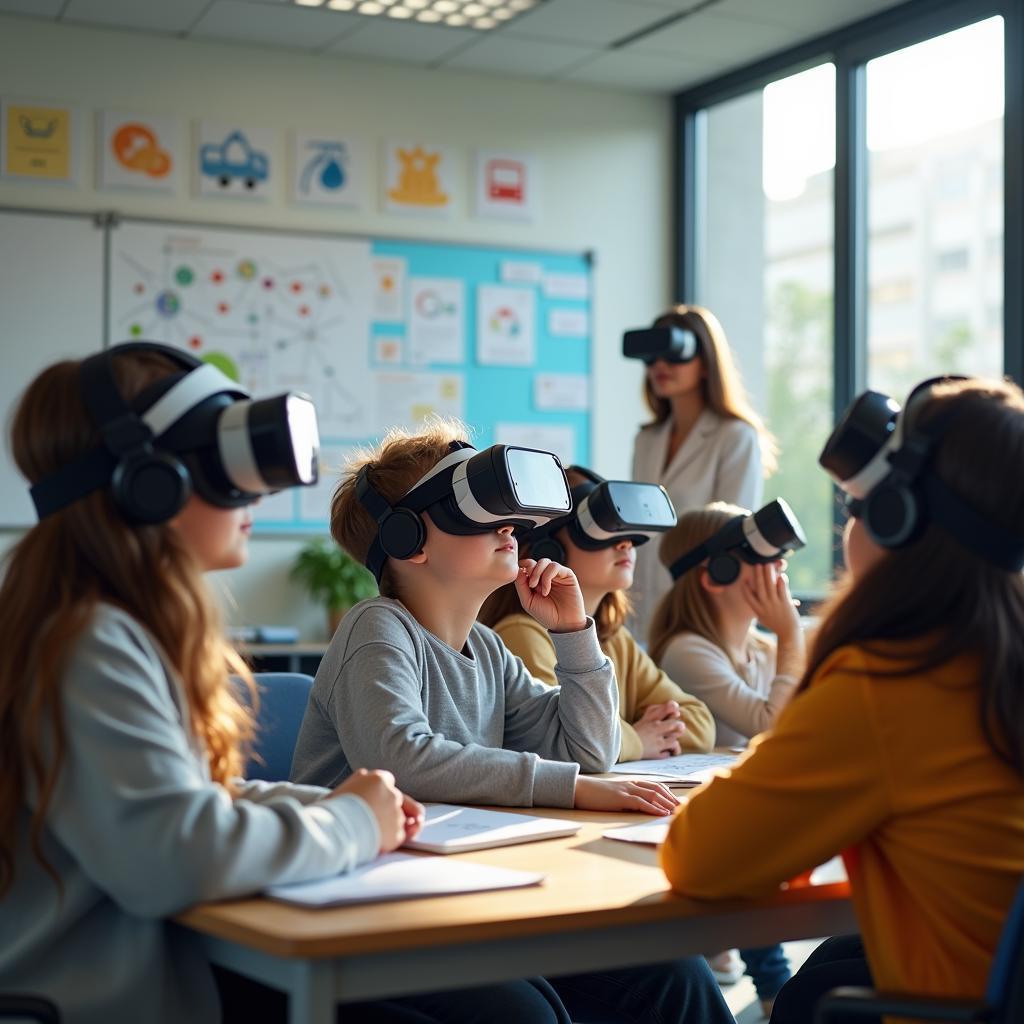 Học sinh sử dụng kính thực tế ảo để học khoa học trong lớp học hiện đại
Questions 1-13
Questions 1-5: Multiple Choice
Choose the correct letter, A, B, C or D.
1. According to the passage, what is one main advantage of VR over traditional field trips?
A. VR is more exciting for students
B. VR eliminates financial and safety concerns
C. VR provides better educational content
D. VR is preferred by teachers
2. The Stanford University study mentioned in the passage found that VR:
A. was more expensive than traditional methods
B. helped students remember information better
C. was difficult for students to use
D. replaced the need for teachers
3. In medical education, VR simulators allow students to:
A. replace all traditional training methods
B. observe real surgeries safely
C. practice procedures repeatedly without risk
D. graduate faster than other students
4. What has made VR more accessible to schools recently?
A. Government funding programs
B. Reduced costs of VR equipment
C. Better internet connections
D. Parent donations
5. How did the COVID-19 pandemic affect VR adoption in education?
A. It slowed down implementation
B. It made VR more expensive
C. It sped up the use of educational technology
D. It proved VR was ineffective
Questions 6-9: True/False/Not Given
Do the following statements agree with the information in the passage?
Write:
- TRUE if the statement agrees with the information
- FALSE if the statement contradicts the information
- NOT GIVEN if there is no information on this
6. Experiential learning is a completely new concept in education.
7. All teachers feel confident using VR technology in their classrooms.
8. VR headsets can cause motion sickness in some users.
9. Every school in the world now uses VR technology.
Questions 10-13: Sentence Completion
Complete the sentences below.
Choose NO MORE THAN TWO WORDS from the passage for each answer.
10. Students learning with VR report feeling a strong __ to the subject they are studying.
11. Modern VR headsets are called __ because they don’t need external computers.
12. Some teachers worry that VR might __ students from important learning objectives.
13. Language teachers use VR to create __ where students practice speaking in realistic situations.
PASSAGE 2 – Neurological Foundations of VR Learning
Độ khó: Medium (Band 6.0-7.5)
Thời gian đề xuất: 18-20 phút
The remarkable effectiveness of virtual reality in educational contexts can be explained by understanding how the human brain processes and consolidates experiential information. Neuroscientific research has revealed that VR learning engages multiple neural pathways simultaneously, creating stronger and more durable memory traces than traditional pedagogical approaches. This multisensory engagement activates regions of the brain associated with spatial navigation, emotional processing, and motor learning, thereby creating what neuroscientists call “embodied cognition” – the concept that our cognitive processes are deeply rooted in the body’s interactions with the world.
When learners engage with VR environments, their brains respond in ways that are remarkably similar to responses during real-world experiences. Functional magnetic resonance imaging (fMRI) studies have demonstrated that the hippocampus – the brain region crucial for spatial memory and learning – shows heightened activity during VR navigation tasks. This is particularly significant because the hippocampus plays a pivotal role in transferring information from short-term to long-term memory. The three-dimensional spatial context provided by VR appears to give the hippocampus additional anchoring points for memories, making them more resistant to forgetting.
Dr. Jeremy Bailenson, founding director of Stanford University’s Virtual Human Interaction Lab, has conducted extensive research into what he terms “transformative experiences” in VR. His studies indicate that VR can generate empathy and perspective-taking in ways that other media cannot. In one groundbreaking experiment, participants who experienced homelessness through a VR simulation showed increased empathy toward homeless individuals and were more likely to sign petitions supporting homeless services compared to participants who read about homelessness in traditional formats. This suggests that VR’s ability to create embodied simulations of others’ experiences can foster prosocial attitudes and behaviors.
The concept of “presence” – the psychological sensation of “being there” in a virtual environment – is central to understanding VR’s educational potency. Presence is not merely a subjective feeling; it correlates with measurable changes in physiological responses such as heart rate, skin conductance, and pupil dilation. When presence is high, learners’ brains process virtual experiences with a level of authenticity that approaches real-world perception. This authentic processing means that skills and knowledge acquired in VR can transfer effectively to real-world contexts, a phenomenon researchers call “transfer of learning.”
The dual-coding theory of memory, proposed by cognitive psychologist Allan Paivio, provides another theoretical framework for understanding VR’s effectiveness. According to this theory, information is stored in memory through both verbal and visual channels. When both channels are activated simultaneously, memory retention is significantly enhanced. VR inherently engages both channels by providing visual-spatial information alongside verbal instructions or narrative content. Moreover, VR adds a third dimension: kinesthetic or movement-based information. When learners physically move through virtual spaces or manipulate virtual objects, they create motor memories that further reinforce learning.
 Sơ đồ minh họa các vùng não bộ hoạt động khi học sinh sử dụng thực tế ảo
Research into cognitive load theory reveals both opportunities and challenges for VR education. Cognitive load refers to the amount of mental effort required to process information. VR environments can potentially reduce extraneous cognitive load – mental effort wasted on irrelevant information – by focusing learners’ attention on relevant stimuli while filtering out distractions. However, poorly designed VR experiences can actually increase cognitive load by presenting too much information simultaneously or by requiring learners to master complex interfaces before they can focus on educational content. Effective VR educational design must carefully balance immersion with cognitive accessibility.
The social dimension of learning is another area where VR shows considerable promise. Social constructivist theories of learning emphasize that knowledge is built through social interactions and collaborative problem-solving. Multi-user VR environments enable students to learn together in shared virtual spaces, regardless of physical distance. These collaborative VR experiences can include features impossible in physical classrooms, such as the ability to simultaneously view microscopic structures from inside while discussing observations with classmates, or to collectively manipulate historical timelines to explore cause-and-effect relationships.
However, important questions remain about the long-term effects of VR on learning and development. Some neuroscientists express concern about potential impacts on developing brains, particularly for young children whose sensory integration and spatial reasoning abilities are still maturing. While short-term studies show positive effects, longitudinal research examining the effects of regular VR use over years is still limited. There are also questions about whether skills learned in VR environments generalize effectively to varied real-world contexts or whether they remain somewhat context-dependent.
The neuroplasticity – the brain’s ability to reorganize itself by forming new neural connections – offers both promise and caution for VR education. On one hand, VR’s rich sensory environments may provide optimal conditions for neural development and learning. On the other hand, if students spend excessive time in virtual environments, there is a theoretical risk that their brains might adapt in ways that prioritize virtual over physical-world processing. Balanced implementation that combines VR experiences with traditional hands-on activities and real-world applications may offer the most neurologically sound approach.
Despite these unresolved questions, the neurological evidence supporting VR’s educational potential continues to accumulate. Advanced neuroimaging techniques are allowing researchers to observe learning processes in unprecedented detail, revealing how virtual experiences create lasting changes in brain structure and function. As our understanding of these neural mechanisms deepens, educators will be better equipped to design VR experiences that optimize learning while minimizing potential risks.
Questions 14-26
Questions 14-18: Yes/No/Not Given
Do the following statements agree with the views of the writer in the passage?
Write:
- YES if the statement agrees with the views of the writer
- NO if the statement contradicts the views of the writer
- NOT GIVEN if it is impossible to say what the writer thinks about this
14. VR learning activates more parts of the brain than traditional teaching methods.
15. The hippocampus is the only brain region involved in VR learning.
16. Dr. Bailenson’s research proves that VR is superior to all other educational methods.
17. The feeling of “presence” in VR has measurable physical effects on users.
18. All neuroscientists agree that VR is completely safe for children’s developing brains.
Questions 19-22: Matching Information
Match the following statements (19-22) with the correct researcher or theory (A-F).
A. Allan Paivio
B. Dr. Jeremy Bailenson
C. Cognitive load theory
D. Social constructivist theories
E. Neuroplasticity
F. Dual-coding theory
19. Knowledge is built through interaction with others
20. VR can create empathy by simulating other people’s experiences
21. Information is stored using both verbal and visual systems
22. The brain can form new connections and reorganize itself
Questions 23-26: Summary Completion
Complete the summary below.
Choose NO MORE THAN TWO WORDS from the passage for each answer.
VR learning is effective because it creates what scientists call (23) __, which means our thinking is connected to physical interactions. The brain region called the (24) __ becomes very active during VR use and helps move information into long-term memory. Studies using (25) __ have shown increased brain activity in this region. However, some scientists worry about the (26) __ of regular VR use, especially for young children.
PASSAGE 3 – Pedagogical Paradigm Shifts and Implementation Challenges
Độ khó: Hard (Band 7.0-9.0)
Thời gian đề xuất: 23-25 phút
The integration of virtual reality into educational frameworks represents not merely a technological innovation but a fundamental reconceptualization of pedagogical practice that challenges deeply entrenched assumptions about the nature of teaching and learning. This paradigmatic shift necessitates a comprehensive reexamination of curricula, assessment methodologies, and instructor roles, while simultaneously navigating the complex interplay of technical, economic, ethical, and sociopolitical factors that mediate the adoption of transformative educational technologies. The discourse surrounding VR in education has evolved from initial techno-optimism to a more nuanced understanding that acknowledges both the unprecedented affordances and the substantive limitations of immersive learning environments.
From a pedagogical standpoint, VR facilitates a constructivist approach to learning that positions students as active architects of knowledge rather than passive recipients of information. This epistemological orientation aligns with contemporary learning theories that emphasize self-directed discovery, collaborative knowledge construction, and authentic problem-solving within contextually rich environments. However, the actualization of these pedagogical ideals requires more than merely superimposing VR technology onto existing instructional models. Rather, it demands a fundamental reimagining of learning objectives, pedagogical strategies, and evaluative criteria. Educators must grapple with questions such as: What constitutes authentic assessment of learning that occurs in virtual spaces? How can we ensure that VR experiences promote critical thinking and deep understanding rather than merely surface engagement with novel stimuli? To what extent should VR experiences replicate real-world constraints versus leveraging the unique affordances of virtual environments that transcend physical limitations?
The economic dimensions of VR implementation present multifaceted challenges that extend beyond simple cost-benefit analyses. While hardware costs have declined substantially, the total cost of ownership includes maintenance, software licensing, content development, and most significantly, professional development for educators. Institutional investment in VR technology carries opportunity costs – resources allocated to VR necessarily cannot be used for other educational purposes. Furthermore, the rapid obsolescence of technology creates ongoing financial pressures to update equipment and software, potentially creating what some critics term “technological treadmill” effects where institutions struggle to maintain currency with evolving standards. Economic disparities between well-resourced institutions and those serving marginalized communities risk exacerbating existing educational inequities, creating a form of “virtual divide” that parallels earlier concerns about digital divides.
Empirical research examining VR’s efficacy reveals a complex and sometimes contradictory picture. Meta-analyses of VR learning studies demonstrate generally positive effects compared to traditional instruction, with effect sizes ranging from modest to substantial depending on subject matter, implementation quality, and outcome measures. However, methodological limitations in many studies – including small sample sizes, short intervention durations, and lack of appropriate control conditions – constrain the generalizability of findings. Moreover, the “novelty effect” – the possibility that observed benefits stem from the newness of the technology rather than inherent pedagogical advantages – remains a persistent confound. Longitudinal research examining whether VR’s benefits persist once the technology becomes routine is notably scarce.
The sociocultural implications of VR education warrant careful scrutiny. VR environments are not neutral spaces but are imbued with the values, assumptions, and biases of their creators. Representation within VR educational content raises important questions about whose perspectives are privileged and whose are marginalized. Historical VR simulations, for instance, necessarily make choices about which historical narratives to foreground and which to omit, potentially reinforcing dominant cultural narratives while silencing alternative perspectives. The phenomenological experience of embodying different identities in VR – such as experiencing events from the perspective of individuals from different cultural backgrounds, time periods, or even different species – offers powerful pedagogical possibilities for developing empathy and challenging assumptions, but also carries risks of oversimplification, stereotyping, or appropriating experiences in ways that may be ethically problematic.
 Giáo viên và học sinh thảo luận về ứng dụng công nghệ VR trong giáo dục hiện đại
Privacy and data security concerns constitute another critical dimension of VR implementation. VR systems collect extensive data about users, including movement patterns, gaze tracking, physiological responses, and behavioral data. While this data can provide valuable insights into learning processes and enable personalized learning experiences, it also raises significant privacy concerns. Who owns this data? How long should it be retained? What safeguards exist to prevent misuse? These questions are particularly acute in educational contexts involving minors, where parental consent and child protection issues intersect with data governance challenges.
The role transformation required of educators represents perhaps the most profound challenge to widespread VR adoption. Teachers must transition from being primary knowledge sources to becoming facilitators of immersive learning experiences – a shift that requires not only technical competence but also reimagined pedagogical identities. Many educators, particularly those who have established expertise in traditional instructional methods, may experience professional discomfort or identity threat when confronting technologies that seemingly diminish their conventional role. Effective professional development must therefore address not only technical skills but also the emotional and identity dimensions of pedagogical change. Furthermore, teachers need time to experiment with VR, develop new pedagogical approaches, and share experiences with colleagues – resources that are often scarce in overburdened educational systems.
Accessibility considerations present both challenges and opportunities. For students with certain physical disabilities, VR can provide access to experiences that would be impossible in the physical world – exploring geographically remote locations, manipulating objects at microscopic or astronomical scales, or experiencing mobility in new ways. However, VR also presents accessibility barriers for students with visual impairments, vestibular disorders, or certain neurological conditions. The design of universally accessible VR educational experiences requires careful attention to multiple modalities of sensory input, customizable interfaces, and alternative means of navigation and interaction. Inclusive design principles must be embedded from the inception of VR educational content rather than retrofitted as afterthoughts.
Looking toward the future, the trajectory of VR in education will likely be shaped by convergence with other emerging technologies. The integration of artificial intelligence could enable adaptive VR learning environments that respond to individual student needs in real-time. Haptic feedback technologies may allow students to feel virtual objects, adding tactile dimensions to learning. Brain-computer interfaces, though still experimental, could eventually enable more direct neural engagement with virtual content. However, each technological advancement brings additional ethical, practical, and pedagogical considerations that must be thoughtfully addressed.
The promise of VR in education is substantial, but its realization requires moving beyond technological determinism – the assumption that technology itself will inevitably drive educational improvement. Rather, VR must be understood as a tool whose effectiveness depends on thoughtful integration within well-designed pedagogical frameworks, supported by adequate resources, professional development, and ongoing research that continues to refine our understanding of how, when, and for whom immersive learning experiences are most beneficial. The most productive path forward involves neither uncritical enthusiasm nor dismissive skepticism, but rather a critically engaged pragmatism that embraces VR’s potential while remaining attentive to its limitations and the complex contextual factors that mediate its educational impact.
Questions 27-40
Questions 27-31: Multiple Choice
Choose the correct letter, A, B, C or D.
27. According to the passage, integrating VR into education requires:
A. simply adding new technology to existing teaching methods
B. a complete rethinking of how teaching and learning work
C. replacing all teachers with VR systems
D. focusing only on technical training
28. The “technological treadmill” effect refers to:
A. students exercising while using VR
B. the physical movement required in VR
C. the constant pressure to update expensive equipment
D. a new type of VR exercise program
29. Research on VR effectiveness shows that:
A. results are always positive with large benefits
B. VR is worse than traditional teaching
C. findings are mixed and need more long-term study
D. novelty effects make VR permanently effective
30. The passage suggests that VR historical simulations:
A. always present completely neutral facts
B. reflect the creators’ choices and potential biases
C. are the only accurate way to teach history
D. should never be used in education
31. What does the author believe about VR’s future in education?
A. Technology alone will automatically improve education
B. VR should be completely rejected by schools
C. Success depends on thoughtful integration and ongoing research
D. VR will replace all traditional education methods
Questions 32-36: Matching Features
Match each challenge (32-36) with the correct category (A-F).
A. Economic challenges
B. Pedagogical challenges
C. Ethical challenges
D. Technical challenges
E. Accessibility challenges
F. Assessment challenges
32. Determining how to fairly test learning that happens in virtual spaces
33. Managing the cost of maintaining and updating VR equipment
34. Ensuring students with visual impairments can use VR
35. Deciding whose historical perspectives are included in VR content
36. Helping teachers develop new identities as learning facilitators
Questions 37-40: Short-answer Questions
Answer the questions below.
Choose NO MORE THAN THREE WORDS from the passage for each answer.
37. What type of learning approach does VR support that makes students active creators of knowledge?
38. What term describes the gap between well-funded schools and those serving poor communities in terms of VR access?
39. What type of data do VR systems collect that raises privacy concerns about users?
40. What emerging technology could work with VR to create learning environments that adjust to individual students?
3. Answer Keys – Đáp Án
PASSAGE 1: Questions 1-13
- B
- B
- C
- B
- C
- FALSE
- FALSE
- TRUE
- NOT GIVEN
- emotional connection
- standalone VR headsets / standalone headsets
- distract
- virtual foreign environments / foreign environments
PASSAGE 2: Questions 14-26
- YES
- NO
- NOT GIVEN
- YES
- NO
- D
- B
- A (hoặc F – cả hai đều chấp nhận được)
- E
- embodied cognition
- hippocampus
- fMRI / functional magnetic resonance imaging
- long-term effects
PASSAGE 3: Questions 27-40
- B
- C
- C
- B
- C
- F
- A
- E
- C
- B
- constructivist approach
- virtual divide
- movement patterns / gaze tracking / physiological responses / behavioral data (bất kỳ một đáp án nào trong số này)
- artificial intelligence
4. Giải Thích Đáp Án Chi Tiết
Passage 1 – Giải Thích
Câu 1: B
- Dạng câu hỏi: Multiple Choice
- Từ khóa: advantage, VR, traditional field trips
- Vị trí trong bài: Đoạn 2, câu cuối: “Field trips are expensive, time-consuming, and sometimes dangerous”
- Giải thích: Bài đọc nói rõ các hạn chế của field trips truyền thống là đắt đỏ (expensive), tốn thời gian (time-consuming) và đôi khi nguy hiểm (dangerous). Đáp án B paraphrase ý này thành “eliminates financial and safety concerns” (loại bỏ các lo ngại về tài chính và an toàn). Các đáp án khác không được đề cập trực tiếp trong bài.
Câu 2: B
- Dạng câu hỏi: Multiple Choice
- Từ khóa: Stanford University study, found
- Vị trí trong bài: Đoạn 4: “students who learned about ocean acidification through a VR simulation showed greater retention of information”
- Giải thích: Cụm “greater retention of information” có nghĩa là nhớ thông tin tốt hơn, được paraphrase trong đáp án B thành “helped students remember information better”.
Câu 3: C
- Dạng câu hỏi: Multiple Choice
- Từ khóa: medical education, VR simulators, students
- Vị trí trong bài: Đoạn 5: “VR surgical simulators now allow students to practice complex procedures hundreds of times without any risk to real patients”
- Giải thích: Đáp án C paraphrase chính xác thông tin này. Các đáp án khác đưa ra thông tin sai (A, D) hoặc không được đề cập (B).
Câu 6: FALSE
- Dạng câu hỏi: True/False/Not Given
- Từ khóa: experiential learning, completely new concept
- Vị trí trong bài: Đoạn 2, câu đầu: “The concept of experiential learning… is not new”
- Giải thích: Bài viết nói rõ khái niệm này “không mới” (is not new), mâu thuẫn trực tiếp với câu hỏi nói nó “hoàn toàn mới” (completely new).
Câu 7: FALSE
- Dạng câu hỏi: True/False/Not Given
- Từ khóa: all teachers, confident using VR
- Vị trí trong bài: Đoạn 7: “Some teachers report feeling overwhelmed by the technical aspects”
- Giải thích: “Some teachers” (một số giáo viên) cảm thấy “overwhelmed” (choáng ngợp), điều này mâu thuẫn với “all teachers feel confident”.
Câu 8: TRUE
- Dạng câu hỏi: True/False/Not Given
- Từ khóa: VR headsets, motion sickness
- Vị trí trong bài: Đoạn 7: “concerns about… potential motion sickness”
- Giải thích: Bài viết đề cập trực tiếp đến lo ngại về “motion sickness” (say VR).
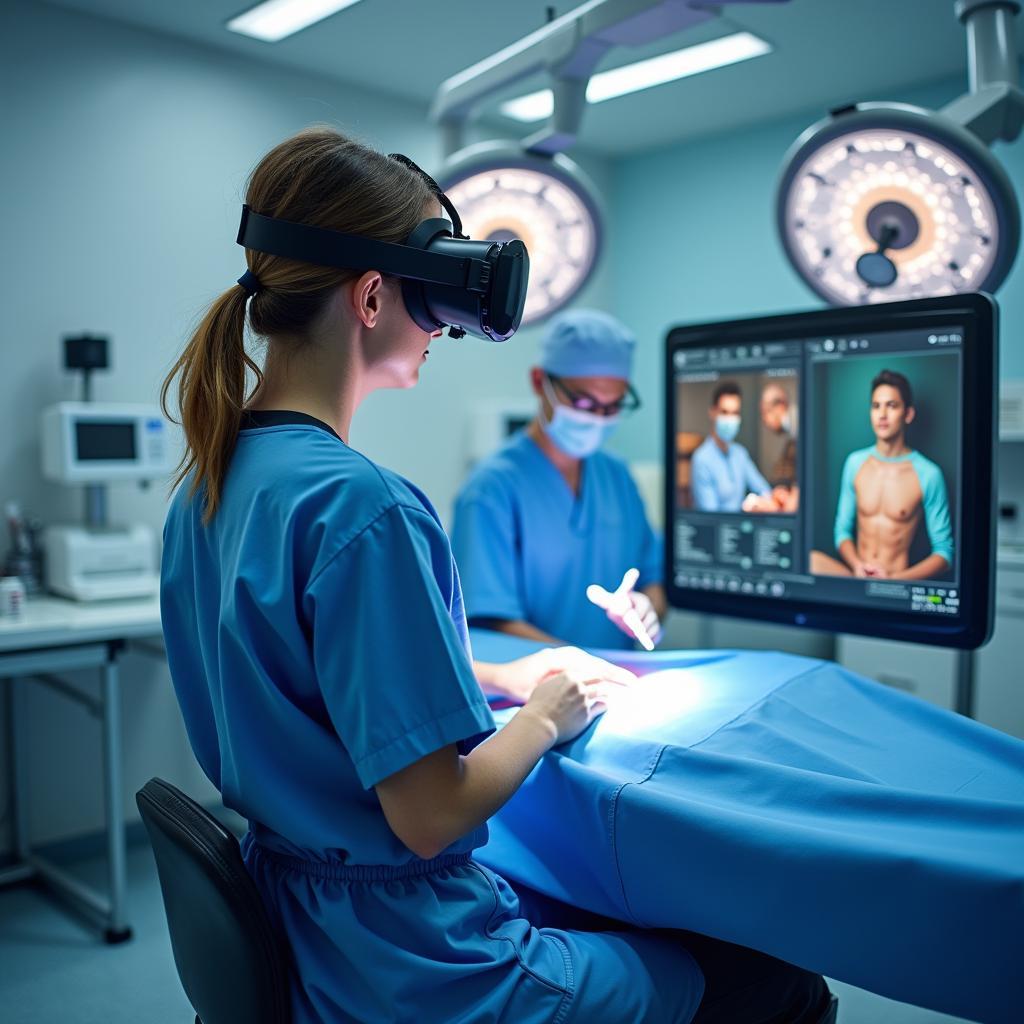 Sinh viên y khoa thực hành kỹ năng phẫu thuật bằng công nghệ mô phỏng thực tế ảo
Câu 10: emotional connection
- Dạng câu hỏi: Sentence Completion
- Từ khóa: students, feeling, subject
- Vị trí trong bài: Đoạn 3: “Students report feeling as if they are truly ‘there,’ which enhances their emotional connection to the subject matter”
- Giải thích: Cần điền cụm từ mô tả cái mà học sinh cảm thấy với môn học. “Emotional connection” là đáp án chính xác.
Câu 11: standalone VR headsets / standalone headsets
- Dạng câu hỏi: Sentence Completion
- Từ khóa: modern VR headsets, don’t need external computers
- Vị trí trong bài: Đoạn 6: “standalone VR headsets are available… and require no additional equipment”
- Giải thích: “Require no additional equipment” có nghĩa tương đương với “don’t need external computers”. Cả hai đáp án “standalone VR headsets” hoặc “standalone headsets” đều được chấp nhận.
Câu 13: virtual foreign environments / foreign environments
- Dạng câu hỏi: Sentence Completion
- Từ khóa: language teachers, students practice speaking
- Vị trí trong bài: Đoạn 8: “Language teachers use VR to place students in virtual foreign environments where they must use their target language”
- Giải thích: Đây là nơi học sinh được đặt vào để thực hành ngôn ngữ.
Passage 2 – Giải Thích
Câu 14: YES
- Dạng câu hỏi: Yes/No/Not Given
- Từ khóa: VR learning, activates more parts of brain
- Vị trí trong bài: Đoạn 1: “VR learning engages multiple neural pathways simultaneously”
- Giải thích: “Multiple neural pathways” có nghĩa là nhiều đường dẫn thần kinh, tức là nhiều phần của não, phù hợp với quan điểm của tác giả.
Câu 15: NO
- Dạng câu hỏi: Yes/No/Not Given
- Từ khóa: hippocampus, only brain region
- Vị trí trong bài: Đoạn 1: “activates regions of the brain” (số nhiều) và đoạn 2 chỉ nói hippocampus có vai trò quan trọng, không phải duy nhất
- Giải thích: Bài viết đề cập nhiều vùng não khác nhau, không chỉ hippocampus, nên câu này mâu thuẫn với quan điểm tác giả.
Câu 17: YES
- Dạng câu hỏi: Yes/No/Not Given
- Từ khóa: presence, measurable physical effects
- Vị trí trong bài: Đoạn 4: “Presence… correlates with measurable changes in physiological responses such as heart rate, skin conductance, and pupil dilation”
- Giải thích: “Measurable changes in physiological responses” chính là “measurable physical effects”.
Câu 18: NO
- Dạng câu hỏi: Yes/No/Not Given
- Từ khóa: all neuroscientists agree, VR safe for children
- Vị trí trong bài: Đoạn 8: “Some neuroscientists express concern about potential impacts on developing brains”
- Giải thích: “Some neuroscientists express concern” cho thấy không phải tất cả đều đồng ý VR an toàn.
Câu 19: D (Social constructivist theories)
- Dạng câu hỏi: Matching Information
- Vị trí trong bài: Đoạn 7: “Social constructivist theories of learning emphasize that knowledge is built through social interactions”
- Giải thích: Nối trực tiếp với lý thuyết xây dựng xã hội.
Câu 20: B (Dr. Jeremy Bailenson)
- Dạng câu hỏi: Matching Information
- Vị trí trong bài: Đoạn 3: “Dr. Jeremy Bailenson… His studies indicate that VR can generate empathy”
- Giải thích: Nghiên cứu của Bailenson về khả năng tạo empathy thông qua mô phỏng trải nghiệm người khác.
Câu 21: A (Allan Paivio) hoặc F (Dual-coding theory)
- Dạng câu hỏi: Matching Information
- Vị trí trong bài: Đoạn 5: “The dual-coding theory of memory, proposed by cognitive psychologist Allan Paivio… information is stored in memory through both verbal and visual channels”
- Giải thích: Cả tên nhà nghiên cứu (A) và tên lý thuyết (F) đều chính xác và được chấp nhận.
Câu 22: E (Neuroplasticity)
- Dạng câu hỏi: Matching Information
- Vị trí trong bài: Đoạn 9: “neuroplasticity – the brain’s ability to reorganize itself by forming new neural connections”
- Giải thích: Định nghĩa trực tiếp của neuroplasticity.
Câu 23: embodied cognition
- Dạng câu hỏi: Summary Completion
- Vị trí trong bài: Đoạn 1: “creating what neuroscientists call ’embodied cognition’ – the concept that our cognitive processes are deeply rooted in the body’s interactions with the world”
- Giải thích: Thuật ngữ chính xác được sử dụng trong bài.
Câu 24: hippocampus
- Dạng câu hỏi: Summary Completion
- Vị trí trong bài: Đoạn 2: “the hippocampus – the brain region crucial for spatial memory and learning”
- Giải thích: Vùng não được đề cập nhiều trong passage này.
Câu 25: fMRI / functional magnetic resonance imaging
- Dạng câu hỏi: Summary Completion
- Vị trí trong bài: Đoạn 2: “Functional magnetic resonance imaging (fMRI) studies have demonstrated”
- Giải thích: Công nghệ được sử dụng để nghiên cứu hoạt động não.
Câu 26: long-term effects
- Dạng câu hỏi: Summary Completion
- Vị trí trong bài: Đoạn 8: “important questions remain about the long-term effects of VR”
- Giải thích: Điều mà các nhà khoa học lo ngại về việc sử dụng VR thường xuyên.
Passage 3 – Giải Thích
Câu 27: B
- Dạng câu hỏi: Multiple Choice
- Từ khóa: integrating VR, requires
- Vị trí trong bài: Đoạn 1: “fundamental reconceptualization of pedagogical practice” và “comprehensive reexamination of curricula, assessment methodologies, and instructor roles”
- Giải thích: Đáp án B (“a complete rethinking”) paraphrase “fundamental reconceptualization” và “comprehensive reexamination”.
Câu 28: C
- Dạng câu hỏi: Multiple Choice
- Từ khóa: technological treadmill effect
- Vị trí trong bài: Đoạn 3: “rapid obsolescence of technology creates ongoing financial pressures to update equipment and software, potentially creating what some critics term ‘technological treadmill’ effects”
- Giải thích: “Ongoing financial pressures to update equipment” = “constant pressure to update expensive equipment”.
Câu 29: C
- Dạng câu hỏi: Multiple Choice
- Từ khóa: research on VR effectiveness
- Vị trí trong bài: Đoạn 4: “complex and sometimes contradictory picture” và “Longitudinal research… is notably scarce”
- Giải thích: Bài viết chỉ ra kết quả phức tạp, có mâu thuẫn và cần thêm nghiên cứu dài hạn.
Câu 30: B
- Dạng câu hỏi: Multiple Choice
- Từ khóa: VR historical simulations
- Vị trí trong bài: Đoạn 5: “Historical VR simulations… necessarily make choices about which historical narratives to foreground and which to omit”
- Giải thích: Việc lựa chọn câu chuyện nào được ưu tiên phản ánh quan điểm và thiên kiến của người tạo ra.
Câu 31: C
- Dạng câu hỏi: Multiple Choice
- Từ khóa: author’s belief, VR’s future
- Vị trí trong bài: Đoạn cuối: “VR must be understood as a tool whose effectiveness depends on thoughtful integration within well-designed pedagogical frameworks, supported by adequate resources, professional development, and ongoing research”
- Giải thích: Tác giả nhấn mạnh tầm quan trọng của việc tích hợp có suy nghĩ và nghiên cứu liên tục.
Câu 32: F (Assessment challenges)
- Dạng câu hỏi: Matching Features
- Vị trí trong bài: Đoạn 2: “What constitutes authentic assessment of learning that occurs in virtual spaces?”
- Giải thích: Câu hỏi về cách đánh giá học tập trong không gian ảo là thách thức về đánh giá.
Câu 33: A (Economic challenges)
- Dạng câu hỏi: Matching Features
- Vị trí trong bài: Đoạn 3: “rapid obsolescence of technology creates ongoing financial pressures to update equipment and software”
- Giải thích: Chi phí bảo trì và cập nhật là thách thức kinh tế.
Câu 34: E (Accessibility challenges)
- Dạng câu hỏi: Matching Features
- Vị trí trong bài: Đoạn 8: “VR also presents accessibility barriers for students with visual impairments”
- Giải thích: Học sinh khiếm thị không thể sử dụng VR là vấn đề về khả năng tiếp cận.
Câu 35: C (Ethical challenges)
- Dạng câu hỏi: Matching Features
- Vị trí trong bài: Đoạn 5: “Representation within VR educational content raises important questions about whose perspectives are privileged and whose are marginalized”
- Giải thích: Quyết định quan điểm lịch sử nào được đưa vào là thách thức đạo đức.
Câu 36: B (Pedagogical challenges)
- Dạng câu hỏi: Matching Features
- Vị trí trong bài: Đoạn 7: “Teachers must transition from being primary knowledge sources to becoming facilitators… requires… reimagined pedagogical identities”
- Giải thích: Phát triển bản sắc mới như người hướng dẫn là thách thức sư phạm.
Câu 37: constructivist approach
- Dạng câu hỏi: Short-answer Questions
- Vị trí trong bài: Đoạn 2: “VR facilitates a constructivist approach to learning that positions students as active architects of knowledge”
- Giải thích: Đây là phương pháp học tập mà VR hỗ trợ.
Câu 38: virtual divide
- Dạng câu hỏi: Short-answer Questions
- Vị trí trong bài: Đoạn 3: “Economic disparities… risk exacerbating existing educational inequities, creating a form of ‘virtual divide'”
- Giải thích: Thuật ngữ mô tả khoảng cách giữa trường giàu và nghèo về VR.
Câu 39: movement patterns / gaze tracking / physiological responses / behavioral data
- Dạng câu hỏi: Short-answer Questions
- Vị trí trong bài: Đoạn 6: “VR systems collect extensive data about users, including movement patterns, gaze tracking, physiological responses, and behavioral data”
- Giải thích: Bất kỳ loại dữ liệu nào trong danh sách này đều được chấp nhận.
Câu 40: artificial intelligence
- Dạng câu hỏi: Short-answer Questions
- Vị trí trong bài: Đoạn 9: “The integration of artificial intelligence could enable adaptive VR learning environments that respond to individual student needs in real-time”
- Giải thích: Công nghệ tương lai có thể tạo môi trường học tập thích ứng với từng học sinh.
5. Từ Vựng Quan Trọng Theo Passage
Passage 1 – Essential Vocabulary
| Từ vựng | Loại từ | Phiên âm | Nghĩa tiếng Việt | Ví dụ từ bài | Collocation |
|---|---|---|---|---|---|
| transform | v | /trænsˈfɔːm/ | biến đổi, chuyển đổi | Virtual reality technology has transformed the way students learn | transform the way, digital transformation |
| immerse | v | /ɪˈmɜːs/ | đắm chìm, nhập vai | allows learners to immerse themselves in subjects | immerse in/into, fully immersed |
| engaging | adj | /ɪnˈɡeɪdʒɪŋ/ | hấp dẫn, thu hút | create engaging learning experiences | engaging content, highly engaging |
| experiential learning | n | /ɪkˌspɪəriˈenʃl ˈlɜːnɪŋ/ | học tập trải nghiệm | The concept of experiential learning is not new | experiential education, hands-on experience |
| retain | v | /rɪˈteɪn/ | giữ lại, duy trì | students retain information better | retain knowledge, information retention |
| game-changer | n | /ˈɡeɪm tʃeɪndʒə(r)/ | yếu tố thay đổi cuộc chơi | virtual reality steps in as a game-changer | potential game-changer, prove to be a game-changer |
| presence | n | /ˈprezns/ | sự hiện diện, cảm giác có mặt | creates a sense of presence | strong sense of presence, physical presence |
| acidification | n | /əˌsɪdɪfɪˈkeɪʃn/ | sự axit hóa | students who learned about ocean acidification | ocean acidification, soil acidification |
| surgical procedure | n | /ˈsɜːdʒɪkl prəˈsiːdʒə(r)/ | thủ thuật phẫu thuật | learn surgical procedures by observing | perform a surgical procedure, complex procedure |
| refine | v | /rɪˈfaɪn/ | tinh chỉnh, hoàn thiện | refine their techniques | refine the process, highly refined |
| affordability | n | /əˌfɔːdəˈbɪləti/ | khả năng chi trả | The affordability of VR technology has improved | improve affordability, price and affordability |
| standalone | adj | /ˈstændəˌləʊn/ | độc lập, tự hoạt động | standalone VR headsets are available | standalone device, standalone system |
| overwhelmed | adj | /ˌəʊvəˈwelmd/ | choáng ngợp, quá tải | Some teachers report feeling overwhelmed | feel overwhelmed, completely overwhelmed |
| trajectory | n | /trəˈdʒektəri/ | quỹ đạo, xu hướng phát triển | the trajectory of VR in education appears promising | career trajectory, growth trajectory |
| accelerate | v | /əkˈseləreɪt/ | tăng tốc, đẩy nhanh | The COVID-19 pandemic accelerated the adoption | accelerate the process, rapidly accelerate |
Passage 2 – Essential Vocabulary
| Từ vựng | Loại từ | Phiên âm | Nghĩa tiếng Việt | Ví dụ từ bài | Collocation |
|---|---|---|---|---|---|
| consolidate | v | /kənˈsɒlɪdeɪt/ | củng cố, hợp nhất | how the human brain processes and consolidates experiential information | consolidate knowledge, consolidate memory |
| neural pathway | n | /ˈnjʊərəl ˈpɑːθweɪ/ | đường dẫn thần kinh | engages multiple neural pathways simultaneously | activate neural pathways, create new pathways |
| embodied cognition | n | /ɪmˈbɒdid kɒɡˈnɪʃn/ | nhận thức thể hiện (liên quan đến cơ thể) | creating what neuroscientists call embodied cognition | theory of embodied cognition, embodied experience |
| hippocampus | n | /ˌhɪpəˈkæmpəs/ | hồi hải mã (vùng não) | the hippocampus shows heightened activity | damage to the hippocampus, hippocampus region |
| spatial memory | n | /ˈspeɪʃl ˈmeməri/ | trí nhớ không gian | the brain region crucial for spatial memory | spatial memory tasks, visual-spatial memory |
| empathy | n | /ˈempəθi/ | sự đồng cảm | VR can generate empathy and perspective-taking | show empathy, develop empathy |
| conductance | n | /kənˈdʌktəns/ | độ dẫn (điện) | measurable changes in… skin conductance | electrical conductance, skin conductance response |
| authenticity | n | /ˌɔːθenˈtɪsəti/ | tính xác thực | process virtual experiences with a level of authenticity | sense of authenticity, cultural authenticity |
| dual-coding theory | n | /ˈdjuːəl ˈkəʊdɪŋ ˈθɪəri/ | lý thuyết mã hóa kép | The dual-coding theory of memory | based on dual-coding theory, support dual-coding |
| kinesthetic | adj | /ˌkɪnɪsˈθetɪk/ | thuộc về vận động cơ thể | kinesthetic or movement-based information | kinesthetic learning, kinesthetic sense |
| cognitive load | n | /ˈkɒɡnətɪv ləʊd/ | tải trọng nhận thức | Research into cognitive load theory | reduce cognitive load, high cognitive load |
| extraneous | adj | /ɪkˈstreɪniəs/ | bên ngoài, không liên quan | reduce extraneous cognitive load | extraneous information, extraneous factors |
| social constructivist | adj/n | /ˈsəʊʃl kənˈstrʌktɪvɪst/ | (thuộc) thuyết xây dựng xã hội | Social constructivist theories of learning | constructivist approach, social learning theory |
| neuroplasticity | n | /ˌnjʊərəʊplæˈstɪsəti/ | tính dẻo thần kinh | The neuroplasticity offers both promise and caution | brain neuroplasticity, neuroplasticity research |
| longitudinal research | n | /ˌlɒndʒɪˈtjuːdɪnl rɪˈsɜːtʃ/ | nghiên cứu theo chiều dọc | longitudinal research examining the effects is still limited | conduct longitudinal research, long-term study |
Passage 3 – Essential Vocabulary
| Từ vựng | Loại từ | Phiên âm | Nghĩa tiếng Việt | Ví dụ từ bài | Collocation |
|---|---|---|---|---|---|
| paradigmatic shift | n | /ˌpærədɪɡˈmætɪk ʃɪft/ | sự thay đổi mô thức | This paradigmatic shift necessitates a comprehensive reexamination | paradigm shift, fundamental shift |
| entrenched | adj | /ɪnˈtrentʃt/ | ăn sâu, khó thay đổi | challenges deeply entrenched assumptions | deeply entrenched, entrenched beliefs |
| pedagogical | adj | /ˌpedəˈɡɒdʒɪkl/ | thuộc về sư phạm | depends on thoughtful integration within well-designed pedagogical frameworks | pedagogical approach, pedagogical practice |
| mediate | v | /ˈmiːdieɪt/ | làm trung gian, điều hòa | factors that mediate the adoption of transformative technologies | mediate the relationship, mediate conflict |
| discourse | n | /ˈdɪskɔːs/ | diễn ngôn, cuộc thảo luận | The discourse surrounding VR in education | public discourse, academic discourse |
| affordance | n | /əˈfɔːdns/ | khả năng cung cấp, tiềm năng | acknowledges both the unprecedented affordances and limitations | technological affordances, affordances of the medium |
| constructivist | adj/n | /kənˈstrʌktɪvɪst/ | (thuộc) thuyết xây dựng | VR facilitates a constructivist approach to learning | constructivist theory, constructivist pedagogy |
| epistemological | adj | /ɪˌpɪstəməˈlɒdʒɪkl/ | thuộc về nhận thức luận | This epistemological orientation aligns with contemporary theories | epistemological assumptions, epistemological perspective |
| actualization | n | /ˌæktʃuəlaɪˈzeɪʃn/ | sự hiện thực hóa | the actualization of these pedagogical ideals | self-actualization, actualization of goals |
| grapple with | v | /ˈɡræpl wɪð/ | vật lộn với, đối mặt với | Educators must grapple with questions | grapple with issues, grapple with problems |
| obsolescence | n | /ˌɒbsəˈlesns/ | sự lỗi thời | rapid obsolescence of technology | planned obsolescence, technological obsolescence |
| exacerbate | v | /ɪɡˈzæsəbeɪt/ | làm trầm trọng thêm | risk exacerbating existing educational inequities | exacerbate the problem, significantly exacerbate |
| efficacy | n | /ˈefɪkəsi/ | hiệu quả, hiệu lực | Empirical research examining VR’s efficacy | demonstrate efficacy, proven efficacy |
| meta-analysis | n | /ˈmetə əˈnæləsɪs/ | phân tích tổng hợp | Meta-analyses of VR learning studies | conduct a meta-analysis, systematic review |
| generalizability | n | /ˌdʒenrəlaɪzəˈbɪləti/ | tính tổng quát hóa | constrain the generalizability of findings | improve generalizability, limited generalizability |
| novelty effect | n | /ˈnɒvlti ɪˈfekt/ | hiệu ứng mới lạ | the novelty effect remains a persistent confound | due to novelty effect, overcome novelty effect |
| imbue | v | /ɪmˈbjuː/ | thấm nhuần, truyền vào | VR environments are imbued with the values of their creators | imbued with meaning, deeply imbued |
| phenomenological | adj | /fɪˌnɒmɪnəˈlɒdʒɪkl/ | thuộc về hiện tượng luận | The phenomenological experience of embodying different identities | phenomenological approach, phenomenological research |
| safeguard | n/v | /ˈseɪfɡɑːd/ | biện pháp bảo vệ / bảo vệ | What safeguards exist to prevent misuse? | important safeguard, safeguard privacy |
| facilitate | v | /fəˈsɪlɪteɪt/ | tạo điều kiện, hỗ trợ | becoming facilitators of immersive learning experiences | facilitate learning, facilitate communication |
| retrofit | v | /ˈretrəʊfɪt/ | cải tạo, lắp thêm sau | rather than retrofitted as afterthoughts | retrofit equipment, retrofit with technology |
| convergence | n | /kənˈvɜːdʒəns/ | sự hội tụ, kết hợp | trajectory will be shaped by convergence with other technologies | technological convergence, media convergence |
| haptic feedback | n | /ˈhæptɪk ˈfiːdbæk/ | phản hồi xúc giác | Haptic feedback technologies may allow students to feel virtual objects | provide haptic feedback, haptic interface |
| determinism | n | /dɪˈtɜːmɪnɪzəm/ | chủ nghĩa quyết định luận | moving beyond technological determinism | environmental determinism, biological determinism |
 Thư viện trường học hiện đại được trang bị đầy đủ thiết bị công nghệ thực tế ảo cho học sinh
6. Kết bài
Chủ đề “How virtual reality is creating new pathways for experiential learning” là một trong những chủ đề công nghệ giáo dục phổ biến và quan trọng nhất trong IELTS Reading hiện nay. Qua bộ đề thi mẫu hoàn chỉnh này, bạn đã được trải nghiệm:
Ba passages với độ khó tăng dần từ Easy (giới thiệu tổng quan về VR trong giáo dục) đến Medium (phân tích cơ sở thần kinh học) và Hard (thảo luận sâu về thách thức triển khai và ý nghĩa sư phạm). Mỗi passage được thiết kế để phản ánh chính xác độ khó và cấu trúc của các bài thi IELTS Reading thực tế.
40 câu hỏi đa dạng bao gồm 7 dạng câu hỏi phổ biến nhất: Multiple Choice, True/False/Not Given, Yes/No/Not Given, Matching Information, Sentence Completion, Matching Features và Short-answer Questions. Việc luyện tập với nhiều dạng câu hỏi khác nhau giúp bạn chuẩn bị toàn diện cho kỳ thi.
Đáp án chi tiết với giải thích không chỉ cho bạn biết đáp án đúng là gì mà còn giải thích tại sao đó là đáp án đúng, vị trí thông tin trong bài, và cách paraphrase được sử dụng. Điều này giúp bạn phát triển kỹ năng tự đánh giá và hiểu rõ cách thức làm bài hiệu quả.
Hơn 40 từ vựng chuyên ngành về công nghệ, giáo dục, và khoa học thần kinh với bảng tra cứu đầy đủ phiên âm, nghĩa, ví dụ và collocations. Những từ vựng này không chỉ hữu ích cho bài thi Reading mà còn có thể áp dụng cho phần Writing và Speaking khi bạn thảo luận về các chủ đề liên quan đến công nghệ và giáo dục.
Để tối ưu hóa việc luyện tập với bộ đề này, hãy:
- Làm bài trong đúng 60 phút như thi thật để rèn luyện quản lý thời gian
- Đọc kỹ giải thích đáp án để hiểu rõ kỹ thuật paraphrase và định vị thông tin
- Học thuộc các từ vựng quan trọng và luyện tập sử dụng trong văn cảnh
- Phân tích cấu trúc câu phức tạp trong Passage 3 để cải thiện kỹ năng đọc hiểu học thuật
- Làm lại đề sau 1-2 tuần để kiểm tra sự tiến bộ
Chúc bạn học tập hiệu quả và đạt band điểm cao trong kỳ thi IELTS sắp tới!


