Giới thiệu
Chủ đề về visual storytelling và language acquisition (kể chuyện bằng hình ảnh và học ngôn ngữ) ngày càng xuất hiện nhiều trong các kỳ thi IELTS Reading gần đây. Đây là một lĩnh vực kết hợp giữa giáo dục, tâm lý học và công nghệ, mang tính thời sự cao và rất phù hợp với xu hướng ra đề của Cambridge.
Trong bài viết này, bạn sẽ được trải nghiệm một bộ đề thi IELTS Reading hoàn chỉnh với:
- 3 passages từ dễ đến khó, tổng cộng hơn 2000 từ, giống như thi thật
- 40 câu hỏi đa dạng các dạng phổ biến: Multiple Choice, True/False/Not Given, Yes/No/Not Given, Matching Headings, Summary Completion, và nhiều dạng khác
- Đáp án chi tiết kèm giải thích cụ thể vị trí trong bài và phương pháp paraphrase
- Từ vựng quan trọng được phân loại theo từng passage với phiên âm, nghĩa và collocation
Đề thi này phù hợp với học viên từ band 5.0 trở lên, giúp bạn làm quen với format thi thật và rèn luyện kỹ năng đọc hiểu học thuật một cách bài bản.
Hướng Dẫn Làm Bài IELTS Reading
Tổng Quan Về IELTS Reading Test
IELTS Reading Test là phần thi kéo dài 60 phút với 3 passages và tổng cộng 40 câu hỏi. Điểm số được tính dựa trên số câu trả lời đúng, không bị trừ điểm khi sai.
Phân bổ thời gian khuyến nghị:
- Passage 1: 15-17 phút (độ khó dễ nhất)
- Passage 2: 18-20 phút (độ khó trung bình)
- Passage 3: 23-25 phút (độ khó cao nhất)
Lưu ý dành 2-3 phút cuối để chép đáp án vào answer sheet.
Các Dạng Câu Hỏi Trong Đề Này
Đề thi mẫu này bao gồm 7 dạng câu hỏi phổ biến:
- Multiple Choice – Chọn đáp án đúng từ các phương án cho sẵn
- True/False/Not Given – Xác định thông tin đúng, sai hay không được nhắc đến
- Matching Information – Nối thông tin với đoạn văn tương ứng
- Yes/No/Not Given – Xác định ý kiến của tác giả
- Matching Headings – Chọn tiêu đề phù hợp cho các đoạn văn
- Summary Completion – Hoàn thành đoạn tóm tắt
- Short-answer Questions – Trả lời câu hỏi ngắn
IELTS Reading Practice Test
PASSAGE 1 – The Power of Pictures in Language Learning
Độ khó: Easy (Band 5.0-6.5)
Thời gian đề xuất: 15-17 phút
For thousands of years, humans have used visual representations to communicate ideas and tell stories. Long before written language existed, cave paintings and symbols served as powerful tools for sharing information across generations. Today, educators are rediscovering the importance of visual storytelling in helping people learn new languages, particularly in early childhood and adult language acquisition programs.
Visual storytelling refers to the practice of using images, illustrations, videos, and other visual media to convey narratives and information. When applied to language learning, this approach combines pictures with words to create meaningful contexts that help learners understand and remember new vocabulary and grammatical structures. Research shows that the human brain processes visual information 60,000 times faster than text alone, making visual aids an incredibly efficient tool for language instruction.
In traditional language classrooms, teachers often rely heavily on textbooks and written exercises. However, this text-based approach can be challenging for beginners who have limited vocabulary and may feel overwhelmed by pages full of unfamiliar words. Visual storytelling offers an alternative by providing contextual clues through images that help learners deduce meaning without immediate translation. For example, a picture of a child eating an apple accompanied by the sentence “The boy eats an apple” allows learners to connect the written words with the action depicted, creating a stronger memory association.
One of the key advantages of visual storytelling in language acquisition is its ability to engage multiple cognitive processes simultaneously. When learners view an image while hearing or reading a story, they activate both the visual cortex and the language processing areas of the brain. This dual coding theory, proposed by psychologist Allan Paivio in the 1970s, suggests that information presented both verbally and visually is encoded in two different ways in memory, making it easier to recall later. The theory has been extensively validated through numerous studies showing improved retention rates when visual and verbal information are combined.
Emotional engagement is another crucial benefit of visual storytelling in language learning. Stories with compelling images can evoke feelings of joy, curiosity, or empathy, creating an emotional connection to the learning material. When learners feel emotionally invested in a story, they are more likely to pay attention, participate actively, and remember the content. This is particularly important for young children, whose attention spans may be limited and who respond well to colorful illustrations and animated characters.
Furthermore, visual storytelling helps address the diverse learning styles found in any classroom. While some students are auditory learners who benefit most from listening to explanations, others are visual learners who need to see information presented graphically. Kinesthetic learners, who learn through movement and hands-on activities, can also benefit when visual stories are combined with interactive elements such as acting out scenes or creating their own illustrations. By incorporating visual storytelling, teachers can create a more inclusive learning environment that accommodates different preferences and abilities.
Technology has significantly expanded the possibilities for visual storytelling in language education. Digital platforms now offer interactive storybooks, animated videos, and augmented reality applications that bring stories to life in ways that were impossible with traditional printed materials. These tools allow learners to control the pace of the story, replay sections as needed, and often include features like pronunciation guides and vocabulary definitions that appear when learners click on specific words or images. Such technology makes language learning more personalized and accessible, allowing students to learn independently outside the classroom.
Despite its many advantages, implementing visual storytelling effectively requires careful planning and pedagogical expertise. Teachers must select or create visual materials that are appropriate for their students’ age, cultural background, and proficiency level. Images should be clear and unambiguous, supporting rather than distracting from the language learning objectives. Additionally, while visual aids are powerful tools, they should complement rather than replace other essential language learning activities such as speaking practice, writing exercises, and grammar instruction.
 Học sinh sử dụng sách tranh và công nghệ để học ngôn ngữ trong lớp học IELTS
Questions 1-5
Do the following statements agree with the information given in Passage 1?
Write:
- TRUE if the statement agrees with the information
- FALSE if the statement contradicts the information
- NOT GIVEN if there is no information on this
- Cave paintings were used by early humans to communicate before writing was invented.
- The human brain processes visual information more quickly than written text.
- Visual storytelling is only effective for children learning languages.
- Allan Paivio’s dual coding theory has been confirmed by multiple research studies.
- All teachers believe that visual storytelling is better than traditional textbook methods.
Questions 6-9
Complete the sentences below.
Choose NO MORE THAN TWO WORDS from the passage for each answer.
- Visual storytelling helps learners understand new vocabulary by providing __ through images.
- When students feel an __ to learning material, they are more likely to remember it.
- Technology has introduced tools such as __ that make stories appear three-dimensional.
- Teachers need __ to implement visual storytelling successfully in their classrooms.
Questions 10-13
Choose the correct letter, A, B, C or D.
-
According to the passage, what is the main purpose of visual storytelling in language learning?
- A) To replace traditional teaching methods completely
- B) To help learners understand and remember language through images
- C) To entertain students during boring lessons
- D) To reduce the amount of homework teachers assign
-
The dual coding theory suggests that:
- A) Visual information is better than verbal information
- B) Information presented in two formats is easier to remember
- C) Only visual learners benefit from pictures
- D) Language learning requires special brain processes
-
Which of the following is NOT mentioned as a benefit of visual storytelling?
- A) It engages multiple cognitive processes
- B) It creates emotional connections
- C) It reduces the cost of education
- D) It accommodates different learning styles
-
The passage suggests that visual storytelling should:
- A) Replace all other teaching methods
- B) Only be used with young children
- C) Work together with other language learning activities
- D) Focus exclusively on vocabulary teaching
PASSAGE 2 – Visual Narratives in Second Language Development
Độ khó: Medium (Band 6.0-7.5)
Thời gian đề xuất: 18-20 phút
The intersection of visual literacy and second language acquisition has emerged as a significant area of research in applied linguistics over the past two decades. While the beneficial effects of visual aids in education have long been recognized, recent neurological studies have provided compelling evidence of the specific mechanisms through which visual narratives facilitate language learning at the cognitive level. Understanding these mechanisms has profound implications for curriculum design and instructional methodology in multilingual educational contexts.
A The concept of visual narrative extends beyond simple illustration to encompass sequential art, graphic novels, animated sequences, and multimedia presentations that combine images with text to create cohesive stories. Unlike static images, visual narratives incorporate elements of temporal progression and causality, allowing learners to follow plot development and character interactions in ways that mirror real-world language use. This narrative structure provides what linguists call “comprehensible input” – language that is slightly beyond a learner’s current level but remains accessible through contextual support.
B Research conducted by Dr. Maria Nikolajeva at the University of Cambridge has demonstrated that visual narratives activate the default mode network (DMN) in the brain, the same neural system engaged during natural language comprehension and social cognition. Her longitudinal studies with adolescent language learners revealed that students who regularly engaged with graphic novels in their target language showed significantly improved pragmatic competence – the ability to use language appropriately in social contexts. This improvement was particularly noticeable in understanding idiomatic expressions, cultural references, and conversational implicature, aspects of language that are often challenging to teach through conventional methods.
C The scaffolding effect of visual narratives is particularly valuable for learners at intermediate proficiency levels. At this stage, students often experience what is termed the “intermediate plateau,” where progress seems to stagnate despite continued effort. Visual narratives can help overcome this obstacle by providing graduated complexity – stories that maintain engagement while introducing progressively more sophisticated vocabulary and syntactic structures. The visual component serves as a cognitive support system, reducing the processing load and allowing learners to focus on linguistic elements that might otherwise overwhelm them in purely textual materials.
D Furthermore, visual narratives offer unique advantages in teaching pragmatic and sociolinguistic competence. Facial expressions, body language, and spatial relationships depicted in illustrations provide crucial information about interpersonal dynamics, social hierarchies, and emotional states that often remain implicit in written text. For instance, a graphic novel depicting a formal business meeting can simultaneously teach business vocabulary while demonstrating appropriate register, turn-taking conventions, and non-verbal communication patterns. This holistic presentation of language in its social context aligns with current communicative approaches to language teaching that emphasize functional language use over isolated grammar rules.
E The cultural mediation function of visual narratives deserves particular attention in multicultural classrooms. Images can bridge cultural gaps and make culturally-specific concepts more accessible to learners from different backgrounds. When encountering stories set in unfamiliar cultural contexts, visual elements help learners develop intercultural competence by providing visual references for clothing, architecture, food, and social customs. This visual cultural scaffolding is especially important in today’s globalized world, where language learning is increasingly motivated by the desire to engage with diverse cultures rather than assimilate into a single target culture.
F However, the effectiveness of visual narratives in language acquisition is not automatic or uniform. Critical visual literacy – the ability to interpret, analyze, and evaluate visual information – is itself a learned skill that varies considerably among learners. Research by Professor Gunther Kress at University College London has shown that students from different educational backgrounds may interpret the same visual narrative in markedly different ways, influenced by their prior exposure to visual media and cultural conventions of image interpretation. This variation necessitates explicit instruction in visual literacy skills alongside language instruction to ensure all students can fully benefit from visual narrative materials.
G The digital revolution has transformed the landscape of visual narratives available for language learning. Interactive digital narratives, virtual reality storytelling, and gamified language learning platforms now offer immersive experiences that were unimaginable a generation ago. These technologies enable adaptive learning pathways where the narrative adjusts to the learner’s responses, providing personalized feedback and targeted practice in areas of difficulty. Preliminary research suggests that the agency and interactivity afforded by digital visual narratives may enhance motivation and engagement, particularly for learners who have previously struggled with traditional instructional approaches.
H Nevertheless, educators must remain mindful of potential challenges associated with visual narratives. An over-reliance on visual support may inadvertently hinder the development of skills needed to process purely textual materials, which students will inevitably encounter in academic and professional contexts. Additionally, the production values and aesthetic qualities of visual narratives can vary widely, and poorly designed materials may confuse rather than clarify. Teachers need training to critically evaluate visual narrative resources and to design activities that strategically withdraw visual support as learners gain proficiency, ensuring a gradual transition toward independence in the target language.
 Học viên trải nghiệm công nghệ thực tế ảo và truyện tranh để học tiếng Anh nâng cao
Questions 14-20
The passage has eight paragraphs, A-H.
Which paragraph contains the following information?
Write the correct letter, A-H.
NB: You may use any letter more than once.
- A description of how visual narratives help learners understand social interactions
- Information about the brain networks activated by visual narratives
- A warning about becoming too dependent on visual support
- Discussion of how digital technology has changed visual narratives
- An explanation of why visual narratives help intermediate learners
- The importance of teaching students how to interpret visual information
- How visual narratives help learners understand different cultures
Questions 21-24
Complete the summary below.
Choose NO MORE THAN TWO WORDS from the passage for each answer.
Visual narratives have become an important tool in language teaching because they provide what linguists call (21) __, which is language input that learners can understand with contextual help. Research by Dr. Maria Nikolajeva found that students using graphic novels showed better (22) __, especially in understanding expressions and cultural references. Visual narratives work as a (23) __ that reduces how much mental effort learners need. They also help develop (24) __ by showing learners about different cultures through images.
Questions 25-26
Choose TWO letters, A-E.
Which TWO of the following are mentioned as advantages of visual narratives?
- A) They are cheaper than traditional textbooks
- B) They help overcome the intermediate plateau
- C) They eliminate the need for grammar teaching
- D) They show non-verbal communication clearly
- E) They are preferred by all students
PASSAGE 3 – Neurological Foundations of Visual-Linguistic Integration in Language Acquisition
Độ khó: Hard (Band 7.0-9.0)
Thời gian đề xuất: 23-25 phút
The neurobiological underpinnings of how visual storytelling facilitates language acquisition have been the subject of intensive investigation in cognitive neuroscience and psycholinguistics. Contemporary research employing functional magnetic resonance imaging (fMRI) and electroencephalography (EEG) has revealed intricate patterns of neural activation that occur when individuals process multimodal narratives – stories that integrate both visual and linguistic information. These findings challenge traditional models of language processing that conceived of linguistic and visual systems as largely independent modules, instead supporting an integrative framework in which these systems engage in dynamic, bidirectional communication that enhances both comprehension and retention.
The neurocognitive architecture supporting visual-linguistic integration involves a distributed network encompassing regions traditionally associated with language processing, including Broca’s area and Wernicke’s area, as well as visual processing regions in the occipital and temporal cortices. Crucially, research by Willems and colleagues (2017) using high-resolution fMRI demonstrated heightened activity in the angular gyrus and supramarginal gyrus – regions of the inferior parietal lobule implicated in cross-modal integration – when participants processed narratives accompanied by congruent visual information compared to text-only conditions. This finding suggests that visual storytelling may facilitate language learning by recruiting additional neural resources that create more robust and elaborate memory traces.
The temporal dynamics of visual-linguistic processing provide further insights into the mechanisms underlying enhanced language acquisition through visual storytelling. EEG studies examining event-related potentials (ERPs) have identified distinct neural signatures associated with the processing of semantically congruent versus incongruent image-word pairs. The N400 component, an ERP deflection occurring approximately 400 milliseconds after stimulus presentation that is sensitive to semantic processing, shows reduced amplitude when words are preceded by semantically related images. This attenuation indicates facilitated semantic integration, suggesting that visual context primes linguistic processing networks, thereby reducing the cognitive resources required for lexical access and semantic integration. For second language learners, this priming effect may be particularly beneficial, as it partially compensates for the increased processing demands associated with operating in a non-native language.
The role of the hippocampus and medial temporal lobe structures in the consolidation of language memories acquired through visual storytelling represents another crucial dimension of this phenomenon. The hippocampus, long recognized for its central role in episodic memory formation, appears to preferentially encode information presented in narrative contexts with rich spatiotemporal structure. Visual narratives, with their sequential organization and spatial relationships between characters and settings, provide precisely this type of structure. Neuroimaging evidence suggests that when language input is embedded within such contextually rich narratives, the resulting memory traces incorporate not only the linguistic information but also the perceptual and emotional features of the narrative context, creating what cognitive psychologists term “enriched encoding.” This multidimensional representation facilitates subsequent retrieval, as multiple retrieval cues – linguistic, visual, or contextual – can potentially activate the memory trace.
Moreover, the affective dimension of visual storytelling has significant neurobiological correlates that influence language acquisition. The amygdala and ventromedial prefrontal cortex, key structures in emotional processing and the formation of emotionally salient memories, show enhanced activation during the processing of emotionally evocative narratives. Research in affective neuroscience has established that emotional arousal, within moderate ranges, enhances memory consolidation through the modulation of hippocampal function by amygdaloid projections. Visual narratives, particularly those with compelling characters and emotionally resonant plotlines, can leverage this emotion-memory interaction to strengthen the encoding of linguistic material. This mechanism may explain why language learners often report superior retention of vocabulary and expressions encountered in engaging stories compared to those learned through decontextualized drill exercises.
The concept of embodied cognition offers an additional theoretical framework for understanding the efficacy of visual storytelling in language acquisition. According to embodied cognition theories, language comprehension is not a purely abstract symbolic process but rather involves the simulation of the sensory, motor, and emotional experiences described by language. Neuroimaging studies have demonstrated that reading action verbs activates premotor and motor cortices in somatotopic patterns corresponding to the body parts involved in those actions – reading “kick,” for instance, activates leg-related motor areas. Visual narratives may enhance this embodied simulation by providing explicit visual representations of actions, objects, and spatial relationships, thereby strengthening the connections between linguistic representations and their sensorimotor correlates. For language learners, this enhanced embodiment may create more intuitive and automatized connections between words and their meanings, reducing reliance on explicit translation or metalinguistic reflection.
However, the relationship between visual information and language processing is not uniformly facilitative; under certain conditions, visual information can impede rather than enhance linguistic processing. The cognitive load theory, developed by Sweller and colleagues, posits that learning is optimized when the cognitive demands of instructional materials do not exceed the limited capacity of working memory. When visual and linguistic information are poorly integrated or when visual elements are extraneous to learning objectives, learners may experience split-attention effects or redundancy effects that actually impair learning. Research by Mayer and colleagues on multimedia learning has identified several design principles – including the spatial contiguity principle (placing related visual and textual information near each other) and the coherence principle (excluding extraneous visual material) – that are essential for optimizing the benefits of visual storytelling while minimizing potential cognitive overload.
Individual differences in visual-spatial abilities and verbal-analytic cognitive styles further modulate the effectiveness of visual storytelling for language acquisition. Some learners, termed “visualizers,” naturally tend to represent information in imagistic formats and may derive particular benefit from visual narratives. Others, characterized as “verbalizers,” prefer linguistic representations and may initially find visual narratives less compatible with their preferred learning strategies. Recent research suggests, however, that explicit instruction in visual-verbal integration strategies can help verbalizers develop skills to leverage visual information effectively. This finding underscores the importance of not merely providing visual narratives but also teaching learners metacognitive strategies for actively integrating visual and linguistic information.
The implications of neuroscientific research on visual storytelling extend to pedagogical innovation and curriculum development in language education. Understanding the neural mechanisms underlying visual-linguistic integration can inform the design of instructional materials that optimally engage relevant brain networks. For instance, the timing of visual presentation relative to linguistic input may be calibrated to maximize semantic priming effects based on the temporal dynamics revealed by ERP research. Similarly, awareness of the emotion-memory relationship suggests that curriculum designers should prioritize narratives with appropriate emotional content rather than focusing solely on linguistic complexity. As neuroscientific methods continue to advance, providing ever more detailed insights into the learning brain, the potential for neuroeducationally-informed language teaching approaches grows correspondingly, promising more efficient and effective pathways to multilingual proficiency.
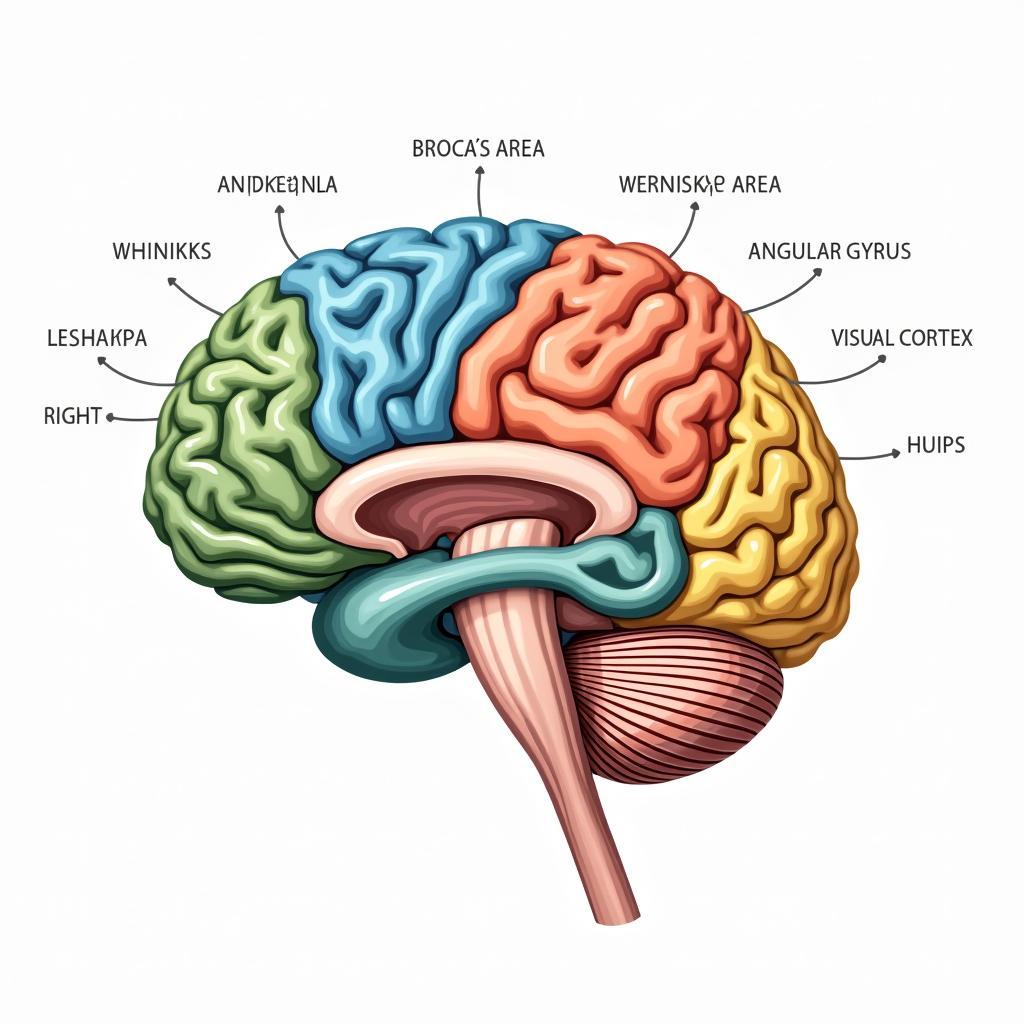 Biểu đồ não bộ hiển thị các vùng được kích hoạt khi học ngôn ngữ qua hình ảnh
Questions 27-31
Choose the correct letter, A, B, C or D.
-
According to the passage, recent neurological research has shown that:
- A) Visual and linguistic systems work completely independently
- B) Visual and linguistic systems interact with each other during learning
- C) Language learning happens only in Broca’s area
- D) Visual information is processed faster than linguistic information
-
The N400 component in EEG studies:
- A) Appears 400 hours after learning begins
- B) Is larger when images and words are related
- C) Shows reduced amplitude when visual context helps language processing
- D) Only appears in native language speakers
-
The hippocampus is important in visual storytelling because it:
- A) Controls visual perception exclusively
- B) Encodes information better when presented in narrative contexts
- C) Prevents emotional information from being stored
- D) Only works with written language
-
According to embodied cognition theories:
- A) Language is purely an abstract symbolic process
- B) Only motor actions help language learning
- C) Understanding language involves simulating related experiences
- D) Visual narratives are unnecessary for language learning
-
Cognitive load theory suggests that visual information can be harmful when:
- A) It is presented to children under 10 years old
- B) Students prefer verbal learning styles
- C) It is poorly integrated with linguistic content
- D) Teachers use traditional teaching methods
Questions 32-36
Complete the summary using the list of words, A-L, below.
Neuroscience research using fMRI and EEG has revealed how the brain processes visual storytelling in language learning. The (32) __ and supramarginal gyrus show increased activity during visual-linguistic integration. The (33) __ in the brain helps consolidate language memories, especially when information is presented in narrative contexts. Visual narratives also activate the (34) __, which processes emotions and helps create stronger memories. Research has found that reading action verbs activates (35) __ in patterns that match the body parts involved in those actions. However, poorly designed materials can cause (36) __, which impairs rather than helps learning.
A hippocampus
B angular gyrus
C split-attention effects
D amygdala
E motor cortices
F cerebellum
G semantic integration
H Broca’s area
I cognitive development
J working memory
K emotional processing
L temporal lobes
Questions 37-40
Do the following statements agree with the views of the writer in Passage 3?
Write:
- YES if the statement agrees with the views of the writer
- NO if the statement contradicts the views of the writer
- NOT GIVEN if it is impossible to say what the writer thinks about this
-
All language learners benefit equally from visual storytelling regardless of their individual learning preferences.
-
Neuroscientific research can help improve the design of language learning materials.
-
Visual storytelling is more effective than all other language teaching methods.
-
Students who are “verbalizers” can learn strategies to use visual information more effectively.
Answer Keys – Đáp Án
PASSAGE 1: Questions 1-13
- TRUE
- TRUE
- FALSE
- TRUE
- NOT GIVEN
- contextual clues
- emotional connection
- augmented reality
- pedagogical expertise
- B
- B
- C
- C
PASSAGE 2: Questions 14-26
- D
- B
- H
- G
- C
- F
- E
- comprehensible input
- pragmatic competence
- cognitive support system / scaffolding effect
- intercultural competence
- B
- D
PASSAGE 3: Questions 27-40
- B
- C
- B
- C
- C
- B
- A
- D
- E
- C
- NO
- YES
- NOT GIVEN
- YES
Giải Thích Đáp Án Chi Tiết
Passage 1 – Giải Thích
Câu 1: TRUE
- Dạng câu hỏi: True/False/Not Given
- Từ khóa: cave paintings, communicate, before writing
- Vị trí trong bài: Đoạn 1, dòng 1-3
- Giải thích: Bài viết nói rõ “Long before written language existed, cave paintings and symbols served as powerful tools for sharing information across generations” – trước khi chữ viết xuất hiện, tranh vẽ hang động đã được dùng để truyền đạt thông tin. Câu hỏi paraphrase “communicate” thay cho “sharing information”.
Câu 2: TRUE
- Dạng câu hỏi: True/False/Not Given
- Từ khóa: brain processes, visual information, faster, written text
- Vị trí trong bài: Đoạn 2, dòng 6-8
- Giải thích: Bài viết khẳng định “the human brain processes visual information 60,000 times faster than text alone”. Câu hỏi dùng “more quickly” thay cho “faster”.
Câu 3: FALSE
- Dạng câu hỏi: True/False/Not Given
- Từ khóa: only effective, children
- Vị trí trong bài: Đoạn 1 và toàn bài
- Giải thích: Bài viết đề cập visual storytelling có hiệu quả với cả “early childhood and adult language acquisition programs”, không chỉ dành cho trẻ em. Từ “only” trong câu hỏi làm cho câu này sai.
Câu 4: TRUE
- Dạng câu hỏi: True/False/Not Given
- Từ khóa: Allan Paivio, dual coding theory, confirmed, research studies
- Vị trí trong bài: Đoạn 4, dòng 6-9
- Giải thích: “The theory has been extensively validated through numerous studies” nghĩa là lý thuyết đã được xác nhận qua nhiều nghiên cứu. Câu hỏi paraphrase “confirmed” cho “validated” và “research studies” cho “studies”.
Câu 5: NOT GIVEN
- Dạng câu hỏi: True/False/Not Given
- Từ khóa: all teachers believe, better than traditional textbook
- Vị trí trong bài: Không có thông tin
- Giải thích: Bài viết không đề cập đến quan điểm của “tất cả giáo viên” về visual storytelling so với sách giáo khoa truyền thống.
Câu 6: contextual clues
- Dạng câu hỏi: Sentence Completion
- Từ khóa: helps learners understand, providing, through images
- Vị trí trong bài: Đoạn 3, dòng 4-6
- Giải thích: “Visual storytelling offers an alternative by providing contextual clues through images that help learners deduce meaning”.
Câu 7: emotional connection
- Dạng câu hỏi: Sentence Completion
- Từ khóa: feel, learning material, more likely to remember
- Vị trí trong bài: Đoạn 5, dòng 3-5
- Giải thích: “When learners feel emotionally invested in a story… they are more likely to… remember the content”. Câu hỏi paraphrase bằng “emotional connection”.
Câu 8: augmented reality
- Dạng câu hỏi: Sentence Completion
- Từ khóa: Technology, tools, stories appear
- Vị trí trong bài: Đoạn 7, dòng 2-4
- Giải thích: “Digital platforms now offer… augmented reality applications that bring stories to life”.
Câu 9: pedagogical expertise
- Dạng câu hỏi: Sentence Completion
- Từ khóa: Teachers need, implement successfully
- Vị trí trong bài: Đoạn 8, dòng 1-2
- Giải thích: “implementing visual storytelling effectively requires careful planning and pedagogical expertise”.
Câu 10: B
- Dạng câu hỏi: Multiple Choice
- Giải thích: Đáp án B đúng vì đoạn 2 nói rõ mục đích là “combines pictures with words to create meaningful contexts that help learners understand and remember new vocabulary and grammatical structures”. Các đáp án khác không được hỗ trợ bởi bài văn.
Câu 11: B
- Dạng câu hỏi: Multiple Choice
- Giải thích: Đoạn 4 giải thích dual coding theory: “information presented both verbally and visually is encoded in two different ways in memory, making it easier to recall later”.
Câu 12: C
- Dạng câu hỏi: Multiple Choice
- Giải thích: Bài văn KHÔNG đề cập đến việc giảm chi phí giáo dục. Các lợi ích khác (A, B, D) đều được nhắc đến rõ ràng.
Câu 13: C
- Dạng câu hỏi: Multiple Choice
- Giải thích: Đoạn cuối nói “while visual aids are powerful tools, they should complement rather than replace other essential language learning activities” – visual storytelling nên bổ trợ chứ không thay thế các hoạt động khác.
Passage 2 – Giải Thích
Câu 14: D
- Dạng câu hỏi: Matching Information
- Từ khóa: social interactions, understand
- Giải thích: Đoạn D nói về “Facial expressions, body language… provide crucial information about interpersonal dynamics, social hierarchies” – giúp hiểu các tương tác xã hội.
Câu 15: B
- Dạng câu hỏi: Matching Information
- Từ khóa: brain networks activated
- Giải thích: Đoạn B đề cập “visual narratives activate the default mode network (DMN) in the brain”.
Câu 16: H
- Dạng câu hỏi: Matching Information
- Từ khóa: warning, dependent, visual support
- Giải thích: Đoạn H cảnh báo “An over-reliance on visual support may inadvertently hinder the development of skills needed to process purely textual materials”.
Câu 17: G
- Dạng câu hỏi: Matching Information
- Từ khóa: digital technology changed
- Giải thích: Đoạn G nói “The digital revolution has transformed the landscape of visual narratives available for language learning”.
Câu 18: C
- Dạng câu hỏi: Matching Information
- Từ khóa: help intermediate learners
- Giải thích: Đoạn C giải thích “The scaffolding effect of visual narratives is particularly valuable for learners at intermediate proficiency levels”.
Câu 19: F
- Dạng câu hỏi: Matching Information
- Từ khóa: teaching students, interpret visual information
- Giải thích: Đoạn F đề cập “This variation necessitates explicit instruction in visual literacy skills”.
Câu 20: E
- Dạng câu hỏi: Matching Information
- Từ khóa: understand different cultures
- Giải thích: Đoạn E nói về “cultural mediation function” và “help learners develop intercultural competence”.
Câu 21: comprehensible input
- Dạng câu hỏi: Summary Completion
- Vị trí trong bài: Đoạn A, cuối đoạn
- Giải thích: “This narrative structure provides what linguists call ‘comprehensible input'”.
Câu 22: pragmatic competence
- Dạng câu hỏi: Summary Completion
- Vị trí trong bài: Đoạn B
- Giải thích: “students… showed significantly improved pragmatic competence”.
Câu 23: cognitive support system / scaffolding effect
- Dạng câu hỏi: Summary Completion
- Vị trí trong bài: Đoạn C
- Giải thích: “The visual component serves as a cognitive support system” hoặc có thể dùng “scaffolding effect” từ đầu đoạn C.
Câu 24: intercultural competence
- Dạng câu hỏi: Summary Completion
- Vị trí trong bài: Đoạn E
- Giải thích: “help learners develop intercultural competence by providing visual references”.
Câu 25-26: B và D
- Dạng câu hỏi: Multiple Choice (chọn 2 đáp án)
- Giải thích:
- B đúng: Đoạn C nói visual narratives giúp vượt qua “intermediate plateau”
- D đúng: Đoạn D nói “Facial expressions, body language… provide crucial information”
- A sai: không đề cập giá thành
- C sai: không nói loại bỏ dạy ngữ pháp
- E sai: đoạn F nói học viên khác nhau phản ứng khác nhau
Passage 3 – Giải Thích
Câu 27: B
- Dạng câu hỏi: Multiple Choice
- Vị trí trong bài: Đoạn 1, cuối đoạn
- Giải thích: “instead supporting an integrative framework in which these systems engage in dynamic, bidirectional communication” – các hệ thống tương tác với nhau.
Câu 28: C
- Dạng câu hỏi: Multiple Choice
- Vị trí trong bài: Đoạn 3
- Giải thích: “The N400 component… shows reduced amplitude when words are preceded by semantically related images. This attenuation indicates facilitated semantic integration”.
Câu 29: B
- Dạng câu hỏi: Multiple Choice
- Vị trí trong bài: Đoạn 4
- Giải thích: “The hippocampus… appears to preferentially encode information presented in narrative contexts with rich spatiotemporal structure”.
Câu 30: C
- Dạng câu hỏi: Multiple Choice
- Vị trí trong bài: Đoạn 6
- Giải thích: “language comprehension… involves the simulation of the sensory, motor, and emotional experiences described by language”.
Câu 31: C
- Dạng câu hỏi: Multiple Choice
- Vị trí trong bài: Đoạn 7
- Giải thích: “When visual and linguistic information are poorly integrated… learners may experience split-attention effects… that actually impair learning”.
Câu 32: B (angular gyrus)
- Dạng câu hỏi: Summary Completion với word bank
- Vị trí trong bài: Đoạn 2
- Giải thích: “heightened activity in the angular gyrus and supramarginal gyrus”.
Câu 33: A (hippocampus)
- Vị trí trong bài: Đoạn 4, đầu đoạn
- Giải thích: “The role of the hippocampus… in the consolidation of language memories”.
Câu 34: D (amygdala)
- Vị trí trong bài: Đoạn 5
- Giải thích: “The amygdala… show enhanced activation during the processing of emotionally evocative narratives”.
Câu 35: E (motor cortices)
- Vị trí trong bài: Đoạn 6
- Giải thích: “reading action verbs activates premotor and motor cortices”.
Câu 36: C (split-attention effects)
- Vị trí trong bài: Đoạn 7
- Giải thích: “learners may experience split-attention effects or redundancy effects that actually impair learning”.
Câu 37: NO
- Dạng câu hỏi: Yes/No/Not Given
- Vị trí trong bài: Đoạn 8
- Giải thích: Tác giả nói rõ “Individual differences in visual-spatial abilities and verbal-analytic cognitive styles further modulate the effectiveness” – có sự khác biệt cá nhân, không phải ai cũng hưởng lợi như nhau. Quan điểm tác giả trái ngược với câu hỏi.
Câu 38: YES
- Dạng câu hỏi: Yes/No/Not Given
- Vị trí trong bài: Đoạn 9
- Giải thích: “Understanding the neural mechanisms… can inform the design of instructional materials” – tác giả đồng ý rằng nghiên cứu thần kinh có thể cải thiện thiết kế tài liệu học.
Câu 39: NOT GIVEN
- Dạng câu hỏi: Yes/No/Not Given
- Giải thích: Tác giả không so sánh visual storytelling với TẤT CẢ các phương pháp khác để nói nó tốt nhất. Bài viết chỉ nói về lợi ích của visual storytelling.
Câu 40: YES
- Dạng câu hỏi: Yes/No/Not Given
- Vị trí trong bài: Đoạn 8, cuối đoạn
- Giải thích: “explicit instruction in visual-verbal integration strategies can help verbalizers develop skills to leverage visual information effectively” – tác giả đồng ý verbalizers có thể học các chiến lược để sử dụng thông tin hình ảnh hiệu quả hơn.
Từ Vựng Quan Trọng Theo Passage
Passage 1 – Essential Vocabulary
| Từ vựng | Loại từ | Phiên âm | Nghĩa tiếng Việt | Ví dụ từ bài | Collocation |
|---|---|---|---|---|---|
| visual representation | n | /ˈvɪʒuəl ˌreprɪzenˈteɪʃn/ | Biểu diễn bằng hình ảnh | humans have used visual representations to communicate ideas | visual representation of data |
| cave painting | n | /keɪv ˈpeɪntɪŋ/ | Tranh vẽ trong hang động | cave paintings served as powerful tools | ancient cave paintings |
| meaningful context | n | /ˈmiːnɪŋfl ˈkɒntekst/ | Ngữ cảnh có ý nghĩa | create meaningful contexts that help learners | provide meaningful context |
| contextual clue | n | /kənˈtekstʃuəl kluː/ | Manh mối từ ngữ cảnh | providing contextual clues through images | use contextual clues |
| deduce meaning | v | /dɪˈdjuːs ˈmiːnɪŋ/ | Suy ra nghĩa | help learners deduce meaning without translation | deduce the meaning from context |
| cognitive process | n | /ˈkɒɡnɪtɪv ˈprəʊses/ | Quá trình nhận thức | engage multiple cognitive processes | higher cognitive processes |
| dual coding theory | n | /ˈdjuːəl ˈkəʊdɪŋ ˈθɪəri/ | Lý thuyết mã hóa kép | dual coding theory, proposed by psychologist Allan Paivio | support dual coding theory |
| emotional engagement | n | /ɪˈməʊʃənl ɪnˈɡeɪdʒmənt/ | Sự gắn kết về mặt cảm xúc | Emotional engagement is another crucial benefit | increase emotional engagement |
| attention span | n | /əˈtenʃn spæn/ | Khả năng tập trung | whose attention spans may be limited | short attention span |
| learning style | n | /ˈlɜːnɪŋ staɪl/ | Phong cách học tập | diverse learning styles found in any classroom | different learning styles |
| auditory learner | n | /ˈɔːdɪtəri ˈlɜːnə/ | Người học qua thính giác | some students are auditory learners | cater to auditory learners |
| visual learner | n | /ˈvɪʒuəl ˈlɜːnə/ | Người học qua thị giác | others are visual learners who need to see information | accommodate visual learners |
| kinesthetic learner | n | /ˌkɪnɪsˈθetɪk ˈlɜːnə/ | Người học qua vận động | Kinesthetic learners, who learn through movement | engage kinesthetic learners |
| inclusive learning environment | n | /ɪnˈkluːsɪv ˈlɜːnɪŋ ɪnˈvaɪrənmənt/ | Môi trường học tập toàn diện | create a more inclusive learning environment | foster an inclusive learning environment |
| augmented reality | n | /ɔːɡˈmentɪd riˈæləti/ | Thực tế tăng cường | augmented reality applications that bring stories to life | use augmented reality |
| pedagogical expertise | n | /ˌpedəˈɡɒdʒɪkl ˌekspɜːˈtiːz/ | Chuyên môn sư phạm | requires careful planning and pedagogical expertise | demonstrate pedagogical expertise |
| proficiency level | n | /prəˈfɪʃnsi ˈlevl/ | Trình độ thành thạo | appropriate for their students’ proficiency level | assess proficiency level |
Passage 2 – Essential Vocabulary
| Từ vựng | Loại từ | Phiên âm | Nghĩa tiếng Việt | Ví dụ từ bài | Collocation |
|---|---|---|---|---|---|
| visual literacy | n | /ˈvɪʒuəl ˈlɪtərəsi/ | Khả năng đọc hiểu hình ảnh | intersection of visual literacy and second language acquisition | develop visual literacy |
| second language acquisition | n | /ˈsekənd ˈlæŋɡwɪdʒ ˌækwɪˈzɪʃn/ | Tiếp thu ngôn ngữ thứ hai | visual literacy and second language acquisition | theories of second language acquisition |
| sequential art | n | /sɪˈkwenʃl ɑːt/ | Nghệ thuật tuần tự | encompasses sequential art, graphic novels | create sequential art |
| temporal progression | n | /ˈtempərəl prəˈɡreʃn/ | Sự tiến triển theo thời gian | incorporate elements of temporal progression | show temporal progression |
| comprehensible input | n | /ˌkɒmprɪˈhensəbl ˈɪnpʊt/ | Đầu vào có thể hiểu được | provides what linguists call “comprehensible input” | provide comprehensible input |
| default mode network | n | /dɪˈfɔːlt məʊd ˈnetwɜːk/ | Mạng chế độ mặc định (não) | activate the default mode network (DMN) | study the default mode network |
| pragmatic competence | n | /præɡˈmætɪk ˈkɒmpɪtəns/ | Năng lực ngữ dụng | showed significantly improved pragmatic competence | develop pragmatic competence |
| idiomatic expression | n | /ˌɪdiəˈmætɪk ɪkˈspreʃn/ | Thành ngữ | understanding idiomatic expressions | use idiomatic expressions |
| conversational implicature | n | /ˌkɒnvəˈseɪʃənl ˌɪmplɪˈkeɪtʃə/ | Hàm ý trong hội thoại | understanding conversational implicature | analyze conversational implicature |
| scaffolding effect | n | /ˈskæfəldɪŋ ɪˈfekt/ | Hiệu ứng giàn giáo (hỗ trợ học) | The scaffolding effect of visual narratives | provide scaffolding effect |
| intermediate plateau | n | /ˌɪntəˈmiːdiət plæˈtəʊ/ | Giai đoạn trung cấp đình trệ | experience what is termed the “intermediate plateau” | overcome the intermediate plateau |
| syntactic structure | n | /sɪnˈtæktɪk ˈstrʌktʃə/ | Cấu trúc cú pháp | more sophisticated vocabulary and syntactic structures | analyze syntactic structures |
| processing load | n | /ˈprəʊsesɪŋ ləʊd/ | Khối lượng xử lý (não) | reducing the processing load | decrease processing load |
| sociolinguistic competence | n | /ˌsəʊsiəʊlɪŋˈɡwɪstɪk ˈkɒmpɪtəns/ | Năng lực ngôn ngữ xã hội | teaching pragmatic and sociolinguistic competence | enhance sociolinguistic competence |
| interpersonal dynamics | n | /ˌɪntəˈpɜːsənl daɪˈnæmɪks/ | Động lực liên nhân | information about interpersonal dynamics | understand interpersonal dynamics |
| turn-taking convention | n | /tɜːn ˈteɪkɪŋ kənˈvenʃn/ | Quy ước luân phiên phát biểu | demonstrating turn-taking conventions | follow turn-taking conventions |
| cultural mediation | n | /ˈkʌltʃərəl ˌmiːdiˈeɪʃn/ | Trung gian hóa văn hóa | The cultural mediation function | provide cultural mediation |
| intercultural competence | n | /ˌɪntəˈkʌltʃərəl ˈkɒmpɪtəns/ | Năng lực liên văn hóa | help learners develop intercultural competence | build intercultural competence |
| critical visual literacy | n | /ˈkrɪtɪkl ˈvɪʒuəl ˈlɪtərəsi/ | Khả năng đọc hình ảnh phản biện | Critical visual literacy is itself a learned skill | teach critical visual literacy |
| adaptive learning pathway | n | /əˈdæptɪv ˈlɜːnɪŋ ˈpɑːθweɪ/ | Con đường học tập thích ứng | enable adaptive learning pathways | create adaptive learning pathways |
| over-reliance | n | /ˌəʊvə rɪˈlaɪəns/ | Sự phụ thuộc quá mức | An over-reliance on visual support | avoid over-reliance on technology |
Passage 3 – Essential Vocabulary
| Từ vựng | Loại từ | Phiên âm | Nghĩa tiếng Việt | Ví dụ từ bài | Collocation |
|---|---|---|---|---|---|
| neurobiological underpinning | n | /ˌnjʊərəʊbaɪəˈlɒdʒɪkl ˌʌndəˈpɪnɪŋ/ | Nền tảng thần kinh sinh học | The neurobiological underpinnings of how visual storytelling facilitates | explore neurobiological underpinnings |
| cognitive neuroscience | n | /ˈkɒɡnɪtɪv ˈnjʊərəʊsaɪəns/ | Khoa học thần kinh nhận thức | subject of investigation in cognitive neuroscience | advances in cognitive neuroscience |
| functional magnetic resonance imaging | n | /ˈfʌŋkʃənl mæɡˈnetɪk ˈrezənəns ˈɪmɪdʒɪŋ/ | Chụp cộng hưởng từ chức năng (fMRI) | research employing functional magnetic resonance imaging (fMRI) | conduct fMRI studies |
| electroencephalography | n | /ɪˌlektrəʊenˌsefəˈlɒɡrəfi/ | Điện não đồ (EEG) | functional magnetic resonance imaging and electroencephalography (EEG) | use electroencephalography |
| neural activation | n | /ˈnjʊərəl ˌæktɪˈveɪʃn/ | Kích hoạt thần kinh | patterns of neural activation that occur | measure neural activation |
| multimodal narrative | n | /ˌmʌltiˈməʊdl ˈnærətɪv/ | Tường thuật đa phương thức | when individuals process multimodal narratives | create multimodal narratives |
| integrative framework | n | /ˈɪntɪɡrətɪv ˈfreɪmwɜːk/ | Khung lý thuyết tích hợp | supporting an integrative framework | develop an integrative framework |
| neurocognitive architecture | n | /ˌnjʊərəʊˈkɒɡnɪtɪv ˈɑːkɪtektʃə/ | Kiến trúc thần kinh nhận thức | The neurocognitive architecture supporting | study neurocognitive architecture |
| Broca’s area | n | /ˈbrəʊkəz ˈeəriə/ | Vùng Broca (não) | regions including Broca’s area and Wernicke’s area | damage to Broca’s area |
| Wernicke’s area | n | /ˈvɜːnɪkəz ˈeəriə/ | Vùng Wernicke (não) | including Broca’s area and Wernicke’s area | lesions in Wernicke’s area |
| angular gyrus | n | /ˈæŋɡjələ ˈdʒaɪrəs/ | Hồi góc (não) | heightened activity in the angular gyrus | stimulate the angular gyrus |
| cross-modal integration | n | /krɒs ˈməʊdl ˌɪntɪˈɡreɪʃn/ | Tích hợp xuyên phương thức | regions implicated in cross-modal integration | facilitate cross-modal integration |
| event-related potential | n | /ɪˈvent rɪˈleɪtɪd pəˈtenʃl/ | Điện thế liên quan đến sự kiện | examining event-related potentials (ERPs) | analyze event-related potentials |
| N400 component | n | /en fɔː ˈhʌndrəd kəmˈpəʊnənt/ | Thành phần N400 (sóng não) | The N400 component, an ERP deflection | observe the N400 component |
| semantic processing | n | /sɪˈmæntɪk ˈprəʊsesɪŋ/ | Xử lý ngữ nghĩa | that is sensitive to semantic processing | involve semantic processing |
| priming effect | n | /ˈpraɪmɪŋ ɪˈfekt/ | Hiệu ứng mồi | this priming effect may be particularly beneficial | demonstrate priming effects |
| hippocampus | n | /ˌhɪpəˈkæmpəs/ | Hồi hải mã (não) | The role of the hippocampus | damage to the hippocampus |
| episodic memory | n | /ˌepɪˈsɒdɪk ˈmeməri/ | Trí nhớ tình huống | central role in episodic memory formation | test episodic memory |
| memory consolidation | n | /ˈmeməri kənˌsɒlɪˈdeɪʃn/ | Củng cố trí nhớ | emotional arousal enhances memory consolidation | promote memory consolidation |
| enriched encoding | n | /ɪnˈrɪtʃt ɪnˈkəʊdɪŋ/ | Mã hóa làm giàu | what cognitive psychologists term “enriched encoding” | facilitate enriched encoding |
| amygdala | n | /əˈmɪɡdələ/ | Hạch hạnh nhân (não) | The amygdala and ventromedial prefrontal cortex | activate the amygdala |
| embodied cognition | n | /ɪmˈbɒdid kɒɡˈnɪʃn/ | Nhận thức cụ thể hóa | The concept of embodied cognition | theories of embodied cognition |
| somatotopic pattern | n | /ˌsəʊmətəʊˈtɒpɪk ˈpætən/ | Mô hình cơ thể định vị | activates motor cortices in somatotopic patterns | display somatotopic patterns |
| sensorimotor correlate | n | /ˌsensəriˈməʊtə ˈkɒrələt/ | Tương quan vận động cảm giác | connections between representations and sensorimotor correlates | identify sensorimotor correlates |
| cognitive load theory | n | /ˈkɒɡnɪtɪv ləʊd ˈθɪəri/ | Lý thuyết tải nhận thức | The cognitive load theory, developed by Sweller | apply cognitive load theory |
| working memory | n | /ˈwɜːkɪŋ ˈmeməri/ | Trí nhớ làm việc | the limited capacity of working memory | test working memory capacity |
| split-attention effect | n | /splɪt əˈtenʃn ɪˈfekt/ | Hiệu ứng tách sự chú ý | may experience split-attention effects | reduce split-attention effects |
| spatial contiguity principle | n | /ˈspeɪʃl kənˈtɪɡjuəti ˈprɪnsəpl/ | Nguyên tắc gần kề không gian | including the spatial contiguity principle | follow spatial contiguity principle |
| coherence principle | n | /kəʊˈhɪərəns ˈprɪnsəpl/ | Nguyên tắc mạch lạc | and the coherence principle | apply the coherence principle |
| cognitive overload | n | /ˈkɒɡnɪtɪv ˌəʊvəˈləʊd/ | Quá tải nhận thức | minimizing potential cognitive overload | prevent cognitive overload |
| metacognitive strategy | n | /ˌmetəˈkɒɡnɪtɪv ˈstrætədʒi/ | Chiến lược siêu nhận thức | teaching learners metacognitive strategies | develop metacognitive strategies |
| multilingual proficiency | n | /ˌmʌltiˈlɪŋɡwəl prəˈfɪʃnsi/ | Sự thành thạo đa ngôn ngữ | promising pathways to multilingual proficiency | achieve multilingual proficiency |
Kết bài
Qua bộ đề thi IELTS Reading hoàn chỉnh về chủ đề “How Visual Storytelling Supports Language Acquisition”, bạn đã được trải nghiệm một bài thi thực chiến với ba passages tăng dần độ khó, từ band 5.0-6.5 đến band 7.0-9.0. Chủ đề về kể chuyện bằng hình ảnh và học ngôn ngữ không chỉ phổ biến trong các kỳ thi IELTS gần đây mà còn phản ánh xu hướng giáo dục hiện đại, nơi công nghệ và phương pháp giảng dạy đa phương thức ngày càng được áp dụng rộng rãi.
Ba passages trong đề thi này đã cung cấp góc nhìn từ cơ bản đến chuyên sâu: Passage 1 giới thiệu khái niệm và lợi ích tổng quan; Passage 2 đi sâu vào ứng dụng thực tế và nghiên cứu học thuật; Passage 3 phân tích nền tảng thần kinh học và các cơ chế não bộ. Sự đa dạng này giúp bạn làm quen với cách IELTS xây dựng độ khó và yêu cầu kỹ năng đọc từ tìm thông tin cụ thể đến phân tích sâu quan điểm tác giả.
Đáp án chi tiết kèm giải thích đã chỉ ra vị trí cụ thể của thông tin trong bài, cách paraphrase từ câu hỏi sang bài đọc, và lý do tại sao các đáp án đúng. Đây là kỹ năng then chốt giúp bạn không chỉ làm đúng bài mà còn hiểu rõ phương pháp để áp dụng vào các đề thi khác.
Phần từ vựng được phân loại theo từng passage với hơn 60 từ và cụm từ quan trọng, kèm phiên âm, nghĩa tiếng Việt và collocation, sẽ là tài liệu quý giá cho việc mở rộng vốn từ học thuật của bạn – một yếu tố quyết định để đạt band điểm cao trong IELTS Reading.
Hãy sử dụng bộ đề này để tự đánh giá trình độ hiện tại, xác định điểm mạnh và điểm cần cải thiện, đồng thời luyện tập quản lý thời gian hiệu quả. Chúc bạn ôn tập tốt và đạt kết quả cao trong kỳ thi IELTS sắp tới!