
Mở bài
Chủ đề Impact Of Automation On Public Transportation Systems (Tác động của tự động hóa đến hệ thống giao thông công cộng) đang trở thành một trong những đề tài nóng bỏng trong kỳ thi IELTS Reading. Với sự phát triển vượt bậc của công nghệ tự động hóa và trí tuệ nhân tạo, hệ thống giao thông công cộng trên toàn thế giới đang trải qua những thay đổi mang tính cách mạng. Chủ đề này thường xuyên xuất hiện trong các đề thi IELTS Academic với tần suất khoảng 15-20% trong các năm gần đây, đặc biệt ở Passage 2 và Passage 3.
Bài viết này cung cấp một đề thi IELTS Reading hoàn chỉnh với 3 passages theo đúng chuẩn Cambridge, bao gồm 40 câu hỏi đa dạng từ dễ đến khó. Bạn sẽ được luyện tập với các dạng câu hỏi phổ biến nhất như True/False/Not Given, Multiple Choice, Matching Headings, và Summary Completion. Đặc biệt, bài viết kèm theo đáp án chi tiết với giải thích từng câu, phân tích vị trí thông tin trong bài, và hướng dẫn kỹ thuật paraphrase – kỹ năng then chốt để đạt band điểm cao.
Đề thi này phù hợp cho học viên từ band 5.0 trở lên, giúp bạn làm quen với độ khó tăng dần và rèn luyện khả năng quản lý thời gian hiệu quả trong phòng thi thực tế.
Hướng dẫn làm bài IELTS Reading
Tổng Quan Về IELTS Reading Test
IELTS Reading Test kéo dài 60 phút cho 3 passages với tổng cộng 40 câu hỏi. Mỗi câu trả lời đúng được tính 1 điểm, và band điểm cuối cùng được quy đổi theo thang điểm từ 0-9. Đây là bài thi yêu cầu khả năng đọc nhanh, hiểu sâu và quản lý thời gian chặt chẽ.
Phân bổ thời gian khuyến nghị:
- Passage 1: 15-17 phút (13 câu hỏi – độ khó dễ)
- Passage 2: 18-20 phút (13 câu hỏi – độ khó trung bình)
- Passage 3: 23-25 phút (14 câu hỏi – độ khó cao)
Lưu ý: Không có thời gian bổ sung để chép đáp án sang phiếu trả lời, vì vậy bạn cần ghi đáp án trực tiếp ngay trong 60 phút làm bài.
Các Dạng Câu Hỏi Trong Đề Này
Đề thi này bao gồm 7 dạng câu hỏi phổ biến nhất trong IELTS Reading:
- Multiple Choice – Câu hỏi trắc nghiệm nhiều lựa chọn
- True/False/Not Given – Xác định thông tin đúng/sai/không được nhắc đến
- Matching Information – Nối thông tin với đoạn văn tương ứng
- Sentence Completion – Hoàn thành câu
- Summary Completion – Hoàn thành đoạn tóm tắt
- Matching Features – Nối đặc điểm với danh sách cho trước
- Short-answer Questions – Câu hỏi trả lời ngắn
Mỗi dạng câu hỏi yêu cầu kỹ năng đọc và chiến lược làm bài khác nhau, giúp kiểm tra toàn diện năng lực đọc hiểu của bạn.
IELTS Reading Practice Test
PASSAGE 1 – The Dawn of Automated Public Transit
Độ khó: Easy (Band 5.0-6.5)
Thời gian đề xuất: 15-17 phút
Public transportation systems around the world are undergoing a fundamental transformation driven by automation technology. From driverless buses navigating city streets to automated train networks operating without human intervention, the landscape of urban mobility is changing rapidly. This shift promises to address many of the longstanding challenges that have plagued public transit for decades, including inefficiency, high operational costs, and safety concerns.
The concept of automated public transportation is not entirely new. The first fully automated metro system was introduced in Kobe, Japan, in 1981, demonstrating that trains could operate safely without drivers. Since then, over 60 cities worldwide have implemented automated rail systems, with varying degrees of automation. Singapore’s Mass Rapid Transit system, which began operations in 1987, has become a benchmark for automated efficiency, moving millions of passengers daily with minimal human oversight.
Recent advances in artificial intelligence and sensor technology have expanded automation beyond rail systems. In 2016, Helsinki, Finland, launched the world’s first automated minibus service on public roads, capable of navigating traffic, detecting obstacles, and making real-time decisions without a driver. The vehicles use sophisticated algorithms to process data from cameras, radar, and GPS systems, creating a comprehensive understanding of their surroundings. This technology represents a significant leap forward from the fixed-route automated trains of the past.
One of the primary advantages of automation is improved operational efficiency. Automated vehicles can maintain optimal spacing between units, reducing the time between services without compromising safety. In cities like Paris and Dubai, automated metro lines have achieved frequency rates of up to 90 seconds between trains during peak hours, compared to 3-5 minutes for manually operated lines. This increased frequency allows transit authorities to accommodate more passengers without expanding infrastructure, making better use of existing resources.
Cost reduction is another compelling benefit. While the initial investment in automation technology is substantial, the long-term savings can be significant. Labor costs typically account for 60-70% of public transportation operating budgets. Automated systems can reduce these costs by eliminating the need for drivers, though they do require specialized technicians for maintenance and monitoring. Cities that have adopted automation report savings of 20-30% in operational costs over ten-year periods, funds that can be redirected toward improving service quality and expanding networks.
Safety improvements represent perhaps the most critical advantage of automation. Human error accounts for approximately 70% of all public transportation accidents, according to the International Association of Public Transport. Automated systems, equipped with advanced collision-avoidance technology and programmed to follow traffic rules precisely, can dramatically reduce accident rates. Copenhagen’s automated metro has operated for over 20 years with zero fatalities, a remarkable safety record that would be difficult to achieve with human operators alone.
However, the transition to automated public transportation is not without challenges. Technical limitations remain a concern, particularly regarding how automated vehicles respond to unexpected situations such as construction zones, emergency vehicles, or unusual weather conditions. Current technology performs well in controlled environments like dedicated rail lines or bus lanes, but struggles with the unpredictability of mixed traffic scenarios where human judgment is still superior.
Public acceptance is another significant hurdle. Surveys conducted in major cities show that 40-50% of residents express reservations about riding in vehicles without human operators, citing concerns about safety and the ability of machines to handle emergencies. Building public trust requires transparent communication about how the technology works, extensive testing periods, and gradual implementation strategies that allow communities to become familiar with automated systems over time.
The employment implications of automation cannot be ignored. Transit agencies worldwide employ millions of drivers, conductors, and related workers whose jobs could be at risk as automation expands. While some argue that new technical positions will be created to maintain automated systems, these jobs require different skill sets and are fewer in number. Forward-thinking cities are addressing this challenge by offering retraining programs to help transit workers transition to new roles within the evolving transportation ecosystem.
Despite these challenges, the momentum toward automated public transportation appears unstoppable. Governments are investing billions in research and infrastructure to support this transition. The European Union has allocated €1.4 billion for automated transport projects through 2025, while China plans to have automated metro lines in 50 cities by 2030. These investments reflect a collective belief that automation represents the future of urban mobility, offering solutions to the mounting pressures of urbanization, environmental concerns, and the need for more efficient transportation systems.
Questions 1-6: Multiple Choice
Choose the correct letter, A, B, C, or D.
-
According to the passage, the first fully automated metro system was established in
A. Singapore in 1987
B. Kobe in 1981
C. Helsinki in 2016
D. Paris in the 1990s -
What is the main advantage of automated vehicles maintaining optimal spacing?
A. They reduce infrastructure costs
B. They improve passenger comfort
C. They increase service frequency
D. They eliminate traffic congestion -
The passage states that labor costs in public transportation typically represent
A. 20-30% of operating budgets
B. 40-50% of operating budgets
C. 60-70% of operating budgets
D. 80-90% of operating budgets -
Copenhagen’s automated metro is mentioned as an example of
A. cost efficiency
B. safety improvements
C. technological innovation
D. public acceptance -
What percentage of residents express concerns about automated vehicles according to surveys?
A. 20-30%
B. 30-40%
C. 40-50%
D. 60-70% -
The European Union’s investment in automated transport projects through 2025 amounts to
A. €1.4 million
B. €1.4 billion
C. €14 billion
D. €140 billion
Questions 7-10: True/False/Not Given
Do the following statements agree with the information given in the passage?
Write:
- TRUE if the statement agrees with the information
- FALSE if the statement contradicts the information
- NOT GIVEN if there is no information on this
- Helsinki’s automated minibus service was the first in the world to operate on public roads.
- Automated metro systems always operate more cheaply than traditional systems from the first year.
- Human error is responsible for the majority of public transportation accidents.
- All transit workers will lose their jobs when automation is fully implemented.
Questions 11-13: Sentence Completion
Complete the sentences below.
Choose NO MORE THAN TWO WORDS from the passage for each answer.
- Automated vehicles use cameras, radar, and GPS to create a _____ of their environment.
- Current automation technology works best in _____ rather than mixed traffic situations.
- Cities are offering _____ to help transit workers adapt to new roles in automated systems.
PASSAGE 2 – Economic and Social Implications of Transit Automation
Độ khó: Medium (Band 6.0-7.5)
Thời gian đề xuất: 18-20 phút
The proliferation of automated technologies in public transportation systems is generating profound economic and social ramifications that extend far beyond the transit sector itself. While much attention has focused on the technical feasibility and operational advantages of automation, the broader societal impacts deserve equally careful consideration. These effects touch upon urban planning, economic development, social equity, and the fundamental relationship between cities and their inhabitants.
From an economic perspective, the automation of public transportation presents a paradoxical scenario. On one hand, cities stand to realize substantial fiscal benefits through reduced operational expenditures and enhanced service efficiency. Research conducted by the International Transport Forum suggests that comprehensive automation could reduce public transit operating costs by 30-40% over a 20-year period, representing billions of dollars in savings for large metropolitan areas. These savings stem not merely from reduced labor costs, but also from optimized energy consumption, decreased vehicle wear through precision driving, and lower insurance premiums resulting from improved safety records.
However, the macroeconomic implications are considerably more complex. The transit sector employs approximately 13 million workers globally, with many occupying middle-income positions that provide stable employment for individuals without advanced degrees. The displacement of these workers could have cascading effects throughout local economies, particularly in cities where public transportation is a major employer. Economic modeling by researchers at MIT suggests that for every transit job lost to automation, there is a multiplier effect that impacts an additional 1.5 jobs in related sectors such as uniform suppliers, training facilities, and worker services.
 Biểu đồ phân tích tác động kinh tế của tự động hóa giao thông công cộng tại các thành phố lớn
The distributional effects of transit automation raise significant equity concerns. Automated systems, while potentially more efficient, require substantial upfront capital investment – often hundreds of millions of dollars for medium-sized cities. This financial burden may disproportionately affect smaller municipalities and developing nations, potentially widening the infrastructure gap between wealthy and less affluent regions. Furthermore, the benefits of automation may not be evenly distributed among population groups. Studies indicate that automated transit services are initially deployed in high-traffic corridors serving business districts and affluent neighborhoods, while underserved communities may wait years or decades for similar upgrades.
Urban planning paradigms are being fundamentally reconceived in response to transit automation. The predictability and reliability of automated systems enable transit-oriented development strategies that were previously difficult to implement with traditional transit models. Developers and city planners can design communities with greater confidence that promised transit services will materialize and maintain consistent performance standards. This shift is particularly evident in cities like Singapore and Seoul, where new residential and commercial developments are being explicitly designed around anticipated automated transit routes.
Tương tự như how green buildings are promoting sustainable urban living, the integration of automated transit into urban ecosystems represents a holistic approach to sustainable city development, combining transportation efficiency with environmental stewardship and community design principles.
The temporal flexibility offered by automation also transforms urban rhythms. Unlike human-operated systems constrained by shift patterns and labor regulations, automated transit can theoretically operate 24/7 without increased costs. This capability supports the emergence of “24-hour cities” where economic and social activities are not constrained by traditional operating hours. Tokyo’s plans to extend automated metro services throughout the night, for instance, aim to accommodate changing work patterns and support the night-time economy, potentially adding billions to the city’s economic output.
Social equity considerations extend to accessibility for disabled passengers. Automation presents opportunities to enhance universal design in public transportation. Automated vehicles can be programmed to provide consistent, patient assistance to passengers with mobility challenges, cognitive disabilities, or visual impairments. The elimination of driver discretion – which sometimes results in inconsistent service quality – could lead to more reliable accessibility features. However, critics argue that the absence of human staff removes a crucial element of personal assistance and crisis intervention that technology cannot fully replicate.
The psychological and social dimensions of transit automation merit attention. Public transportation has traditionally served as incidental social space where diverse urban populations interact, fostering social cohesion and urban community identity. The presence of drivers and conductors provides not only operational oversight but also human connection and informal social mediation. Some sociologists worry that fully automated systems might contribute to the atomization of urban experience, reducing opportunities for spontaneous human interaction that characterizes vibrant city life.
Environmental considerations present perhaps the most universally positive aspect of transit automation. Automated systems can be optimized for energy efficiency in ways that human operators cannot consistently achieve. Smooth acceleration and braking patterns, optimal speed maintenance, and precise scheduling that minimizes idle time collectively reduce energy consumption by an estimated 20-30%. When combined with electric vehicle technology, automated public transit could significantly reduce urban transportation’s carbon footprint. Amsterdam’s automated electric buses, for example, have reduced emissions per passenger-kilometer by 45% compared to the diesel buses they replaced.
The governance frameworks required for automated transit systems raise novel policy questions. Traditional transit governance structures, developed for human-operated systems, may be inadequate for managing the complex technological infrastructure that automation entails. Cities must develop new regulatory approaches addressing issues such as data privacy – automated systems generate vast amounts of passenger and operational data – algorithmic accountability, and the distribution of liability when accidents occur. These challenges require interdisciplinary collaboration among technologists, urban planners, legal experts, and community representatives to ensure that automation serves public interest rather than narrow commercial goals.
Public engagement in the automation transition remains underdeveloped in most cities. Decisions about automation deployment are often made by technical experts and administrators with limited input from affected communities and workers. This technocratic approach risks implementing systems that fail to address actual community needs or that generate unforeseen negative consequences. More participatory governance models, where diverse stakeholders contribute to automation planning and implementation, could produce systems that better balance efficiency with equity, innovation with employment, and technological progress with human values.
Questions 14-18: Yes/No/Not Given
Do the following statements agree with the views of the writer in the passage?
Write:
- YES if the statement agrees with the views of the writer
- NO if the statement contradicts the views of the writer
- NOT GIVEN if it is impossible to say what the writer thinks about this
- The economic benefits of transit automation are straightforward and uniformly positive.
- Automated transit systems may increase inequality between different regions and communities.
- The removal of human drivers will definitely improve service for disabled passengers.
- Automated transit systems are more environmentally friendly than traditional systems.
- Cities should include diverse community voices in automation planning decisions.
Questions 19-23: Matching Information
Match the following statements (19-23) with the correct paragraph (A-K). You may use any letter more than once.
A. Paragraph about paradoxical economic scenario
B. Paragraph about macroeconomic implications
C. Paragraph about distributional effects
D. Paragraph about urban planning paradigms
E. Paragraph about temporal flexibility
F. Paragraph about accessibility for disabled passengers
G. Paragraph about psychological and social dimensions
H. Paragraph about environmental considerations
I. Paragraph about governance frameworks
J. Paragraph about public engagement
- A discussion of how automation affects opportunities for human interaction in cities
- An explanation of how automated transit enables new patterns of urban development
- A description of the potential job losses in related industries beyond direct transit employment
- An analysis of the data privacy concerns raised by automated systems
- Information about how automation affects energy consumption and emissions
Questions 24-26: Summary Completion
Complete the summary below.
Choose NO MORE THAN TWO WORDS from the passage for each answer.
Transit automation could reduce operating costs by 30-40% according to the 24. . However, the impact on employment is concerning as the displacement of transit workers could create a 25. affecting 1.5 additional jobs for each position lost. The benefits may not be equally shared, as automated services are often first introduced in 26. _____ serving wealthier areas while other communities wait longer for improvements.
PASSAGE 3 – Technological Challenges and Future Trajectories in Autonomous Transit Systems
Độ khó: Hard (Band 7.0-9.0)
Thời gian đề xuất: 23-25 phút
The inexorable march toward fully autonomous public transportation systems confronts a constellation of technical, infrastructural, and epistemological challenges that resist straightforward solutions. While the aspirational vision of seamlessly integrated, self-directing transit networks captivates urban planners and technologists alike, the actualization of this vision necessitates overcoming formidable obstacles that span multiple domains of engineering, computer science, and urban systems management. The gap between current proof-of-concept demonstrations and scalable, resilient deployments remains substantial, revealing the profound complexity inherent in creating machines capable of navigating the chaotic, unpredictable environments that characterize real-world urban spaces.
At the technological core of autonomous transit systems lies the challenge of perception and situational awareness. Contemporary autonomous vehicles employ a sensor fusion approach, integrating data from LiDAR (Light Detection and Ranging), radar, cameras, ultrasonic sensors, and GPS to construct a comprehensive environmental model. However, each sensing modality possesses inherent limitations that become critical in edge cases – scenarios that occur infrequently but carry significant safety implications. LiDAR, for instance, provides precise three-dimensional spatial mapping but degrades substantially in heavy rain, fog, or snow when water droplets scatter laser beams. Camera-based systems struggle with extreme lighting conditions, failing to distinguish obstacles against bright backlighting or in near-total darkness despite advances in low-light imaging technology.
The computational demands of real-time environmental interpretation represent another formidable barrier. An autonomous bus operating in urban traffic generates approximately 4 terabytes of data daily from its sensor array. Processing this torrential data stream to identify pedestrians, vehicles, traffic signals, road conditions, and countless other variables while maintaining millisecond-level response times requires extraordinary computational power. Current systems employ specialized processors capable of performing trillions of operations per second, yet even these sophisticated computing platforms occasionally suffer latency issues when confronted with computationally intensive scenarios such as crowded intersections with multiple moving objects.
Machine learning algorithms, particularly deep neural networks, underpin the decision-making frameworks of autonomous systems, enabling vehicles to recognize patterns, predict behaviors, and select appropriate responses. However, these algorithms exhibit what researchers term the “black box problem” – their decision-making processes are often opaque and inscrutable even to their creators. When an autonomous vehicle makes an unexpected or erroneous decision, engineers frequently cannot determine precisely why the system behaved as it did, complicating efforts to rectify deficiencies and validate improvements. This epistemological limitation poses significant challenges for safety certification and regulatory approval, as traditional engineering approaches rely on transparent, traceable decision pathways that neural networks do not provide.
Một khía cạnh tương tự được thể hiện trong how is autonomous vehicle technology progressing, the ethical dimensions of autonomous transit decision-making introduce philosophical complexities that transcend purely technical considerations. Autonomous systems must be programmed to handle dilemma scenarios where all available options produce negative outcomes – the contemporary manifestation of classic ethical thought experiments like the trolley problem. Should an autonomous bus, faced with unavoidable collision, prioritize passenger safety over pedestrian safety? Should it distribute risk equally among all parties, or make decisions based on factors such as the number of individuals affected? These questions lack consensus answers even among ethicists and moral philosophers, yet programmers must encode specific responses into autonomous systems, effectively making consequential ethical determinations through technical specifications.
The infrastructural prerequisites for widespread autonomous transit deployment extend far beyond the vehicles themselves. Vehicle-to-infrastructure (V2I) communication systems represent a critical enabler, allowing autonomous vehicles to receive real-time information about traffic signal timing, road conditions, construction zones, and other dynamic factors affecting route planning and navigation. However, implementing comprehensive V2I infrastructure requires retrofitting existing urban environments with vast arrays of connected sensors, communication nodes, and data processing centers – an undertaking that demands coordinated investment across multiple jurisdictional boundaries and governmental levels. The heterogeneity of existing infrastructure across different cities and regions further complicates efforts to establish interoperable standards that would allow autonomous vehicles to function seamlessly across diverse urban environments.
Cybersecurity vulnerabilities constitute an existential threat to autonomous transit systems that has received insufficient attention relative to its potential severity. Automated vehicles represent cyberphysical systems where digital intrusions can produce immediate physical consequences. A coordinated cyberattack targeting autonomous transit infrastructure could simultaneously compromise multiple vehicles, potentially causing collisions, service disruptions, or holding transit systems hostage through ransomware attacks. The 2020 incident in which security researchers demonstrated remote hijacking of a commercial automated shuttle during testing highlighted the tangible reality of these threats. Securing autonomous systems requires multilayered defensive strategies encompassing encrypted communications, intrusion detection systems, secure software development practices, and physical tamper-resistance – each adding complexity and cost to already expensive implementations.
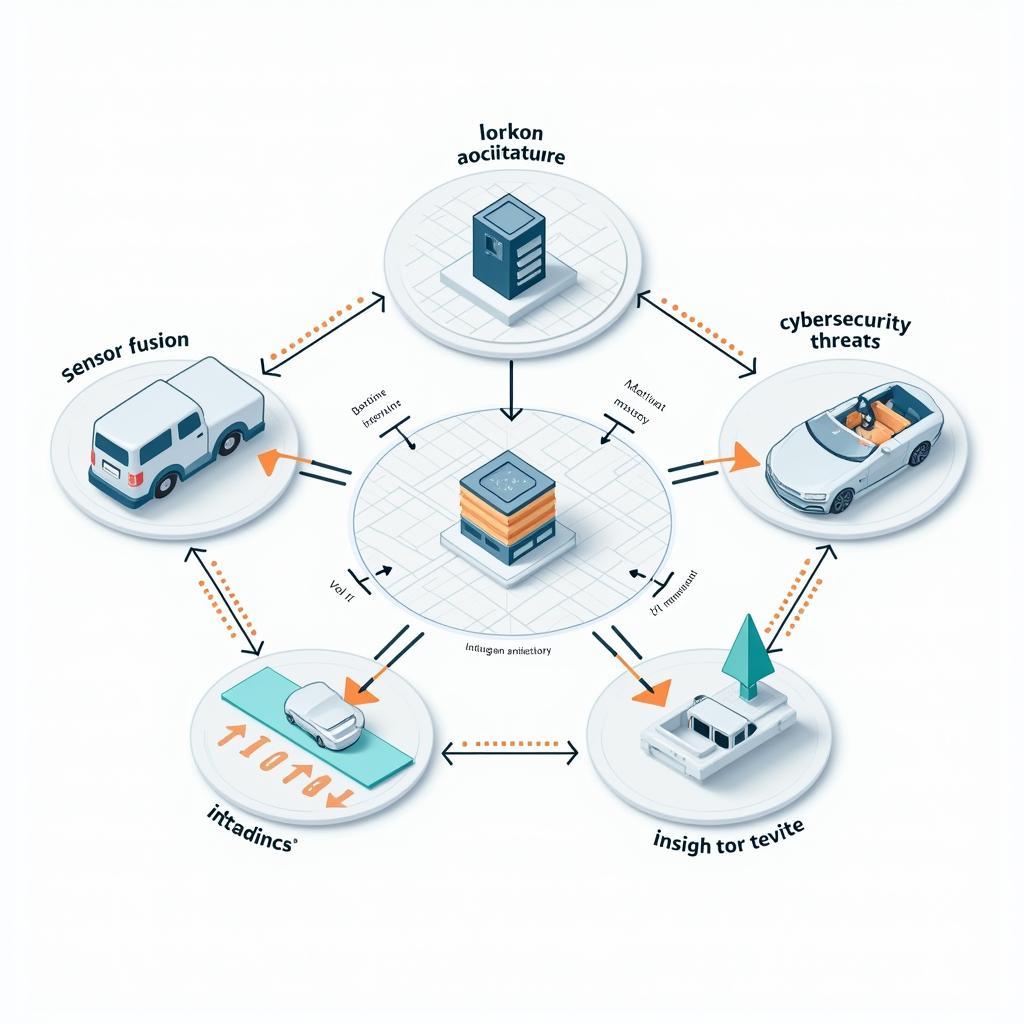 Sơ đồ minh họa các thách thức kỹ thuật chính trong hệ thống giao thông tự động
The edge case problem – autonomous systems’ struggles with rare, unusual scenarios – presents perhaps the most intractable challenge to achieving human-equivalent performance. Human drivers draw upon accumulated experience, general intelligence, and common sense reasoning to navigate unprecedented situations that fall outside explicit training examples. Autonomous systems, conversely, perform narrowly within their training distributions, exhibiting brittle behavior when confronting novel circumstances. Despite millions of kilometers of test driving, autonomous systems continue to encounter scenarios their designers never anticipated: a person in a wheelchair crossing the street, a mattress falling from a truck, a police officer manually directing traffic with non-standard gestures. Each incident reveals the fundamental difficulty of programming systems to exhibit genuine situational understanding rather than pattern matching.
Điều này có điểm tương đồng với ethical concerns in facial recognition technology khi xử lý các vấn đề về độ chính xác và công bằng trong các tình huống biên giới, where the algorithmic limitations and bias issues mirror challenges faced in autonomous transit contexts.
Regulatory frameworks governing autonomous transit remain nascent and fragmented, creating legal ambiguity that impedes deployment while potentially exposing municipalities to liability risks. Existing transportation regulations were drafted with the assumption of human operation, addressing issues such as driver licensing, operator qualifications, and accident liability attribution. These frameworks prove inadequate for scenarios involving fully autonomous systems where no human operator exists. Who bears legal responsibility when an autonomous bus causes injury – the transit authority, the vehicle manufacturer, the software developer, or the sensor supplier? Different jurisdictions have adopted divergent approaches to these questions, creating a patchwork regulatory landscape that complicates efforts to deploy standardized autonomous systems across multiple cities or regions.
Looking forward, the trajectory of autonomous transit development appears likely to follow an incremental path rather than the revolutionary transformation sometimes depicted in popular discourse. Most experts envision graduated automation where human oversight and intervention capabilities are retained even as system autonomy increases. This hybrid approach acknowledges both the current limitations of autonomous technology and the practical necessity of fallback mechanisms when systems encounter scenarios beyond their operational design domain. Singapore’s autonomous bus pilots, for instance, maintain onboard attendants capable of assuming control, representing a pragmatic middle ground between full automation and traditional operation.
The research frontiers advancing autonomous transit capabilities span diverse disciplines. Computer vision researchers develop algorithms for robust object detection under adverse conditions. Materials scientists create advanced sensor technologies with improved performance characteristics. Control theorists design optimization algorithms for coordinated fleet management. Urban planners model integrated mobility ecosystems where autonomous transit interacts with other transportation modes. This multidisciplinary convergence suggests that breakthroughs enabling truly reliable autonomous public transportation will emerge not from isolated technical advances but from synergistic integration of progress across multiple domains.
The sociotechnical systems perspective emphasizes that successful autonomous transit implementation requires co-evolution of technology, infrastructure, policy, and social practices. Technical capabilities alone prove insufficient; they must be complemented by appropriate institutional arrangements, regulatory frameworks, workforce development programs, and public engagement processes. Cities serving as testbeds for autonomous transit – including Columbus, Stockholm, and Shenzhen – are pioneering holistic approaches that address technical and social dimensions simultaneously, potentially offering replicable models for broader deployment. Their experiences suggest that the question is not whether autonomous public transportation will arrive, but rather how quickly societies can develop the comprehensive ecosystems necessary to support it effectively and equitably.
Questions 27-31: Multiple Choice
Choose the correct letter, A, B, C, or D.
-
According to the passage, LiDAR technology is limited by
A. its inability to create three-dimensional maps
B. its high cost compared to other sensors
C. its reduced effectiveness in certain weather conditions
D. its slow processing speed -
The “black box problem” refers to
A. the high cost of neural network systems
B. the difficulty in understanding how neural networks make decisions
C. the inability of systems to process large amounts of data
D. the challenge of protecting systems from cyberattacks -
The passage suggests that edge cases are problematic because
A. they occur too frequently for systems to handle
B. they require computational power that exceeds current capabilities
C. autonomous systems lack the general intelligence to handle unprecedented situations
D. they are deliberately created by hackers to disrupt systems -
According to the passage, current transportation regulations are inadequate because they
A. are too strict for autonomous vehicles
B. were designed assuming human operators
C. vary too much between different countries
D. do not address cybersecurity concerns -
The author suggests that the future development of autonomous transit will most likely be
A. revolutionary and rapid
B. gradual with continued human oversight
C. limited to specific cities only
D. abandoned in favor of traditional systems
Questions 32-36: Matching Features
Match each challenge (32-36) with the correct domain (A-F) from the list below.
Write the correct letter, A-F.
Domains:
A. Computational processing
B. Sensor technology
C. Machine learning
D. Infrastructure
E. Legal/regulatory
F. Cybersecurity
Challenges:
32. The need for millisecond response times when processing massive data streams
33. The requirement to retrofit cities with communication nodes and connected sensors
34. The opacity of neural network decision-making processes
35. The vulnerability of cyberphysical systems to coordinated digital attacks
36. The ambiguity regarding liability attribution when accidents occur
Questions 37-40: Short-answer Questions
Answer the questions below.
Choose NO MORE THAN THREE WORDS AND/OR A NUMBER from the passage for each answer.
- How much data does an autonomous bus typically generate each day from its sensors?
- What term do researchers use to describe scenarios that occur infrequently but have significant safety implications?
- What type of approach do most experts envision for the development of autonomous transit?
- Which perspective emphasizes that technology must evolve together with policy and social practices?
Answer Keys – Đáp Án
PASSAGE 1: Questions 1-13
- B
- C
- C
- B
- C
- B
- TRUE
- FALSE
- TRUE
- FALSE
- comprehensive understanding
- controlled environments
- retraining programs
PASSAGE 2: Questions 14-26
- NO
- YES
- NOT GIVEN
- YES
- YES
- G
- D
- B
- I
- H
- International Transport Forum
- multiplier effect
- high-traffic corridors
PASSAGE 3: Questions 27-40
- C
- B
- C
- B
- B
- A
- D
- C
- F
- E
- 4 terabytes
- edge cases
- graduated automation / incremental path
- sociotechnical systems perspective
Giải Thích Đáp Án Chi Tiết
Passage 1 – Giải Thích
Câu 1: B
- Dạng câu hỏi: Multiple Choice
- Từ khóa: first fully automated metro system, established
- Vị trí trong bài: Đoạn 2, dòng 1-2
- Giải thích: Bài đọc nêu rõ “The first fully automated metro system was introduced in Kobe, Japan, in 1981”. Đây là thông tin trực tiếp không cần paraphrase. Singapore được nhắc đến sau đó (1987) nhưng không phải là hệ thống đầu tiên.
Câu 2: C
- Dạng câu hỏi: Multiple Choice
- Từ khóa: main advantage, optimal spacing
- Vị trí trong bài: Đoạn 4, dòng 1-3
- Giải thích: Câu “Automated vehicles can maintain optimal spacing between units, reducing the time between services” được paraphrase thành “increase service frequency” trong đáp án C. Đây là lợi ích chính được nhấn mạnh.
Câu 3: C
- Dạng câu hỏi: Multiple Choice
- Từ khóa: labor costs, typically represent
- Vị trí trong bài: Đoạn 5, dòng 2-3
- Giải thích: Thông tin rõ ràng: “Labor costs typically account for 60-70% of public transportation operating budgets.”
Câu 7: TRUE
- Dạng câu hỏi: True/False/Not Given
- Từ khóa: Helsinki’s automated minibus, first in the world, public roads
- Vị trí trong bài: Đoạn 3, dòng 1-3
- Giải thích: Bài viết khẳng định “Helsinki, Finland, launched the world’s first automated minibus service on public roads” – khớp hoàn toàn với câu phát biểu.
Câu 8: FALSE
- Dạng câu hỏi: True/False/Not Given
- Từ khóa: always operate more cheaply, first year
- Vị trí trong bài: Đoạn 5, dòng 1-2
- Giải thích: Bài viết nói “While the initial investment in automation technology is substantial, the long-term savings can be significant” và “over ten-year periods” – ngụ ý không rẻ hơn ngay từ năm đầu tiên, do chi phí đầu tư ban đầu cao.
Câu 11: comprehensive understanding
- Dạng câu hỏi: Sentence Completion
- Từ khóa: create a ___ of their environment
- Vị trí trong bài: Đoạn 3, dòng 5-6
- Giải thích: Nguyên văn: “creating a comprehensive understanding of their surroundings” – cần điền chính xác 2 từ này.
 Infographic hướng dẫn phương pháp làm bài IELTS Reading hiệu quả cho chủ đề giao thông
Passage 2 – Giải Thích
Câu 14: NO
- Dạng câu hỏi: Yes/No/Not Given
- Từ khóa: economic benefits, straightforward, uniformly positive
- Vị trí trong bài: Đoạn 2, dòng 1-2
- Giải thích: Tác giả sử dụng cụm “paradoxical scenario” (tình huống nghịch lý) và sau đó nêu “macroeconomic implications are considerably more complex”, cho thấy lợi ích kinh tế KHÔNG đơn giản và đồng nhất. Đây là quan điểm trái ngược với câu phát biểu.
Câu 15: YES
- Dạng câu hỏi: Yes/No/Not Given
- Từ khóa: increase inequality, regions and communities
- Vị trí trong bài: Đoạn 4, dòng 2-6
- Giải thích: Tác giả nêu rõ “potentially widening the infrastructure gap between wealthy and less affluent regions” và “benefits may not be evenly distributed” – đồng tình với việc tự động hóa có thể tăng bất bình đẳng.
Câu 19: G
- Dạng câu hỏi: Matching Information
- Từ khóa: human interaction in cities
- Vị trí trong bài: Đoạn G (psychological and social dimensions)
- Giải thích: Đoạn này thảo luận về “spontaneous human interaction” và lo ngại về “atomization of urban experience” – khớp với yêu cầu tìm thông tin về tương tác con người.
Câu 24: International Transport Forum
- Dạng câu hỏi: Summary Completion
- Từ khóa: reduce operating costs by 30-40%, according to
- Vị trí trong bài: Đoạn 2, dòng 3-4
- Giải thích: “Research conducted by the International Transport Forum suggests that comprehensive automation could reduce public transit operating costs by 30-40%”
Câu 25: multiplier effect
- Dạng câu hỏi: Summary Completion
- Từ khóa: displacement of workers, 1.5 additional jobs
- Vị trí trong bài: Đoạn 3, dòng 5-7
- Giải thích: Bài viết nêu rõ “there is a multiplier effect that impacts an additional 1.5 jobs in related sectors”
Passage 3 – Giải Thích
Câu 27: C
- Dạng câu hỏi: Multiple Choice
- Từ khóa: LiDAR technology, limited by
- Vị trí trong bài: Đoạn 2, dòng 5-7
- Giải thích: “LiDAR… degrades substantially in heavy rain, fog, or snow when water droplets scatter laser beams” – rõ ràng chỉ ra hạn chế trong điều kiện thời tiết nhất định.
Câu 28: B
- Dạng câu hỏi: Multiple Choice
- Từ khóa: black box problem, refers to
- Vị trí trong bài: Đoạn 4, dòng 2-4
- Giải thích: “Their decision-making processes are often opaque and inscrutable even to their creators” và “engineers frequently cannot determine precisely why the system behaved as it did” – đây chính là định nghĩa của vấn đề hộp đen.
Câu 29: C
- Dạng câu hỏi: Multiple Choice
- Từ khóa: edge cases, problematic because
- Vị trí trong bài: Đoạn 8, dòng 2-4
- Giải thích: “Human drivers draw upon accumulated experience, general intelligence, and common sense reasoning to navigate unprecedented situations” trong khi “Autonomous systems… perform narrowly within their training distributions” – chỉ ra rằng hệ thống thiếu trí thông minh tổng quát.
Câu 32: A
- Dạng câu hỏi: Matching Features
- Từ khóa: millisecond response times, massive data streams
- Vị trí trong bài: Đoạn 3, toàn bộ
- Giải thích: Đoạn này thảo luận về “computational demands” và “millisecond-level response times” – thuộc về Computational processing.
Câu 37: 4 terabytes
- Dạng câu hỏi: Short-answer
- Từ khóa: data, autonomous bus, generate, each day
- Vị trí trong bài: Đoạn 3, dòng 1-2
- Giải thích: “An autonomous bus operating in urban traffic generates approximately 4 terabytes of data daily”
Câu 39: graduated automation / incremental path
- Dạng câu hỏi: Short-answer
- Từ khóa: experts envision, development
- Vị trí trong bài: Đoạn 10, dòng 1-3
- Giải thích: “Most experts envision graduated automation” hoặc “incremental path” – cả hai đều được chấp nhận vì xuất hiện trong cùng một câu.
Từ Vựng Quan Trọng Theo Passage
Passage 1 – Essential Vocabulary
| Từ vựng | Loại từ | Phiên âm | Nghĩa tiếng Việt | Ví dụ từ bài | Collocation |
|---|---|---|---|---|---|
| undergo | v | /ˌʌndəˈɡəʊ/ | trải qua, chịu | undergoing a fundamental transformation | undergo changes/transformation |
| driverless | adj | /ˈdraɪvələs/ | không người lái | driverless buses navigating city streets | driverless vehicles/cars |
| longstanding | adj | /ˌlɒŋˈstændɪŋ/ | tồn tại lâu dài | longstanding challenges | longstanding problem/tradition |
| benchmark | n | /ˈbentʃmɑːk/ | điểm chuẩn, thước đo | become a benchmark for efficiency | set a benchmark |
| sophisticated | adj | /səˈfɪstɪkeɪtɪd/ | tinh vi, phức tạp | sophisticated algorithms | sophisticated technology/system |
| optimal | adj | /ˈɒptɪməl/ | tối ưu | maintain optimal spacing | optimal conditions/level |
| accommodate | v | /əˈkɒmədeɪt/ | chứa, đáp ứng | accommodate more passengers | accommodate needs/requirements |
| eliminate | v | /ɪˈlɪmɪneɪt/ | loại bỏ | eliminating the need for drivers | eliminate waste/risk |
| dramatically | adv | /drəˈmætɪkli/ | một cách đáng kể | dramatically reduce accident rates | dramatically improve/increase |
| resilience | n | /rɪˈzɪliəns/ | khả năng phục hồi | reservations about riding | show resilience |
| transparent | adj | /trænsˈpærənt/ | minh bạch | transparent communication | transparent process/system |
| implications | n | /ˌɪmplɪˈkeɪʃnz/ | hệ quả, tác động | employment implications | have implications for |
Đối với những ai quan tâm đến economic impacts of automation on service industries, việc nắm vững từ vựng về tự động hóa là vô cùng quan trọng.
Passage 2 – Essential Vocabulary
| Từ vựng | Loại từ | Phiên âm | Nghĩa tiếng Việt | Ví dụ từ bài | Collocation |
|---|---|---|---|---|---|
| proliferation | n | /prəˌlɪfəˈreɪʃn/ | sự gia tăng nhanh | proliferation of automated technologies | nuclear proliferation |
| ramifications | n | /ˌræmɪfɪˈkeɪʃnz/ | hậu quả, tác động | profound ramifications | have ramifications |
| paradoxical | adj | /ˌpærəˈdɒksɪkl/ | nghịch lý | paradoxical scenario | paradoxical situation/effect |
| fiscal | adj | /ˈfɪskl/ | thuộc về tài chính | substantial fiscal benefits | fiscal policy/year |
| displacement | n | /dɪsˈpleɪsmənt/ | sự thay thế, di dời | displacement of workers | job displacement |
| cascading | adj | /kæsˈkeɪdɪŋ/ | liên tiếp, dây chuyền | cascading effects | cascading failure |
| multiplier effect | n | /ˈmʌltɪplaɪə ɪˈfekt/ | hiệu ứng nhân | has a multiplier effect | economic multiplier effect |
| distributional | adj | /ˌdɪstrɪˈbjuːʃənl/ | thuộc phân phối | distributional effects | distributional impact/justice |
| disproportionately | adv | /ˌdɪsprəˈpɔːʃnətli/ | không cân xứng | disproportionately affect | disproportionately high/large |
| transit-oriented | adj | /ˈtrænsɪt ˈɔːrientɪd/ | định hướng giao thông | transit-oriented development | transit-oriented design |
| temporal | adj | /ˈtempərəl/ | thuộc về thời gian | temporal flexibility | temporal variations |
| atomization | n | /ˌætəmaɪˈzeɪʃn/ | sự nguyên tử hóa, phân mảnh | atomization of urban experience | social atomization |
| technocratic | adj | /ˌteknəˈkrætɪk/ | quan liêu kỹ trị | technocratic approach | technocratic government |
| participatory | adj | /pɑːˈtɪsɪpətri/ | có sự tham gia | participatory governance models | participatory democracy |
| stakeholder | n | /ˈsteɪkhəʊldə(r)/ | bên liên quan | diverse stakeholders | key stakeholder |
Passage 3 – Essential Vocabulary
| Từ vựng | Loại từ | Phiên âm | Nghĩa tiếng Việt | Ví dụ từ bài | Collocation |
|---|---|---|---|---|---|
| inexorable | adj | /ɪnˈeksərəbl/ | không thể cưỡng lại | inexorable march | inexorable decline/rise |
| constellation | n | /ˌkɒnstəˈleɪʃn/ | chòm sao, tập hợp | constellation of challenges | constellation of factors |
| epistemological | adj | /ɪˌpɪstɪməˈlɒdʒɪkl/ | thuộc nhận thức luận | epistemological challenges | epistemological problems |
| actualization | n | /ˌæktʃuəlaɪˈzeɪʃn/ | sự hiện thực hóa | actualization of this vision | self-actualization |
| formidable | adj | /ˈfɔːmɪdəbl/ | ghê gớm, đáng gờm | formidable obstacles | formidable challenge/task |
| sensor fusion | n | /ˈsensə ˈfjuːʒn/ | tích hợp cảm biến | sensor fusion approach | advanced sensor fusion |
| degrade | v | /dɪˈɡreɪd/ | làm giảm chất lượng | degrades substantially | degrade performance/quality |
| torrential | adj | /təˈrenʃl/ | như trút nước | torrential data stream | torrential rain |
| latency | n | /ˈleɪtnsi/ | độ trễ | latency issues | low latency |
| opaque | adj | /əʊˈpeɪk/ | mơ hồ, không rõ ràng | opaque and inscrutable | opaque process/system |
| inscrutable | adj | /ɪnˈskruːtəbl/ | khó hiểu | opaque and inscrutable | inscrutable expression |
| rectify | v | /ˈrektɪfaɪ/ | sửa chữa | rectify deficiencies | rectify errors/mistakes |
| dilemma | n | /dɪˈlemə/ | tình thế tiến thoái lưỡng nan | dilemma scenarios | face a dilemma |
| prerequisite | n | /priːˈrekwəzɪt/ | điều kiện tiên quyết | infrastructural prerequisites | essential prerequisite |
| cyberphysical | adj | /ˌsaɪbəˈfɪzɪkl/ | thuộc mạng-vật lý | cyberphysical systems | cyberphysical security |
| intrusion | n | /ɪnˈtruːʒn/ | sự xâm nhập | digital intrusions | intrusion detection |
| brittle | adj | /ˈbrɪtl/ | dễ vỡ, mỏng manh | brittle behavior | brittle material |
| nascent | adj | /ˈnæsnt/ | mới nảy sinh | nascent and fragmented | nascent industry/technology |
| incremental | adj | /ˌɪŋkrəˈmentl/ | tăng dần | incremental path | incremental change/improvement |
| synergistic | adj | /ˌsɪnəˈdʒɪstɪk/ | hiệp đồng | synergistic integration | synergistic effect |
Kết bài
Chủ đề Impact of automation on public transportation systems không chỉ phản ánh xu hướng công nghệ hiện đại mà còn mang tính thời sự cao trong kỳ thi IELTS. Qua bài viết này, bạn đã được trải nghiệm một đề thi Reading hoàn chỉnh với 3 passages theo đúng chuẩn Cambridge, từ độ khó dễ (Band 5.0-6.5) đến trung bình (Band 6.0-7.5) và nâng cao (Band 7.0-9.0).
Cả 40 câu hỏi được thiết kế bao gồm 7 dạng bài phổ biến nhất: Multiple Choice, True/False/Not Given, Yes/No/Not Given, Matching Information, Sentence Completion, Summary Completion, Matching Features và Short-answer Questions. Mỗi dạng câu hỏi đòi hỏi kỹ năng đọc và chiến lược làm bài riêng biệt, giúp bạn rèn luyện toàn diện năng lực Reading.
Phần đáp án chi tiết không chỉ cung cấp đáp án đúng mà còn giải thích rõ ràng vị trí thông tin trong bài, cách paraphrase giữa câu hỏi và passage, cũng như lý do tại sao các đáp án khác không chính xác. Đây là chìa khóa giúp bạn tự đánh giá và cải thiện kỹ năng làm bài của mình.
Bảng từ vựng với hơn 40 từ quan trọng kèm phiên âm, nghĩa tiếng Việt, ví dụ và collocation sẽ giúp bạn không chỉ nắm vững từ vựng chủ đề mà còn biết cách sử dụng chúng trong ngữ cảnh thực tế. Hãy dành thời gian học kỹ những từ này vì chúng thường xuyên xuất hiện trong các đề thi IELTS về công nghệ, giao thông và phát triển đô thị.
Để đạt kết quả tốt nhất, hãy luyện tập đề thi này trong điều kiện như thi thật: 60 phút cho cả 3 passages, không tra từ điển, và ghi đáp án trực tiếp. Sau đó, đối chiếu đáp án, phân tích những câu sai để hiểu rõ điểm yếu cần cải thiện. Chúc bạn ôn tập hiệu quả và đạt band điểm mục tiêu trong kỳ thi IELTS sắp tới!


[…] làm bài đã học để nâng cao band điểm Reading của bạn. Việc tương tác với Impact of automation on public transportation systems cũng sẽ giúp bạn hiểu rõ hơn về phạm vi ảnh hưởng của tự động hóa trong […]