Mở Bài
Biến đổi khí hậu và tác động của nó đến sự di cư của động vật hoang dã là một trong những chủ đề môi trường xuất hiện thường xuyên nhất trong kỳ thi IELTS Reading. Chủ đề này không chỉ phản ánh những vấn đề toàn cầu cấp bách mà còn đòi hỏi người học phải có khả năng hiểu sâu về các khái niệm khoa học, phân tích dữ liệu và nắm vững từ vựng chuyên ngành sinh thái học.
Qua kinh nghiệm giảng dạy hơn 20 năm, tôi nhận thấy đề tài về động vật hoang dã và môi trường thường xuất hiện ở cả ba levels trong bài thi IELTS Reading thực tế. Bài viết này cung cấp một bộ đề thi hoàn chỉnh với ba passages có độ khó tăng dần từ Easy đến Hard, bao gồm 40 câu hỏi đa dạng với đầy đủ các dạng bài phổ biến nhất.
Học viên sẽ được thực hành với bài đọc giống như trong Cambridge IELTS thật, kèm theo đáp án chi tiết và giải thích cặn kẽ từng câu hỏi. Đặc biệt, bài viết còn tổng hợp từ vựng quan trọng theo từng passage và chia sẻ những kỹ thuật làm bài hiệu quả. Đề thi này phù hợp cho học viên có trình độ từ band 5.0 trở lên, giúp các bạn làm quen với format bài thi và nâng cao kỹ năng đọc hiểu một cách toàn diện.
Hướng Dẫn Làm Bài IELTS Reading
Tổng Quan Về IELTS Reading Test
Bài thi IELTS Reading kéo dài trong 60 phút với 3 passages và tổng cộng 40 câu hỏi. Mỗi câu trả lời đúng được tính 1 điểm, không bị trừ điểm nếu sai. Độ dài mỗi passage dao động từ 650 đến 1000 từ, với độ khó tăng dần.
Phân bổ thời gian khuyến nghị:
- Passage 1: 15-17 phút (dễ nhất, cần hoàn thành nhanh)
- Passage 2: 18-20 phút (độ khó trung bình, cần đọc kỹ hơn)
- Passage 3: 23-25 phút (khó nhất, cần thời gian phân tích)
Lưu ý quan trọng là các bạn nên dành 2-3 phút cuối để chuyển đáp án lên Answer Sheet, đảm bảo viết rõ ràng và không có lỗi chính tả.
Các Dạng Câu Hỏi Trong Đề Này
Đề thi mẫu này bao gồm 7 dạng câu hỏi phổ biến nhất trong IELTS Reading:
- Multiple Choice – Trắc nghiệm nhiều lựa chọn
- True/False/Not Given – Xác định thông tin đúng/sai/không được đề cập
- Matching Information – Nối thông tin với đoạn văn
- Yes/No/Not Given – Xác định quan điểm tác giả
- Matching Headings – Nối tiêu đề với đoạn văn
- Summary Completion – Hoàn thành đoạn tóm tắt
- Short-answer Questions – Câu hỏi trả lời ngắn
IELTS Reading Practice Test
PASSAGE 1 – Changing Migration Patterns in Arctic Birds
Độ khó: Easy (Band 5.0-6.5)
Thời gian đề xuất: 15-17 phút
The Arctic region has been experiencing some of the most dramatic climate changes on Earth over the past few decades. Average temperatures in this area have risen at nearly twice the global rate, a phenomenon scientists refer to as Arctic amplification. This warming trend has had profound effects on the migratory patterns of various bird species that call the Arctic their summer breeding ground.
Every spring, millions of birds embark on long journeys from their winter homes in warmer regions to the Arctic tundra. These migratory birds include species such as the Arctic tern, various types of geese, and numerous shorebirds. Traditionally, these birds have timed their arrival to coincide with the peak abundance of insects and other food sources, which typically occurs when snow and ice begin to melt. However, climate change is disrupting this delicate timing.
One of the most noticeable changes involves the earlier onset of spring in Arctic regions. Snow now melts 2-3 weeks earlier than it did 40 years ago in many areas. This earlier thaw means that insects emerge sooner, and plants begin growing earlier in the season. For birds that have evolved over millennia to arrive at a specific time, this shift creates a critical mismatch. Many species are arriving at their breeding grounds only to find that the peak food availability has already passed.
Research conducted by the International Arctic Bird Monitoring Program has documented these changes across multiple species. The red knot, a medium-sized shorebird, provides a particularly clear example. These birds travel more than 9,000 miles from their wintering grounds in South America to the Canadian Arctic. Studies show that red knots have been arriving progressively earlier over the past two decades, but not early enough to match the accelerated timing of insect emergence. As a result, breeding success rates have declined by approximately 15% since 2000.
Some bird species are demonstrating remarkable adaptability to these changing conditions. The barnacle goose, which breeds in Greenland and Svalbard, has shown the ability to advance its migration timing by about one week over a 20-year period. Scientists believe this adjustment occurs through a combination of genetic adaptation and behavioral flexibility. Younger birds, in particular, seem more capable of modifying their migration schedules in response to environmental cues.
However, not all species possess this level of flexibility. The Arctic breeding cycle depends on a complex web of ecological relationships. When one element of this system shifts, it can create cascading effects throughout the food chain. For instance, if birds arrive too late to capitalize on peak insect populations, not only do the birds suffer, but predators that rely on bird eggs and chicks also face food shortages.
Climate change is also affecting the Arctic in ways beyond temperature increases. Changes in precipitation patterns have altered the landscape, with some areas becoming wetter while others experience increased drought. These changes affect the habitat quality available to migratory birds. Wetlands that traditionally served as crucial feeding and nesting sites may dry up or become flooded at inappropriate times. The permafrost, which once provided stable ground for nesting, is now thawing in many regions, making some traditional breeding sites unsuitable.
Another concern involves the expansion of shrubs in areas that were once open tundra. As temperatures rise, woody plants are growing in regions where they previously could not survive. While this might seem like a positive development, it actually reduces the open habitat that many ground-nesting birds require. Species like the buff-breasted sandpiper and golden plover prefer wide, unobstructed views that allow them to spot predators. The encroachment of shrubs compromises this safety advantage.
Conservation efforts are now focusing on understanding which species are most vulnerable to these changes and why some adapt better than others. Scientists are using satellite tracking technology to monitor individual birds throughout their annual cycle, from breeding grounds to wintering areas and back again. This research reveals that success in adapting to climate change often depends on conditions throughout the entire migratory route, not just at the breeding grounds.
The future of Arctic migratory birds remains uncertain. Climate models predict that Arctic temperatures will continue rising faster than the global average. Some scientists suggest that certain species may need to find new breeding grounds at higher latitudes or elevations. Others may experience population declines if they cannot adapt quickly enough. Understanding these dynamics is crucial not only for bird conservation but also for maintaining the ecological integrity of Arctic ecosystems, where migratory birds play vital roles as predators, prey, and nutrient transporters.
 Chim di cư Bắc Cực thay đổi lộ trình di cư do tác động của biến đổi khí hậu toàn cầu
Questions 1-13
Questions 1-5: Multiple Choice
Choose the correct letter, A, B, C or D.
-
According to the passage, Arctic amplification refers to:
- A. The loud sounds birds make in the Arctic
- B. The fact that Arctic temperatures rise faster than the global average
- C. The increase in the number of birds migrating to the Arctic
- D. The expansion of Arctic breeding grounds
-
The main problem caused by earlier snow melt is that:
- A. Birds cannot find suitable nesting sites
- B. There is too much water in the tundra
- C. Birds arrive after peak food availability has passed
- D. Predators have more access to bird nests
-
Research on red knots shows that:
- A. They have stopped migrating to the Arctic
- B. Their breeding success has decreased by 15% since 2000
- C. They now arrive too early for food sources
- D. They travel shorter distances than before
-
Barnacle geese demonstrate adaptability by:
- A. Changing their breeding locations
- B. Advancing their migration timing
- C. Eating different types of food
- D. Nesting in shrubs instead of open ground
-
The expansion of shrubs in the Arctic is problematic because:
- A. Shrubs consume too much water
- B. Birds cannot eat shrub vegetation
- C. Ground-nesting birds need open views to spot predators
- D. Shrubs attract more predators to the area
Questions 6-9: True/False/Not Given
Do the following statements agree with the information in the passage?
Write:
- TRUE if the statement agrees with the information
- FALSE if the statement contradicts the information
- NOT GIVEN if there is no information on this
- The Arctic tern is one of the species that migrates to the Arctic for breeding.
- All Arctic bird species are equally capable of adapting to climate change.
- Thawing permafrost makes some traditional nesting sites unusable.
- European countries have provided the most funding for Arctic bird research.
Questions 10-13: Sentence Completion
Complete the sentences below. Choose NO MORE THAN TWO WORDS from the passage for each answer.
- Migratory birds have evolved to arrive when there is __ of food sources in the Arctic.
- Changes in __ have caused some wetland areas to become either too dry or too flooded.
- Scientists use __ to follow individual birds throughout their yearly migration cycle.
- Migratory birds serve important functions as predators, prey, and __ in Arctic ecosystems.
PASSAGE 2 – Oceanic Migration Routes Under Threat
Độ khó: Medium (Band 6.0-7.5)
Thời gian đề xuất: 18-20 phút
The world’s oceans serve as highways for countless species that undertake some of the planet’s most extraordinary migrations. From humpback whales traveling between polar feeding grounds and tropical breeding areas to leatherback turtles crossing entire ocean basins, these marine migrations represent evolutionary adaptations refined over millions of years. However, the accelerating pace of climate change is fundamentally altering ocean conditions, with far-reaching consequences for these ancient journeys.
Ocean temperature stands as one of the most critical factors governing marine migration patterns. Many species rely on specific thermal conditions to trigger migratory movements or to locate appropriate breeding and feeding habitats. The Pacific bluefin tuna, for instance, spawns exclusively in waters between 20-30°C. As ocean temperatures rise, these thermal zones shift poleward, effectively moving spawning grounds hundreds of kilometers from their historical locations. This displacement creates cascading challenges: traditional fishing communities lose access to these valuable species, and the tuna themselves must expend additional energy reaching suitable breeding waters.
The phenomenon of marine heatwaves, defined as periods when sea surface temperatures exceed the 90th percentile of historical measurements for five or more consecutive days, has become increasingly prevalent. Between 2014 and 2016, a massive marine heatwave nicknamed “The Blob” persisted in the northeastern Pacific Ocean, with temperatures up to 6°C above normal. This event caused widespread disruptions to migration patterns. Sockeye salmon returning to spawn in rivers along the North American coast experienced mortality rates exceeding 90% in some systems. The unusually warm water depleted oxygen levels and increased metabolic demands, leaving the salmon exhausted and vulnerable to disease before they could reach their spawning grounds.
Ocean acidification, caused by the absorption of excess atmospheric carbon dioxide, represents another insidious threat to marine migrations. As seawater becomes more acidic, its chemical composition changes in ways that affect various organisms differently. Recent research has revealed that acidification impairs the sensory capabilities of many fish species. Juvenile salmon, for example, use their sense of smell to imprint on their natal rivers, allowing them to return to the exact same streams years later when ready to spawn. Experiments show that salmon raised in acidified water exhibit compromised olfactory function, reducing their ability to navigate accurately. If fish cannot find their way back to appropriate spawning sites, recruitment failure becomes inevitable.
For species that migrate between different ocean depths, changes in oxygen distribution pose existential challenges. The ocean contains oxygen minimum zones (OMZs), layers of water with very low dissolved oxygen that most marine life cannot tolerate. Climate change is causing these zones to expand both horizontally and vertically. The blue marlin, a highly migratory apex predator, typically dives to depths exceeding 200 meters while hunting. However, in areas where OMZs have shoaled, these fish are compressed into shallower waters, making them more susceptible to surface fishing gear and reducing access to deep-dwelling prey.
The relationship between climate change and marine migration extends beyond direct physiological effects. Many migratory species rely on predictable ecological events, such as phytoplankton blooms, which form the foundation of ocean food webs. These blooms typically occur when seasonal conditions align: adequate sunlight, appropriate water temperature, and sufficient nutrients. Climate change is decoupling these factors, causing blooms to occur at different times or in different locations than historically observed. Baleen whales, which time their migrations to coincide with bloom-driven aggregations of krill, may arrive at feeding grounds to find food scarce or absent.
Sea level rise, while gradual compared to other climate impacts, threatens critical coastal habitats that many migratory species depend upon. Horseshoe crabs provide a compelling case study. These ancient arthropods migrate to specific beaches along the Atlantic coast of North America each spring to spawn. Their eggs provide essential nutrition for migratory shorebirds, including the red knot, which times its northward migration to feast on this abundant food source. Rising seas are eroding and inundating these beaches, reducing available spawning habitat. Meanwhile, coastal development prevents the natural landward migration of beaches, creating a habitat squeeze that threatens both the crabs and the birds that depend on them.
Changes in ocean circulation patterns represent perhaps the most profound potential disruption to marine migrations. The Atlantic Meridional Overturning Circulation (AMOC), which includes the Gulf Stream, transports warm water northward and cold water southward, creating temperature gradients that influence the distribution of marine life throughout the Atlantic Ocean. Evidence suggests that the AMOC is weakening, with potential implications for species that navigate using thermal cues or that depend on the nutrient transport this circulation provides. A significantly altered AMOC could fundamentally restructure marine ecosystems and the migration patterns they support.
Adaptation strategies among marine migrants vary considerably. Some species display phenotypic plasticity, the ability to adjust behaviors or physiologies in response to environmental changes within a single generation. Others must rely on evolutionary adaptation through natural selection, a process that may be too slow given the rapid pace of climate change. Research on European eels, which undertake a remarkable migration from freshwater rivers to the Sargasso Sea to spawn, suggests that some populations are shifting spawning times and potentially spawning locations, though whether these changes will ensure long-term survival remains uncertain.
Conservation efforts face the formidable challenge of protecting highly mobile species that cross multiple jurisdictions throughout their migrations. Traditional marine protected areas may prove insufficient if the species they aim to protect no longer utilize those areas due to changing conditions. Dynamic ocean management approaches, which adjust protection measures in real-time based on species locations and ocean conditions, offer promise but require sophisticated monitoring systems and international cooperation. As climate change continues to reshape ocean environments, ensuring the persistence of migratory marine species will demand innovative conservation strategies that account for both ecological complexity and geopolitical realities.
Questions 14-26
Questions 14-18: Yes/No/Not Given
Do the following statements agree with the views of the writer in the passage?
Write:
- YES if the statement agrees with the views of the writer
- NO if the statement contradicts the views of the writer
- NOT GIVEN if it is impossible to say what the writer thinks about this
- Marine migrations are relatively recent evolutionary developments.
- The displacement of Pacific bluefin tuna spawning grounds creates difficulties for both the fish and fishing communities.
- Marine heatwaves have become more common in recent years.
- All fish species are equally affected by ocean acidification.
- Dynamic ocean management is currently used by most countries to protect marine species.
Questions 19-22: Matching Information
Match the following statements with the correct species (A-F). You may use any letter more than once.
A. Humpback whales
B. Sockeye salmon
C. Blue marlin
D. Baleen whales
E. Horseshoe crabs
F. European eels
- This species experienced very high death rates during a marine heatwave event.
- This species relies on timing its migration to coincide with krill availability.
- This species is being forced into shallower waters due to expanding oxygen-poor zones.
- This species may be changing when and where it reproduces.
Questions 23-26: Summary Completion
Complete the summary below. Choose NO MORE THAN TWO WORDS from the passage for each answer.
Ocean acidification is caused by the ocean absorbing excessive (23) __ from the atmosphere. This process affects the (24) __ of fish, making it harder for species like salmon to navigate back to their birthplace. Fish use their sense of (25) __ to remember and return to their natal rivers. When this ability is compromised, it can lead to (26) __, meaning fish populations fail to replenish themselves.
PASSAGE 3 – Terrestrial Megafauna Migration in a Warming World
Độ khó: Hard (Band 7.0-9.0)
Thời gian đề xuất: 23-25 phút
The migrations of terrestrial megafauna represent some of the most visually spectacular and ecologically significant natural phenomena on Earth. Species such as African elephants, Mongolian gazelles, caribou, and wildebeest undertake journeys spanning hundreds or even thousands of kilometers annually, their movements intricately synchronized with seasonal variations in resource availability. These migrations have persisted for millennia, shaping ecosystems through nutrient redistribution, seed dispersal, and top-down regulation of plant communities. However, the compounding pressures of climate change and anthropogenic landscape modification are disrupting these ancient patterns with potentially irreversible consequences.
Climate-driven alterations in precipitation regimes constitute perhaps the most pervasive threat to terrestrial megafauna migrations. In savanna ecosystems, where the spatial and temporal distribution of rainfall determines vegetation growth, even subtle changes in precipitation patterns can have dramatic effects. The Serengeti-Mara ecosystem, which supports one of the last great terrestrial migrations involving over 1.3 million wildebeest alongside hundreds of thousands of zebras and gazelles, depends on a highly predictable seasonal rainfall pattern. Wildebeest movements track the sequential greening of grasslands as rains progress across the landscape. Recent climatological analyses indicate that rainfall in this region is becoming more variable and less predictable, with delayed onset of wet seasons and increased frequency of drought events.
This increased climatic variability creates what ecologists term “ecological traps,” situations where traditional migratory cues become decoupled from actual resource availability. Wildebeest migrations are triggered primarily by depletion of local forage and the olfactory detection of distant rainfall. If rains occur sporadically or fail to generate sustained vegetation growth, migratory herds may arrive at traditional grazing areas to find insufficient food, leading to mass mortality events. A severe drought in 1993 resulted in the death of approximately 170,000 wildebeest, and climate models suggest such extreme events may become more frequent. Conversely, unseasonal rains in usually dry areas can cause herds to disperse prematurely, fragmenting the migration and reducing the collective vigilance that provides protection from predators.
The situation facing North American caribou populations illuminates additional dimensions of climate-induced migration disruption. Caribou inhabit boreal and Arctic environments where winter temperatures have risen at rates substantially exceeding the global mean. These increases are causing fundamental changes in snowpack characteristics. Warmer temperatures create rain-on-snow events, where precipitation falls as rain rather than snow, subsequently freezing into ice layers that prevent caribou from accessing underlying lichens, their primary winter food source. The Peary caribou of Canada’s Arctic islands declined by more than 70% between 1961 and 1997, with icing events identified as a major contributing factor.
Furthermore, earlier spring thaws are advancing the phenology of Arctic plant growth. For caribou, the timing of migration to calving grounds is genetically determined and relatively inflexible. Females must arrive at these areas when vegetation provides optimal nutrition for lactation. However, as plants now green up earlier, there is increasing asynchrony between caribou arrival and peak forage quality. Research on caribou populations in Greenland documented a two-week advance in plant growth over a 15-year period, while caribou calving dates shifted by only a few days. This phenological mismatch results in lower calf survival rates, as mothers produce less milk and young animals enter winter in poorer body condition.
Threshold effects and non-linear responses characterize many climate-migration interactions, creating disproportionate impacts from seemingly modest environmental changes. The Mongolian gazelle migrations, occurring across the Eurasian steppe, demonstrate this principle. These migrations depend on access to widely dispersed water sources. As temperatures rise and evapotranspiration increases, many small ephemeral water bodies that historically persisted through summer months are now drying up weeks earlier. The loss of even a single critical water source can render vast areas of otherwise suitable habitat effectively inaccessible, constraining movement corridors and forcing higher densities in remaining habitable areas. This spatial compression intensifies intraspecific competition, increases parasite transmission, and makes populations more vulnerable to localized drought events.
The synergistic interaction between climate change and habitat fragmentation represents an existential threat multiplier for migratory megafauna. Migrations require landscape connectivity, yet human activities have created an increasingly fragmented terrestrial environment. Roads, fences, agricultural lands, and urban development form barriers that impede movement. Climate change exacerbates these effects by shifting the geographic distribution of suitable habitat, potentially displacing it beyond existing migration routes or into areas rendered inaccessible by human infrastructure. Theoretical models suggest that species requiring contiguous habitat corridors are particularly vulnerable, as even small habitat discontinuities can prevent successful migration, leading to isolated subpopulations susceptible to local extinction.
African elephant migrations provide a cogent example of these interacting stressors. Elephants require substantial daily water intake and thus orient their movements around water availability. Climate change is altering precipitation patterns across African savannas, with many regions experiencing longer dry seasons and more intense droughts. Simultaneously, expanding human settlements and agricultural lands have appropriated traditional elephant migration routes and dry-season refugia. Elephants attempting to access water or follow ancestral pathways increasingly encounter human-dominated landscapes, resulting in human-elephant conflict that claims both human lives and elephants. Some elephant populations have essentially ceased migrating, remaining in protected areas year-round, which leads to localized overgrazing, habitat degradation, and ultimately reduced carrying capacity.
Adaptive capacity varies considerably among migratory megafauna species and depends on factors including behavioral flexibility, phenotypic plasticity, generation time, and genetic diversity. Species with longer generation times, such as elephants with 20-30 year reproductive cycles, face particular challenges in evolutionary adaptation to rapidly changing conditions. Behavioral adaptations, while potentially faster, may be constrained by phylogenetic conservatism, the tendency for traits to remain unchanged across evolutionary lineages. Some caribou populations show evidence of adjusting migration routes in response to changing conditions, while others appear behaviorally inflexible, continuing to follow traditional paths even when they no longer lead to optimal habitat.
Conservation strategies for migratory megafauna in the Anthropocene must transcend traditional protected area approaches. Transboundary conservation initiatives, which coordinate management across political borders, are essential for species whose migrations cross multiple jurisdictions. The Kavango-Zambezi Transfrontier Conservation Area, spanning five African nations and encompassing elephant migration routes, represents one such effort. However, success requires not only political will but also mechanisms to mitigate climate impacts. This includes maintaining and restoring habitat connectivity, protecting critical resources such as water sources and salt licks, and developing climate-informed management plans that anticipate future shifts in species distributions. Assisted migration, the deliberate translocation of populations to areas projected to remain suitable under future climates, has been proposed but remains controversial due to ecological uncertainties and ethical considerations.
Ultimately, the persistence of terrestrial megafauna migrations may serve as a bellwether for broader ecosystem health in a changing climate. These migrations embody complex ecological relationships refined over evolutionary timescales, and their disruption signals fundamental ecosystem restructuring. The loss of these migrations would represent not merely the disappearance of spectacular natural phenomena but the unraveling of ecological processes essential for ecosystem function and resilience. As climate change accelerates, the fate of migratory megafauna will depend on humanity’s ability to implement comprehensive, adaptive conservation approaches that address both climatic and non-climatic stressors across landscapes that retain sufficient ecological integrity to support these remarkable journeys.
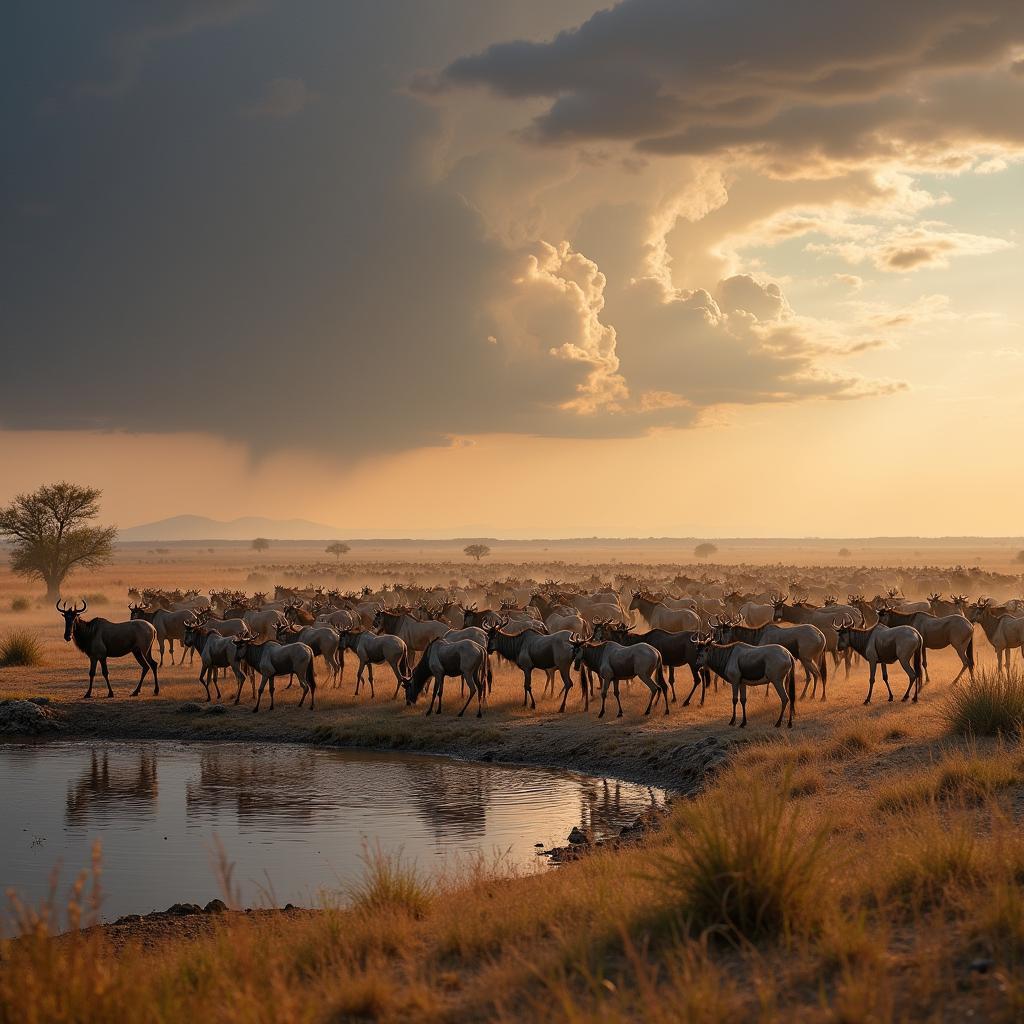 Động vật có vú lớn di cư đối mặt khó khăn từ biến đổi khí hậu và mất môi trường sống
Questions 27-40
Questions 27-31: Multiple Choice
Choose the correct letter, A, B, C or D.
-
According to the passage, ecological traps occur when:
- A. Animals are caught by predators during migration
- B. Traditional migration signals no longer accurately indicate resource availability
- C. Human infrastructure blocks traditional migration routes
- D. Diseases spread rapidly among migrating populations
-
Rain-on-snow events are problematic for caribou because:
- A. They create ice layers that prevent access to food
- B. They cause flooding in calving areas
- C. They attract more predators to caribou habitats
- D. They delay the spring migration
-
The research on Greenland caribou revealed that:
- A. Caribou calving dates have changed dramatically
- B. Plant growth timing has advanced much more than caribou calving timing
- C. Climate change has not affected caribou populations
- D. Caribou have successfully adapted to earlier spring conditions
-
The Mongolian gazelle example illustrates that:
- A. Large climate changes are needed to impact migrations
- B. Small environmental changes can have disproportionate effects
- C. Gazelles are more adaptable than other species
- D. Water sources are increasing due to climate change
-
Species with longer generation times face challenges because:
- A. They travel longer distances during migration
- B. They require more food and water
- C. Evolutionary adaptation occurs more slowly
- D. They are more likely to encounter human settlements
Questions 32-36: Matching Features
Match each characteristic with the correct species or ecosystem. Write the correct letter A-F next to questions 32-36.
A. Wildebeest
B. Peary caribou
C. Mongolian gazelles
D. African elephants
E. Serengeti-Mara ecosystem
F. North American caribou
- Population declined by over 70% between 1961 and 1997
- Depend on predictable seasonal rainfall patterns
- Have largely stopped migrating in some areas due to human settlement
- Rely on access to scattered water sources across steppes
- Migration timing is genetically fixed and difficult to change
Questions 37-40: Short-answer Questions
Answer the questions below. Choose NO MORE THAN THREE WORDS from the passage for each answer.
- What do migratory megafauna help redistribute across ecosystems?
- What type of conservation areas coordinate management across national borders?
- What controversial strategy involves moving populations to areas expected to remain suitable in future climates?
- What does the passage suggest migratory megafauna migrations may indicate about overall ecosystem condition?
Answer Keys – Đáp Án
PASSAGE 1: Questions 1-13
- B
- C
- B
- B
- C
- TRUE
- FALSE
- TRUE
- NOT GIVEN
- peak abundance
- precipitation patterns
- satellite tracking (technology)
- nutrient transporters
PASSAGE 2: Questions 14-26
- NO
- YES
- YES
- NO
- NOT GIVEN
- B
- D
- C
- F
- carbon dioxide
- sensory capabilities
- smell
- recruitment failure
PASSAGE 3: Questions 27-40
- B
- A
- B
- B
- C
- B
- E
- D
- C
- F
- nutrients (hoặc nutrient/seeds)
- transboundary conservation (initiatives)
- assisted migration
- ecosystem health
Giải Thích Đáp Án Chi Tiết
Passage 1 – Giải Thích
Câu 1: B
- Dạng câu hỏi: Multiple Choice
- Từ khóa: Arctic amplification
- Vị trí trong bài: Đoạn 1, dòng 2-4
- Giải thích: Bài đọc nói rõ “Average temperatures in this area have risen at nearly twice the global rate, a phenomenon scientists refer to as Arctic amplification.” Đây là paraphrase của đáp án B – nhiệt độ Bắc Cực tăng nhanh hơn mức trung bình toàn cầu.
Câu 2: C
- Dạng câu hỏi: Multiple Choice
- Từ khóa: main problem, earlier snow melt
- Vị trí trong bài: Đoạn 3, dòng 5-8
- Giải thích: Bài viết chỉ ra “Many species are arriving at their breeding grounds only to find that the peak food availability has already passed.” Đây chính xác là nội dung của đáp án C.
Câu 3: B
- Dạng câu hỏi: Multiple Choice
- Từ khóa: red knots, research
- Vị trí trong bài: Đoạn 4, dòng cuối
- Giải thích: Đoạn văn nêu rõ “breeding success rates have declined by approximately 15% since 2000” khi nói về red knots.
Câu 5: C
- Dạng câu hỏi: Multiple Choice
- Từ khóa: expansion of shrubs, problematic
- Vị trí trong bài: Đoạn 8, dòng 4-6
- Giải thích: Bài viết giải thích “Species like the buff-breasted sandpiper and golden plover prefer wide, unobstructed views that allow them to spot predators. The encroachment of shrubs compromises this safety advantage.”
Câu 6: TRUE
- Dạng câu hỏi: True/False/Not Given
- Từ khóa: Arctic tern, migrates
- Vị trí trong bài: Đoạn 2, dòng 2-3
- Giải thích: Đoạn 2 liệt kê các loài chim di cư và có nhắc đến “the Arctic tern” là một trong số đó.
Câu 7: FALSE
- Dạng câu hỏi: True/False/Not Given
- Từ khóa: all Arctic bird species, equally capable
- Vị trí trong bài: Đoạn 5-6
- Giải thích: Đoạn 6 bắt đầu bằng “However, not all species possess this level of flexibility,” cho thấy không phải tất cả loài đều có khả năng thích nghi như nhau. Đây mâu thuẫn trực tiếp với câu hỏi.
Câu 8: TRUE
- Dạng câu hỏi: True/False/Not Given
- Từ khóa: thawing permafrost, nesting sites unsuitable
- Vị trí trong bài: Đoạn 7, dòng cuối
- Giải thích: Bài viết nêu “The permafrost, which once provided stable ground for nesting, is now thawing in many regions, making some traditional breeding sites unsuitable.”
Câu 10: peak abundance
- Dạng câu hỏi: Sentence Completion
- Từ khóa: evolved to arrive, food sources
- Vị trí trong bài: Đoạn 2, dòng 4-5
- Giải thích: “These migratory birds…have timed their arrival to coincide with the peak abundance of insects and other food sources.”
Câu 11: precipitation patterns
- Dạng câu hỏi: Sentence Completion
- Từ khóa: wetland areas, too dry or too flooded
- Vị trí trong bài: Đoạn 7, dòng 2-3
- Giải thích: “Changes in precipitation patterns have altered the landscape, with some areas becoming wetter while others experience increased drought.”
Câu 13: nutrient transporters
- Dạng câu hỏi: Sentence Completion
- Từ khóa: migratory birds, predators, prey
- Vị trí trong bài: Đoạn 10, dòng cuối
- Giải thích: Câu cuối cùng nói về vai trò của chim di cư: “where migratory birds play vital roles as predators, prey, and nutrient transporters.”
Passage 2 – Giải Thích
Câu 14: NO
- Dạng câu hỏi: Yes/No/Not Given
- Từ khóa: marine migrations, recent evolutionary developments
- Vị trí trong bài: Đoạn 1, dòng 3-4
- Giải thích: Bài viết mô tả di cư biển là “evolutionary adaptations refined over millions of years,” cho thấy đây không phải là hiện tượng gần đây. Điều này trái ngược với câu hỏi.
Câu 15: YES
- Dạng câu hỏi: Yes/No/Not Given
- Từ khóa: Pacific bluefin tuna, displacement, difficulties
- Vị trí trong bài: Đoạn 2, dòng cuối
- Giải thích: Bài viết nêu rõ “This displacement creates cascading challenges: traditional fishing communities lose access to these valuable species, and the tuna themselves must expend additional energy.”
Câu 16: YES
- Dạng câu hỏi: Yes/No/Not Given
- Từ khóa: marine heatwaves, more common
- Vị trí trong bài: Đoạn 3, dòng 1-2
- Giải thích: Đoạn văn mô tả marine heatwaves “has become increasingly prevalent,” nghĩa là ngày càng phổ biến hơn.
Câu 19: B (Sockeye salmon)
- Dạng câu hỏi: Matching Information
- Từ khóa: very high death rates, marine heatwave
- Vị trí trong bài: Đoạn 3, giữa đoạn
- Giải thích: “Sockeye salmon…experienced mortality rates exceeding 90% in some systems” trong sự kiện The Blob.
Câu 20: D (Baleen whales)
- Dạng câu hỏi: Matching Information
- Từ khóa: timing migration, krill availability
- Vị trí trong bài: Đoạn 6, dòng cuối
- Giải thích: “Baleen whales, which time their migrations to coincide with bloom-driven aggregations of krill.”
Câu 23: carbon dioxide
- Dạng câu hỏi: Summary Completion
- Từ khóa: ocean acidification, absorbing
- Vị trí trong bài: Đoạn 4, dòng 1
- Giải thích: “Ocean acidification, caused by the absorption of excess atmospheric carbon dioxide.”
Câu 25: smell
- Dạng câu hỏi: Summary Completion
- Từ khóa: salmon, navigate, natal rivers
- Vị trí trong bài: Đoạn 4, giữa đoạn
- Giải thích: “Juvenile salmon…use their sense of smell to imprint on their natal rivers.”
Passage 3 – Giải Thích
Câu 27: B
- Dạng câu hỏi: Multiple Choice
- Từ khóa: ecological traps
- Vị trí trong bài: Đoạn 3, dòng 1-3
- Giải thích: Bài viết định nghĩa ecological traps là “situations where traditional migratory cues become decoupled from actual resource availability.” Đây chính là paraphrase của đáp án B.
Câu 28: A
- Dạng câu hỏi: Multiple Choice
- Từ khóa: rain-on-snow events, caribou
- Vị trí trong bài: Đoạn 4, giữa đoạn
- Giải thích: “precipitation falls as rain rather than snow, subsequently freezing into ice layers that prevent caribou from accessing underlying lichens.”
Câu 29: B
- Dạng câu hỏi: Multiple Choice
- Từ khóa: Greenland caribou, research
- Vị trí trong bài: Đoạn 5, cuối đoạn
- Giải thích: “Research on caribou populations in Greenland documented a two-week advance in plant growth over a 15-year period, while caribou calving dates shifted by only a few days.” Điều này cho thấy thời điểm phát triển của thực vật thay đổi nhiều hơn so với thời điểm đẻ của caribou.
Câu 30: B
- Dạng câu hỏi: Multiple Choice
- Từ khóa: Mongolian gazelle, illustrates
- Vị trí trong bài: Đoạn 6, dòng đầu
- Giải thích: Đoạn bắt đầu với “Threshold effects and non-linear responses characterize many climate-migration interactions, creating disproportionate impacts from seemingly modest environmental changes.” Ví dụ về Mongolian gazelle minh họa nguyên tắc này.
Câu 32: B (Peary caribou)
- Dạng câu hỏi: Matching Features
- Từ khóa: declined 70%, 1961-1997
- Vị trí trong bài: Đoạn 4, cuối đoạn
- Giải thích: “The Peary caribou of Canada’s Arctic islands declined by more than 70% between 1961 and 1997.”
Câu 34: D (African elephants)
- Dạng câu hỏi: Matching Features
- Từ khóa: stopped migrating, human settlement
- Vị trí trong bài: Đoạn 8, cuối đoạn
- Giải thích: “Some elephant populations have essentially ceased migrating, remaining in protected areas year-round.”
Câu 37: nutrients
- Dạng câu hỏi: Short-answer
- Từ khóa: redistribute across ecosystems
- Vị trí trong bài: Đoạn 1, dòng 4-5
- Giải thích: “shaping ecosystems through nutrient redistribution, seed dispersal.”
Câu 39: assisted migration
- Dạng câu hỏi: Short-answer
- Từ khóa: controversial, moving populations, future climates
- Vị trí trong bài: Đoạn 10, giữa đoạn
- Giải thích: “Assisted migration, the deliberate translocation of populations to areas projected to remain suitable under future climates, has been proposed but remains controversial.”
Câu 40: ecosystem health
- Dạng câu hỏi: Short-answer
- Từ khóa: indicate, overall ecosystem condition
- Vị trí trong bài: Đoạn 11, dòng đầu
- Giải thích: “the persistence of terrestrial megafauna migrations may serve as a bellwether for broader ecosystem health.”
Từ Vựng Quan Trọng Theo Passage
Passage 1 – Essential Vocabulary
| Từ vựng | Loại từ | Phiên âm | Nghĩa tiếng Việt | Ví dụ từ bài | Collocation |
|---|---|---|---|---|---|
| dramatic | adj | /drəˈmætɪk/ | ấn tượng, mạnh mẽ | dramatic climate changes | dramatic increase/change |
| amplification | n | /ˌæmplɪfɪˈkeɪʃn/ | sự khuếch đại | Arctic amplification | signal amplification |
| profound | adj | /prəˈfaʊnd/ | sâu sắc, to lớn | profound effects | profound impact/influence |
| embark on | phrasal v | /ɪmˈbɑːk ɒn/ | bắt đầu (hành trình) | embark on long journeys | embark on a journey |
| peak abundance | n phrase | /piːk əˈbʌndəns/ | lượng dồi dào nhất | peak abundance of insects | reach peak abundance |
| disrupt | v | /dɪsˈrʌpt/ | làm gián đoạn | disrupting this delicate timing | disrupt the process |
| emerge | v | /ɪˈmɜːdʒ/ | xuất hiện, nổi lên | insects emerge sooner | emerge from |
| evolve | v | /ɪˈvɒlv/ | tiến hóa | evolved over millennia | evolve gradually |
| mismatch | n | /ˈmɪsmætʃ/ | sự không khớp | critical mismatch | timing mismatch |
| adaptability | n | /əˌdæptəˈbɪləti/ | khả năng thích nghi | remarkable adaptability | show adaptability |
| cascading effects | n phrase | /kæˈskeɪdɪŋ ɪˈfekts/ | hiệu ứng dây chuyền | cascading effects throughout | create cascading effects |
| vulnerable | adj | /ˈvʌlnərəbl/ | dễ bị tổn thương | most vulnerable to changes | vulnerable to attack |
Passage 2 – Essential Vocabulary
| Từ vựng | Loại từ | Phiên âm | Nghĩa tiếng Việt | Ví dụ từ bài | Collocation |
|---|---|---|---|---|---|
| extraordinary | adj | /ɪkˈstrɔːdnri/ | phi thường | extraordinary migrations | extraordinary achievement |
| accelerating | adj | /əkˈseləreɪtɪŋ/ | tăng tốc | accelerating pace of climate change | accelerating rate |
| thermal | adj | /ˈθɜːml/ | thuộc về nhiệt | thermal conditions | thermal energy |
| spawn | v | /spɔːn/ | đẻ trứng | spawns exclusively in waters | spawn offspring |
| prevalent | adj | /ˈprevələnt/ | phổ biến | increasingly prevalent | become prevalent |
| mortality rate | n phrase | /mɔːˈtæləti reɪt/ | tỷ lệ tử vong | mortality rates exceeding 90% | high mortality rate |
| deplete | v | /dɪˈpliːt/ | làm cạn kiệt | depleted oxygen levels | deplete resources |
| insidious | adj | /ɪnˈsɪdiəs/ | âm thầm nguy hiểm | insidious threat | insidious disease |
| impair | v | /ɪmˈpeə(r)/ | làm suy yếu | acidification impairs sensory capabilities | impair function |
| imprint on | phrasal v | /ɪmˈprɪnt ɒn/ | ghi nhớ sâu sắc | imprint on their natal rivers | imprint on memory |
| olfactory | adj | /ɒlˈfæktəri/ | thuộc về khứu giác | olfactory function | olfactory system |
| decouple | v | /diːˈkʌpl/ | tách rời | decoupling these factors | decouple from |
| compelling | adj | /kəmˈpelɪŋ/ | thuyết phục | compelling case study | compelling evidence |
| formidable | adj | /ˈfɔːmɪdəbl/ | đáng gờm, lớn lao | formidable challenge | formidable opponent |
| sophisticated | adj | /səˈfɪstɪkeɪtɪd/ | tinh vi, phức tạp | sophisticated monitoring systems | sophisticated technology |
Passage 3 – Essential Vocabulary
| Từ vựng | Loại từ | Phiên âm | Nghĩa tiếng Việt | Ví dụ từ bài | Collocation |
|---|---|---|---|---|---|
| megafauna | n | /ˌmeɡəˈfɔːnə/ | động vật lớn | terrestrial megafauna | extinct megafauna |
| intricately | adv | /ˈɪntrɪkətli/ | một cách phức tạp | intricately synchronized | intricately connected |
| compounding | adj | /kəmˈpaʊndɪŋ/ | chồng chất | compounding pressures | compounding problems |
| anthropogenic | adj | /ˌænθrəpəˈdʒenɪk/ | do con người gây ra | anthropogenic landscape modification | anthropogenic emissions |
| pervasive | adj | /pəˈveɪsɪv/ | lan tràn | pervasive threat | pervasive influence |
| climatological | adj | /ˌklaɪmətəˈlɒdʒɪkl/ | thuộc khí hậu học | climatological analyses | climatological data |
| sequential | adj | /sɪˈkwenʃl/ | tuần tự | sequential greening | sequential order |
| olfactory detection | n phrase | /ɒlˈfæktəri dɪˈtekʃn/ | phát hiện bằng khứu giác | olfactory detection of rainfall | olfactory detection system |
| phenology | n | /fɪˈnɒlədʒi/ | sinh vật theo mùa | phenology of Arctic plant growth | study phenology |
| asynchrony | n | /eɪˈsɪŋkrəni/ | sự không đồng bộ | increasing asynchrony | temporal asynchrony |
| evapotranspiration | n | /ɪˌvæpəʊtrænspaɪˈreɪʃn/ | sự bốc thoát hơi nước | evapotranspiration increases | high evapotranspiration |
| ephemeral | adj | /ɪˈfemərəl/ | tạm thời, ngắn ngủi | ephemeral water bodies | ephemeral stream |
| synergistic | adj | /ˌsɪnəˈdʒɪstɪk/ | cộng hưởng | synergistic interaction | synergistic effect |
| existential | adj | /ˌeɡzɪˈstenʃl/ | hiện sinh, tồn tại | existential threat | existential crisis |
| contiguous | adj | /kənˈtɪɡjuəs/ | tiếp giáp, liên tục | contiguous habitat corridors | contiguous area |
| cogent | adj | /ˈkəʊdʒənt/ | thuyết phục | cogent example | cogent argument |
| phylogenetic | adj | /ˌfaɪləʊdʒəˈnetɪk/ | thuộc phát sinh loài | phylogenetic conservatism | phylogenetic tree |
| bellwether | n | /ˈbelweðə(r)/ | chỉ báo, dấu hiệu | serve as a bellwether | bellwether indicator |
Kết Bài
Chủ đề về tác động của biến đổi khí hậu đến di cư động vật hoang dã là một trong những nội dung xuất hiện thường xuyên và quan trọng nhất trong kỳ thi IELTS Reading. Qua bộ đề thi mẫu này, các bạn đã được thực hành với ba passages có độ khó tăng dần, từ Easy với chim di cư Bắc Cực, Medium với các loài sinh vật biển, đến Hard với động vật có vú lớn trên cạn.
Bộ đề cung cấp đầy đủ 40 câu hỏi với 7 dạng bài khác nhau, bao gồm Multiple Choice, True/False/Not Given, Yes/No/Not Given, Matching Information, Matching Features, Summary Completion và Short-answer Questions. Mỗi dạng câu hỏi đều được thiết kế để kiểm tra các kỹ năng đọc hiểu khác nhau, từ việc tìm thông tin cụ thể đến phân tích quan điểm tác giả.
Đáp án chi tiết kèm giải thích đã chỉ ra vị trí cụ thể của thông tin trong bài, cách paraphrase giữa câu hỏi và passage, cũng như lý do tại sao các đáp án khác không đúng. Điều này giúp các bạn không chỉ biết đáp án mà còn hiểu phương pháp làm bài một cách bài bản. Bảng từ vựng tổng hợp hơn 40 từ quan trọng với phiên âm, nghĩa tiếng Việt và cách sử dụng trong ngữ cảnh thực tế sẽ giúp các bạn mở rộng vốn từ học thuật.
Hãy dành thời gian làm lại đề thi này nhiều lần, phân tích kỹ các câu khó và học thuộc từ vựng. Những kiến thức về How biodiversity loss affects ecosystem services sẽ giúp bạn hiểu sâu hơn về mối liên hệ giữa sự đa dạng sinh học và chức năng hệ sinh thái. Việc luyện tập đều đặn với các đề thi chất lượng cao như thế này là chìa khóa để đạt được band điểm mong muốn trong kỳ thi IELTS Reading thực tế.