
Mở Bài
Chủ đề về hàng không điện và tác động của nó đối với ngành hàng không toàn cầu đang trở thành một trong những xu hướng nổi bật trong các đề thi IELTS Reading hiện đại. Với sự phát triển nhanh chóng của công nghệ xanh và nhu cầu giảm phát thải carbon, Impact Of Electric Aviation On Global Air Travel đã xuất hiện ngày càng nhiều trong các bài thi chính thức từ năm 2020 đến nay.
Bài viết này cung cấp một bộ đề thi IELTS Reading hoàn chỉnh gồm 3 passages với độ khó tăng dần từ Easy đến Hard, phù hợp cho học viên từ band 5.0 trở lên. Bạn sẽ được trải nghiệm:
- 40 câu hỏi đa dạng bao gồm 7 dạng câu hỏi phổ biến nhất trong IELTS Reading
- Đáp án chi tiết với giải thích cụ thể về vị trí thông tin và kỹ thuật paraphrase
- Từ vựng chuyên ngành về công nghệ hàng không, môi trường và kinh tế
- Chiến lược làm bài thực chiến từ kinh nghiệm giảng dạy 20 năm
Đây là tài liệu luyện tập lý tưởng giúp bạn làm quen với chủ đề công nghệ môi trường – một trong những chủ đề “nóng” nhất của IELTS Reading trong những năm gần đây.
Hướng Dẫn Làm Bài IELTS Reading
Tổng Quan Về IELTS Reading Test
IELTS Reading Test là bài kiểm tra kéo dài 60 phút với 3 passages và tổng cộng 40 câu hỏi. Điểm số của bạn phụ thuộc vào số câu trả lời đúng, không bị trừ điểm cho câu sai.
Phân bổ thời gian khuyến nghị:
- Passage 1: 15-17 phút (độ khó Easy, band 5.0-6.5)
- Passage 2: 18-20 phút (độ khó Medium, band 6.0-7.5)
- Passage 3: 23-25 phút (độ khó Hard, band 7.0-9.0)
Lưu ý dành 2-3 phút cuối để chuyển đáp án vào Answer Sheet và kiểm tra lại.
Các Dạng Câu Hỏi Trong Đề Này
Đề thi mẫu này bao gồm 7 dạng câu hỏi phổ biến:
- Multiple Choice – Câu hỏi trắc nghiệm
- True/False/Not Given – Xác định thông tin đúng/sai/không có
- Matching Information – Nối thông tin với đoạn văn
- Sentence Completion – Hoàn thành câu
- Matching Headings – Nối tiêu đề với đoạn văn
- Summary Completion – Hoàn thành đoạn tóm tắt
- Short-answer Questions – Câu hỏi ngắn
IELTS Reading Practice Test
PASSAGE 1 – The Dawn of Electric Flight
Độ khó: Easy (Band 5.0-6.5)
Thời gian đề xuất: 15-17 phút
The aviation industry stands at the threshold of a revolutionary transformation. For over a century, aircraft have relied almost exclusively on fossil fuels to power their engines, but recent technological advances are paving the way for a new era of electric flight. This shift represents not merely a change in propulsion systems, but a fundamental reimagining of how we approach air travel and its environmental impact.
Electric aircraft utilize battery-powered electric motors instead of traditional combustion engines. The concept is similar to electric cars, which have already gained significant market share in the automotive industry. However, adapting this technology to aviation presents unique challenges. Aircraft require substantially more power to achieve and maintain flight compared to ground vehicles, and the weight of batteries becomes a critical factor. Despite these obstacles, several companies and research institutions have made remarkable progress in developing viable electric aircraft.
The environmental benefits of electric aviation are considerable. Traditional jet aircraft are responsible for approximately 2-3% of global carbon dioxide emissions, and this figure is projected to rise as air travel demand increases. Electric planes produce zero direct emissions during flight, significantly reducing the aviation industry’s carbon footprint. Additionally, they operate much more quietly than conventional aircraft, which could help address noise pollution concerns around airports and reduce the impact on communities living near flight paths.
Early prototypes and commercial applications of electric aircraft have already taken flight. In 2020, Harbour Air, a Canadian seaplane operator, successfully conducted the first commercial electric aircraft flight. The plane, a modified de Havilland DHC-2 Beaver, completed a test flight near Vancouver, demonstrating the feasibility of electric power for short-haul routes. Similarly, several companies are developing small electric aircraft designed for urban air mobility – essentially flying taxis that could transport passengers across cities, avoiding ground traffic congestion.
The economic implications of electric aviation extend beyond environmental concerns. Electric motors have fewer moving parts than traditional engines, potentially reducing maintenance costs by up to 50%. The cost of electricity is also generally lower and more stable than aviation fuel, which could lead to significant operational savings for airlines. However, the initial investment required for electric aircraft technology remains substantial, and the infrastructure needed to support electric aviation – including charging stations and specialized maintenance facilities – must be developed.
Battery technology represents both the greatest challenge and the most critical area of development for electric aviation. Current lithium-ion batteries provide insufficient energy density for long-haul flights. A fully-loaded commercial aircraft might require batteries weighing several tons to match the range of traditional fuel, making the concept impractical with today’s technology. Researchers are exploring several solutions, including hybrid-electric systems that combine electric motors with small auxiliary engines, and the development of more advanced battery technologies such as solid-state batteries and hydrogen fuel cells.
The regulatory landscape is also evolving to accommodate electric aviation. Aviation authorities worldwide, including the Federal Aviation Administration (FAA) in the United States and the European Union Aviation Safety Agency (EASA), are establishing certification standards for electric aircraft. These regulations must balance innovation with safety, ensuring that new technologies meet the rigorous standards expected in aviation while not creating unnecessary barriers to development.
Looking ahead, experts predict a phased adoption of electric aviation. The first commercial applications will likely focus on short-range flights of under 500 miles, such as regional routes and island-hopping services. As battery technology improves, medium-range flights could become feasible within the next 15-20 years. Long-haul international flights will probably remain dependent on traditional or hybrid propulsion for the foreseeable future, though ongoing research may eventually extend electric aviation’s reach to these routes as well.
Questions 1-6: Multiple Choice
Choose the correct letter, A, B, C, or D.
1. What is the main difference between electric aircraft and traditional aircraft?
A. Electric aircraft are faster
B. Electric aircraft use battery-powered motors
C. Electric aircraft are larger
D. Electric aircraft carry more passengers
2. According to the passage, what percentage of global carbon dioxide emissions comes from traditional jet aircraft?
A. 1-2%
B. 2-3%
C. 3-4%
D. 4-5%
3. What advantage did Harbour Air’s test flight demonstrate?
A. Electric planes are faster than traditional planes
B. Electric power is suitable for short-haul routes
C. Electric planes can carry more passengers
D. Electric planes are cheaper to build
4. What is one of the economic benefits of electric motors mentioned in the passage?
A. They are lighter than traditional engines
B. They require more maintenance
C. They have fewer moving parts
D. They use more expensive fuel
5. What is the main challenge regarding battery technology for electric aviation?
A. Batteries are too expensive
B. Batteries do not provide enough energy density
C. Batteries are difficult to manufacture
D. Batteries are unsafe for aviation
6. Which type of flights will likely be the first to adopt electric aviation commercially?
A. Long-haul international flights
B. Medium-range flights
C. Short-range flights under 500 miles
D. Transcontinental flights
Questions 7-10: True/False/Not Given
Write TRUE if the statement agrees with the information
Write FALSE if the statement contradicts the information
Write NOT GIVEN if there is no information on this
7. Electric aircraft produce no noise during flight.
8. Harbour Air conducted the first commercial electric aircraft flight in 2020.
9. Electric aircraft maintenance costs could be reduced by up to 50%.
10. All countries have established certification standards for electric aircraft.
Questions 11-13: Sentence Completion
Complete the sentences below. Choose NO MORE THAN THREE WORDS from the passage for each answer.
11. Electric aircraft could help reduce __ around airports.
12. Several companies are developing electric aircraft for __, which would function as flying taxis.
13. Researchers are exploring __ that combine electric motors with small auxiliary engines.
PASSAGE 2 – Technical and Economic Barriers to Electric Aviation
Độ khó: Medium (Band 6.0-7.5)
Thời gian đề xuất: 18-20 phút
The transition to electric aviation, while promising, faces a complex web of technical, economic, and infrastructural challenges that must be addressed before widespread commercial adoption becomes reality. Understanding these barriers is essential for stakeholders seeking to navigate the transformation of the aviation industry and for governments developing policies to support this technological shift.
A. Energy Storage Limitations
The most significant technical obstacle confronting electric aviation is the fundamental physics of energy storage. Jet fuel contains approximately 12,000 watt-hours of energy per kilogram, whereas the most advanced lithium-ion batteries currently available offer only about 250 watt-hours per kilogram – nearly 50 times less energy density. This disparity means that an electric aircraft would need to carry substantially more weight in batteries to achieve the same range as a conventional aircraft with fuel. Moreover, unlike fuel, which becomes lighter as it is consumed during flight, batteries maintain their weight throughout the journey, creating additional aerodynamic drag and requiring more energy for the entire duration of the flight.
The weight-to-power ratio becomes particularly problematic for larger aircraft. A typical narrow-body commercial aircraft like the Boeing 737 or Airbus A320 carries approximately 26,000 liters of jet fuel, weighing around 20,000 kilograms at takeoff. To match this energy content with current battery technology would require batteries weighing approximately one million kilograms – clearly an impractical proposition. This fundamental constraint explains why initial electric aviation applications focus on small aircraft for short distances, where the battery weight remains manageable relative to the aircraft’s total weight and payload capacity.
B. Infrastructure Development Requirements
The infrastructure ecosystem supporting electric aviation must be built essentially from scratch. Airports will need to install high-capacity charging stations capable of rapidly recharging large battery arrays. Unlike refueling conventional aircraft, which takes 30-60 minutes, current battery technology would require several hours to recharge fully, potentially disrupting airline scheduling efficiency and reducing aircraft utilization rates. Fast-charging technology exists but generates significant heat and may degrade battery longevity, creating a trade-off between operational efficiency and equipment lifespan.
Furthermore, airports’ electrical grids must be substantially upgraded to handle the increased power demand. A major airport might need to add hundreds of megawatts of electrical capacity to support a fleet of electric aircraft – equivalent to the power consumption of a small city. This infrastructure investment represents billions of dollars in costs that must be recovered through fees or government subsidies. The coordination required between airports, airlines, aircraft manufacturers, and utility companies adds layers of complexity to the transition process.
C. Economic Viability and Market Forces
The economic calculus of electric aviation presents a challenging cost-benefit analysis. While electric aircraft promise lower operating costs through reduced fuel and maintenance expenses, the upfront capital costs are substantially higher than conventional aircraft. Current estimates suggest electric aircraft might cost 20-40% more to purchase than comparable traditional planes, though these figures remain uncertain as the technology is still maturing.
Airlines operate on notoriously thin profit margins, typically ranging from 3-6% in good years. The industry’s financial fragility became evident during the COVID-19 pandemic, when most major carriers required government assistance to survive. This economic reality makes airlines risk-averse when adopting new technologies, particularly those requiring significant capital investment without proven return profiles. Additionally, aircraft purchases are typically financed over 15-25 years, meaning airlines must have confidence that electric aircraft technology will remain viable and competitive for decades.
D. Regulatory and Certification Challenges
Aviation is one of the most heavily regulated industries globally, with stringent safety standards developed over decades of operation. Electric aircraft must navigate this regulatory framework while introducing fundamentally new technologies. Certification processes for aircraft typically take 5-7 years and cost hundreds of millions of dollars. Electric propulsion systems, battery safety protocols, and electromagnetic interference considerations introduce novel elements that regulators must evaluate without extensive historical data.
Standardization presents another regulatory challenge. Different battery types, charging systems, and electrical architectures could lead to fragmentation in the market, reducing economies of scale and increasing costs. International regulatory harmonization is essential, as aircraft regularly cross borders and airlines operate in multiple jurisdictions. The International Civil Aviation Organization (ICAO) is working to develop global standards, but progress is incremental, and regional variations in regulations could impede the technology’s adoption.
E. The Hybrid Solution Pathway
Many industry experts view hybrid-electric propulsion as a transitional technology that bridges current capabilities and fully electric flight. Hybrid systems combine traditional engines with electric motors, allowing aircraft to use electric power during portions of the flight where it is most efficient, such as taxi, takeoff, and landing – operations that occur near populated areas where noise and emissions have the greatest impact. The traditional engine provides extended range capability, addressing the battery limitation issue while still delivering environmental benefits.
Several manufacturers are developing hybrid designs. For instance, the concept involves using electric motors for initial climb performance, where they can provide efficient power, then switching to conventional engines for cruising at altitude. Tương tự như Impact of electric vehicles on global oil consumption, khi xe điện dần thay thế phương tiện sử dụng nhiên liệu hóa thạch trong giao thông mặt đất, this hybrid approach could reduce fuel consumption by 30-40% on short to medium routes while providing a commercially viable product with current technology.
Questions 14-18: Matching Information
Match the statements (14-18) with the correct paragraph (A-E). You may use any letter more than once.
14. Describes how different regulatory systems across countries create difficulties
15. Explains why airlines are cautious about investing in new aircraft technology
16. Discusses the power supply challenges airports will face
17. Presents a compromise approach between traditional and electric aviation
18. Identifies the primary technical limitation of electric aircraft
Questions 19-23: Yes/No/Not Given
Write YES if the statement agrees with the claims of the writer
Write NO if the statement contradicts the claims of the writer
Write NOT GIVEN if it is impossible to say what the writer thinks about this
19. Jet fuel contains approximately 50 times more energy per kilogram than lithium-ion batteries.
20. Fast-charging technology is always the best solution for electric aircraft.
21. The aviation industry made significant profits during the COVID-19 pandemic.
22. Aircraft certification processes are faster for electric planes than traditional aircraft.
23. Hybrid-electric systems could reduce fuel consumption by 30-40% on certain routes.
Questions 24-26: Summary Completion
Complete the summary below. Choose NO MORE THAN TWO WORDS from the passage for each answer.
Electric aviation faces several major obstacles. The most significant technical challenge is the limited (24) __ of batteries compared to jet fuel. Additionally, airports need to develop new (25) __ and upgrade their electrical systems. From a financial perspective, airlines are hesitant because they operate on very (26) __, making large investments risky.
PASSAGE 3 – The Geopolitical and Environmental Implications of Electric Aviation
Độ khó: Hard (Band 7.0-9.0)
Thời gian đề xuất: 23-25 phút
The advent of electric aviation represents far more than a mere technological evolution in transportation; it embodies a paradigm shift with profound implications for global geopolitics, environmental sustainability, and socioeconomic structures. As the aviation sector accounts for a disproportionate share of individual carbon footprints among frequent travelers and contributes significantly to anthropogenic climate change, the transition to electric propulsion carries ramifications that extend well beyond the confines of the aerospace industry. Understanding these broader implications requires examining the intricate interplay between technological innovation, policy frameworks, economic incentives, and international relations in the context of decarbonization imperatives.
The Geopolitical Reconfiguration of Energy Dependencies
The current aviation industry’s reliance on kerosene-based jet fuel creates substantial geopolitical vulnerabilities and dependencies that have shaped international relations for decades. Approximately 60% of global oil consumption is dedicated to transportation, with aviation representing a growing share. This dependency grants disproportionate influence to oil-producing nations and regions, particularly those in the Middle East, creating both strategic leverage and economic volatility as fuel prices fluctuate based on geopolitical tensions, production decisions, and market speculation.
Electric aviation fundamentally disrupts this geopolitical calculus by decoupling air transportation from fossil fuel dependencies. However, this transition does not eliminate resource dependencies; it merely transforms them. The production of batteries requires substantial quantities of rare earth elements and critical minerals, including lithium, cobalt, nickel, and copper. Current global reserves of these materials are geographically concentrated, with China controlling approximately 80% of rare earth processing capacity, the Democratic Republic of Congo producing nearly 70% of the world’s cobalt, and Australia and Chile dominating lithium extraction.
This geographic concentration creates new strategic dependencies that could prove equally significant to historical oil dependencies. Nations seeking to develop electric aviation capabilities must secure access to these critical materials, potentially creating new spheres of influence and diplomatic priorities. The scramble for battery materials has already intensified international competition, with major powers pursuing bilateral agreements, direct investments in mining operations, and efforts to develop domestic processing capabilities to reduce supply chain vulnerabilities. How does climate change impact international trade? The shift toward electric aviation intersects significantly with this question, as new trade patterns emerge around battery materials and clean technologies rather than fossil fuels.
Environmental Benefits Beyond Carbon Emissions
While the reduction of carbon emissions represents the most prominent environmental benefit of electric aviation, the technology offers additional ecological advantages that warrant consideration. Noise pollution from conventional aircraft affects millions of people living near airports and under flight paths, with documented impacts on cardiovascular health, cognitive development in children, sleep disruption, and mental health. Electric aircraft operate at significantly lower noise levels – typically 60-70% quieter than conventional jets – potentially transforming the environmental footprint of aviation in urban and suburban areas.
This noise reduction could have cascading effects on urban development patterns and airport operations. Currently, stringent noise restrictions limit nighttime flights at many airports, constraining capacity and creating operational inefficiencies. Quieter electric aircraft might allow expanded nighttime operations, increasing airport utilization without proportionally increasing community impact. Additionally, noise abatement procedures that require aircraft to operate at less fuel-efficient profiles could be relaxed, potentially improving overall energy efficiency even for conventional aircraft that share airspace with electric planes.
The lifecycle environmental assessment of electric aviation, however, presents a more nuanced picture than simple operational emissions comparisons suggest. Battery production is energy-intensive and generates significant emissions, particularly when manufacturing occurs in regions relying heavily on coal-powered electricity. Mining operations for battery materials can cause habitat destruction, water pollution, and social disruption in extraction regions. The end-of-life disposal or recycling of aircraft batteries presents logistical and environmental challenges that currently lack comprehensive solutions.
Moreover, the environmental benefits of electric aviation depend critically on the carbon intensity of electrical generation. An electric aircraft charged with electricity from coal-fired power plants may produce more lifecycle emissions than a fuel-efficient conventional aircraft. This reality underscores the interdependence between aviation’s electrification and broader energy transition efforts. The decarbonization of the electricity grid becomes a prerequisite for realizing the full environmental potential of electric aviation, creating policy synchronization challenges across the transportation and energy sectors.
Socioeconomic Disruptions and Labor Market Transformations
The transition to electric aviation will inevitably trigger substantial disruptions in labor markets and economic structures associated with the aviation industry. The conventional aerospace sector employs millions of people globally in manufacturing, maintenance, fuel production, and distribution. Electric propulsion systems, with their simpler mechanical architecture and reduced maintenance requirements, may require substantially fewer workers, particularly in maintenance, repair, and overhaul (MRO) operations.
Jet engines contain thousands of precision components requiring specialized maintenance performed by highly trained technicians. Electric motors, by contrast, have relatively few moving parts and significantly lower maintenance requirements. Industry analyses suggest electric propulsion could reduce MRO employment by 30-50%, representing tens of thousands of jobs in major aviation markets. While new employment opportunities will emerge in battery management, electrical systems, and charging infrastructure, the skills required differ substantially from traditional aerospace competencies, potentially creating a mismatch between displaced workers and new opportunities.
The fuel production and distribution sector faces even more existential challenges. The petroleum refining industry currently produces jet fuel as one component of a complex refining process. As demand for aviation fuel declines, refineries must adjust their product mix, potentially reducing overall efficiency and profitability. Fuel distribution networks, including pipeline infrastructure, storage facilities, and airport fueling systems, represent billions of dollars in stranded assets with limited alternative uses.
 Máy bay điện hiện đại bay trên bầu trời xanh thể hiện tương lai của hàng không xanh bền vững
The Innovation Ecosystem and Competitive Dynamics
Electric aviation is catalyzing a reconfiguration of competitive dynamics within the aerospace industry. Traditional aircraft manufacturers – Boeing and Airbus have dominated commercial aviation for decades – face challenges from new entrants unburdened by legacy technologies, organizational structures, and established supply chains. Startups and technology companies bring fresh approaches, digital-native engineering practices, and willingness to embrace disruptive business models.
This competitive shift mirrors the automotive industry’s transformation, where Tesla and other electric vehicle manufacturers challenged incumbent automakers’ dominance. However, aviation’s regulatory complexity, safety requirements, and capital intensity create higher barriers to entry than automotive markets, potentially limiting the extent of disruption. Nevertheless, established aerospace companies are responding by developing electric aviation programs, acquiring innovative startups, and restructuring their organizations to accommodate alternative propulsion technologies.
The geographical distribution of aerospace innovation may also shift. Historically, aerospace leadership concentrated in the United States and Europe, with emerging capabilities in China and other Asian nations. Electric aviation could democratize aerospace development by reducing the complexity of propulsion systems and leveraging technologies developed in adjacent sectors such as automotive and consumer electronics. Nations lacking traditional aerospace industries might leapfrog conventional technologies, much as some developing countries bypassed landline telecommunications infrastructure to adopt mobile networks directly.
Policy Frameworks and International Coordination Imperatives
The successful transition to electric aviation requires unprecedented levels of international policy coordination across multiple domains. Carbon pricing mechanisms, including emissions trading systems and carbon taxes, must be designed to create appropriate incentives for airlines to adopt electric aircraft without creating competitive distortions or economic hardship. The International Civil Aviation Organization’s (ICAO) Carbon Offsetting and Reduction Scheme for International Aviation (CORSIA) represents one attempt at global coordination, though critics argue its voluntary nature and limited ambition inadequately address aviation’s climate impact.
Subsidy frameworks and research funding priorities significantly influence the pace of electric aviation development. Governments must balance supporting innovation through direct research grants, tax incentives, and procurement commitments while avoiding market distortions that might entrench suboptimal technologies or create unsustainable dependencies on government support. The European Union’s Clean Sky program and various national initiatives demonstrate different approaches to public support for aviation innovation, with varying degrees of effectiveness and efficiency.
Infrastructure investment decisions require coordination between government agencies, airport authorities, airlines, and utilities. The chicken-and-egg problem of infrastructure development – airlines won’t adopt electric aircraft without charging infrastructure, but infrastructure won’t be built without aircraft demand – necessitates government intervention to catalyze the transition. Public-private partnerships, risk-sharing mechanisms, and coordinated investment strategies can help overcome these market coordination failures.
Finally, international standards for battery safety, charging protocols, and aircraft certification must be harmonized to prevent market fragmentation and facilitate the global operation of electric aircraft. The divergence between regulatory approaches could create trade barriers, increase costs, and slow adoption rates. Multilateral negotiations through organizations like ICAO, the International Electrotechnical Commission (IEC), and bilateral agreements between major aviation markets will determine whether electric aviation develops as an integrated global system or fragments into regional variants with limited interoperability.
Questions 27-31: Multiple Choice
Choose the correct letter, A, B, C, or D.
27. According to the passage, what percentage of rare earth processing capacity is controlled by China?
A. 60%
B. 70%
C. 80%
D. 90%
28. How much quieter are electric aircraft compared to conventional jets?
A. 50-60%
B. 60-70%
C. 70-80%
D. 80-90%
29. What does the passage suggest about the environmental benefits of electric aviation?
A. They are guaranteed regardless of electricity source
B. They depend on how electricity is generated
C. They are minimal compared to conventional aircraft
D. They only relate to noise reduction
30. By how much might electric propulsion reduce MRO employment according to industry analyses?
A. 10-20%
B. 20-30%
C. 30-50%
D. 50-70%
31. What does the passage say about ICAO’s CORSIA scheme?
A. It is highly effective
B. Critics consider it inadequate
C. It is mandatory for all nations
D. It has eliminated aviation emissions
Questions 32-36: Matching Features
Match the following impacts (32-36) with the correct category (A-D). You may use any letter more than once.
A. Geopolitical impacts
B. Environmental impacts
C. Economic impacts
D. Policy impacts
32. New dependencies on battery material suppliers
33. Reduction in aircraft noise affecting communities
34. Potential job losses in aircraft maintenance sectors
35. Need for international coordination on carbon pricing
36. Habitat destruction from mining operations
Questions 37-40: Short-answer Questions
Answer the questions below. Choose NO MORE THAN THREE WORDS AND/OR A NUMBER from the passage for each answer.
37. Which country produces nearly 70% of the world’s cobalt?
38. What type of health issues in children are documented as being caused by aircraft noise pollution?
39. What term describes assets like fuel distribution infrastructure that may lose value due to electrification?
40. Which company is mentioned as an example of challenging incumbent automakers in the electric vehicle market?
Answer Keys – Đáp Án
PASSAGE 1: Questions 1-13
- B
- B
- B
- C
- B
- C
- FALSE
- TRUE
- TRUE
- NOT GIVEN
- noise pollution
- urban air mobility
- hybrid-electric systems
PASSAGE 2: Questions 14-26
- D
- C
- B
- E
- A
- YES
- NO
- NO
- NOT GIVEN
- YES
- energy density
- charging stations
- thin profit margins
PASSAGE 3: Questions 27-40
- C
- B
- B
- C
- B
- A
- B
- C
- D
- B
- Democratic Republic of Congo / Congo
- cognitive development
- stranded assets
- Tesla
Giải Thích Đáp Án Chi Tiết
Passage 1 – Giải Thích
Câu 1: B
- Dạng câu hỏi: Multiple Choice
- Từ khóa: main difference, electric aircraft, traditional aircraft
- Vị trí trong bài: Đoạn 2, dòng 1-2
- Giải thích: Bài đọc nêu rõ “Electric aircraft utilize battery-powered electric motors instead of traditional combustion engines”. Đây là sự khác biệt chính được nhấn mạnh ngay đầu đoạn 2. Các phương án khác không được đề cập như là điểm khác biệt chính.
Câu 2: B
- Dạng câu hỏi: Multiple Choice
- Từ khóa: percentage, carbon dioxide emissions, traditional jet aircraft
- Vị trí trong bài: Đoạn 3, dòng 2-3
- Giải thích: Thông tin được trích dẫn trực tiếp: “Traditional jet aircraft are responsible for approximately 2-3% of global carbon dioxide emissions”. Con số này được nêu rõ ràng trong bài.
Câu 3: B
- Dạng câu hỏi: Multiple Choice
- Từ khóa: Harbour Air, test flight, demonstrate
- Vị trí trong bài: Đoạn 4, dòng 4-5
- Giải thích: Đoạn văn kết luận rằng chuyến bay của Harbour Air “demonstrating the feasibility of electric power for short-haul routes” – chứng minh tính khả thi cho các tuyến bay ngắn. Đây là paraphrase của “suitable for short-haul routes”.
Câu 7: FALSE
- Dạng câu hỏi: True/False/Not Given
- Từ khóa: electric aircraft, produce no noise
- Vị trí trong bài: Đoạn 3, dòng 5-6
- Giải thích: Bài viết nói rằng máy bay điện “operate much more quietly” nhưng không nói là không có tiếng ồn. Câu này mâu thuẫn với thông tin vì máy bay điện vẫn tạo ra tiếng ồn, chỉ là ít hơn.
Câu 11: noise pollution
- Dạng câu hỏi: Sentence Completion
- Từ khóa: reduce, around airports
- Vị trí trong bài: Đoạn 3, dòng 6-7
- Giải thích: Bài viết nêu “could help address noise pollution concerns around airports”. Đáp án phải là “noise pollution” vì đây là cụm từ chính xác được sử dụng trong ngữ cảnh này.
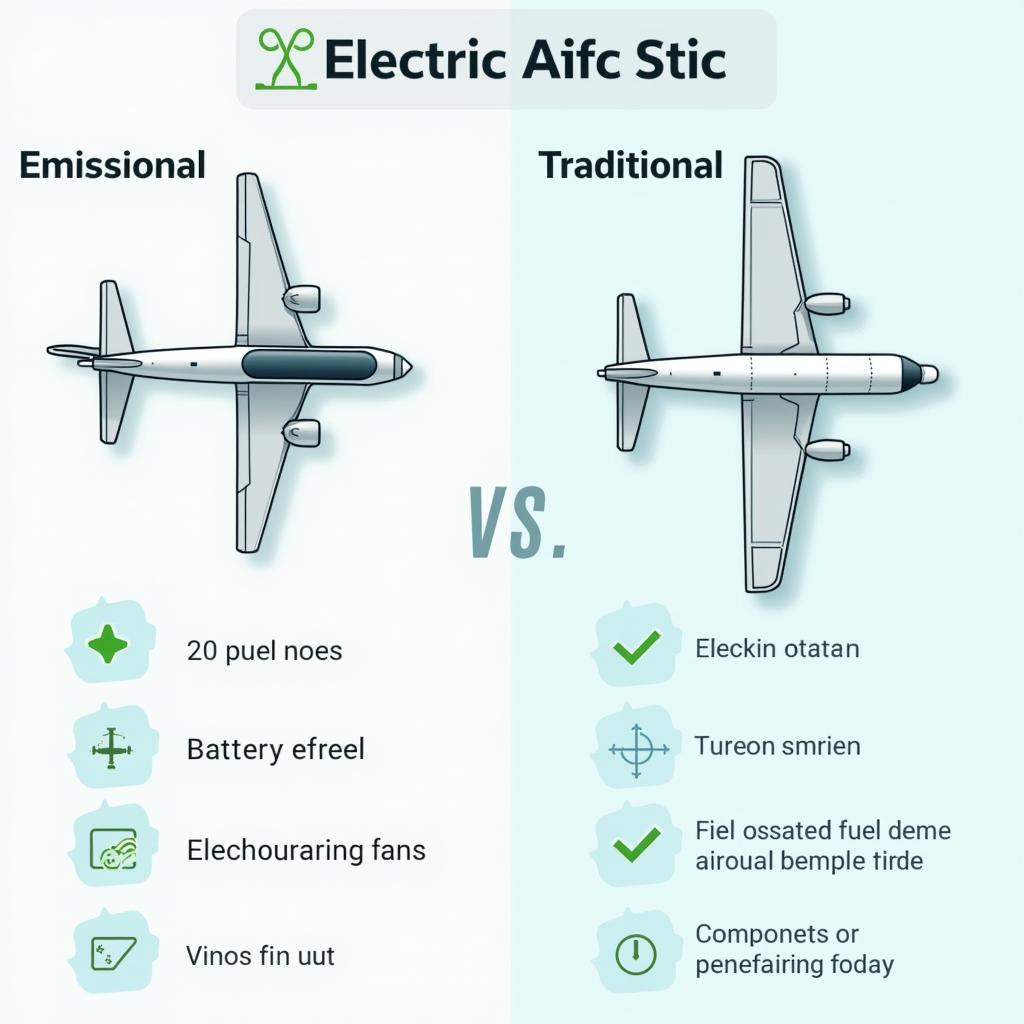 So sánh công nghệ máy bay điện với máy bay truyền thống trong IELTS Reading
Passage 2 – Giải Thích
Câu 14: D
- Dạng câu hỏi: Matching Information
- Từ khóa: regulatory systems, different countries, difficulties
- Vị trí trong bài: Đoạn D, dòng cuối đoạn
- Giải thích: Đoạn D thảo luận về “regional variations in regulations could impede the technology’s adoption” và “International regulatory harmonization is essential”, cho thấy các hệ thống pháp lý khác nhau giữa các quốc gia tạo ra khó khăn.
Câu 15: C
- Dạng câu hỏi: Matching Information
- Từ khóa: airlines, cautious, investing, new aircraft technology
- Vị trí trong bài: Đoạn C
- Giải thích: Đoạn C giải thích rằng hãng hàng không có “thin profit margins” và “This economic reality makes airlines risk-averse when adopting new technologies”. Đây là lý do tại sao họ thận trọng với đầu tư mới.
Câu 19: YES
- Dạng câu hỏi: Yes/No/Not Given
- Từ khóa: Jet fuel, 50 times more energy, lithium-ion batteries
- Vị trí trong bài: Đoạn A, dòng 2-4
- Giải thích: Bài viết nêu rõ “Jet fuel contains approximately 12,000 watt-hours of energy per kilogram, whereas the most advanced lithium-ion batteries currently available offer only about 250 watt-hours per kilogram – nearly 50 times less energy density”. Điều này xác nhận tuyên bố.
Câu 20: NO
- Dạng câu hỏi: Yes/No/Not Given
- Từ khóa: Fast-charging technology, always best solution
- Vị trí trong bài: Đoạn B, giữa đoạn
- Giải thích: Bài viết chỉ ra “Fast-charging technology exists but generates significant heat and may degrade battery longevity, creating a trade-off”. Từ “trade-off” cho thấy nó không phải lúc nào cũng là giải pháp tốt nhất.
Câu 24: energy density
- Dạng câu hỏi: Summary Completion
- Từ khóa: technical challenge, batteries, jet fuel
- Vị trí trong bài: Đoạn A
- Giải thích: Toàn bộ đoạn A thảo luận về “energy density” như thách thức kỹ thuật chính, với so sánh cụ thể giữa pin và nhiên liệu máy bay.
Passage 3 – Giải Thích
Câu 27: C
- Dạng câu hỏi: Multiple Choice
- Từ khóa: percentage, rare earth processing capacity, China
- Vị trí trong bài: Đoạn 2 trong phần “The Geopolitical Reconfiguration”, dòng 4-5
- Giải thích: Thông tin được nêu rõ ràng: “China controlling approximately 80% of rare earth processing capacity”. Đây là dữ liệu cụ thể về sự thống trị của Trung Quốc trong lĩnh vực này.
Câu 28: B
- Dạng câu hỏi: Multiple Choice
- Từ khóa: how much quieter, electric aircraft, conventional jets
- Vị trí trong bài: Đoạn 2 trong phần “Environmental Benefits Beyond Carbon Emissions”
- Giải thích: Bài viết nêu “Electric aircraft operate at significantly lower noise levels – typically 60-70% quieter than conventional jets”. Con số này được trích dẫn trực tiếp.
Câu 32: A (Geopolitical impacts)
- Dạng câu hỏi: Matching Features
- Từ khóa: dependencies, battery material suppliers
- Vị trí trong bài: Phần “The Geopolitical Reconfiguration”
- Giải thích: Toàn bộ phần này thảo luận về việc chuyển từ phụ thuộc dầu mỏ sang phụ thuộc vào các nhà cung cấp vật liệu pin, đây là tác động địa chính trị rõ ràng.
Câu 33: B (Environmental impacts)
- Dạng câu hỏi: Matching Features
- Từ khóa: reduction, aircraft noise, communities
- Vị trí trong bài: Phần “Environmental Benefits Beyond Carbon Emissions”
- Giải thích: Việc giảm tiếng ồn ảnh hưởng đến cộng đồng là một tác động môi trường được thảo luận chi tiết, bao gồm cả ảnh hưởng đến sức khỏe.
Câu 37: Democratic Republic of Congo / Congo
- Dạng câu hỏi: Short-answer Questions
- Từ khóa: country, 70%, cobalt
- Vị trí trong bài: Đoạn 2 trong phần “The Geopolitical Reconfiguration”
- Giải thích: Bài viết nêu rõ “the Democratic Republic of Congo producing nearly 70% of the world’s cobalt”. Cả hai hình thức trả lời đều được chấp nhận.
Câu 40: Tesla
- Dạng câu hỏi: Short-answer Questions
- Từ khóa: company, example, challenging, automakers
- Vị trí trong bài: Đoạn 2 trong phần “The Innovation Ecosystem”
- Giải thích: Tesla được đề cập cụ thể như một ví dụ: “This competitive shift mirrors the automotive industry’s transformation, where Tesla and other electric vehicle manufacturers challenged incumbent automakers’ dominance”.
Từ Vựng Quan Trọng Theo Passage
Passage 1 – Essential Vocabulary
| Từ vựng | Loại từ | Phiên âm | Nghĩa tiếng Việt | Ví dụ từ bài | Collocation |
|---|---|---|---|---|---|
| threshold | n | /ˈθreʃhəʊld/ | ngưỡng cửa, bước ngoặt | stands at the threshold of a revolutionary transformation | on the threshold of |
| propulsion | n | /prəˈpʌlʃən/ | sự đẩy, hệ thống động lực | change in propulsion systems | propulsion system/technology |
| combustion | n | /kəmˈbʌstʃən/ | sự đốt cháy | traditional combustion engines | internal combustion |
| feasibility | n | /ˌfiːzəˈbɪləti/ | tính khả thi | demonstrating the feasibility of electric power | technical feasibility |
| infrastructure | n | /ˈɪnfrəstrʌktʃə(r)/ | cơ sở hạ tầng | infrastructure needed to support electric aviation | develop infrastructure |
| auxiliary | adj | /ɔːɡˈzɪliəri/ | phụ trợ, bổ sung | combine electric motors with small auxiliary engines | auxiliary power/engine |
| regulatory | adj | /ˈreɡjələtəri/ | thuộc về quy định | regulatory landscape is evolving | regulatory framework |
| certification | n | /ˌsɜːtɪfɪˈkeɪʃən/ | chứng nhận | certification standards for electric aircraft | safety certification |
| phased adoption | n phrase | /feɪzd əˈdɒpʃən/ | sự áp dụng theo từng giai đoạn | experts predict a phased adoption | phased approach/implementation |
| carbon footprint | n phrase | /ˈkɑːbən ˈfʊtprɪnt/ | dấu chân carbon | reducing the aviation industry’s carbon footprint | reduce carbon footprint |
Passage 2 – Essential Vocabulary
| Từ vựng | Loại từ | Phiên âm | Nghĩa tiếng Việt | Ví dụ từ bài | Collocation |
|---|---|---|---|---|---|
| disparity | n | /dɪˈspærəti/ | sự chênh lệch lớn | This disparity means that an electric aircraft would need | income/wealth disparity |
| aerodynamic | adj | /ˌeərəʊdaɪˈnæmɪk/ | thuộc về khí động học | creating additional aerodynamic drag | aerodynamic design/efficiency |
| impractical | adj | /ɪmˈpræktɪkəl/ | không thực tế | clearly an impractical proposition | highly impractical |
| utilization rate | n phrase | /ˌjuːtɪlaɪˈzeɪʃən reɪt/ | tỷ lệ sử dụng | reducing aircraft utilization rates | improve utilization rate |
| longevity | n | /lɒnˈdʒevəti/ | tuổi thọ, độ bền | may degrade battery longevity | battery longevity |
| cost-benefit analysis | n phrase | /kɒst ˈbenɪfɪt əˈnæləsɪs/ | phân tích chi phí-lợi ích | presents a challenging cost-benefit analysis | conduct cost-benefit analysis |
| upfront capital | n phrase | /ˌʌpfrʌnt ˈkæpɪtl/ | vốn ban đầu | upfront capital costs are substantially higher | upfront capital investment |
| risk-averse | adj | /rɪsk əˈvɜːs/ | né tránh rủi ro | makes airlines risk-averse | risk-averse investors |
| fragmentation | n | /ˌfræɡmenˈteɪʃən/ | sự chia rẽ, phân mảnh | could lead to fragmentation in the market | market fragmentation |
| economies of scale | n phrase | /ɪˈkɒnəmiz əv skeɪl/ | lợi thế quy mô | reducing economies of scale | achieve economies of scale |
| harmonization | n | /ˌhɑːmənaɪˈzeɪʃən/ | sự hài hòa hóa | International regulatory harmonization is essential | regulatory harmonization |
| transitional | adj | /trænˈzɪʃənəl/ | chuyển tiếp | view hybrid-electric as a transitional technology | transitional period/phase |
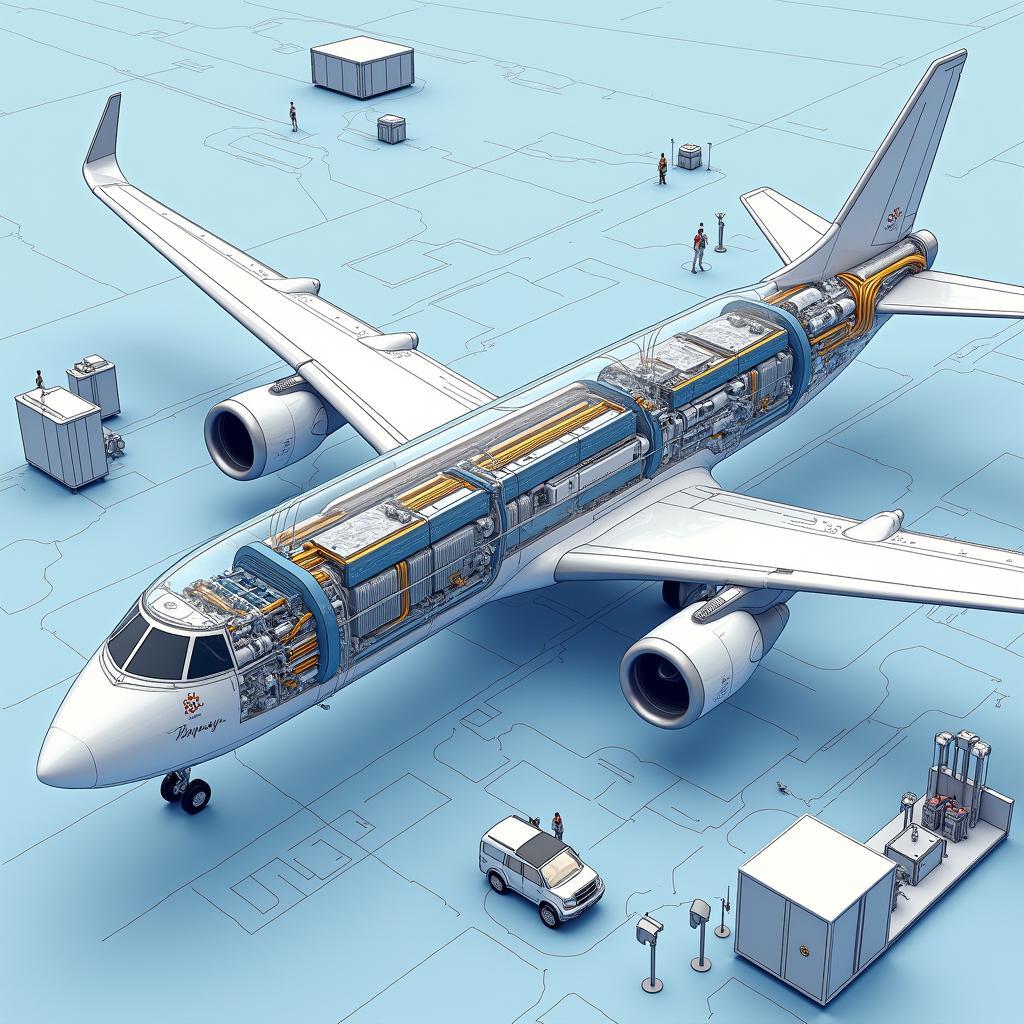 Công nghệ pin và hệ thống sạc cho máy bay điện trong IELTS Reading về hàng không xanh
Passage 3 – Essential Vocabulary
| Từ vựng | Loại từ | Phiên âm | Nghĩa tiếng Việt | Ví dụ từ bài | Collocation |
|---|---|---|---|---|---|
| paradigm shift | n phrase | /ˈpærədaɪm ʃɪft/ | thay đổi mô hình căn bản | embodies a paradigm shift | undergo paradigm shift |
| anthropogenic | adj | /ˌænθrəpəˈdʒenɪk/ | do con người gây ra | contributes to anthropogenic climate change | anthropogenic emissions |
| intricate | adj | /ˈɪntrɪkət/ | phức tạp, rắc rối | intricate interplay between technology and policy | intricate details/system |
| decarbonization | n | /diːˌkɑːbənaɪˈzeɪʃən/ | khử carbon | in the context of decarbonization imperatives | energy decarbonization |
| disproportionate | adj | /ˌdɪsprəˈpɔːʃənət/ | không cân đối, quá mức | grants disproportionate influence to oil-producing nations | disproportionate impact/share |
| decouple | v | /diːˈkʌpl/ | tách rời | by decoupling air transportation from fossil fuel | decouple from/between |
| geographically concentrated | adj phrase | /ˌdʒiːəˈɡræfɪkli ˈkɒnsəntreɪtɪd/ | tập trung về mặt địa lý | global reserves are geographically concentrated | geographically concentrated resources |
| sphere of influence | n phrase | /sfɪər əv ˈɪnfluəns/ | phạm vi ảnh hưởng | creating new spheres of influence | expand sphere of influence |
| cascading effect | n phrase | /kæsˈkeɪdɪŋ ɪˈfekt/ | hiệu ứng dây chuyền | could have cascading effects on urban development | trigger cascading effects |
| lifecycle assessment | n phrase | /ˈlaɪfsaɪkəl əˈsesmənt/ | đánh giá vòng đời | lifecycle environmental assessment presents a nuanced picture | conduct lifecycle assessment |
| energy-intensive | adj | /ˈenədʒi ɪnˈtensɪv/ | tốn nhiều năng lượng | Battery production is energy-intensive | energy-intensive process/industry |
| prerequisite | n | /ˌpriːˈrekwəzɪt/ | điều kiện tiên quyết | becomes a prerequisite for realizing | essential prerequisite |
| stranded assets | n phrase | /ˈstrændɪd ˈæsets/ | tài sản bị mắc kẹt | representing billions in stranded assets | risk of stranded assets |
| catalyze | v | /ˈkætəlaɪz/ | xúc tác, thúc đẩy | Electric aviation is catalyzing a reconfiguration | catalyze change/growth |
| leapfrog | v | /ˈliːpfrɒɡ/ | nhảy vọt | might leapfrog conventional technologies | leapfrog development/technology |
| multilateral | adj | /ˌmʌltiˈlætərəl/ | đa phương | Multilateral negotiations through organizations | multilateral agreement/cooperation |
| interoperability | n | /ˌɪntərˌɒpərəˈbɪləti/ | khả năng tương tác | with limited interoperability | ensure interoperability |
Kết Bài
Chủ đề impact of electric aviation on global air travel không chỉ là một xu hướng công nghệ đơn thuần mà còn phản ánh những thay đổi sâu rộng trong cách chúng ta tiếp cận vấn đề môi trường và phát triển bền vững. Qua bài thi mẫu này, bạn đã được trải nghiệm một bộ đề IELTS Reading hoàn chỉnh với 3 passages có độ khó tăng dần, bao gồm đầy đủ 40 câu hỏi và 7 dạng bài khác nhau.
Passage 1 giới thiệu những khái niệm cơ bản về hàng không điện, phù hợp với học viên band 5.0-6.5 đang xây dựng nền tảng. Passage 2 đi sâu vào các thách thức kỹ thuật và kinh tế, yêu cầu khả năng hiểu sâu hơn ở mức band 6.0-7.5. Passage 3 phân tích những tác động địa chính trị và môi trường phức tạp, đòi hỏi kỹ năng đọc hiểu ở trình độ band 7.0-9.0.
Đáp án chi tiết kèm giải thích đã chỉ ra cách xác định thông tin trong bài, kỹ thuật paraphrase và chiến lược làm bài cho từng dạng câu hỏi. Bảng từ vựng tổng hợp hơn 35 từ và cụm từ quan trọng sẽ giúp bạn mở rộng vốn từ học thuật, đặc biệt trong các lĩnh vực công nghệ, môi trường và kinh tế.
Để đạt hiệu quả cao nhất, hãy luyện tập bài này theo đúng thời gian quy định (60 phút), sau đó đối chiếu đáp án và đọc kỹ phần giải thích. Ghi chép lại những từ vựng mới và luyện tập sử dụng chúng trong ngữ cảnh. Những chủ đề tương tự về công nghệ xanh và biến đổi khí hậu thường xuyên xuất hiện trong IELTS, vì vậy việc nắm vững nội dung này sẽ mang lại lợi thế lớn cho kỳ thi của bạn.
Chúc bạn ôn tập hiệu quả và đạt được band điểm mong muốn trong kỳ thi IELTS sắp tới!


