Giới Thiệu
Chủ đề năng lượng tái tạo và tác động của nó lên ngành công nghiệp nhiên liệu hóa thạch đang là một trong những vấn đề nóng bỏng nhất trong các kỳ thi IELTS gần đây. Theo thống kê từ Cambridge IELTS và British Council, chủ đề về năng lượng, môi trường và phát triển bền vững xuất hiện với tần suất cao trong phần Reading, đặc biệt là ở Passage 2 và Passage 3 với độ khó từ trung bình đến nâng cao.
Bài viết này cung cấp cho bạn một bộ đề thi IELTS Reading hoàn chỉnh gồm 3 passages với độ khó tăng dần, từ band 5.0 đến 9.0. Bạn sẽ được luyện tập với đầy đủ 40 câu hỏi theo đúng format thi thật, bao gồm đa dạng các dạng câu hỏi phổ biến như True/False/Not Given, Matching Headings, Summary Completion, và Multiple Choice. Mỗi câu hỏi đều đi kèm với đáp án chi tiết, giải thích cặn kẽ về cách tìm thông tin, kỹ thuật paraphrase, và chiến lược làm bài hiệu quả.
Ngoài ra, bạn sẽ nhận được bộ từ vựng quan trọng được phân loại theo từng passage, kèm phiên âm, nghĩa tiếng Việt, ví dụ thực tế và collocations hữu ích. Đề thi này phù hợp cho học viên từ band 5.0 trở lên, giúp bạn làm quen với văn phong học thuật và nâng cao khả năng đọc hiểu trong bối cảnh thi thật.
Hướng Dẫn Làm Bài IELTS Reading
Tổng Quan Về IELTS Reading Test
IELTS Reading Test kéo dài 60 phút và bao gồm 3 passages với tổng cộng 40 câu hỏi. Mỗi passage có độ khó tăng dần, yêu cầu kỹ năng đọc hiểu và phân tích ngày càng cao. Điểm số được tính dựa trên số câu trả lời đúng, không bị trừ điểm khi sai.
Phân bổ thời gian khuyến nghị:
- Passage 1: 15-17 phút (13 câu hỏi) – Độ khó Easy
- Passage 2: 18-20 phút (13 câu hỏi) – Độ khó Medium
- Passage 3: 23-25 phút (14 câu hỏi) – Độ khó Hard
Lưu ý dành 2-3 phút cuối để chuyển đáp án vào answer sheet và kiểm tra lại các câu trả lời.
Các Dạng Câu Hỏi Trong Đề Này
Đề thi mẫu này bao gồm 7 dạng câu hỏi phổ biến nhất trong IELTS Reading:
- Multiple Choice – Trắc nghiệm nhiều lựa chọn
- True/False/Not Given – Xác định tính đúng/sai của thông tin
- Matching Information – Nối thông tin với đoạn văn
- Summary Completion – Hoàn thành đoạn tóm tắt
- Matching Headings – Nối tiêu đề với đoạn văn
- Sentence Completion – Hoàn thành câu
- Short-answer Questions – Câu hỏi trả lời ngắn
IELTS Reading Practice Test
PASSAGE 1 – The Dawn of Renewable Energy Revolution
Độ khó: Easy (Band 5.0-6.5)
Thời gian đề xuất: 15-17 phút
The global energy landscape is undergoing a dramatic transformation as renewable energy sources increasingly challenge the dominance of fossil fuels. For over a century, coal, oil, and natural gas have powered industrial development and modern civilization, but their reign is now being contested by cleaner alternatives. This shift represents not merely a technological evolution, but a fundamental reimagining of how humanity produces and consumes energy.
Solar and wind power have emerged as the frontrunners in this renewable revolution. In 2010, global solar capacity stood at just 40 gigawatts; by 2023, this figure had skyrocketed to over 1,000 gigawatts. Wind energy has followed a similar trajectory, with worldwide installations growing from 198 gigawatts in 2010 to more than 900 gigawatts today. These exponential growth rates far exceed the predictions made by energy analysts just a decade ago, surprising even the most optimistic supporters of renewable technology.
The economic competitiveness of renewables has become a game-changer in the energy sector. The levelized cost of electricity (LCOE) from solar photovoltaic panels has plummeted by approximately 90% since 2010, making solar power cheaper than coal in many regions. Wind energy costs have similarly declined by around 70% over the same period. This dramatic cost reduction has been driven by technological improvements, economies of scale, and increased competition among manufacturers, particularly in China, which produces over 70% of the world’s solar panels.
Governments worldwide have played a crucial role in accelerating this transition through policy interventions. The European Union has committed to achieving carbon neutrality by 2050, with intermediate targets requiring member states to generate at least 40% of their electricity from renewable sources by 2030. China, despite being the world’s largest consumer of coal, has become the global leader in renewable energy investment, spending over $150 billion annually on clean energy projects. Even in the United States, where fossil fuel interests remain powerful, renewable energy installations have continued to grow rapidly, driven primarily by market forces rather than government mandates.
The impact of renewable energy growth on fossil fuel consumption has been most pronounced in the electricity generation sector. In many developed countries, coal-fired power plants are being retired at an accelerating pace. Germany has closed more than half of its coal capacity since 2010, while the United Kingdom went an entire month without using coal for electricity generation in 2020 – a milestone unimaginable just a few years earlier. Natural gas, once considered a “bridge fuel” to a low-carbon future, is now facing increasing competition from renewables in many markets.
However, the renewable energy transition faces several significant challenges. The intermittent nature of solar and wind power – they only generate electricity when the sun shines or wind blows – requires substantial investment in energy storage systems and grid infrastructure. Current battery technology, while improving rapidly, remains expensive for large-scale applications. Additionally, some industries, particularly aviation, shipping, and heavy manufacturing, continue to rely heavily on fossil fuels because renewable alternatives are not yet economically viable or technologically mature for these applications.
The geopolitical implications of this energy shift are profound. Countries that built their wealth and influence on fossil fuel exports, such as Saudi Arabia, Russia, and Venezuela, face an uncertain future as global oil demand plateaus and potentially begins to decline. Meanwhile, nations with abundant renewable resources or advanced clean energy technology – like Iceland with its geothermal potential or Denmark with its wind expertise – are positioning themselves as the energy superpowers of tomorrow. This redistribution of energy power could reshape international relations and global trade patterns in ways that are only beginning to emerge.
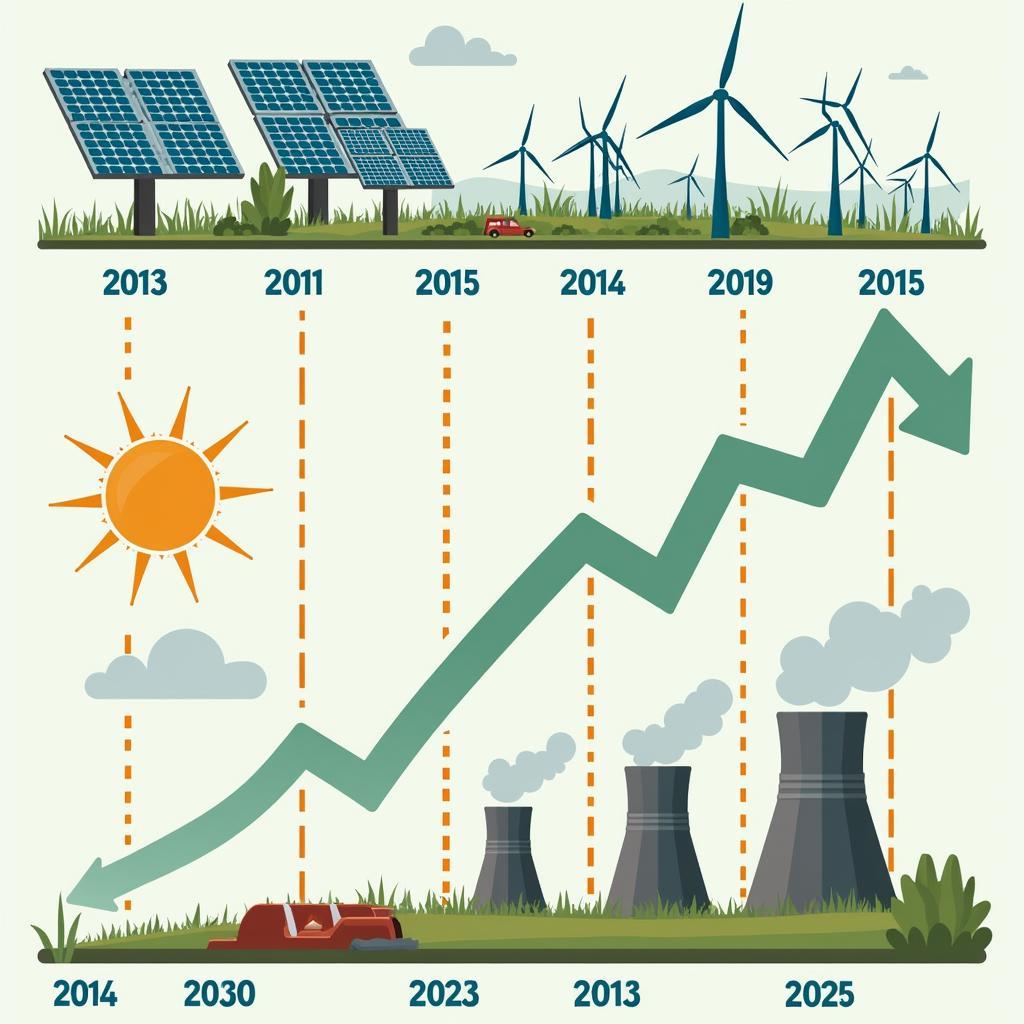 Quá trình chuyển đổi từ năng lượng hóa thạch sang năng lượng tái tạo trên toàn cầu
Questions 1-6
Do the following statements agree with the information given in Passage 1?
Write:
- TRUE if the statement agrees with the information
- FALSE if the statement contradicts the information
- NOT GIVEN if there is no information on this
- Solar energy capacity increased by more than twenty-five times between 2010 and 2023.
- China manufactures the majority of the world’s solar panels.
- The United States government has mandated that all states must use renewable energy.
- Germany has eliminated all of its coal-powered electricity plants.
- Battery storage technology costs are decreasing rapidly.
- Saudi Arabia has successfully transitioned its economy away from oil dependence.
Questions 7-10
Complete the sentences below.
Choose NO MORE THAN THREE WORDS from the passage for each answer.
- The cost of electricity from solar panels, known as __, has decreased by about 90% since 2010.
- The European Union aims to reach __ by the year 2050.
- Solar and wind power are described as having an __, meaning they do not produce electricity continuously.
- Countries with strong renewable energy capabilities are described as __ of the future.
Questions 11-13
Choose the correct letter, A, B, C, or D.
-
According to the passage, what was unexpected about renewable energy growth?
- A) The speed at which costs decreased
- B) The level of government support provided
- C) The rate of capacity expansion exceeded forecasts
- D) The opposition from fossil fuel companies
-
Which sector has seen the greatest impact from renewable energy?
- A) Transportation
- B) Electricity generation
- C) Heavy manufacturing
- D) Aviation
-
The passage suggests that natural gas was previously viewed as:
- A) A permanent replacement for coal
- B) An temporary solution during the transition to renewables
- C) More harmful than coal
- D) Incompatible with renewable energy
PASSAGE 2 – The Economic Disruption of Fossil Fuel Industries
Độ khó: Medium (Band 6.0-7.5)
Thời gian đề xuất: 18-20 phút
The ascendancy of renewable energy technologies has precipitated an unprecedented economic disruption across the fossil fuel sector, fundamentally altering the financial calculus that has governed energy markets for generations. This transformation extends far beyond simple market share competition; it represents a systemic reconfiguration of capital flows, corporate valuations, and investment strategies that is reverberating through global financial markets with profound and often unanticipated consequences.
Financial divestment from fossil fuel assets has emerged as a powerful force reshaping energy economics. Institutional investors controlling assets worth over $40 trillion have now committed to some form of fossil fuel divestment, whether complete withdrawal from coal, oil, and gas holdings or more nuanced strategies that exclude the most carbon-intensive segments. This movement, which began with university endowments and faith-based organizations, has been embraced by mainstream financial institutions including major pension funds, insurance companies, and sovereign wealth funds. The Norwegian Government Pension Fund, the world’s largest sovereign wealth fund with assets exceeding $1.3 trillion, has systematically divested from companies whose business models depend on thermal coal extraction or generate more than 30% of their revenue from coal-based activities.
The concept of “stranded assets” has become central to discussions of fossil fuel economics. This term refers to fossil fuel reserves and infrastructure that may lose economic value well before the end of their anticipated operational lifetime due to changes in regulation, market conditions, or technology. Carbon Tracker, a financial think tank, estimates that up to $900 billion in planned oil and gas projects could become economically unviable if the world successfully limits global warming to 1.5°C above pre-industrial levels, as outlined in the Paris Agreement. Coal assets face even greater vulnerability, with some analysts suggesting that the majority of the world’s coal reserves will remain permanently unexploited – effectively worthless from an economic perspective despite their physical presence.
The renewable energy sector has demonstrated remarkably different investment characteristics compared to traditional fossil fuel projects. While oil and gas developments typically require substantial upfront capital expenditure followed by ongoing extraction costs and volatile revenue streams dependent on commodity prices, renewable installations involve higher initial costs but subsequently benefit from near-zero marginal operating expenses. Solar and wind facilities essentially convert sunlight and wind – free, inexhaustible resources – into electricity once the capital infrastructure is in place. This fundamental economic distinction has made renewables increasingly attractive to investors seeking predictable long-term returns, particularly in an era of historically low interest rates where the stable cash flows from operational wind and solar farms command premium valuations.
Tương tự như challenges in renewable energy adoption, the transition has created a bifurcated employment landscape within the energy sector. While approximately 11 million people work in renewable energy industries globally – a figure that has more than doubled since 2015 – the fossil fuel sector has experienced substantial job losses, particularly in coal mining regions. The geographical concentration of fossil fuel employment in specific regions has made this transition socially and politically contentious. In the United States, for example, coal mining employment has declined from over 150,000 workers in 1985 to fewer than 50,000 today, with devastating effects on communities in Appalachia and Wyoming that built their entire economic identities around extraction industries.
The oil and gas sector has responded to the renewable challenge with diverse strategies that reflect divergent corporate philosophies and regional contexts. European energy majors such as BP, Shell, and TotalEnergies have announced ambitious plans to transform themselves into “integrated energy companies,” committing significant capital to renewable projects and, in some cases, explicit targets to reduce oil and gas production. BP, for instance, has pledged to reduce its oil and gas output by 40% by 2030 while increasing its renewable energy capacity twenty-fold. By contrast, American oil companies like ExxonMobil and Chevron have largely maintained their focus on hydrocarbon production, arguing that global energy demand will continue to require substantial oil and gas supply for decades and that their role should be to produce these resources as efficiently and cleanly as possible.
 Biểu đồ so sánh đầu tư vào năng lượng tái tạo và nhiên liệu hóa thạch qua các năm
Market volatility has become an increasingly prominent feature of fossil fuel economics. The COVID-19 pandemic provided a stark illustration of this vulnerability when oil prices briefly turned negative in April 2020 – a historically unprecedented event – as storage capacity became saturated and demand collapsed. While prices subsequently recovered, the episode underscored the precarious position of an industry facing simultaneous challenges from renewable competition, climate policy, and demand uncertainty. The International Energy Agency’s projection that global oil demand may peak before 2030 has introduced a new element of temporal urgency into investment decisions, as companies grapple with the possibility that today’s investments in new extraction capacity may not generate returns before market conditions fundamentally deteriorate.
The financial performance metrics of renewable versus fossil fuel companies have diverged markedly in recent years, with profound implications for capital allocation. Between 2015 and 2023, the market capitalization of leading renewable energy companies and manufacturers such as NextEra Energy and Vestas increased by an average of 250%, while major oil companies saw their valuations stagnate or decline. The price-to-earnings ratios commanded by renewable companies typically exceed those of fossil fuel counterparts by a factor of two or more, reflecting investor expectations of sustained growth in the former and structural decline in the latter. This valuation differential has created a self-reinforcing dynamic whereby renewable companies can access capital more easily and cheaply, further accelerating their competitive advantage.
Questions 14-18
Choose the correct letter, A, B, C, or D.
-
What does the passage say about fossil fuel divestment?
- A) It has been rejected by mainstream financial institutions
- B) It began with large pension funds
- C) It involves over $40 trillion in committed assets
- D) It only applies to coal investments
-
According to the passage, “stranded assets” refers to:
- A) Fossil fuel reserves that are difficult to access
- B) Renewable energy projects that have failed
- C) Fossil fuel resources that may lose value prematurely
- D) Oil infrastructure damaged by climate change
-
How do renewable energy projects differ economically from fossil fuel projects?
- A) They require less initial investment
- B) They have higher ongoing operational costs
- C) They provide more volatile revenue streams
- D) They have near-zero marginal operating costs after installation
-
The passage indicates that European energy companies have:
- A) Completely abandoned oil and gas production
- B) Announced plans to become integrated energy companies
- C) Focused exclusively on hydrocarbon extraction
- D) Reduced renewable investments due to low returns
-
What does the passage suggest about oil prices during COVID-19?
- A) They remained stable throughout the pandemic
- B) They temporarily became negative
- C) They increased due to reduced supply
- D) They were unaffected by demand changes
Questions 19-23
Complete the summary below.
Choose NO MORE THAN TWO WORDS from the passage for each answer.
The Norwegian Government Pension Fund has removed investments from companies involved in (19) __ or those generating significant revenue from coal. The concept of (20) __ describes fossil fuel resources that may become worthless before their expected lifespan ends. Unlike fossil fuel projects with (21) __ that depend on commodity prices, renewable installations benefit from predictable income once built. The oil price crisis in April 2020, when prices briefly turned (22) __, demonstrated the industry’s vulnerability. Renewable energy companies now command higher (23) __ ratios compared to oil companies, reflecting expectations of continued growth.
Questions 24-26
Do the following statements agree with the information given in Passage 2?
Write:
- YES if the statement agrees with the views of the writer
- NO if the statement contradicts the views of the writer
- NOT GIVEN if it is impossible to say what the writer thinks about this
- The geographical concentration of fossil fuel jobs has made the energy transition politically difficult.
- American oil companies have been more aggressive than European companies in transitioning to renewables.
- The renewable energy sector currently employs more people globally than the fossil fuel industry.
PASSAGE 3 – Technological Innovation and the Future Energy Paradigm
Độ khó: Hard (Band 7.0-9.0)
Thời gian đề xuất: 23-25 phút
The inexorable displacement of fossil fuels by renewable energy systems represents far more than a straightforward substitution of one energy source for another; it epitomizes a fundamental reconceptualization of energy infrastructure, predicated on decentralization, digitalization, and the seamless integration of previously discrete technological domains. This paradigmatic transformation is being catalyzed by a confluence of innovations spanning energy storage, smart grid technologies, artificial intelligence, and novel materials science, each reinforcing the others in a synergistic process that is reconfiguring the techno-economic landscape of global energy systems with implications that extend well beyond the energy sector per se.
Energy storage technology, long identified as the Achilles heel of renewable energy systems, has undergone dramatic advances that are fundamentally altering the competitive dynamics between renewables and fossil fuels. Lithium-ion battery costs have declined from approximately $1,200 per kilowatt-hour in 2010 to under $140 per kilowatt-hour in 2023, crossing the critical threshold at which battery-backed renewable electricity becomes economically competitive with fossil fuel peaker plants – the gas-fired facilities traditionally used to meet periods of high electricity demand. Simultaneously, alternative storage technologies are emerging from research laboratories into commercial deployment. Flow batteries, which store energy in liquid electrolytes that can be scaled independently of power capacity, offer the potential for multi-day energy storage at costs approaching $100 per kilowatt-hour for duration-intensive applications. Compressed air energy storage, thermal storage systems utilizing molten salt, and even mechanical approaches such as raising weights in disused mine shafts are being deployed at utility scale, each optimized for particular temporal and economic niches within an increasingly diversified storage ecosystem.
For insights into how this technological shift affects employment patterns, consider how is renewable energy impacting job markets, which examines the broader economic implications of this transition.
The convergence of renewable energy systems with digital technologies has given rise to the concept of the “smart grid” – an electricity network characterized by bidirectional power and information flows that enable unprecedented levels of optimization and responsiveness. Advanced metering infrastructure, deploying over one billion smart meters globally, provides granular real-time data on electricity consumption patterns, enabling dynamic pricing mechanisms that incentivize demand shifting to periods of high renewable generation. Machine learning algorithms analyze vast datasets encompassing weather forecasts, historical demand patterns, electricity prices, and grid conditions to optimize the dispatching of diverse generation assets and storage systems, extracting maximum value from renewable resources while maintaining grid stability. In regions with high renewable penetration, such as South Australia, artificial intelligence systems now autonomously manage instantaneous supply-demand balancing with a precision and speed unattainable through traditional human-operated control systems.
The electrification of end-use sectors traditionally dependent on direct fossil fuel combustion represents another crucial dimension of the renewable transition with profound ramifications for oil and gas demand. The transportation sector, responsible for approximately 60% of global oil consumption, is experiencing rapid electrification driven by technological improvements and policy interventions. Electric vehicle (EV) batteries have experienced cost reductions and energy density improvements paralleling those in stationary storage, with costs declining from over $1,000 per kilowatt-hour in 2010 to approximately $130 per kilowatt-hour today – approaching the estimated threshold of $100 per kilowatt-hour at which EVs achieve purchase price parity with internal combustion vehicles without subsidies. The International Energy Agency projects that EVs will displace approximately 5 million barrels per day of oil demand by 2030, equivalent to more than 5% of current global consumption, with this figure potentially doubling by 2040.
This trend parallels what is discussed in impact of electric vehicles on global oil consumption, where the relationship between transportation electrification and petroleum demand is explored in greater depth.
Hydrogen, produced through the electrolysis of water using renewable electricity, has emerged as a potentially transformative energy carrier for decarbonizing sectors recalcitrant to direct electrification, including heavy industry, long-distance shipping, and aviation. While hydrogen’s role in the future energy system remains subject to considerable debate – with skeptics highlighting substantial inefficiencies in the electricity-to-hydrogen-to-end-use conversion process and formidable infrastructure requirements – numerous governments and corporations have announced ambitious “hydrogen strategies” committing billions in investment. The European Union’s hydrogen strategy envisions 40 gigawatts of renewable hydrogen electrolysis capacity by 2030, while Japan and South Korea have positioned hydrogen as central to their decarbonization pathways. If these initiatives achieve their stated objectives, green hydrogen could displace significant quantities of natural gas in industrial processes and potentially create entirely new energy value chains independent of fossil fuel infrastructure.
To understand the challenges facing this transformation, the rise of energy-efficient data centers provides context on how technological efficiency improvements are reshaping energy demand patterns.
The geopolitical and macroeconomic implications of this technological transformation extend far beyond energy markets themselves. The shift from fossil fuels to renewable energy systems represents a transition from scarce, geographically concentrated resources requiring continuous extraction to technologies based on abundant, widely distributed resources requiring manufacturing capacity. This reconceptualization fundamentally alters the sources of strategic advantage in energy systems. While oil and gas reserves are concentrated in specific regions – the Middle East contains approximately 50% of conventional oil reserves – solar and wind resources, though variable in intensity, exist in some form across virtually all geographies. Technological capability and manufacturing scale rather than resource endowment become the determinants of energy competitiveness and security.
Similarly, how is the rise of electric vehicles impacting global oil markets explores how changing transportation patterns are creating new dynamics in global energy markets.
However, this transition creates new resource dependencies and potential vulnerabilities. Renewable energy technologies and battery storage systems require substantial quantities of specific minerals including lithium, cobalt, rare earth elements, and copper. Global lithium demand is projected to increase forty-fold by 2040 relative to 2020 levels if current electrification trajectories continue, while cobalt demand could increase twenty-fold. These materials exhibit their own patterns of geographic concentration – the Democratic Republic of Congo produces approximately 70% of the world’s cobalt, China dominates rare earth production and refining, and Chile and Australia control the majority of lithium supply. This has prompted concerns about “swapping one resource dependency for another,” though proponents argue that minerals, unlike fossil fuels, can be recycled and that supply sources are more geographically diverse and politically stable than major oil exporters.
 Hệ thống công nghệ lưu trữ năng lượng hiện đại và lưới điện thông minh tích hợp AI
The fossil fuel industry’s response to these technological disruptions has been characterized by considerable heterogeneity, reflecting divergent assessments of the pace and depth of the energy transition. Some major oil companies have begun repositioning themselves as “energy companies” rather than specifically oil and gas producers, investing in renewable generation, EV charging infrastructure, and hydrogen production. Shell, for instance, has committed to deploying 500,000 EV charging points globally by 2025 and has acquired renewable energy companies including European solar developer Savion. Other fossil fuel producers, particularly in the United States, have maintained a more skeptical stance, arguing that continued global population growth, economic development in emerging markets, and the inherent limitations of renewable technologies will sustain substantial fossil fuel demand for decades. These companies have focused on improving the carbon intensity of their operations through methane reduction and carbon capture technologies rather than fundamentally diversifying their business models.
Questions 27-31
Choose the correct letter, A, B, C, or D.
-
According to the passage, what makes the current energy transition different from simple substitution?
- A) It involves government regulations
- B) It represents a fundamental reconceptualization of energy infrastructure
- C) It only affects electricity generation
- D) It is limited to developed countries
-
What does the passage identify as the “Achilles heel” of renewable energy?
- A) High installation costs
- B) Geographic limitations
- C) Energy storage technology
- D) Government policy uncertainty
-
How do machine learning algorithms contribute to renewable energy systems?
- A) They design solar panels
- B) They reduce manufacturing costs
- C) They optimize dispatching of generation assets and maintain grid stability
- D) They predict long-term climate patterns
-
What is the estimated threshold cost for EV batteries to achieve price parity with combustion vehicles?
- A) $1,000 per kilowatt-hour
- B) $140 per kilowatt-hour
- C) $130 per kilowatt-hour
- D) $100 per kilowatt-hour
-
According to the passage, what becomes more important than resource endowment in renewable energy systems?
- A) Geographic location
- B) Political stability
- C) Technological capability and manufacturing scale
- D) Population size
Questions 32-37
Complete the summary using the list of words/phrases, A-L, below.
The transition to renewable energy involves multiple technological innovations working together. Energy storage costs have declined dramatically, with lithium-ion batteries dropping from $1,200 to under $140 per (32) __. Alternative technologies like (33) __ offer potential for extended energy storage. Smart grids enable (34) __ power flows and use (35) __ to optimize system performance. The transportation sector is being transformed through (36) __, which will significantly reduce oil demand. For industries difficult to electrify directly, (37) __ produced from renewable electricity offers a potential solution.
A. bidirectional
B. kilowatt-hour
C. machine learning
D. flow batteries
E. electrification
F. hydrogen
G. natural gas
H. solar panels
I. unidirectional
J. wind turbines
K. coal replacement
L. nuclear fusion
Questions 38-40
Answer the questions below.
Choose NO MORE THAN THREE WORDS AND/OR A NUMBER from the passage for each answer.
- What percentage of conventional oil reserves are located in the Middle East?
- Which country produces approximately 70% of the world’s cobalt?
- How many EV charging points has Shell committed to deploying globally by 2025?
Answer Keys – Đáp Án
PASSAGE 1: Questions 1-13
- TRUE
- TRUE
- NOT GIVEN
- FALSE
- NOT GIVEN
- NOT GIVEN
- levelized cost of electricity / LCOE
- carbon neutrality
- intermittent nature
- energy superpowers
- C
- B
- B
PASSAGE 2: Questions 14-26
- C
- C
- D
- B
- B
- thermal coal (extraction)
- stranded assets
- volatile revenue streams
- negative
- price-to-earnings
- YES
- NO
- NOT GIVEN
PASSAGE 3: Questions 27-40
- B
- C
- C
- D
- C
- B
- D
- A
- C
- E
- F
- 50% / approximately 50%
- Democratic Republic of Congo / DRC
- 500,000
Giải Thích Đáp Án Chi Tiết
Passage 1 – Giải Thích
Câu 1: TRUE
- Dạng câu hỏi: True/False/Not Given
- Từ khóa: Solar energy capacity, increased, twenty-five times, 2010-2023
- Vị trí trong bài: Đoạn 2, dòng 2-3
- Giải thích: Bài viết nêu rõ “In 2010, global solar capacity stood at just 40 gigawatts; by 2023, this figure had skyrocketed to over 1,000 gigawatts.” Tính toán: 1,000 ÷ 40 = 25 lần. Từ “skyrocketed” được paraphrase thành “increased”, con số chính xác khớp với phát biểu trong câu hỏi.
Câu 2: TRUE
- Dạng câu hỏi: True/False/Not Given
- Từ khóa: China, manufactures, majority, solar panels
- Vị trí trong bài: Đoạn 3, dòng 5-6
- Giải thích: Đoạn văn khẳng định “particularly in China, which produces over 70% of the world’s solar panels.” Từ “over 70%” rõ ràng là “majority” (đa số), và “produces” đồng nghĩa với “manufactures”.
Câu 4: FALSE
- Dạng câu hỏi: True/False/Not Given
- Từ khóa: Germany, eliminated all, coal-powered plants
- Vị trí trong bài: Đoạn 5, dòng 2-3
- Giải thích: Bài viết chỉ nói “Germany has closed more than half of its coal capacity since 2010”, có nghĩa là đóng hơn một nửa, không phải tất cả. “More than half” khác hoàn toàn với “all”, do đó câu này sai.
Câu 7: levelized cost of electricity / LCOE
- Dạng câu hỏi: Sentence Completion
- Từ khóa: cost of electricity, solar panels, decreased by 90%
- Vị trí trong bài: Đoạn 3, dòng 1-2
- Giải thích: Cụm từ chính xác trong bài là “The levelized cost of electricity (LCOE) from solar photovoltaic panels has plummeted by approximately 90% since 2010.” Đây là thuật ngữ kỹ thuật được viết in nghiêng, chỉ chi phí sản xuất điện bình quân.
Câu 11: C
- Dạng câu hỏi: Multiple Choice
- Từ khóa: unexpected, renewable energy growth
- Vị trí trong bài: Đoạn 2, dòng cuối
- Giải thích: Câu “These exponential growth rates far exceed the predictions made by energy analysts just a decade ago, surprising even the most optimistic supporters” cho thấy tốc độ tăng trưởng công suất vượt xa dự báo. “Exceed predictions” được paraphrase thành “exceeded forecasts” ở đáp án C.
Câu 12: B
- Dạng câu hỏi: Multiple Choice
- Từ khóa: sector, greatest impact, renewable energy
- Vị trí trong bài: Đoạn 5, câu đầu
- Giải thích: Câu mở đầu đoạn 5 nêu rõ “The impact of renewable energy growth on fossil fuel consumption has been most pronounced in the electricity generation sector.” Cụm “most pronounced” có nghĩa là tác động lớn nhất, trả lời trực tiếp câu hỏi về sector chịu tác động nhiều nhất.
Passage 2 – Giải Thích
Câu 14: C
- Dạng câu hỏi: Multiple Choice
- Từ khóa: fossil fuel divestment
- Vị trí trong bài: Đoạn 2, câu đầu tiên
- Giải thích: “Institutional investors controlling assets worth over $40 trillion have now committed to some form of fossil fuel divestment” khớp chính xác với đáp án C. Các đáp án khác không được đề cập hoặc mâu thuẫn với thông tin trong bài.
Câu 15: C
- Dạng câu hỏi: Multiple Choice
- Từ khóa: stranded assets, refers to
- Vị trí trong bài: Đoạn 3, câu thứ 2
- Giải thích: Bài viết định nghĩa rõ ràng: “This term refers to fossil fuel reserves and infrastructure that may lose economic value well before the end of their anticipated operational lifetime.” Đây là paraphrase của đáp án C “may lose value prematurely”.
Câu 16: D
- Dạng câu hỏi: Multiple Choice
- Từ khóa: renewable energy projects, differ economically
- Vị trí trong bài: Đoạn 4, câu thứ 2
- Giải thích: Đoạn văn giải thích “renewable installations involve higher initial costs but subsequently benefit from near-zero marginal operating expenses.” Đây chính là đáp án D. Các đáp án khác mâu thuẫn với thông tin trong bài.
Câu 19: thermal coal (extraction)
- Dạng câu hỏi: Summary Completion
- Từ khóa: Norwegian Fund, divested from
- Vị trí trong bài: Đoạn 2, câu cuối
- Giải thích: “The Norwegian Government Pension Fund… has systematically divested from companies whose business models depend on thermal coal extraction.” Cụm từ chính xác cần điền là “thermal coal” hoặc “thermal coal extraction”.
Câu 24: YES
- Dạng câu hỏi: Yes/No/Not Given
- Từ khóa: geographical concentration, fossil fuel jobs, politically difficult
- Vị trí trong bài: Đoạn 5, câu thứ 3
- Giải thích: Bài viết khẳng định “The geographical concentration of fossil fuel employment in specific regions has made this transition socially and politically contentious.” Từ “contentious” (gây tranh cãi) đồng nghĩa với “difficult”, do đó câu này đúng theo quan điểm tác giả.
Câu 25: NO
- Dạng câu hỏi: Yes/No/Not Given
- Từ khóa: American oil companies, more aggressive, European companies
- Vị trí trong bài: Đoạn 6
- Giải thích: Đoạn 6 cho thấy xu hướng ngược lại: “European energy majors… have announced ambitious plans to transform” trong khi “American oil companies… have largely maintained their focus on hydrocarbon production.” Do đó, công ty Mỹ ít tích cực hơn, không phải nhiều hơn.
Passage 3 – Giải Thích
Câu 27: B
- Dạng câu hỏi: Multiple Choice
- Từ khóa: energy transition, different, simple substitution
- Vị trí trong bài: Đoạn 1, câu đầu
- Giải thích: Câu mở đầu nêu rõ “The inexorable displacement of fossil fuels… represents far more than a straightforward substitution… it epitomizes a fundamental reconceptualization of energy infrastructure.” Đây chính là đáp án B.
Câu 28: C
- Dạng câu hỏi: Multiple Choice
- Từ khóa: Achilles heel, renewable energy
- Vị trí trong bài: Đoạn 2, câu đầu
- Giải thích: “Energy storage technology, long identified as the Achilles heel of renewable energy systems” trả lời trực tiếp câu hỏi này. “Achilles heel” là điểm yếu chí mạng.
Câu 29: C
- Dạng câu hỏi: Multiple Choice
- Từ khóa: machine learning algorithms, contribute
- Vị trí trong bài: Đoạn 3, giữa đoạn
- Giải thích: “Machine learning algorithms analyze vast datasets… to optimize the dispatching of diverse generation assets and storage systems… while maintaining grid stability.” Đây là mô tả chính xác vai trò của AI trong hệ thống năng lượng.
Câu 30: D
- Dạng câu hỏi: Multiple Choice
- Từ khóa: threshold cost, EV batteries, price parity
- Vị trí trong bài: Đoạn 4, cuối đoạn
- Giải thích: Bài viết nêu rõ “approaching the estimated threshold of $100 per kilowatt-hour at which EVs achieve purchase price parity with internal combustion vehicles.” Con số $100 chính là đáp án D.
Câu 31: C
- Dạng câu hỏi: Multiple Choice
- Từ khóa: more important, resource endowment, renewable energy
- Vị trí trong bài: Đoạn 6, giữa đoạn
- Giải thích: “Technological capability and manufacturing scale rather than resource endowment become the determinants of energy competitiveness and security.” Câu này khẳng định công nghệ và quy mô sản xuất quan trọng hơn tài nguyên thiên nhiên.
Câu 38: 50% / approximately 50%
- Dạng câu hỏi: Short-answer Question
- Từ khóa: percentage, conventional oil reserves, Middle East
- Vị trí trong bài: Đoạn 6, giữa đoạn
- Giải thích: “the Middle East contains approximately 50% of conventional oil reserves” – câu trả lời trực tiếp và chính xác.
Câu 39: Democratic Republic of Congo / DRC
- Dạng câu hỏi: Short-answer Question
- Từ khóa: country, 70%, cobalt
- Vị trí trong bài: Đoạn 7, giữa đoạn
- Giải thích: “the Democratic Republic of Congo produces approximately 70% of the world’s cobalt” – thông tin chính xác về sản xuất cobalt toàn cầu.
Câu 40: 500,000
- Dạng câu hỏi: Short-answer Question
- Từ khóa: Shell, EV charging points, 2025
- Vị trí trong bài: Đoạn cuối, câu thứ 2
- Giải thích: “Shell… has committed to deploying 500,000 EV charging points globally by 2025” – con số cụ thể về kế hoạch của Shell.
Từ Vựng Quan Trọng Theo Passage
Passage 1 – Essential Vocabulary
| Từ vựng | Loại từ | Phiên âm | Nghĩa tiếng Việt | Ví dụ từ bài | Collocation |
|---|---|---|---|---|---|
| dramatic transformation | n. phrase | /drəˈmætɪk ˌtrænsfəˈmeɪʃn/ | Sự chuyển đổi mạnh mẽ | The global energy landscape is undergoing a dramatic transformation | undergo transformation, witness transformation |
| dominance | n. | /ˈdɒmɪnəns/ | Sự thống trị | challenge the dominance of fossil fuels | maintain dominance, establish dominance |
| frontrunners | n. | /ˈfrʌntˌrʌnəz/ | Những đối thủ dẫn đầu | Solar and wind power have emerged as the frontrunners | emerge as frontrunners, remain frontrunners |
| skyrocketed | v. | /ˈskaɪˌrɒkɪtɪd/ | Tăng vọt | this figure had skyrocketed to over 1,000 gigawatts | prices skyrocket, demand skyrockets |
| exponential growth | n. phrase | /ˌekspəˈnenʃl ɡrəʊθ/ | Tăng trưởng theo cấp số nhân | These exponential growth rates far exceed predictions | achieve exponential growth, experience exponential growth |
| game-changer | n. | /ˈɡeɪm ˌtʃeɪndʒə/ | Yếu tố thay đổi cuộc chơi | economic competitiveness has become a game-changer | prove to be a game-changer, represent a game-changer |
| levelized cost | n. phrase | /ˈlevəlaɪzd kɒst/ | Chi phí bình quân hóa | The levelized cost of electricity has plummeted | calculate levelized cost, reduce levelized cost |
| economies of scale | n. phrase | /ɪˈkɒnəmiz əv skeɪl/ | Lợi thế kinh tế theo quy mô | driven by economies of scale | benefit from economies of scale, achieve economies of scale |
| carbon neutrality | n. phrase | /ˈkɑːbən njuːˈtræləti/ | Trạng thái trung hòa carbon | committed to achieving carbon neutrality by 2050 | reach carbon neutrality, commit to carbon neutrality |
| intermittent nature | n. phrase | /ˌɪntəˈmɪtənt ˈneɪtʃə/ | Tính chất gián đoạn | The intermittent nature of solar and wind power | address intermittent nature, overcome intermittent nature |
| geopolitical implications | n. phrase | /ˌdʒiːəʊpəˈlɪtɪkl ˌɪmplɪˈkeɪʃnz/ | Những tác động địa chính trị | The geopolitical implications are profound | consider geopolitical implications, analyze geopolitical implications |
Passage 2 – Essential Vocabulary
| Từ vựng | Loại từ | Phiên âm | Nghĩa tiếng Việt | Ví dụ từ bài | Collocation |
|---|---|---|---|---|---|
| precipitated | v. | /prɪˈsɪpɪteɪtɪd/ | Gây ra, thúc đẩy | has precipitated an unprecedented economic disruption | precipitate a crisis, precipitate change |
| systemic reconfiguration | n. phrase | /sɪˈstemɪk riːkənˌfɪɡjəˈreɪʃn/ | Sự tái cấu trúc hệ thống | represents a systemic reconfiguration of capital flows | undergo systemic reconfiguration, require systemic reconfiguration |
| divestment | n. | /daɪˈvestmənt/ | Rút vốn đầu tư | Financial divestment from fossil fuel assets | announce divestment, complete divestment |
| stranded assets | n. phrase | /ˈstrændɪd ˈæsets/ | Tài sản mắc cạn | The concept of stranded assets has become central | risk of stranded assets, value of stranded assets |
| upfront capital | n. phrase | /ˌʌpˈfrʌnt ˈkæpɪtl/ | Vốn ban đầu | require substantial upfront capital expenditure | invest upfront capital, raise upfront capital |
| volatile revenue | n. phrase | /ˈvɒlətaɪl ˈrevənjuː/ | Doanh thu biến động | volatile revenue streams dependent on prices | generate volatile revenue, face volatile revenue |
| marginal operating expenses | n. phrase | /ˈmɑːdʒɪnl ˈɒpəreɪtɪŋ ɪkˈspensɪz/ | Chi phí vận hành biên | near-zero marginal operating expenses | minimize marginal expenses, reduce marginal expenses |
| bifurcated | adj. | /ˈbaɪfəkeɪtɪd/ | Phân đôi, chia làm hai | created a bifurcated employment landscape | bifurcated approach, bifurcated market |
| devastating effects | n. phrase | /ˈdevəsteɪtɪŋ ɪˈfekts/ | Tác động tàn phá | with devastating effects on communities | cause devastating effects, suffer devastating effects |
| market volatility | n. phrase | /ˈmɑːkɪt ˌvɒləˈtɪləti/ | Sự biến động thị trường | Market volatility has become increasingly prominent | experience market volatility, reduce market volatility |
| valuation differential | n. phrase | /ˌvæljuˈeɪʃn ˌdɪfəˈrenʃl/ | Chênh lệch định giá | This valuation differential has created dynamics | significant valuation differential, narrow valuation differential |
| self-reinforcing dynamic | n. phrase | /ˌself riːɪnˈfɔːsɪŋ daɪˈnæmɪk/ | Động lực tự củng cố | created a self-reinforcing dynamic | establish self-reinforcing dynamic, create self-reinforcing dynamic |
Passage 3 – Essential Vocabulary
| Từ vựng | Loại từ | Phiên âm | Nghĩa tiếng Việt | Ví dụ từ bài | Collocation |
|---|---|---|---|---|---|
| inexorable | adj. | /ɪnˈeksərəbl/ | Không thể cưỡng lại | The inexorable displacement of fossil fuels | inexorable trend, inexorable decline |
| epitomizes | v. | /ɪˈpɪtəmaɪzɪz/ | Tiêu biểu hóa | it epitomizes a fundamental reconceptualization | epitomize change, epitomize innovation |
| paradigmatic transformation | n. phrase | /ˌpærədɪɡˈmætɪk ˌtrænsfəˈmeɪʃn/ | Sự chuyển đổi mô hình | This paradigmatic transformation is being catalyzed | undergo paradigmatic transformation, represent paradigmatic transformation |
| confluence | n. | /ˈkɒnfluəns/ | Sự hợp lưu | catalyzed by a confluence of innovations | confluence of factors, confluence of events |
| synergistic process | n. phrase | /ˌsɪnəˈdʒɪstɪk ˈprəʊses/ | Quá trình hiệp đồng | each reinforcing in a synergistic process | create synergistic process, benefit from synergistic process |
| Achilles heel | n. phrase | /əˌkɪliːz ˈhiːl/ | Điểm yếu chí mạng | long identified as the Achilles heel | expose Achilles heel, protect Achilles heel |
| critical threshold | n. phrase | /ˈkrɪtɪkl ˈθreʃhəʊld/ | Ngưỡng quyết định | crossing the critical threshold | reach critical threshold, exceed critical threshold |
| bidirectional flows | n. phrase | /ˌbaɪdɪˈrekʃənl fləʊz/ | Dòng chảy hai chiều | characterized by bidirectional power flows | enable bidirectional flows, support bidirectional flows |
| granular real-time data | n. phrase | /ˈɡrænjʊlə ˌrɪəl ˈtaɪm ˈdeɪtə/ | Dữ liệu chi tiết thời gian thực | provides granular real-time data | collect granular data, analyze granular data |
| electrification | n. | /ɪˌlektrɪfɪˈkeɪʃn/ | Điện khí hóa | The electrification of end-use sectors | promote electrification, accelerate electrification |
| recalcitrant | adj. | /rɪˈkælsɪtrənt/ | Khó xử lý, bướng bỉnh | sectors recalcitrant to direct electrification | recalcitrant problems, recalcitrant industries |
| formidable | adj. | /ˈfɔːmɪdəbl/ | Đáng gờm, to lớn | formidable infrastructure requirements | formidable challenges, formidable obstacles |
| resource endowment | n. phrase | /rɪˈsɔːs ɪnˈdaʊmənt/ | Phú bẩm tài nguyên | rather than resource endowment | natural resource endowment, benefit from resource endowment |
| determinants | n. | /dɪˈtɜːmɪnənts/ | Yếu tố quyết định | become the determinants of competitiveness | key determinants, major determinants |
| heterogeneity | n. | /ˌhetərədʒɪˈniːəti/ | Tính không đồng nhất | characterized by considerable heterogeneity | reflect heterogeneity, demonstrate heterogeneity |
Kết Bài
Chủ đề “Impact Of Renewable Energy On Fossil Fuels” không chỉ là một trong những chủ đề nóng trong các kỳ thi IELTS gần đây mà còn phản ánh sự thay đổi sâu sắc trong hệ thống năng lượng toàn cầu. Bộ đề thi mẫu này đã cung cấp cho bạn trải nghiệm học tập toàn diện với 3 passages được thiết kế tỉ mỉ, tăng dần về độ khó từ band 5.0 đến 9.0.
Passage 1 giới thiệu những khái niệm cơ bản về sự phát triển của năng lượng tái tạo với ngôn ngữ dễ tiếp cận. Passage 2 đi sâu vào các tác động kinh tế phức tạp với từ vựng học thuật và cấu trúc câu nâng cao hơn. Passage 3 thách thức bạn với phân tích kỹ thuật chuyên sâu, yêu cầu kỹ năng đọc hiểu và suy luận ở trình độ cao nhất.
Với 40 câu hỏi đa dạng bao gồm True/False/Not Given, Multiple Choice, Summary Completion, Matching và Short-answer Questions, bạn đã luyện tập được tất cả các dạng bài phổ biến trong IELTS Reading. Phần đáp án chi tiết không chỉ cung cấp key answers mà còn giải thích cặn kẽ cách tìm thông tin, nhận diện paraphrase và áp dụng chiến lược làm bài hiệu quả.
Bộ từ vựng phân loại theo từng passage với hơn 40 từ và cụm từ quan trọng sẽ giúp bạn nâng cao vốn từ học thuật, đặc biệt trong lĩnh vực năng lượng và môi trường. Hãy chú ý đến các collocations và cách sử dụng từ trong ngữ cảnh thực tế để áp dụng vào Writing và Speaking.
Để đạt kết quả tốt nhất, hãy làm bài trong điều kiện thi thật với giới hạn thời gian 60 phút, sau đó đối chiếu đáp án và nghiên cứu kỹ phần giải thích. Lặp lại quá trình này với các chủ đề khác nhau sẽ giúp bạn xây dựng sự tự tin và kỹ năng cần thiết để chinh phục IELTS Reading. Chúc bạn ôn tập hiệu quả và đạt band điểm mong muốn!