
Giới Thiệu
Chủ đề năng lượng tái tạo và phát triển bền vững là một trong những đề tài xuất hiện thường xuyên nhất trong kỳ thi IELTS Reading. Với sự quan tâm ngày càng tăng của toàn cầu về vấn đề biến đổi khí hậu và bảo vệ môi trường, các passage liên quan đến renewable energy, sustainable development và green industries đã trở thành nội dung phổ biến trong các đề thi IELTS gần đây.
Bài viết này cung cấp một bộ đề thi IELTS Reading hoàn chỉnh với 3 passages theo đúng cấu trúc thi thật, từ độ khó Easy đến Hard. Bạn sẽ được luyện tập với đầy đủ các dạng câu hỏi phổ biến như Multiple Choice, True/False/Not Given, Matching Headings, Summary Completion và nhiều dạng khác. Mỗi câu hỏi đều có đáp án chi tiết kèm giải thích cụ thể về vị trí thông tin trong bài và cách paraphrase.
Đề thi này phù hợp cho học viên từ band 5.0 trở lên, giúp bạn làm quen với văn phong học thuật, mở rộng vốn từ vựng chuyên ngành và rèn luyện kỹ năng đọc hiểu theo yêu cầu của IELTS. Bạn cũng sẽ học được các chiến lược làm bài hiệu quả thông qua phần giải thích đáp án và bảng từ vựng tổng hợp theo từng passage.
Hướng Dẫn Làm Bài IELTS Reading
Tổng Quan Về IELTS Reading Test
IELTS Reading Test kéo dài 60 phút và bao gồm 3 passages với tổng cộng 40 câu hỏi. Mỗi câu trả lời đúng được tính 1 điểm, và điểm số sẽ được quy đổi thành band score từ 1-9.
Phân bổ thời gian khuyến nghị:
- Passage 1: 15-17 phút (độ khó Easy, band 5.0-6.5)
- Passage 2: 18-20 phút (độ khó Medium, band 6.0-7.5)
- Passage 3: 23-25 phút (độ khó Hard, band 7.0-9.0)
Lưu ý quan trọng: Không có thời gian riêng để chép đáp án sang answer sheet, vì vậy bạn cần quản lý thời gian sao cho vừa đủ đọc, làm bài và ghi chép cẩn thận.
Các Dạng Câu Hỏi Trong Đề Này
Đề thi mẫu này bao gồm 7 dạng câu hỏi phổ biến:
- Multiple Choice – Chọn đáp án đúng từ 3-4 lựa chọn
- True/False/Not Given – Xác định thông tin đúng/sai/không được đề cập
- Matching Information – Nối thông tin với đoạn văn tương ứng
- Summary Completion – Điền từ vào chỗ trống trong đoạn tóm tắt
- Matching Headings – Chọn tiêu đề phù hợp cho mỗi đoạn
- Matching Features – Nối đặc điểm với danh mục cho trước
- Short-answer Questions – Trả lời câu hỏi ngắn với số từ quy định
Việc hiểu rõ yêu cầu của từng dạng câu hỏi là chìa khóa để đạt điểm cao trong IELTS Reading.
IELTS Reading Practice Test
PASSAGE 1 – The Dawn of Clean Energy Revolution
Độ khó: Easy (Band 5.0-6.5)
Thời gian đề xuất: 15-17 phút
The global shift towards renewable energy sources has become one of the most significant transformations in modern industrial history. For decades, traditional manufacturing and production sectors relied heavily on fossil fuels such as coal, oil, and natural gas. However, the growing awareness of climate change and environmental degradation has pushed governments, corporations, and communities worldwide to embrace cleaner alternatives.
Solar power has emerged as a leading renewable energy technology. Modern photovoltaic panels can convert sunlight directly into electricity with increasing efficiency. Countries like Germany and Spain have invested billions in solar farms, which now provide substantial portions of their national energy needs. These installations not only reduce carbon emissions but also create thousands of jobs in manufacturing, installation, and maintenance sectors. The cost of solar technology has dropped by over 80% in the past decade, making it accessible to both developed and developing nations.
Wind energy represents another crucial component of the renewable revolution. Massive wind turbines, both onshore and offshore, harness the power of moving air to generate electricity. Denmark generates nearly half of its electricity from wind power, demonstrating the viability of this technology at a national scale. Offshore wind farms, located in coastal waters, can capture stronger and more consistent winds than land-based installations. The engineering behind these structures has advanced significantly, with modern turbines capable of producing enough electricity to power thousands of homes from a single unit.
The manufacturing industry has been particularly responsive to renewable energy adoption. Major corporations such as Apple, Google, and IKEA have committed to powering their operations entirely with clean energy. These companies recognize that sustainable practices not only reduce environmental impact but also improve their brand reputation and appeal to environmentally conscious consumers. The shift has created a competitive advantage for businesses that embrace green technologies early.
Hydroelectric power, though not a new technology, continues to play a vital role in sustainable industrial development. Modern hydroelectric dams use the flow of water to generate electricity without producing greenhouse gas emissions during operation. Countries with abundant water resources, such as Norway and Brazil, generate the majority of their electricity from hydropower. Small-scale hydroelectric projects, known as micro-hydro systems, are particularly beneficial for rural communities in developing countries, providing reliable electricity without the need for extensive infrastructure.
The automotive industry exemplifies how renewable energy drives industrial transformation. Electric vehicles (EVs) powered by batteries charged with renewable electricity produce zero direct emissions. Tesla, BYD, and traditional automakers like Volkswagen and General Motors have invested heavily in EV production. This shift has created entirely new supply chains for battery production, charging infrastructure, and recycling systems. Governments worldwide offer incentives such as tax credits and subsidies to accelerate EV adoption, recognizing their role in reducing urban air pollution and dependence on imported oil.
Energy storage technology has become critical for maximizing renewable energy utilization. Lithium-ion batteries and other storage systems allow excess energy generated during peak production times to be stored and used when renewable sources are unavailable. For example, solar panels generate electricity only during daylight hours, but battery systems enable this energy to be used at night. Advances in battery technology are making renewable energy more reliable and practical for industrial applications that require consistent power supply.
The economic benefits of renewable energy extend beyond environmental protection. The renewable energy sector employed over 12 million people globally by 2020, with projections suggesting this number will triple by 2030. These jobs span a wide range of skill levels, from research and engineering positions to manufacturing and installation roles. Many former coal miners and oil industry workers have successfully transitioned to renewable energy careers through retraining programs, demonstrating that a just transition is possible.
Developing countries are increasingly recognizing renewable energy as a path to industrialization without repeating the pollution-intensive mistakes of earlier industrial revolutions. Countries like Kenya and Morocco have made substantial investments in solar and wind capacity. These projects often receive international funding and technical assistance, creating partnerships that transfer knowledge and technology. Decentralized renewable energy systems, such as village-scale solar installations, can provide electricity to remote areas that traditional power grids cannot reach economically.
Despite the remarkable progress, challenges remain in achieving fully sustainable industries. The intermittent nature of solar and wind power requires backup systems or storage solutions. Some manufacturing processes still require high-temperature heat that renewable electricity cannot easily provide. Additionally, the mining of materials for solar panels and batteries raises environmental and ethical concerns. However, ongoing research into hydrogen fuel cells, advanced geothermal systems, and next-generation nuclear power promises to address these limitations and further expand the toolkit of clean energy technologies.
Questions 1-6: Multiple Choice
Choose the correct letter, A, B, C, or D.
-
According to the passage, what has driven the shift toward renewable energy?
A. The decreasing cost of fossil fuels
B. Government regulations only
C. Awareness of climate change and environmental problems
D. The invention of new technologies -
What percentage has the cost of solar technology decreased by?
A. 50%
B. 60%
C. 70%
D. 80% -
Which country generates nearly half its electricity from wind power?
A. Germany
B. Denmark
C. Spain
D. Norway -
Why do major corporations adopt renewable energy according to the passage?
A. To reduce costs only
B. To follow government orders
C. To improve brand reputation and appeal to consumers
D. To avoid paying taxes -
What advantage do offshore wind farms have?
A. They are cheaper to build
B. They require less maintenance
C. They capture stronger and more consistent winds
D. They produce more types of energy -
How many people were employed in the renewable energy sector by 2020?
A. Over 8 million
B. Over 10 million
C. Over 12 million
D. Over 15 million
Questions 7-10: True/False/Not Given
Do the following statements agree with the information in the passage? Write:
- TRUE if the statement agrees with the information
- FALSE if the statement contradicts the information
- NOT GIVEN if there is no information on this
- Solar farms in Germany and Spain now provide all of their countries’ energy needs.
- Electric vehicles produce zero direct emissions when powered by renewable electricity.
- Lithium-ion batteries are the only type of energy storage system available.
- Some former fossil fuel industry workers have moved to renewable energy jobs.
Questions 11-13: Sentence Completion
Complete the sentences below. Choose NO MORE THAN TWO WORDS from the passage for each answer.
- Modern __ can convert sunlight directly into electricity.
- Small-scale hydroelectric projects called __ are beneficial for rural communities.
- The mining of materials for renewable technology raises both environmental and __ concerns.
PASSAGE 2 – Industrial Transformation Through Renewable Integration
Độ khó: Medium (Band 6.0-7.5)
Thời gian đề xuất: 18-20 phút
The integration of renewable energy into industrial processes represents a fundamental paradigm shift in how societies conceptualize production and consumption. This transformation extends far beyond simply replacing coal-fired power plants with wind turbines; it encompasses a complete reimagining of supply chains, manufacturing methodologies, and corporate governance structures. Industries that successfully navigate this transition position themselves not only as environmental stewards but also as economic leaders in an increasingly carbon-conscious global marketplace.
The steel industry, historically one of the most carbon-intensive sectors, illustrates the complexity and potential of renewable integration. Traditional steelmaking relies on blast furnaces that burn coking coal to reduce iron ore into metallic iron, producing vast quantities of carbon dioxide as an inevitable byproduct. However, innovative companies are now developing hydrogen-based direct reduction processes. In this method, hydrogen produced through electrolysis powered by renewable electricity replaces carbon as the reducing agent. Swedish company SSAB has pioneered this approach, producing the world’s first fossil-free steel in 2021. While currently more expensive than conventional methods, economies of scale and technological refinement are expected to make green steel cost-competitive within a decade.
The chemical industry presents equally significant challenges and opportunities. Many chemical processes require both electricity and high-temperature heat, traditionally supplied by burning natural gas or oil. Electrification of these processes using renewable power is technically feasible but requires substantial infrastructure investment. Companies like BASF and Dow Chemical are experimenting with electric steam crackers – massive devices that break down hydrocarbons into useful chemicals – powered entirely by renewable electricity. These facilities must be located strategically near abundant renewable energy sources or require dedicated transmission infrastructure to ensure reliable, cost-effective power supply.
Tương tự như global energy transitions and the shift towards sustainability, việc chuyển đổi năng lượng trong sản xuất công nghiệp cũng yêu cầu sự hợp tác chặt chẽ giữa chính phủ, doanh nghiệp và các tổ chức nghiên cứu.
Cement production, responsible for approximately 8% of global carbon emissions, faces unique decarbonization challenges. The chemical reaction that transforms limestone into cement inherently releases carbon dioxide, regardless of the energy source used to heat the kiln. Addressing this requires carbon capture and storage (CCS) technology, which traps CO₂ emissions and stores them underground or uses them in other industrial processes. Companies like Heidelberg Cement and LafargeHolcim are piloting CCS systems at their facilities, though widespread adoption awaits regulatory frameworks that make carbon capture economically viable through carbon pricing or direct subsidies.
The concept of industrial symbiosis has gained traction as a strategy for maximizing resource efficiency in renewable-powered industries. In this model, the waste products or excess energy from one industrial process become inputs for another. The Kalundborg Symbiosis in Denmark serves as the most famous example, where a coal-fired power plant (gradually transitioning to biomass), an oil refinery, a pharmaceutical plant, and other facilities exchange steam, water, and various materials. As renewable energy becomes predominant, similar networks are emerging around solar farms and wind installations, with industries locating nearby to take advantage of cheap, abundant clean electricity.
Data centers and digital infrastructure represent a rapidly growing energy demand that renewable integration can address effectively. Internet giants have constructed some of the world’s largest solar and wind installations to power their server farms. Google achieved 100% renewable energy matching for its global operations in 2017, meaning it purchases renewable energy equivalent to what its data centers consume. However, true 24/7 carbon-free operation requires more sophisticated approaches, including strategically locating data centers in regions with complementary renewable resources and using artificial intelligence to shift computing workloads to times when renewable generation is highest.
The textile industry is embracing renewable energy as part of broader sustainability initiatives. Manufacturing fabrics is energy-intensive, particularly the dyeing and finishing processes that require heating large volumes of water. Companies like H&M and Patagonia have committed to powering their supply chains with renewable energy, though implementing this commitment across complex global networks of suppliers presents significant challenges. Innovative technologies such as air-dyeing and supercritical CO₂ dyeing reduce both energy and water consumption, making renewable power integration more practical.
Financial mechanisms play a crucial role in facilitating industrial renewable energy adoption. Green bonds allow companies to raise capital specifically for environmental projects at favorable interest rates. Power Purchase Agreements (PPAs) enable industries to contract directly with renewable energy generators, securing long-term price certainty while providing developers with the guaranteed revenue streams needed to finance new projects. Carbon pricing schemes, whether through taxes or cap-and-trade systems, create economic incentives for industries to reduce emissions by adopting renewable energy.
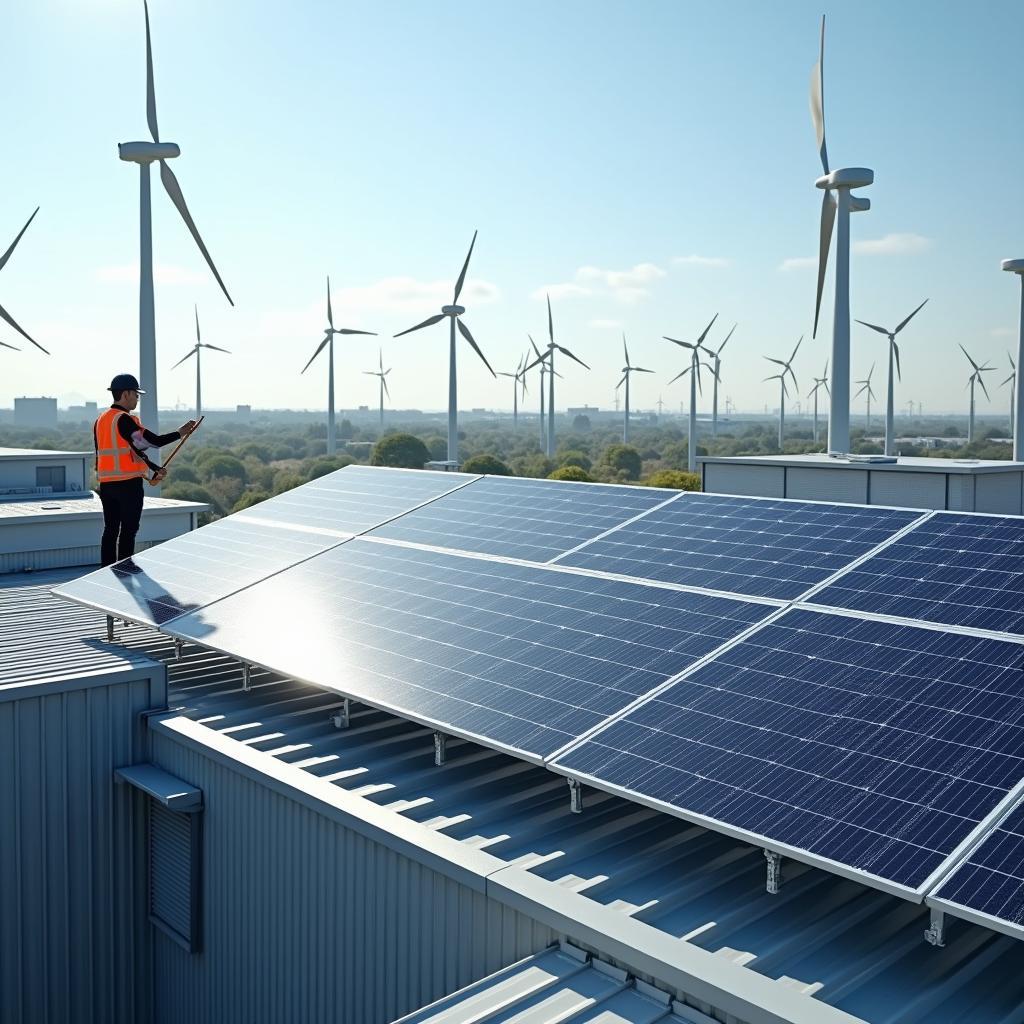 Nhà máy sản xuất hiện đại sử dụng năng lượng tái tạo với tấm pin mặt trời và turbine gió
The transition to renewable-powered industries requires significant workforce development. Engineers must learn to design processes around variable renewable energy supply rather than consistent fossil fuel power. Electricians need training in solar panel installation and wind turbine maintenance. Welders working with new materials for green technologies require specialized certifications. Germany’s Energiewende (energy transition) has been accompanied by comprehensive vocational training programs that ensure workers possess the skills needed for the renewable economy. These programs have become models for other nations planning similar transitions.
Policy coherence across different government levels and departments is essential for successful industrial transformation. Energy policy, industrial policy, environmental regulation, and trade policy must align to create an environment where renewable-powered industries can thrive. Contradictory policies – such as subsidizing fossil fuels while promoting renewables – waste resources and slow transition. Countries like Costa Rica and Scotland have developed integrated strategies that coordinate various policy instruments toward clear renewable energy targets, demonstrating that political will and administrative coordination can accelerate industrial transformation.
Questions 14-18: Yes/No/Not Given
Do the following statements agree with the claims of the writer? Write:
- YES if the statement agrees with the views of the writer
- NO if the statement contradicts the views of the writer
- NOT GIVEN if it is impossible to say what the writer thinks about this
- The transition to renewable energy in industry only involves replacing power sources.
- Green steel production is currently cheaper than traditional steelmaking methods.
- The cement industry can eliminate all emissions by switching to renewable electricity.
- Google has achieved complete carbon-free operation 24 hours a day.
- Contradictory government policies can slow down the renewable energy transition.
Questions 19-23: Matching Headings
Choose the correct heading for paragraphs B-F from the list of headings below.
List of Headings:
i. Financial tools supporting renewable adoption
ii. The challenge of cement industry emissions
iii. Steel industry’s hydrogen revolution
iv. Textile sector sustainability efforts
v. Chemical industry’s electrification experiments
vi. Workforce training for new energy economy
vii. Industrial waste as resource opportunity
viii. Digital sector’s renewable energy leadership
- Paragraph B (Steel industry…)
- Paragraph C (Chemical industry…)
- Paragraph D (Cement production…)
- Paragraph F (Industrial symbiosis…)
- Paragraph G (Data centers…)
Questions 24-26: Summary Completion
Complete the summary below. Choose NO MORE THAN THREE WORDS from the passage for each answer.
The integration of renewable energy into industrial processes involves more than simply changing power sources. It requires rethinking entire (24) __, manufacturing approaches, and corporate structures. In the steel industry, companies are developing processes that use hydrogen created through (25) __ powered by renewable energy. Meanwhile, the concept of (26) __ allows different industries to share resources and waste products efficiently.
PASSAGE 3 – Techno-Economic Frontiers of Sustainable Industrial Systems
Độ khó: Hard (Band 7.0-9.0)
Thời gian đề xuất: 23-25 phút
The emergence of renewable energy as the cornerstone of sustainable industrial development represents not merely a technological substitution but a profound socio-technical transition that challenges fundamental assumptions about economic growth, energy systems, and the relationship between human activities and planetary boundaries. Contemporary scholarship in industrial ecology and ecological economics increasingly recognizes that achieving genuinely sustainable industries requires systemic transformation that transcends conventional incrementalist approaches to environmental management. This paradigm shift necessitates grappling with complex questions of technological lock-in, path dependency, and the political economy of energy transitions in ways that acknowledge both the immense opportunities and the formidable barriers inherent in restructuring industrial civilization.
The concept of sector coupling has emerged as a critical framework for understanding how renewable energy can catalyze comprehensive industrial transformation. Rather than viewing electricity, heating, transportation, and industrial processes as discrete domains, sector coupling recognizes their interdependencies and seeks to optimize resource flows across these boundaries. Power-to-X technologies exemplify this approach: excess renewable electricity that would otherwise be curtailed can be converted into hydrogen through electrolysis, synthetic methane through methanation, or liquid fuels through Fischer-Tropsch synthesis. These energy carriers can then serve as feedstocks for chemical industries, fuels for transportation, or storage media for seasonal energy buffering. The German research project Kopernikus P2X is pioneering the large-scale implementation of these concepts, though significant technical and economic hurdles remain before widespread commercialization becomes viable.
Trong bối cảnh the rise of green energy technologies đang thay đổi cảnh quan năng lượng toàn cầu, các hệ thống công nghiệp bền vững đòi hỏi sự tích hợp công nghệ tinh vi hơn nhiều so với các mô hình truyền thống.
The challenge of industrial decarbonization is inextricably linked to questions of thermodynamic efficiency and exergy analysis. Traditional economic assessments often obscure the fundamental physical constraints governing energy transformations. Converting renewable electricity to hydrogen, then hydrogen to ammonia for fertilizer production, then transporting and applying that fertilizer involves multiple conversion steps, each subject to thermodynamic losses. While technically feasible, such pathways may prove less efficient than alternative approaches such as artificial nitrogen fixation using renewable energy directly. Rigorous life-cycle assessment and exergy accounting are essential for identifying pathways that appear sustainable on surface analysis but actually involve substantial hidden energy costs or environmental burdens.
The phenomenon of carbon lock-in represents a particularly pernicious obstacle to industrial transformation. Massive investments in fossil fuel infrastructure – power plants designed to operate for 40-50 years, petroleum refineries, natural gas pipelines, and the myriad industrial processes optimized around cheap fossil energy – create powerful economic incentives to continue their use despite environmental costs. The concept of stranded assets has gained prominence as analysts recognize that achieving climate goals would render trillions of dollars of fossil fuel reserves and infrastructure economically worthless before their expected operational lifespan ends. This creates fierce political resistance from incumbent industries and regions whose economies depend on fossil fuel extraction. Addressing carbon lock-in requires not only developing renewable alternatives but also managing the political economy of decline in fossil fuel sectors through just transition frameworks that provide economic alternatives for affected workers and communities.
Material criticality poses complex challenges for renewable energy-powered industries that extend beyond energy considerations. The batteries, solar panels, wind turbines, and electrolyzers central to renewable energy systems require substantial quantities of critical minerals including lithium, cobalt, rare earth elements, and platinum-group metals. Current production of many of these materials is geographically concentrated, often in regions with questionable labor practices or environmental standards. Scaling renewable energy to the levels necessary for comprehensive industrial decarbonization could strain supply chains and create new forms of resource dependency that replicate problematic aspects of fossil fuel geopolitics. Addressing material criticality requires multifaceted strategies including circular economy approaches emphasizing recycling and reuse, materials substitution research to develop alternatives using more abundant elements, and supply chain diversification to reduce dependence on single sources.
The intermittency challenge of solar and wind power profoundly shapes the technical architecture of renewable-powered industrial systems. Unlike fossil fuel plants that can generate power on demand, renewable output fluctuates with weather patterns and diurnal cycles. This variability creates particular difficulties for industries requiring continuous high-temperature heat or those with chemical processes that cannot be easily interrupted. Three broad approaches address this challenge: flexibility (designing industrial processes that can ramp production up or down to match renewable availability), storage (using batteries, hydrogen, or thermal storage to buffer supply-demand mismatches), and overcapacity (building excess renewable generation to ensure adequate supply during low-output periods). Each approach involves different technical challenges and economic trade-offs. Aluminum smelting, for instance, has historically required extremely consistent power supply, but innovative companies are developing modular cell technology that allows production to vary in response to electricity availability, effectively transforming smelters into flexible loads that stabilize grid operations.
Để hiểu rõ hơn về how clean energy is driving job creation trong các ngành công nghiệp bền vững, cần phân tích sâu về cơ cấu lao động và yêu cầu kỹ năng mới trong bối cảnh chuyển đổi năng lượng này.
Digital technologies are proving instrumental in optimizing renewable energy integration into industrial systems. Industrial Internet of Things (IIoT) sensors provide real-time data on energy consumption patterns, enabling demand-response systems that automatically adjust production schedules to align with renewable availability. Machine learning algorithms can predict renewable energy generation hours or days in advance based on weather forecasts, allowing industries to plan production accordingly. Digital twins – virtual replicas of physical industrial facilities – enable engineers to test different operational strategies and identify opportunities for efficiency improvements without risking actual production disruptions. The steel industry is pioneering the use of AI to optimize blast furnace operations, reducing energy consumption by several percentage points – seemingly modest improvements that translate to substantial absolute energy savings given the scale of global steel production.
The geographical distribution of industrial activity is being reshaped by renewable energy availability. Historically, industries located near fossil fuel sources, deep-water ports for fuel imports, or regions with cheap electricity from hydropower or nuclear plants. As solar and wind become cost-competitive, new location factors emerge. Energy-intensive industries may increasingly cluster in regions with exceptional renewable resources – solar industries in desert regions, wind-powered manufacturing in coastal areas with strong, consistent winds. This geographical reordering has profound implications for economic development, potentially offering industrialization opportunities for regions previously lacking conventional energy resources. However, it also raises concerns about energy colonialism, where wealthy nations or corporations establish renewable-powered industries in developing countries to take advantage of their solar or wind resources without ensuring equitable benefit distribution.
The concept of industrial sustainability must evolve beyond narrow focus on energy sources to encompass broader considerations of circularity and regenerative design. Even with abundant renewable energy, extracting virgin materials, manufacturing products designed for short lifespans, and treating waste as an inevitable byproduct remains fundamentally unsustainable. Truly sustainable industries must embrace cradle-to-cradle design principles, creating products designed for disassembly and material recovery. Companies like Interface (carpets) and Fairphone (smartphones) demonstrate that combining renewable energy with circular business models creates more resilient and genuinely sustainable industrial systems. The bioeconomy, based on renewable biological resources and biotechnology, offers pathways to replace fossil fuel-derived materials with biobased alternatives, though careful governance is needed to ensure such transitions do not create new environmental problems through unsustainable agriculture or biodiversity loss.
 Khu công nghiệp tích hợp năng lượng tái tạo với hệ thống pin mặt trời và turbine gió quy mô lớn
Policy innovation represents a frontier as important as technological development in enabling sustainable industrial transformation. Carbon border adjustment mechanisms, which impose tariffs on imports from countries without robust carbon pricing, seek to prevent carbon leakage – industries relocating to jurisdictions with lax environmental standards. Green public procurement policies leverage government purchasing power to create demand for sustainably produced industrial goods, helping emerging green technologies achieve the scale needed for cost competitiveness. Contracts for Difference provide financial guarantees that reduce investment risk for pioneer green industrial facilities. The sophistication and coordination of these policy instruments will significantly influence the pace and equity of industrial transformation.
The temporal dimension of sustainable industrial transformation warrants careful consideration. Many analyses project renewable energy trajectories decades into the future, but the urgency of climate change demands accelerated timelines. However, premature lock-in to particular technological pathways risks foreclosing potentially superior alternatives that might emerge with continued research. This tension between urgency and flexibility requires adaptive governance frameworks that can adjust strategies as technologies evolve and new knowledge emerges. The concept of transitional pathways acknowledges that the optimal long-term solution may differ from the best approach for rapid near-term emissions reductions, requiring sequential strategies rather than single comprehensive solutions.
Questions 27-31: Multiple Choice
Choose the correct letter, A, B, C, or D.
-
According to the passage, sector coupling involves:
A. Connecting different countries’ energy grids
B. Optimizing resource flows across different industrial domains
C. Coupling solar panels with wind turbines
D. Linking fossil fuel and renewable energy systems -
What does the passage suggest about converting renewable electricity through multiple steps?
A. It is always the most efficient approach
B. It eliminates all environmental concerns
C. It may involve substantial hidden energy costs
D. It is impossible with current technology -
The concept of “stranded assets” refers to:
A. Renewable energy equipment left unused
B. Fossil fuel infrastructure that may become worthless
C. Islands affected by climate change
D. Abandoned industrial facilities -
Material criticality in renewable energy systems:
A. Only affects solar panel production
B. Has been completely solved through recycling
C. Could create new forms of resource dependency
D. Is not a significant concern for industry -
According to the passage, aluminum smelting companies are developing technology that:
A. Eliminates the need for electricity entirely
B. Allows production to vary with renewable availability
C. Converts aluminum into energy storage
D. Replaces aluminum with other materials
Questions 32-36: Matching Features
Match each concept (A-H) with the correct description (32-36). Write the correct letter, A-H.
Concepts:
A. Power-to-X technologies
B. Carbon lock-in
C. Digital twins
D. Energy colonialism
E. Circular economy
F. Carbon border adjustment
G. Exergy analysis
H. Industrial symbiosis
- Virtual replicas used to test operational strategies ___
- Economic incentives to continue using fossil fuel infrastructure ___
- Wealthy nations establishing industries in developing countries for their renewable resources ___
- Tariffs on imports from countries without carbon pricing ___
- Converting excess renewable electricity into other energy carriers ___
Questions 37-40: Short-answer Questions
Answer the questions below. Choose NO MORE THAN THREE WORDS from the passage for each answer.
- What type of assessment is essential for identifying pathways with hidden energy costs?
- What term describes the political economy issues when fossil fuel sectors decline?
- Which type of sensors provide real-time data on industrial energy consumption?
- What design principles create products designed for disassembly and material recovery?
Answer Keys – Đáp Án
PASSAGE 1: Questions 1-13
- C
- D
- B
- C
- C
- C
- FALSE
- TRUE
- NOT GIVEN
- TRUE
- photovoltaic panels
- micro-hydro systems
- ethical
PASSAGE 2: Questions 14-26
- NO
- NO
- NO
- NOT GIVEN
- YES
- iii
- v
- ii
- vii
- viii
- supply chains
- electrolysis
- industrial symbiosis
PASSAGE 3: Questions 27-40
- B
- C
- B
- C
- B
- C
- B
- D
- F
- A
- life-cycle assessment
- just transition (frameworks)
- Industrial Internet of Things / IIoT (sensors)
- cradle-to-cradle design (principles)
Giải Thích Đáp Án Chi Tiết
Passage 1 – Giải Thích
Câu 1: C
- Dạng câu hỏi: Multiple Choice
- Từ khóa: driven the shift, renewable energy
- Vị trí trong bài: Đoạn A, dòng 3-4
- Giải thích: Bài viết nói rõ “the growing awareness of climate change and environmental degradation has pushed governments, corporations, and communities worldwide to embrace cleaner alternatives.” Đáp án C paraphrase chính xác ý này.
Câu 2: D
- Dạng câu hỏi: Multiple Choice
- Từ khóa: cost, solar technology, decreased
- Vị trí trong bài: Đoạn B, dòng cuối
- Giải thích: Câu gốc: “The cost of solar technology has dropped by over 80% in the past decade.” Đáp án D trùng khớp chính xác với thông tin này.
Câu 3: B
- Dạng câu hỏi: Multiple Choice
- Từ khóa: generates nearly half, electricity, wind power
- Vị trí trong bài: Đoạn C, dòng 3
- Giải thích: “Denmark generates nearly half of its electricity from wind power” – câu này nêu rõ Denmark là quốc gia đạt được thành tựu này.
Câu 4: C
- Dạng câu hỏi: Multiple Choice
- Từ khóa: major corporations, adopt renewable energy
- Vị trí trong bài: Đoạn D, dòng 3-5
- Giải thích: Bài viết giải thích “sustainable practices not only reduce environmental impact but also improve their brand reputation and appeal to environmentally conscious consumers.” Đáp án C tóm tắt chính xác lý do này.
Câu 5: C
- Dạng câu hỏi: Multiple Choice
- Từ khóa: offshore wind farms, advantage
- Vị trí trong bài: Đoạn C, dòng 5-6
- Giải thích: “Offshore wind farms, located in coastal waters, can capture stronger and more consistent winds than land-based installations.” Đáp án C paraphrase thông tin này.
Câu 6: C
- Dạng câu hỏi: Multiple Choice
- Từ khóa: employed, renewable energy sector, 2020
- Vị trí trong bài: Đoạn H, dòng 2
- Giải thích: “The renewable energy sector employed over 12 million people globally by 2020” – thông tin trực tiếp từ bài.
Câu 7: FALSE
- Dạng câu hỏi: True/False/Not Given
- Từ khóa: solar farms, Germany, Spain, all energy needs
- Vị trí trong bài: Đoạn B, dòng 3-4
- Giải thích: Bài viết chỉ nói “provide substantial portions of their national energy needs” chứ không phải “all” (tất cả), do đó câu này là FALSE.
Câu 8: TRUE
- Dạng câu hỏi: True/False/Not Given
- Từ khóa: electric vehicles, zero direct emissions, renewable electricity
- Vị trí trong bài: Đoạn F, dòng 1-2
- Giải thích: “Electric vehicles (EVs) powered by batteries charged with renewable electricity produce zero direct emissions” – trùng khớp hoàn toàn với câu hỏi.
Câu 9: NOT GIVEN
- Dạng câu hỏi: True/False/Not Given
- Từ khóa: lithium-ion batteries, only type
- Vị trí trong bài: Đoạn G
- Giải thích: Bài viết đề cập “Lithium-ion batteries and other storage systems” nhưng không nói rõ có bao nhiêu loại hoặc liệu lithium-ion có phải là loại duy nhất hay không, do đó là NOT GIVEN.
Câu 10: TRUE
- Dạng câu hỏi: True/False/Not Given
- Từ khóa: former fossil fuel workers, moved to renewable energy
- Vị trí trong bài: Đoạn H, dòng 4-5
- Giải thích: “Many former coal miners and oil industry workers have successfully transitioned to renewable energy careers through retraining programs” – xác nhận thông tin trong câu hỏi.
Câu 11: photovoltaic panels
- Dạng câu hỏi: Sentence Completion
- Từ khóa: convert sunlight, electricity
- Vị trí trong bài: Đoạn B, dòng 1-2
- Giải thích: “Modern photovoltaic panels can convert sunlight directly into electricity” – đáp án chính xác là “photovoltaic panels”.
Câu 12: micro-hydro systems
- Dạng câu hỏi: Sentence Completion
- Từ khóa: small-scale hydroelectric, rural communities
- Vị trí trong bài: Đoạn E, dòng 4-5
- Giải thích: “Small-scale hydroelectric projects, known as micro-hydro systems, are particularly beneficial for rural communities” – đáp án là “micro-hydro systems”.
Câu 13: ethical
- Dạng câu hỏi: Sentence Completion
- Từ khóa: mining, materials, environmental
- Vị trí trong bài: Đoạn J, dòng 3-4
- Giải thích: “the mining of materials for solar panels and batteries raises environmental and ethical concerns” – từ còn thiếu là “ethical”.
Passage 2 – Giải Thích
Câu 14: NO
- Dạng câu hỏi: Yes/No/Not Given
- Từ khóa: transition, only involves replacing power sources
- Vị trí trong bài: Đoạn A, dòng 2-4
- Giải thích: Tác giả nói rõ “This transformation extends far beyond simply replacing coal-fired power plants with wind turbines; it encompasses a complete reimagining of supply chains, manufacturing methodologies, and corporate governance structures.” Câu hỏi nói “only involves” (chỉ bao gồm) là mâu thuẫn với quan điểm của tác giả.
Câu 15: NO
- Dạng câu hỏi: Yes/No/Not Given
- Từ khóa: green steel, cheaper, traditional
- Vị trí trong bài: Đoạn B, dòng 7-8
- Giải thích: “While currently more expensive than conventional methods, economies of scale and technological refinement are expected to make green steel cost-competitive within a decade.” Tác giả khẳng định hiện tại green steel đắt hơn, do đó câu hỏi sai.
Câu 16: NO
- Dạng câu hỏi: Yes/No/Not Given
- Từ khóa: cement industry, eliminate all emissions, renewable electricity
- Vị trí trong bài: Đoạn D, dòng 1-3
- Giải thích: “The chemical reaction that transforms limestone into cement inherently releases carbon dioxide, regardless of the energy source used to heat the kiln.” Tác giả chỉ ra rằng ngay cả khi dùng năng lượng tái tạo, vẫn có phát thải từ phản ứng hóa học, do đó không thể loại bỏ hoàn toàn.
Câu 17: NOT GIVEN
- Dạng câu hỏi: Yes/No/Not Given
- Từ khóa: Google, complete carbon-free, 24 hours
- Vị trí trong bài: Đoạn G, dòng 2-5
- Giải thích: Bài viết nói “Google achieved 100% renewable energy matching for its global operations in 2017” nhưng cũng nói “However, true 24/7 carbon-free operation requires more sophisticated approaches.” Không rõ Google đã đạt được 24/7 carbon-free hay chưa.
Câu 18: YES
- Dạng câu hỏi: Yes/No/Not Given
- Từ khóa: contradictory policies, slow down
- Vị trí trong bài: Đoạn K, dòng 3-4
- Giải thích: “Contradictory policies – such as subsidizing fossil fuels while promoting renewables – waste resources and slow transition.” Tác giả đồng ý với quan điểm này.
Câu 19: iii (Steel industry’s hydrogen revolution)
- Dạng câu hỏi: Matching Headings
- Giải thích: Đoạn B tập trung vào việc ngành thép sử dụng hydrogen để thay thế carbon trong quá trình sản xuất, với ví dụ của công ty SSAB.
Câu 20: v (Chemical industry’s electrification experiments)
- Dạng câu hỏi: Matching Headings
- Giải thích: Đoạn C thảo luận về việc điện khí hóa các quy trình hóa học và các thí nghiệm với electric steam crackers của BASF và Dow Chemical.
Câu 21: ii (The challenge of cement industry emissions)
- Dạng câu hỏi: Matching Headings
- Giải thích: Đoạn D giải thích thách thức đặc biệt của ngành xi măng với việc phát thải CO₂ từ phản ứng hóa học và nhu cầu sử dụng công nghệ CCS.
Câu 22: vii (Industrial waste as resource opportunity)
- Dạng câu hỏi: Matching Headings
- Giải thích: Đoạn F mô tả khái niệm industrial symbiosis, nơi chất thải của một ngành trở thành đầu vào của ngành khác, với ví dụ Kalundborg.
Câu 23: viii (Digital sector’s renewable energy leadership)
- Dạng câu hỏi: Matching Headings
- Giải thích: Đoạn G tập trung vào data centers và cách các công ty Internet như Google dẫn đầu trong việc sử dụng năng lượng tái tạo.
Câu 24: supply chains
- Dạng câu hỏi: Summary Completion
- Vị trí trong bài: Đoạn A, dòng 2-3
- Giải thích: “it encompasses a complete reimagining of supply chains, manufacturing methodologies, and corporate governance structures.”
Câu 25: electrolysis
- Dạng câu hỏi: Summary Completion
- Vị trí trong bài: Đoạn B, dòng 4-5
- Giải thích: “hydrogen produced through electrolysis powered by renewable electricity”
Câu 26: industrial symbiosis
- Dạng câu hỏi: Summary Completion
- Vị trí trong bài: Đoạn F, dòng 1
- Giải thích: “The concept of industrial symbiosis has gained traction as a strategy for maximizing resource efficiency”
Passage 3 – Giải Thích
Câu 27: B
- Dạng câu hỏi: Multiple Choice
- Từ khóa: sector coupling, involves
- Vị trí trong bài: Đoạn B, dòng 1-3
- Giải thích: “Rather than viewing electricity, heating, transportation, and industrial processes as discrete domains, sector coupling recognizes their interdependencies and seeks to optimize resource flows across these boundaries.” Đáp án B paraphrase chính xác ý này.
Câu 28: C
- Dạng câu hỏi: Multiple Choice
- Từ khóa: converting renewable electricity, multiple steps
- Vị trí trong bài: Đoạn C, dòng 3-7
- Giải thích: Bài viết giải thích rằng các bước chuyển đổi nhiều lần “each subject to thermodynamic losses” và “such pathways may prove less efficient” với “hidden energy costs.”
Câu 29: B
- Dạng câu hỏi: Multiple Choice
- Từ khóa: stranded assets
- Vị trí trong bài: Đoạn D, dòng 4-6
- Giải thích: “The concept of stranded assets has gained prominence as analysts recognize that achieving climate goals would render trillions of dollars of fossil fuel reserves and infrastructure economically worthless before their expected operational lifespan ends.”
Câu 30: C
- Dạng câu hỏi: Multiple Choice
- Từ khóa: material criticality
- Vị trí trong bài: Đoạn E, dòng 5-7
- Giải thích: “Scaling renewable energy to the levels necessary for comprehensive industrial decarbonization could strain supply chains and create new forms of resource dependency that replicate problematic aspects of fossil fuel geopolitics.”
Câu 31: B
- Dạng câu hỏi: Multiple Choice
- Từ khóa: aluminum smelting, developing technology
- Vị trí trong bài: Đoạn F, dòng cuối
- Giải thích: “innovative companies are developing modular cell technology that allows production to vary in response to electricity availability”
Câu 32: C (Digital twins)
- Dạng câu hỏi: Matching Features
- Vị trí trong bài: Đoạn G, dòng 4-5
- Giải thích: “Digital twins – virtual replicas of physical industrial facilities – enable engineers to test different operational strategies”
Câu 33: B (Carbon lock-in)
- Dạng câu hỏi: Matching Features
- Vị trí trong bài: Đoạn D, dòng 1-3
- Giải thích: “Massive investments in fossil fuel infrastructure… create powerful economic incentives to continue their use”
Câu 34: D (Energy colonialism)
- Dạng câu hỏi: Matching Features
- Vị trí trong bài: Đoạn H, dòng cuối
- Giải thích: “it also raises concerns about energy colonialism, where wealthy nations or corporations establish renewable-powered industries in developing countries to take advantage of their solar or wind resources”
Câu 35: F (Carbon border adjustment)
- Dạng câu hỏi: Matching Features
- Vị trí trong bài: Đoạn J, dòng 2-3
- Giải thích: “Carbon border adjustment mechanisms, which impose tariffs on imports from countries without robust carbon pricing”
Câu 36: A (Power-to-X technologies)
- Dạng câu hỏi: Matching Features
- Vị trí trong bài: Đoạn B, dòng 3-5
- Giải thích: “Power-to-X technologies exemplify this approach: excess renewable electricity that would otherwise be curtailed can be converted into hydrogen through electrolysis, synthetic methane through methanation, or liquid fuels”
Câu 37: life-cycle assessment
- Dạng câu hỏi: Short-answer
- Từ khóa: essential, identifying pathways, hidden energy costs
- Vị trí trong bài: Đoạn C, dòng 8-9
- Giải thích: “Rigorous life-cycle assessment and exergy accounting are essential for identifying pathways that appear sustainable on surface analysis but actually involve substantial hidden energy costs”
Câu 38: just transition (frameworks)
- Dạng câu hỏi: Short-answer
- Từ khóa: political economy, fossil fuel sectors decline
- Vị trí trong bài: Đoạn D, dòng 8-9
- Giải thích: “managing the political economy of decline in fossil fuel sectors through just transition frameworks”
Câu 39: Industrial Internet of Things / IIoT (sensors)
- Dạng câu hỏi: Short-answer
- Từ khóa: sensors, real-time data, energy consumption
- Vị trí trong bài: Đoạn G, dòng 1-2
- Giải thích: “Industrial Internet of Things (IIoT) sensors provide real-time data on energy consumption patterns”
Câu 40: cradle-to-cradle design (principles)
- Dạng câu hỏi: Short-answer
- Từ khóa: design principles, disassembly, material recovery
- Vị trí trong bài: Đoạn I, dòng 4-5
- Giải thích: “Truly sustainable industries must embrace cradle-to-cradle design principles, creating products designed for disassembly and material recovery”
Từ Vựng Quan Trọng Theo Passage
Passage 1 – Essential Vocabulary
| Từ vựng | Loại từ | Phiên âm | Nghĩa tiếng Việt | Ví dụ từ bài | Collocation |
|---|---|---|---|---|---|
| renewable energy | n | /rɪˈnjuːəbl ˈenədʒi/ | năng lượng tái tạo | renewable energy sources has become one of the most significant transformations | renewable energy sector, renewable energy technology |
| fossil fuels | n | /ˈfɒsl fjuːəlz/ | nhiên liệu hóa thạch | relied heavily on fossil fuels such as coal, oil | burn fossil fuels, fossil fuel industry |
| photovoltaic panels | n | /ˌfəʊtəʊvɒlˈteɪɪk ˈpænlz/ | tấm pin quang điện | Modern photovoltaic panels can convert sunlight | install photovoltaic panels |
| wind turbines | n | /wɪnd ˈtɜːbaɪnz/ | tuabin gió | Massive wind turbines, both onshore and offshore | wind turbine technology, offshore wind turbines |
| solar farms | n | /ˈsəʊlə fɑːmz/ | trang trại năng lượng mặt trời | invested billions in solar farms | large-scale solar farms |
| climate change | n | /ˈklaɪmət tʃeɪndʒ/ | biến đổi khí hậu | growing awareness of climate change | combat climate change, climate change mitigation |
| carbon emissions | n | /ˈkɑːbən ɪˈmɪʃənz/ | khí thải carbon | reduce carbon emissions | reduce carbon emissions, zero carbon emissions |
| hydroelectric power | n | /ˌhaɪdrəʊɪˈlektrɪk ˈpaʊə/ | thủy điện | Hydroelectric power continues to play a vital role | hydroelectric power generation |
| brand reputation | n | /brænd ˌrepjuˈteɪʃən/ | uy tín thương hiệu | improve their brand reputation | protect brand reputation, enhance brand reputation |
| energy storage | n | /ˈenədʒi ˈstɔːrɪdʒ/ | lưu trữ năng lượng | Energy storage technology has become critical | energy storage system, battery energy storage |
| lithium-ion batteries | n | /ˈlɪθiəm ˈaɪən ˈbætəriz/ | pin lithium-ion | Lithium-ion batteries and other storage systems | lithium-ion battery technology |
| just transition | n | /dʒʌst trænˈzɪʃən/ | chuyển đổi công bằng | demonstrating that a just transition is possible | just transition framework, ensure just transition |
Passage 2 – Essential Vocabulary
| Từ vựng | Loại từ | Phiên âm | Nghĩa tiếng Việt | Ví dụ từ bài | Collocation |
|---|---|---|---|---|---|
| paradigm shift | n | /ˈpærədaɪm ʃɪft/ | sự thay đổi mô hình | represents a fundamental paradigm shift | undergo a paradigm shift |
| supply chains | n | /səˈplaɪ tʃeɪnz/ | chuỗi cung ứng | complete reimagining of supply chains | global supply chains, optimize supply chains |
| steelmaking | n | /ˈstiːlmeɪkɪŋ/ | sản xuất thép | Traditional steelmaking relies on blast furnaces | steelmaking process, modern steelmaking |
| electrolysis | n | /ɪˌlekˈtrɒləsɪs/ | điện phân | hydrogen produced through electrolysis | water electrolysis, electrolysis process |
| fossil-free steel | n | /ˈfɒsl friː stiːl/ | thép không dùng nhiên liệu hóa thạch | producing the world’s first fossil-free steel | produce fossil-free steel |
| decarbonization | n | /diːˌkɑːbənaɪˈzeɪʃən/ | phi carbon hóa | decarbonization challenges | industrial decarbonization, decarbonization strategy |
| carbon capture | n | /ˈkɑːbən ˈkæptʃə/ | thu giữ carbon | carbon capture and storage (CCS) technology | carbon capture technology, carbon capture system |
| industrial symbiosis | n | /ɪnˈdʌstriəl ˌsɪmbaɪˈəʊsɪs/ | cộng sinh công nghiệp | The concept of industrial symbiosis has gained traction | industrial symbiosis network |
| data centers | n | /ˈdeɪtə ˈsentəz/ | trung tâm dữ liệu | Data centers and digital infrastructure | large-scale data centers, data center operations |
| green bonds | n | /ɡriːn bɒndz/ | trái phiếu xanh | Green bonds allow companies to raise capital | issue green bonds, green bond market |
| power purchase agreements | n | /ˈpaʊə ˈpɜːtʃəs əˈɡriːmənts/ | hợp đồng mua điện | Power Purchase Agreements (PPAs) enable industries | sign power purchase agreements |
| cap-and-trade systems | n | /kæp ənd treɪd ˈsɪstəmz/ | hệ thống hạn ngạch và giao dịch | whether through taxes or cap-and-trade systems | implement cap-and-trade systems |
| workforce development | n | /ˈwɜːkfɔːs dɪˈveləpmənt/ | phát triển lực lượng lao động | requires significant workforce development | workforce development program |
| policy coherence | n | /ˈpɒləsi kəʊˈhɪərəns/ | tính nhất quán của chính sách | Policy coherence across different government levels | ensure policy coherence |
Passage 3 – Essential Vocabulary
| Từ vựng | Loại từ | Phiên âm | Nghĩa tiếng Việt | Ví dụ từ bài | Collocation |
|---|---|---|---|---|---|
| socio-technical transition | n | /ˌsəʊsiəʊ ˈteknɪkəl trænˈzɪʃən/ | chuyển đổi xã hội-kỹ thuật | represents a profound socio-technical transition | manage socio-technical transition |
| industrial ecology | n | /ɪnˈdʌstriəl iˈkɒlədʒi/ | sinh thái công nghiệp | scholarship in industrial ecology | industrial ecology principles |
| sector coupling | n | /ˈsektə ˈkʌplɪŋ/ | liên kết ngành | The concept of sector coupling has emerged | sector coupling strategy |
| power-to-X technologies | n | /ˈpaʊə tə eks tekˈnɒlədʒiz/ | công nghệ chuyển đổi điện sang X | Power-to-X technologies exemplify this approach | develop power-to-X technologies |
| thermodynamic efficiency | n | /ˌθɜːməʊdaɪˈnæmɪk ɪˈfɪʃənsi/ | hiệu suất nhiệt động | questions of thermodynamic efficiency | improve thermodynamic efficiency |
| carbon lock-in | n | /ˈkɑːbən lɒk ɪn/ | khóa carbon | The phenomenon of carbon lock-in represents | overcome carbon lock-in |
| stranded assets | n | /ˈstrændɪd ˈæsets/ | tài sản mắc kẹt | The concept of stranded assets has gained prominence | manage stranded assets |
| critical minerals | n | /ˈkrɪtɪkəl ˈmɪnərəlz/ | khoáng sản quan trọng | require substantial quantities of critical minerals | supply of critical minerals |
| circular economy | n | /ˈsɜːkjələ ɪˈkɒnəmi/ | kinh tế tuần hoàn | circular economy approaches emphasizing recycling | transition to circular economy |
| intermittency challenge | n | /ˌɪntəˈmɪtənsi ˈtʃælɪndʒ/ | thách thức gián đoạn | The intermittency challenge of solar and wind power | address intermittency challenge |
| Industrial Internet of Things | n | /ɪnˈdʌstriəl ˈɪntənet əv θɪŋz/ | Internet vạn vật công nghiệp | Industrial Internet of Things (IIoT) sensors | implement Industrial Internet of Things |
| machine learning algorithms | n | /məˈʃiːn ˈlɜːnɪŋ ˈælɡərɪðəmz/ | thuật toán học máy | Machine learning algorithms can predict | develop machine learning algorithms |
| digital twins | n | /ˈdɪdʒɪtəl twɪnz/ | bản sao kỹ thuật số | Digital twins – virtual replicas of physical facilities | create digital twins, use digital twins |
| energy colonialism | n | /ˈenədʒi kəˈləʊniəlɪzəm/ | chủ nghĩa thực dân năng lượng | raises concerns about energy colonialism | avoid energy colonialism |
| cradle-to-cradle design | n | /ˈkreɪdl tə ˈkreɪdl dɪˈzaɪn/ | thiết kế từ nôi đến nôi | embrace cradle-to-cradle design principles | implement cradle-to-cradle design |
| bioeconomy | n | /ˌbaɪəʊɪˈkɒnəmi/ | kinh tế sinh học | The bioeconomy, based on renewable biological resources | develop bioeconomy |
| carbon border adjustment | n | /ˈkɑːbən ˈbɔːdə əˈdʒʌstmənt/ | điều chỉnh biên giới carbon | Carbon border adjustment mechanisms | implement carbon border adjustment |
| carbon leakage | n | /ˈkɑːbən ˈliːkɪdʒ/ | rò rỉ carbon | seek to prevent carbon leakage | reduce carbon leakage, prevent carbon leakage |
Kết Luận
Bài thi IELTS Reading mẫu về chủ đề “Renewable Energy For Creating Sustainable Industries” đã cung cấp cho bạn một trải nghiệm học tập toàn diện với ba passages ở các mức độ khác nhau. Từ những kiến thức cơ bản về năng lượng mặt trời và gió trong Passage 1, đến sự phức tạp của việc tích hợp năng lượng tái tạo vào các ngành công nghiệp trong Passage 2, và cuối cùng là những khái niệm học thuật sâu sắc về hệ thống công nghiệp bền vững trong Passage 3.
Việc luyện tập với các dạng câu hỏi đa dạng như Multiple Choice, True/False/Not Given, Matching Headings, Summary Completion và Short-answer Questions sẽ giúp bạn làm quen với format thi thực tế. Đáp án chi tiết kèm giải thích cụ thể về vị trí thông tin và cách paraphrase sẽ giúp bạn hiểu rõ logic làm bài và tránh những sai lầm phổ biến.
Chủ đề năng lượng tái tạo và phát triển bền vững không chỉ quan trọng trong kỳ thi IELTS mà còn là kiến thức thiết thực trong thế giới hiện đại. Việc nắm vững từ vựng chuyên ngành thông qua ba bảng từ vựng tổng hợp sẽ giúp bạn không chỉ trong phần Reading mà còn trong Writing và Speaking khi bàn về các vấn đề môi trường.
Hãy nhớ rằng việc đạt điểm cao trong IELTS Reading đòi hỏi sự kết hợp giữa kỹ năng đọc hiểu, quản lý thời gian và hiểu biết về các dạng câu hỏi. Thực hành thường xuyên với các đề thi mẫu chất lượng cao như bài này sẽ giúp bạn tự tin hơn và đạt được band điểm mục tiêu. Chúc bạn học tốt và thành công trong kỳ thi IELTS sắp tới!

