Mở Bài
Chủ đề năng lượng tái tạo (renewable energy) là một trong những chủ đề phổ biến nhất trong IELTS Reading, xuất hiện thường xuyên với tần suất cao trong cả bài thi Academic và General Training. Đặc biệt, khi Châu Á đang chuyển mình trở thành động lực chính của cuộc cách mạng năng lượng xanh toàn cầu, việc hiểu rõ về The Future Of Renewable Energy In Asia không chỉ giúp bạn làm tốt bài thi mà còn mở rộng kiến thức về xu hướng phát triển bền vững.
Bài viết này cung cấp một đề thi IELTS Reading hoàn chỉnh với 3 passages từ dễ đến khó, bao gồm 40 câu hỏi đa dạng hoàn toàn giống với format thi thật. Bạn sẽ được luyện tập với các dạng câu hỏi như Multiple Choice, True/False/Not Given, Matching Headings, Summary Completion và nhiều dạng khác. Mỗi câu hỏi đều có đáp án chi tiết kèm giải thích cụ thể về vị trí thông tin và kỹ thuật paraphrase, giúp bạn hiểu rõ cách tìm đáp án chính xác. Phần từ vựng được tổng hợp đầy đủ với phiên âm, nghĩa tiếng Việt và collocation thực tế.
Đề thi này phù hợp cho học viên từ band 5.0 trở lên, đặc biệt hữu ích cho những ai đang nhắm đến band 6.5-8.0 và muốn làm quen với chủ đề năng lượng tái tạo trong bối cảnh Châu Á.
1. Hướng Dẫn Làm Bài IELTS Reading
Tổng Quan Về IELTS Reading Test
IELTS Reading Test kéo dài 60 phút với 3 passages và tổng cộng 40 câu hỏi. Mỗi câu trả lời đúng được tính 1 điểm, không bị trừ điểm khi sai. Độ dài mỗi passage dao động từ 650-1000 từ, với độ khó tăng dần.
Phân bổ thời gian khuyến nghị:
- Passage 1 (Easy): 15-17 phút – Đây là passage dễ nhất, bạn cần tận dụng để ghi điểm tối đa
- Passage 2 (Medium): 18-20 phút – Độ khó trung bình, cần đọc kỹ và chú ý paraphrase
- Passage 3 (Hard): 23-25 phút – Passage khó nhất với từ vựng học thuật và cấu trúc phức tạp
Lưu ý quan trọng: Dành 2-3 phút cuối để chuyển đáp án lên Answer Sheet. Đảm bảo viết đúng chính tả và số câu hỏi.
Các Dạng Câu Hỏi Trong Đề Này
Đề thi mẫu này bao gồm 7 dạng câu hỏi phổ biến:
- Multiple Choice – Chọn đáp án đúng từ A, B, C, D
- True/False/Not Given – Xác định thông tin đúng, sai hay không được đề cập
- Matching Headings – Nối tiêu đề với đoạn văn phù hợp
- Summary Completion – Điền từ vào chỗ trống trong đoạn tóm tắt
- Matching Features – Nối thông tin với nhân vật/tổ chức/quốc gia
- Sentence Completion – Hoàn thành câu với từ từ bài đọc
- Short-answer Questions – Trả lời câu hỏi ngắn với số từ giới hạn
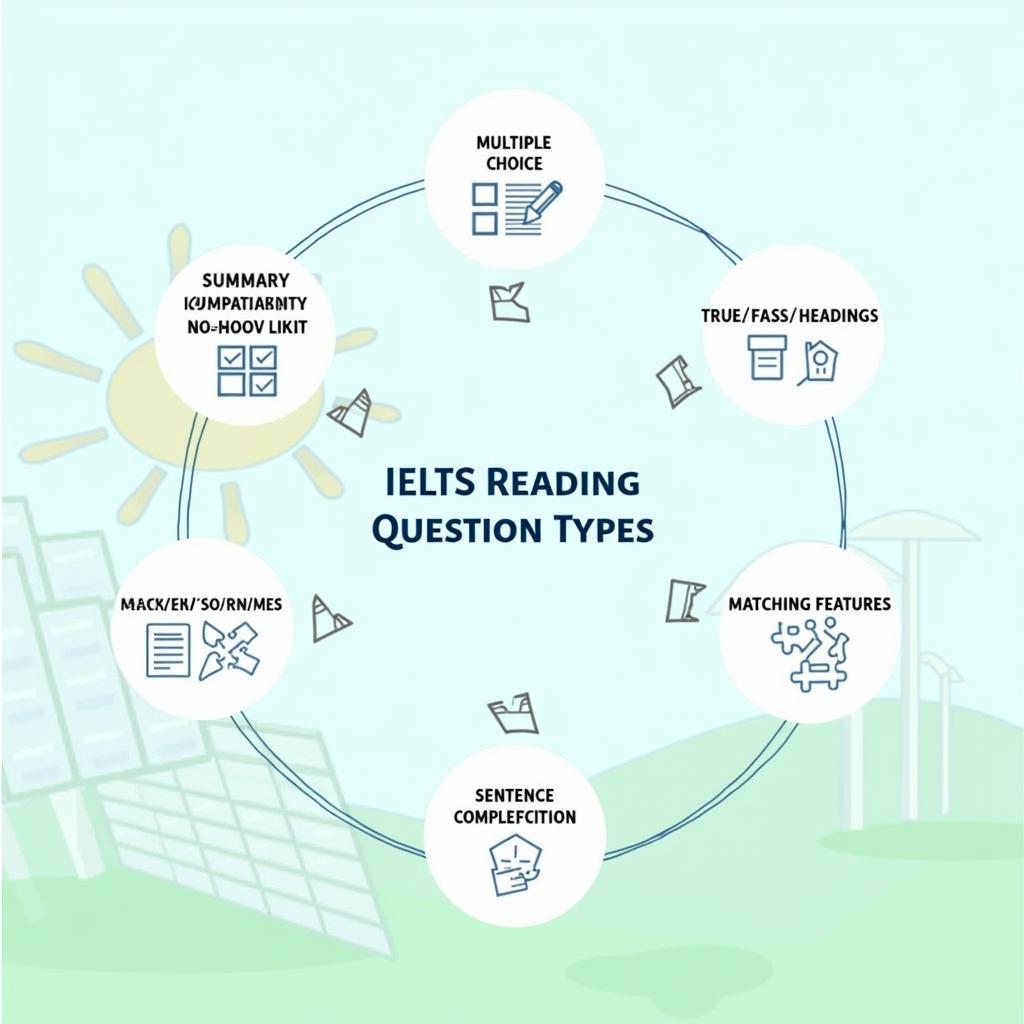 Các dạng câu hỏi phổ biến trong IELTS Reading về năng lượng tái tạo Châu Á
2. IELTS Reading Practice Test
PASSAGE 1 – Solar Power Revolution in Southeast Asia
Độ khó: Easy (Band 5.0-6.5)
Thời gian đề xuất: 15-17 phút
Southeast Asia is experiencing a remarkable transformation in its energy landscape, with solar power leading the charge towards a sustainable future. Countries across the region, from Vietnam to Thailand, are rapidly adopting solar energy solutions to meet their growing electricity demands while reducing carbon emissions. This shift represents not just an environmental necessity but also an economic opportunity that could reshape the entire region’s energy infrastructure.
The Philippines has emerged as one of the pioneers in solar energy adoption. In 2019, the country commissioned one of Southeast Asia’s largest solar farms in Calatagan, Batangas, with a capacity of 132.5 megawatts. This facility alone can generate enough electricity to power approximately 170,000 homes annually. The success of this project has inspired other provinces to explore similar initiatives, creating a domino effect throughout the archipelago. Local communities have also benefited significantly, with the solar farms creating thousands of jobs during construction and providing stable employment for maintenance workers long after completion.
Vietnam’s solar story is equally impressive. The country has witnessed an unprecedented boom in solar installations, particularly in the sun-drenched southern provinces. Between 2018 and 2020, Vietnam added over 16,500 megawatts of solar capacity, catapulting it into the top ten solar markets globally. This rapid expansion was facilitated by attractive feed-in tariffs that the government offered to investors and developers. The policy guaranteed fixed prices for solar-generated electricity, making investments more predictable and appealing. However, experts note that the real challenge lies not in installation but in grid integration – ensuring that the existing power network can handle the influx of renewable energy without compromising stability.
Thailand has taken a different approach by focusing on distributed solar energy. Rather than building massive solar farms, the Thai government has encouraged homeowners and businesses to install rooftop solar panels through various incentive programs. The Solar Rooftop Program, launched in 2013, allows participants to sell excess electricity back to the grid at competitive rates. By 2021, over 60,000 households and commercial buildings had installed solar panels, collectively generating more than 2,500 megawatts. This decentralized model has proven particularly effective in urban areas where land for large-scale solar farms is scarce and expensive. Bangkok alone accounts for nearly 30% of all rooftop installations nationwide.
The economic benefits of solar energy extend beyond electricity generation. The solar industry has become a significant employment generator across Southeast Asia. Manufacturing facilities producing solar panels, inverters, and mounting systems have sprung up in industrial zones, creating thousands of skilled jobs. In Malaysia, the solar sector employed over 50,000 people directly and indirectly by 2020, with numbers expected to double by 2025. Technical training institutes have responded by developing specialized programs in solar installation and maintenance, ensuring a steady supply of qualified workers. Young people in rural areas, where employment opportunities are traditionally limited, are finding new career paths in this burgeoning industry.
Despite these encouraging developments, several challenges remain. The intermittent nature of solar power – it only generates electricity when the sun shines – requires robust energy storage solutions. Current battery technologies, while improving, are still relatively expensive for widespread deployment in developing economies. Additionally, the initial capital investment for solar installations, though decreasing, can still be prohibitive for small businesses and low-income households without access to financing. Governments are exploring various financing mechanisms, including low-interest loans and subsidy programs, to make solar energy more accessible to all socioeconomic groups.
Looking ahead, the future of solar energy in Southeast Asia appears bright. Technological advancements are continuously reducing costs while improving efficiency. New innovations such as floating solar farms – solar panels installed on water bodies – are gaining traction in countries like Singapore and Indonesia, where land is limited. These floating installations not only generate electricity but also reduce water evaporation from reservoirs, providing a dual benefit. As the region continues to grapple with air pollution and climate change, solar power stands as a beacon of hope for a cleaner, more sustainable energy future.
Questions 1-5: Multiple Choice
Choose the correct letter, A, B, C, or D.
1. According to the passage, the solar farm in Calatagan, Philippines can:
A. Power the entire country
B. Provide electricity for around 170,000 homes
C. Generate 132.5 megawatts per hour
D. Create permanent jobs for 170,000 people
2. Vietnam’s rapid solar expansion between 2018 and 2020 was mainly due to:
A. International pressure
B. Abundant land availability
C. Attractive government pricing policies
D. Advanced technology from other countries
3. Thailand’s Solar Rooftop Program allows participants to:
A. Receive free solar panels
B. Get government subsidies for installation
C. Sell surplus electricity back to the grid
D. Install panels on government buildings
4. The passage suggests that distributed solar energy is particularly suitable for:
A. Rural agricultural areas
B. Coastal fishing communities
C. Densely populated urban areas
D. Industrial manufacturing zones
5. What is identified as a major technical challenge for solar power?
A. The high cost of solar panels
B. Lack of qualified workers
C. Government regulations
D. Energy storage limitations
Questions 6-9: True/False/Not Given
Do the following statements agree with the information given in the passage?
Write:
- TRUE if the statement agrees with the information
- FALSE if the statement contradicts the information
- NOT GIVEN if there is no information on this
6. The solar farm in Batangas created employment opportunities for local communities.
7. Vietnam became the world’s largest solar market in 2020.
8. Bangkok has the highest number of rooftop solar installations in Thailand.
9. Battery technology for energy storage is now affordable for all Southeast Asian countries.
Questions 10-13: Sentence Completion
Complete the sentences below.
Choose NO MORE THAN TWO WORDS from the passage for each answer.
10. Malaysia’s solar sector employed over 50,000 people through both direct and __ means by 2020.
11. Educational institutions have created specialized programs to ensure a __ of trained workers in the solar industry.
12. Floating solar farms provide a __ by both generating electricity and reducing water loss.
13. The passage describes solar power as a __ for addressing pollution and climate issues in the region.
PASSAGE 2 – Wind Energy Development Across Asia
Độ khó: Medium (Band 6.0-7.5)
Thời gian đề xuất: 18-20 phút
The ascendancy of wind energy in Asia represents one of the most consequential shifts in the global energy paradigm. While Europe and North America pioneered wind technology decades ago, Asian nations are now spearheading the next phase of wind energy evolution, characterized by unprecedented scale, technological sophistication, and strategic integration into national energy portfolios. This transformation is being driven by a confluence of factors: declining technology costs, increasingly stringent environmental regulations, and growing recognition that energy security demands diversification away from fossil fuel dependence.
China has emerged as the undisputed titan of global wind energy, accounting for more than one-third of the world’s total installed wind capacity. The country’s wind energy trajectory has been nothing short of spectacular. From negligible capacity at the turn of the century, China now boasts over 280 gigawatts of installed wind power – more than the United States and Europe combined. This exponential growth has been orchestrated through a combination of government mandates, substantial subsidies, and streamlined approval processes for wind farm development. The Chinese government’s commitment extends beyond onshore installations; it has embarked on an ambitious offshore wind program, with plans to install 50 gigawatts of offshore capacity by 2030. The rationale is clear: offshore winds are typically stronger and more consistent than their onshore counterparts, though the technology is more complex and costly to deploy.
India’s wind energy sector tells a different story – one of grassroots entrepreneurship meeting government policy. The country’s wind capacity has grown to exceed 40 gigawatts, making it the fourth-largest wind energy market globally. What distinguishes India’s approach is the significant role played by private sector companies and independent power producers. Unlike China’s state-directed model, India’s wind expansion has been largely market-driven, with companies investing in wind farms to meet their own electricity needs or to sell power through competitive auctions. The state of Tamil Nadu exemplifies this trend, hosting nearly 25% of India’s total wind capacity. The region’s consistent coastal winds, coupled with proactive state policies, have attracted substantial investment from both domestic and international developers. Companies like Tata Power and Adani Green Energy have constructed massive wind farms that serve as benchmarks for the industry.
The technological sophistication of modern wind turbines has been instrumental in Asia’s wind revolution. Contemporary turbines are engineering marvels – standing over 150 meters tall with rotor blades spanning more than 100 meters in diameter. These colossal structures can generate between 5 and 15 megawatts each, depending on wind conditions. Advanced computer modeling allows developers to optimize turbine placement, maximizing energy capture while minimizing environmental impact. Predictive maintenance powered by artificial intelligence and Internet of Things (IoT) sensors has dramatically reduced downtime and operational costs. Turbines now communicate real-time data about their operational status, allowing technicians to identify and address potential issues before they result in costly failures. This technological leap has been particularly significant for offshore installations, where maintenance is more challenging and expensive.
Japan presents an intriguing case study in overcoming geographical constraints. Despite having limited suitable land for large-scale wind farms and relatively shallow continental shelves unsuitable for traditional offshore installations, Japan is pioneering floating offshore wind technology. Unlike conventional fixed-bottom offshore turbines that require water depths of less than 60 meters, floating turbines can be deployed in waters exceeding 200 meters deep. These platforms, tethered to the seabed with cables, can access stronger, more consistent winds in deep ocean waters. Japan has established several demonstration projects off the coast of Fukushima and Nagasaki, with plans to scale up commercial deployment throughout the 2020s. If successful, this technology could unlock vast wind resources in countries with steep underwater topography, potentially revolutionizing offshore wind development globally.
The integration of wind energy into existing power grids poses substantial technical challenges. Wind is an inherently variable resource – turbine output fluctuates with changing wind speeds, creating potential instability in electricity networks designed for predictable baseload generation from fossil fuel or nuclear plants. Similiar to how Impact of electric vehicles on global oil consumption is transforming the transportation sector, wind energy is reshaping the electricity infrastructure across Asia. Grid operators must carefully balance supply and demand in real-time, a task that becomes exponentially more complex as intermittent renewable sources constitute a larger share of the energy mix. Sophisticated forecasting systems using meteorological data and machine learning algorithms now predict wind patterns with increasing accuracy, allowing operators to anticipate supply fluctuations and adjust other generation sources accordingly. Energy storage systems, particularly large-scale batteries and pumped hydroelectric storage, play a crucial complementary role by storing excess wind energy during periods of high generation and releasing it when winds subside.
South Korea’s approach to wind energy emphasizes community engagement and equitable benefit distribution. The government has mandated that wind farm developers establish community benefit funds and offer local residents equity stakes in projects. This inclusive model has significantly reduced local opposition that often hampers renewable energy projects elsewhere. In the southwestern region of Jeollanam-do, several wind farms operate under cooperative ownership structures where local residents collectively own shares and receive dividend payments from electricity sales. This approach has transformed wind energy from an external imposition into a source of community income and pride, providing a replicable model for other Asian nations grappling with similar stakeholder concerns.
The future trajectory of wind energy in Asia will be shaped by several converging trends. Technological advances continue to push boundaries – experimental turbines with adaptive blade designs that adjust to wind conditions in real-time, and vertical-axis turbines suitable for urban environments are under development. Policy frameworks are evolving to facilitate cross-border electricity transmission, allowing wind-rich regions to export power to consumption centers hundreds of kilometers away. The emergence of green hydrogen production – using surplus wind electricity to split water molecules – offers a promising pathway for storing renewable energy in chemical form. As costs continue to decline and technology matures, wind energy is poised to become the cornerstone of Asia’s decarbonized energy future.
Questions 14-18: Yes/No/Not Given
Do the following statements agree with the claims of the writer in the passage?
Write:
- YES if the statement agrees with the claims of the writer
- NO if the statement contradicts the claims of the writer
- NOT GIVEN if it is impossible to say what the writer thinks about this
14. Europe and North America are still leading the global wind energy development.
15. China’s offshore wind program is more expensive but potentially more effective than onshore installations.
16. India’s wind energy growth has been primarily driven by government-owned companies.
17. Modern wind turbines can predict their own maintenance needs using advanced technology.
18. Floating offshore wind technology is cheaper than traditional fixed-bottom installations.
Questions 19-23: Matching Headings
Choose the correct heading for each section from the list of headings below.
Write the correct number (i-ix) next to Questions 19-23.
List of Headings:
i. The role of artificial intelligence in wind energy
ii. China’s dominance in the global wind market
iii. Addressing the challenge of variable energy supply
iv. India’s market-based approach to wind expansion
v. Financial benefits for local communities
vi. Japan’s innovative solution for deep water installations
vii. The evolution of turbine design and capabilities
viii. Environmental concerns about wind farms
ix. Cross-border energy cooperation
19. Paragraph about China ___
20. Paragraph about India ___
21. Paragraph about technological sophistication ___
22. Paragraph about Japan ___
23. Paragraph about grid integration ___
Questions 24-26: Summary Completion
Complete the summary below.
Choose NO MORE THAN TWO WORDS from the passage for each answer.
South Korea has implemented a unique model for wind energy development that focuses on involving local communities. The government requires developers to create 24. __ and offer residents the opportunity to own shares in wind projects. In regions like Jeollanam-do, some wind farms operate under 25. __ structures where local people collectively own shares. This approach has successfully reduced 26. __ that typically affects renewable energy projects in other locations.
PASSAGE 3 – The Integration of Renewable Energy Technologies in Asia’s Emerging Economies
Độ khó: Hard (Band 7.0-9.0)
Thời gian đề xuất: 23-25 phút
The nexus between economic development and energy infrastructure in Asia’s emerging economies presents a paradoxical challenge that epitomizes the broader tensions inherent in the global sustainability transition. These nations find themselves at a critical juncture: they must simultaneously accommodate rapidly expanding energy demand driven by industrialization and urbanization, while circumventing the carbon-intensive development pathway that characterized Western modernization. This imperative has catalyzed unprecedented innovation in renewable energy deployment strategies, necessitating not merely technological adoption but fundamental reconceptualization of energy systems architecture. The trajectory of renewable energy integration in these contexts is shaped by a complex interplay of technological, economic, political, and social factors that defy simple generalization, yet certain discernible patterns and instructive precedents are emerging that may illuminate pathways for other developing regions.
Bangladesh offers a particularly compelling case study in distributed renewable energy deployment. The country’s Solar Home Systems (SHS) program represents arguably the world’s most successful off-grid electrification initiative, bringing electricity to over 20 million people in rural areas where grid extension remained economically untenable. The program’s success hinged not on technological breakthroughs but on ingenious institutional design. Infrastructure Development Company Limited (IDCOL), a government-backed financial institution, developed a multifaceted approach that addressed the principal barriers to renewable energy uptake: high upfront costs, limited technical capacity, and absent after-sales service networks. IDCOL pioneered a microfinance model specifically tailored for solar systems, offering concessional loans with flexible repayment terms that aligned with rural households’ irregular income streams. Crucially, the organization accredited and monitored a network of local partner organizations responsible for system installation and maintenance, thereby creating a sustainable service ecosystem. This decentralized yet coordinated approach circumvented the prohibitive costs and logistical complexities of grid extension while building local technical capacity and entrepreneurship. The implications extend beyond electrification: studies indicate that households with solar systems experience improved educational outcomes, as children can study after dark, and enhanced economic opportunities, as small businesses can operate extended hours.
The archipelagic geography of Indonesia and the Philippines presents distinct challenges and opportunities for renewable energy integration. Both nations comprise thousands of islands, many too remote or sparsely populated to justify conventional grid infrastructure. This geographical fragmentation, traditionally viewed as an impediment to development, has paradoxically become an impetus for renewable energy innovation. Microgrid systems – small-scale electricity networks that can operate independently or in conjunction with the main grid – have emerged as particularly apposite solutions. These systems typically combine multiple renewable sources (solar, wind, small-scale hydro, biomass) with battery storage and sophisticated control systems that optimize generation and consumption in real-time. The island of Sumba in eastern Indonesia has become a living laboratory for this approach, aiming to achieve 100% renewable electricity by 2025 through an integrated network of solar, wind, and biogas installations. The multifarious benefits include not only electrification but also enhanced energy security – islanders are insulated from the price volatility and supply disruptions that afflict diesel-dependent systems – and environmental preservation critical for tourism-dependent economies. However, the replicability of such showcase projects remains contingent on continued financial support and technical assistance, as the sophisticated technology and specialized expertise required for microgrid operation exceed the capabilities of many local communities and governments.
The concept of “leapfrogging” – whereby developing countries bypass intermediate technological stages that characterized industrialized nations’ development – has gained considerable currency in discussions of Asia’s renewable energy transition. This concept related to The integration of global case studies in economics classes demonstrates how developing nations can learn from both successes and failures of advanced economies. Proponents argue that emerging Asian economies can avoid the lock-in effects and stranded assets associated with fossil fuel infrastructure by directly adopting advanced renewable technologies whose costs have declined dramatically in recent years. The plausibility of this trajectory, however, remains hotly contested. Skeptics point to the formidable barriers that persist: despite cost reductions, renewable energy systems still require substantial capital expenditure that strains the fiscal resources of debt-burdened governments; the intermittency of solar and wind generation necessitates either backup capacity (often fossil fuel-based) or expensive energy storage; and the institutional capacity required to plan, finance, construct, and operate modern renewable energy systems remains underdeveloped in many contexts. Moreover, the political economy of energy transitions cannot be overlooked – powerful incumbent interests tied to fossil fuel industries possess considerable resources to resist policy changes that threaten their economic positions. The coal industry in Indonesia, for instance, wields substantial political influence derived from its contribution to government revenues and employment, creating entrenched opposition to aggressive renewable energy targets that might undermine coal demand.
The role of international development finance in facilitating Asia’s renewable energy transition merits particular attention. Multilateral development banks (MDBs) such as the Asian Development Bank, World Bank, and Asian Infrastructure Investment Bank have collectively pledged tens of billions of dollars for renewable energy projects across the region. This financial support ostensibly addresses the capital constraints that constitute primary obstacles to renewable energy deployment in capital-scarce developing economies. However, the efficacy and appropriateness of this approach have been subject to increasing scrutiny. Critics contend that international lending, while providing necessary capital, saddles already debt-stressed countries with additional liabilities, particularly when projects fail to generate anticipated returns. Furthermore, the conditionalities attached to development loans often reflect donor priorities rather than recipient needs, potentially distorting national energy strategies. The proliferation of different financing modalities – concessional loans, risk guarantees, blended finance instruments, green bonds – has created a complex and sometimes opaque landscape that overwhelms the limited administrative capacity of recipient governments. An alternative perspective emphasizes that grant-based financing or debt relief tied to renewable energy investments might be more equitable and effective, recognizing that climate change mitigation benefits the global community and should not disproportionately burden developing nations already contending with the most severe climate impacts.
Examining the relationship between renewable energy and economic development reveals nuanced and context-dependent outcomes that complicate simplistic narratives of win-win solutions. While renewable energy proponents emphasize co-benefits including job creation, improved health outcomes from reduced air pollution, and enhanced energy access, empirical evidence presents a more variegated picture. Employment generation, for instance, while substantial during the construction phase of renewable energy projects, may be more limited during the operational phase, which typically requires fewer workers than fossil fuel facilities. The quality and durability of employment also vary considerably – installation and maintenance jobs require technical skills that necessitate vocational training investments not always forthcoming. The work on Impact of green energy on global economies provides insights into these complex economic dynamics. Industrial policy considerations add another layer of complexity: should governments prioritize indigenous manufacturing capacity for renewable energy equipment, even if this increases costs and slows deployment, or leverage cheaper imported technology to accelerate the transition? Countries like India have pursued domestic content requirements for solar projects to stimulate local manufacturing, with mixed results – while creating some industrial capacity, these policies have also increased project costs and created trade tensions. The optimal balance between deployment speed and local value creation remains an unresolved tension in renewable energy policy.
The trajectory of renewable energy in Asia’s emerging economies will ultimately be determined by the interplay between technological evolution, policy frameworks, financial mechanisms, and sociopolitical dynamics. Technological advances continue to expand possibilities – next-generation battery technologies promise to address intermittency challenges, while artificial intelligence and blockchain applications may enable more sophisticated and decentralized energy systems. However, technology alone will prove insufficient without supportive institutional frameworks, adequate financing, and inclusive governance that ensures equitable benefit distribution and addresses legitimate concerns of communities affected by energy transitions. The stakes extend beyond national boundaries – Asia’s energy choices will profoundly influence global climate trajectories and demonstrate whether sustainable development pathways are achievable for the billions of people in developing regions worldwide who rightfully aspire to improved living standards.
Questions 27-31: Multiple Choice
Choose the correct letter, A, B, C, or D.
27. According to the passage, Bangladesh’s Solar Home Systems program succeeded primarily because:
A. It used the most advanced solar technology available
B. It received substantial international funding
C. It addressed financial and service barriers through innovative institutional design
D. The government mandated solar adoption in rural areas
28. The passage suggests that microgrid systems in Indonesia and Philippines are particularly suitable because:
A. These countries have abundant renewable energy resources
B. The island geography makes traditional grid extension impractical
C. Local populations prefer independent energy systems
D. International organizations require these technologies
29. Skeptics of the “leapfrogging” concept argue that:
A. Developing countries lack the technological expertise
B. Renewable energy costs remain too high for most applications
C. Multiple barriers including capital constraints and institutional capacity persist
D. Fossil fuel industries have already invested too heavily
30. Critics of international development finance for renewable energy contend that:
A. The amounts provided are insufficient for meaningful impact
B. Loans may burden countries with debt while reflecting donor priorities
C. Multilateral development banks lack expertise in renewable energy
D. Developing countries should finance projects independently
31. The passage indicates that domestic content requirements in countries like India have:
A. Successfully created competitive local manufacturing industries
B. Reduced project costs significantly
C. Produced mixed results with both benefits and drawbacks
D. Been rejected by the international trade community
Questions 32-36: Matching Features
Match each statement (32-36) with the correct country/region (A-F).
You may use any letter more than once.
A. Bangladesh
B. Indonesia
C. Philippines
D. India
E. China
F. Sumba
32. Has implemented policies requiring local manufacturing components in renewable projects
33. Developed a successful microfinance model for household solar systems
34. Aims to achieve complete renewable electricity within a specific timeframe
35. Faces political resistance from the coal industry
36. Created a network of accredited local organizations for system maintenance
Questions 37-40: Short-answer Questions
Answer the questions below.
Choose NO MORE THAN THREE WORDS from the passage for each answer.
37. What type of income pattern characterizes rural households in Bangladesh?
38. What two benefits do studies show for households with solar systems?
39. What type of energy systems can operate both independently and with the main grid?
40. According to proponents, what effects can countries avoid by directly adopting renewable technologies?
 Tương lai năng lượng tái tạo Châu Á với các công nghệ hiện đại và thông minh
3. Answer Keys – Đáp Án
PASSAGE 1: Questions 1-13
- B
- C
- C
- C
- D
- TRUE
- NOT GIVEN
- NOT GIVEN
- FALSE
- indirect(ly)
- steady supply
- dual benefit
- beacon
PASSAGE 2: Questions 14-26
- NO
- YES
- NO
- YES
- NOT GIVEN
- ii
- iv
- vii
- vi
- iii
- community benefit funds / benefit funds
- cooperative ownership
- local opposition / opposition
PASSAGE 3: Questions 27-40
- C
- B
- C
- B
- C
- D
- A
- F
- B
- A
- irregular income streams
- improved educational outcomes / enhanced economic opportunities (ANY TWO)
- microgrid systems / microgrids
- lock-in effects / stranded assets (EITHER ONE)
4. Giải Thích Đáp Án Chi Tiết
Passage 1 – Giải Thích
Câu 1: B
- Dạng câu hỏi: Multiple Choice
- Từ khóa: solar farm, Calatagan, Philippines, capacity
- Vị trí trong bài: Đoạn 2, dòng 2-4
- Giải thích: Bài đọc nói rõ “This facility alone can generate enough electricity to power approximately 170,000 homes annually”. Đáp án A sai vì không đề cập đến toàn quốc, C sai vì 132.5 MW là công suất chứ không phải năng lượng mỗi giờ, D sai vì không phải 170,000 việc làm vĩnh viễn.
Câu 2: C
- Dạng câu hỏi: Multiple Choice
- Từ khóa: Vietnam, rapid expansion, 2018-2020
- Vị trí trong bài: Đoạn 3, dòng 3-5
- Giải thích: Passage nói “This rapid expansion was facilitated by attractive feed-in tariffs that the government offered” – chính sách giá hấp dẫn từ chính phủ. Đây là paraphrase của “attractive government pricing policies”.
Câu 3: C
- Dạng câu hỏi: Multiple Choice
- Từ khóa: Thailand, Solar Rooftop Program, participants
- Vị trí trong bài: Đoạn 4, dòng 3-4
- Giải thích: Bài viết nêu rõ “allows participants to sell excess electricity back to the grid at competitive rates”. Từ “excess electricity” được paraphrase thành “surplus electricity”.
Câu 6: TRUE
- Dạng câu hỏi: True/False/Not Given
- Từ khóa: solar farm, Batangas, employment, local communities
- Vị trí trong bài: Đoạn 2, dòng 5-7
- Giải thích: Passage nói “Local communities have also benefited significantly, with the solar farms creating thousands of jobs during construction and providing stable employment for maintenance workers” – rõ ràng tạo việc làm cho cộng đồng địa phương.
Câu 7: NOT GIVEN
- Dạng câu hỏi: True/False/Not Given
- Từ khóa: Vietnam, world’s largest solar market, 2020
- Vị trí trong bài: Đoạn 3
- Giải thích: Bài chỉ nói Vietnam “catapulting it into the top ten solar markets globally” – vào top 10, không phải lớn nhất thế giới. Không có thông tin về việc trở thành số 1.
Câu 9: FALSE
- Dạng câu hỏi: True/False/Not Given
- Từ khóa: battery technology, affordable, all Southeast Asian countries
- Vị trí trong bài: Đoạn 6, dòng 2-4
- Giải thích: Passage nói “Current battery technologies, while improving, are still relatively expensive for widespread deployment in developing economies” – vẫn còn tương đối đắt, mâu thuẫn với “affordable for all”.
Câu 10: indirect(ly)
- Dạng câu hỏi: Sentence Completion
- Từ khóa: Malaysia, solar sector, 50,000 people, 2020
- Vị trí trong bài: Đoạn 5, dòng 3
- Giải thích: Bài viết nói “employed over 50,000 people directly and indirectly” – cần điền “indirectly” để hoàn thiện cụm “direct and indirect”.
Câu 11: steady supply
- Dạng câu hỏi: Sentence Completion
- Từ khóa: training institutes, programs, qualified workers
- Vị trí trong bài: Đoạn 5, dòng 4-5
- Giải thích: Passage nói “ensuring a steady supply of qualified workers” – chính xác cụm từ cần điền.
Câu 12: dual benefit
- Dạng câu hỏi: Sentence Completion
- Từ khóa: floating solar farms, electricity, water
- Vị trí trong bài: Đoạn 7, dòng 4-5
- Giải thích: Bài đọc nói “providing a dual benefit” khi đề cập đến việc floating solar vừa phát điện vừa giảm bay hơi nước.
Câu 13: beacon
- Dạng câu hỏi: Sentence Completion
- Từ khóa: solar power, pollution, climate change
- Vị trí trong bài: Đoạn 7, dòng cuối
- Giải thích: “Solar power stands as a beacon of hope” – beacon là từ được dùng để mô tả vai trò của năng lượng mặt trời.
Passage 2 – Giải Thích
Câu 14: NO
- Dạng câu hỏi: Yes/No/Not Given
- Từ khóa: Europe, North America, leading, wind energy
- Vị trí trong bài: Đoạn 1, dòng 1-3
- Giải thích: Bài viết nói “While Europe and North America pioneered wind technology decades ago, Asian nations are now spearheading the next phase” – rõ ràng Châu Á hiện đang dẫn đầu, không phải châu Âu và Bắc Mỹ nữa.
Câu 15: YES
- Dạng câu hỏi: Yes/No/Not Given
- Từ khóa: China, offshore wind, expensive, effective
- Vị trí trong bài: Đoạn 2, dòng 7-9
- Giải thích: Passage nói “offshore winds are typically stronger and more consistent than their onshore counterparts, though the technology is more complex and costly to deploy” – đắt hơn nhưng hiệu quả hơn (gió mạnh và ổn định hơn).
Câu 16: NO
- Dạng câu hỏi: Yes/No/Not Given
- Từ khóa: India, wind energy growth, government-owned companies
- Vị trí trong bài: Đoạn 3, dòng 3-5
- Giải thích: Bài viết nêu rõ “Unlike China’s state-directed model, India’s wind expansion has been largely market-driven” với vai trò chính từ “private sector companies and independent power producers” – không phải công ty nhà nước.
Câu 17: YES
- Dạng câu hỏi: Yes/No/Not Given
- Từ khóa: modern turbines, predict, maintenance needs, technology
- Vị trí trong bài: Đoạn 4, dòng 6-8
- Giải thích: Passage nói “Predictive maintenance powered by artificial intelligence and IoT sensors” và “allowing technicians to identify and address potential issues before they result in costly failures” – turbines có thể dự đoán nhu cầu bảo trì.
Câu 19: ii (China’s dominance in the global wind market)
- Vị trí: Đoạn về China
- Giải thích: Đoạn văn tập trung vào việc China chiếm hơn 1/3 công suất gió toàn cầu, với các cụm từ như “undisputed titan”, “spectacular trajectory”, “more than the United States and Europe combined”.
Câu 20: iv (India’s market-based approach to wind expansion)
- Vị trí: Đoạn về India
- Giải thích: Đoạn văn nhấn mạnh “market-driven” approach của Ấn Độ, vai trò của “private sector companies”, “competitive auctions”, trái ngược với mô hình nhà nước của Trung Quốc.
Câu 21: vii (The evolution of turbine design and capabilities)
- Vị trí: Đoạn về technological sophistication
- Giải thích: Đoạn văn mô tả chi tiết về turbines hiện đại: “engineering marvels”, kích thước, công suất, AI, IoT sensors, predictive maintenance.
Câu 24: community benefit funds / benefit funds
- Dạng câu hỏi: Summary Completion
- Từ khóa: South Korea, developers, create
- Vị trí trong bài: Đoạn về South Korea, dòng 2
- Giải thích: “The government has mandated that wind farm developers establish community benefit funds” – chính xác cụm từ trong bài.
Câu 25: cooperative ownership
- Dạng câu hỏi: Summary Completion
- Từ khóa: Jeollanam-do, wind farms, operate, structures
- Vị trí trong bài: Đoạn về South Korea, dòng 4-5
- Giải thích: “Several wind farms operate under cooperative ownership structures” – đây là cụm từ chính xác từ passage.
Câu 26: local opposition / opposition
- Dạng câu hỏi: Summary Completion
- Từ khóa: reduced, renewable energy projects
- Vị trí trong bài: Đoạn về South Korea, dòng 3
- Giải thích: “This inclusive model has significantly reduced local opposition that often hampers renewable energy projects elsewhere” – model này giảm sự phản đối từ địa phương.
Passage 3 – Giải Thích
Câu 27: C
- Dạng câu hỏi: Multiple Choice
- Từ khóa: Bangladesh, Solar Home Systems, succeeded
- Vị trí trong bài: Đoạn 2, dòng 3-6
- Giải thích: Bài viết nêu rõ “The program’s success hinged not on technological breakthroughs but on ingenious institutional design” và sau đó mô tả cách IDCOL giải quyết các rào cản về chi phí ban đầu, năng lực kỹ thuật và dịch vụ hậu mãi thông qua microfinance model và mạng lưới đối tác địa phương.
Câu 28: B
- Dạng câu hỏi: Multiple Choice
- Từ khóa: microgrid systems, Indonesia, Philippines, suitable
- Vị trí trong bài: Đoạn 3, dòng 1-4
- Giải thích: Passage giải thích “Both nations comprise thousands of islands, many too remote or sparsely populated to justify conventional grid infrastructure. This geographical fragmentation, traditionally viewed as an impediment to development, has paradoxically become an impetus for renewable energy innovation.”
Câu 29: C
- Dạng câu hỏi: Multiple Choice
- Từ khóa: skeptics, leapfrogging, argue
- Vị trí trong bài: Đoạn 4, dòng 5-9
- Giải thích: Bài viết liệt kê nhiều rào cản: “substantial capital expenditure”, “intermittency necessitates backup or expensive storage”, “institutional capacity remains underdeveloped” – bao gồm cả vấn đề vốn và năng lực thể chế.
Câu 30: B
- Dạng câu hỏi: Multiple Choice
- Từ khóa: critics, international development finance, contend
- Vị trí trong bài: Đoạn 5, dòng 5-8
- Giải thích: “Critics contend that international lending, while providing necessary capital, saddles already debt-stressed countries with additional liabilities” và “conditionalities attached to development loans often reflect donor priorities rather than recipient needs” – cho vay tạo gánh nặng nợ và phản ánh ưu tiên của nhà tài trợ.
Câu 31: C
- Dạng câu hỏi: Multiple Choice
- Từ khóa: domestic content requirements, India
- Vị trí trong bài: Đoạn 6, dòng 7-10
- Giải thích: Passage nói “Countries like India have pursued domestic content requirements for solar projects to stimulate local manufacturing, with mixed results – while creating some industrial capacity, these policies have also increased project costs and created trade tensions.”
Câu 32: D (India)
- Vị trí trong bài: Đoạn 6
- Giải thích: “Countries like India have pursued domestic content requirements for solar projects” – rõ ràng đề cập đến chính sách yêu cầu nội dung sản xuất trong nước của Ấn Độ.
Câu 33: A (Bangladesh)
- Vị trí trong bài: Đoạn 2
- Giải thích: “IDCOL pioneered a microfinance model specifically tailored for solar systems” – Bangladesh thông qua IDCOL phát triển mô hình microfinance cho hệ thống năng lượng mặt trời hộ gia đình.
Câu 34: F (Sumba)
- Vị trí trong bài: Đoạn 3
- Giải thích: “The island of Sumba in eastern Indonesia has become a living laboratory for this approach, aiming to achieve 100% renewable electricity by 2025” – mục tiêu 100% điện tái tạo trong khung thời gian cụ thể.
Câu 35: B (Indonesia)
- Vị trí trong bài: Đoạn 4
- Giải thích: “The coal industry in Indonesia, for instance, wields substantial political influence…creating entrenched opposition to aggressive renewable energy targets” – ngành than ở Indonesia gây ra sự phản đối chính trị.
Câu 36: A (Bangladesh)
- Vị trí trong bài: Đoạn 2
- Giải thích: “The organization accredited and monitored a network of local partner organizations responsible for system installation and maintenance” – IDCOL tạo mạng lưới các tổ chức địa phương được chứng nhận.
Câu 37: irregular income streams
- Dạng câu hỏi: Short-answer
- Từ khóa: rural households, Bangladesh, income pattern
- Vị trí trong bài: Đoạn 2, dòng 6
- Giải thích: “Offering concessional loans with flexible repayment terms that aligned with rural households’ irregular income streams” – thu nhập không đều là đặc điểm của hộ gia đình nông thôn.
Câu 38: improved educational outcomes / enhanced economic opportunities
- Dạng câu hỏi: Short-answer
- Từ khóa: studies, households, solar systems, benefits
- Vị trí trong bài: Đoạn 2, dòng cuối
- Giải thích: “Studies indicate that households with solar systems experience improved educational outcomes…and enhanced economic opportunities” – hai lợi ích được nghiên cứu chỉ ra.
Câu 39: microgrid systems / microgrids
- Dạng câu hỏi: Short-answer
- Từ khóa: operate independently, with main grid
- Vị trí trong bài: Đoạn 3, dòng 5
- Giải thích: “Microgrid systems – small-scale electricity networks that can operate independently or in conjunction with the main grid” – định nghĩa chính xác của microgrid.
Câu 40: lock-in effects / stranded assets
- Dạng câu hỏi: Short-answer
- Từ khóa: avoid, directly adopting, renewable technologies
- Vị trí trong bài: Đoạn 4, dòng 3-4
- Giải thích: “Emerging Asian economies can avoid the lock-in effects and stranded assets associated with fossil fuel infrastructure by directly adopting advanced renewable technologies” – hai hiệu ứng có thể tránh được.
5. Từ Vựng Quan Trọng Theo Passage
Passage 1 – Essential Vocabulary
| Từ vựng | Loại từ | Phiên âm | Nghĩa tiếng Việt | Ví dụ từ bài | Collocation |
|---|---|---|---|---|---|
| remarkable | adj | /rɪˈmɑːkəbl/ | đáng chú ý, xuất sắc | experiencing a remarkable transformation | remarkable achievement/progress |
| commissioned | v | /kəˈmɪʃənd/ | đưa vào hoạt động, khởi công | the country commissioned one of Southeast Asia’s largest solar farms | commission a project/facility |
| domino effect | n | /ˈdɒmɪnəʊ ɪˈfekt/ | hiệu ứng domino, tác động dây chuyền | creating a domino effect throughout the archipelago | trigger/create a domino effect |
| unprecedented | adj | /ʌnˈpresɪdentɪd/ | chưa từng có | witnessed an unprecedented boom | unprecedented growth/scale |
| sun-drenched | adj | /sʌn drentʃt/ | ngập tràn ánh nắng | particularly in the sun-drenched southern provinces | sun-drenched region/area |
| feed-in tariff | n | /fiːd ɪn ˈtærɪf/ | giá mua điện ưu đãi | attractive feed-in tariffs that the government offered | competitive/guaranteed feed-in tariff |
| grid integration | n | /ɡrɪd ˌɪntɪˈɡreɪʃn/ | tích hợp lưới điện | the real challenge lies in grid integration | seamless grid integration |
| influx | n | /ˈɪnflʌks/ | dòng vào, sự tràn vào | handle the influx of renewable energy | massive/sudden influx |
| distributed | adj | /dɪˈstrɪbjuːtɪd/ | phân tán, phân bố | focusing on distributed solar energy | distributed generation/system |
| decentralized | adj | /diːˈsentrəlaɪzd/ | phi tập trung | This decentralized model has proven | decentralized approach/network |
| burgeoning | adj | /ˈbɜːdʒənɪŋ/ | đang phát triển mạnh | new career paths in this burgeoning industry | burgeoning sector/market |
| intermittent | adj | /ˌɪntəˈmɪtənt/ | gián đoạn, không liên tục | The intermittent nature of solar power | intermittent supply/generation |
Passage 2 – Essential Vocabulary
| Từ vựng | Loại từ | Phiên âm | Nghĩa tiếng Việt | Ví dụ từ bài | Collocation |
|---|---|---|---|---|---|
| ascendancy | n | /əˈsendənsi/ | sự vượt trội, thống trị | The ascendancy of wind energy | political/economic ascendancy |
| consequential | adj | /ˌkɒnsɪˈkwenʃl/ | quan trọng, có hậu quả | one of the most consequential shifts | consequential decision/impact |
| spearheading | v | /ˈspɪəhedɪŋ/ | dẫn đầu, đi tiên phong | Asian nations are now spearheading | spearhead an initiative/campaign |
| confluence | n | /ˈkɒnfluəns/ | sự hội tụ, gặp nhau | driven by a confluence of factors | confluence of events/factors |
| stringent | adj | /ˈstrɪndʒənt/ | nghiêm ngặt, khắt khe | increasingly stringent environmental regulations | stringent rules/standards |
| undisputed | adj | /ˌʌndɪˈspjuːtɪd/ | không thể chối cãi | emerged as the undisputed titan | undisputed leader/champion |
| trajectory | n | /trəˈdʒektəri/ | quỹ đạo, xu hướng phát triển | The country’s wind energy trajectory | upward/downward trajectory |
| exponential | adj | /ˌekspəˈnenʃl/ | theo cấp số nhân, tăng nhanh | This exponential growth has been orchestrated | exponential increase/growth |
| rationale | n | /ˌræʃəˈnɑːl/ | lý do, cơ sở lý luận | The rationale is clear | underlying/basic rationale |
| proactive | adj | /prəʊˈæktɪv/ | chủ động, tích cực | coupled with proactive state policies | proactive approach/measures |
| colossal | adj | /kəˈlɒsl/ | khổng lồ, to lớn | These colossal structures can generate | colossal scale/structure |
| intermittent | adj | /ˌɪntəˈmɪtənt/ | không liên tục, ngắt quãng | as intermittent renewable sources | intermittent power/supply |
| tethered | v | /ˈteðəd/ | buộc, neo | platforms tethered to the seabed | tethered to/by something |
| inherently | adv | /ɪnˈherəntli/ | vốn có, bản chất | Wind is an inherently variable resource | inherently risky/unstable |
| equity stake | n | /ˈekwəti steɪk/ | cổ phần | offer local residents equity stakes | acquire/hold an equity stake |
Passage 3 – Essential Vocabulary
| Từ vựng | Loại từ | Phiên âm | Nghĩa tiếng Việt | Ví dụ từ bài | Collocation |
|---|---|---|---|---|---|
| nexus | n | /ˈneksəs/ | mối liên hệ, điểm giao thoa | The nexus between economic development and energy | critical/important nexus |
| paradoxical | adj | /ˌpærəˈdɒksɪkl/ | nghịch lý | presents a paradoxical challenge | paradoxical situation/effect |
| epitomize | v | /ɪˈpɪtəmaɪz/ | là hiện thân, tiêu biểu | that epitomizes the broader tensions | epitomize the problem/issue |
| circumvent | v | /ˌsɜːkəmˈvent/ | vượt qua, tránh né | while circumventing the carbon-intensive pathway | circumvent regulations/restrictions |
| imperative | n | /ɪmˈperətɪv/ | điều cấp thiết, bắt buộc | This imperative has catalyzed | moral/strategic imperative |
| catalyze | v | /ˈkætəlaɪz/ | xúc tác, thúc đẩy | has catalyzed unprecedented innovation | catalyze change/growth |
| untenable | adj | /ʌnˈtenəbl/ | không thể duy trì | where grid extension remained economically untenable | untenable position/situation |
| ingenious | adj | /ɪnˈdʒiːniəs/ | khéo léo, tài tình | hinged on ingenious institutional design | ingenious solution/method |
| concessional | adj | /kənˈseʃənl/ | ưu đãi | offering concessional loans | concessional rate/terms |
| accredited | v | /əˈkredɪtɪd/ | được chứng nhận, công nhận | The organization accredited | accredited institution/program |
| archipelagic | adj | /ˌɑːkɪpəˈlæɡɪk/ | thuộc quần đảo | The archipelagic geography | archipelagic state/nation |
| sparsely populated | adj | /spɑːsli ˈpɒpjuleɪtɪd/ | dân cư thưa thớt | too remote or sparsely populated | sparsely populated area/region |
| apposite | adj | /ˈæpəzɪt/ | thích hợp, phù hợp | particularly apposite solutions | apposite remark/example |
| biomass | n | /ˈbaɪəʊmæs/ | sinh khối | solar, wind, small-scale hydro, biomass | biomass energy/fuel |
| insulated from | v | /ˈɪnsjuleɪtɪd frɒm/ | được cách ly, bảo vệ khỏi | islanders are insulated from the price volatility | insulated from competition/criticism |
| contingent on | adj | /kənˈtɪndʒənt ɒn/ | phụ thuộc vào | replicability remains contingent on | contingent on/upon approval |
| leapfrogging | n | /ˈliːpfrɒɡɪŋ/ | nhảy vọt | The concept of leapfrogging | technological leapfrogging |
| stranded assets | n | /strændɪd ˈæsets/ | tài sản bỏ hoang | avoid stranded assets associated with fossil fuel | stranded assets risk |
| incumbent | adj/n | /ɪnˈkʌmbənt/ | đương nhiệm, đang chiếm giữ | powerful incumbent interests | incumbent government/operator |
| entrenched | adj | /ɪnˈtrentʃt/ | ăn sâu, bám rễ | creating entrenched opposition | entrenched position/interests |
| multilateral | adj | /ˌmʌltiˈlætərəl/ | đa phương | Multilateral development banks | multilateral agreement/cooperation |
| efficacy | n | /ˈefɪkəsi/ | hiệu quả, hiệu lực | the efficacy and appropriateness | demonstrate/prove efficacy |
| saddle with | v | /sædl wɪð/ | đè nặng, gây gánh nặng | saddles already debt-stressed countries | saddled with debt/problems |
| conditionality | n | /kənˌdɪʃəˈnæləti/ | điều kiện ràng buộc | the conditionalities attached | policy conditionality |
| proliferation | n | /prəˌlɪfəˈreɪʃn/ | sự gia tăng nhanh | The proliferation of different financing | nuclear proliferation |
| opaque | adj | /əʊˈpeɪk/ | mờ đục, khó hiểu | complex and sometimes opaque landscape | opaque system/process |
| nuanced | adj | /ˈnjuːɑːnst/ | tinh tế, nhiều sắc thái | reveals nuanced and context-dependent outcomes | nuanced understanding/view |
| variegated | adj | /ˈveəriəɡeɪtɪd/ | đa dạng, nhiều màu sắc | empirical evidence presents a more variegated picture | variegated landscape/pattern |
 Từ vựng quan trọng trong IELTS Reading về năng lượng tái tạo Châu Á
Kết Bài
Chủ đề the future of renewable energy in Asia không chỉ là một trong những topic xuất hiện thường xuyên nhất trong IELTS Reading mà còn phản ánh xu hướng phát triển toàn cầu đang diễn ra mạnh mẽ. Qua đề thi mẫu này, bạn đã được trải nghiệm đầy đủ ba mức độ khó từ dễ đến nâng cao, với tổng cộng 40 câu hỏi đa dạng hoàn toàn giống format thi thật.
Ba passages trong đề thi đã cung cấp góc nhìn toàn diện về năng lượng tái tạo tại Châu Á: Passage 1 giới thiệu cơ bản về năng lượng mặt trời ở Đông Nam Á với từ vựng dễ tiếp cận; Passage 2 đi sâu vào phát triển năng lượng gió với độ phức tạp trung bình; và Passage 3 phân tích sâu sắc về tích hợp công nghệ tái tạo trong các nền kinh tế mới nổi với từ vựng học thuật cao cấp. Tương tự như The rise of energy-efficient data centers đang thay đổi ngành công nghiệp dữ liệu, năng lượng tái tạo đang định hình lại tương lai năng lượng của cả châu lục.
Phần đáp án chi tiết kèm giải thích đã chỉ ra chính xác vị trí thông tin trong bài, cách paraphrase giữa câu hỏi và passage, giúp bạn hiểu rõ phương pháp tìm đáp án đúng. Đây là kỹ năng thiết yếu để đạt band điểm cao trong IELTS Reading. Bộ từ vựng được tổng hợp với đầy đủ phiên âm, nghĩa tiếng Việt, ví dụ thực tế và collocations sẽ giúp bạn mở rộng vốn từ academic một cách có hệ thống.
Hãy dành thời gian làm lại đề thi này nhiều lần, phân tích kỹ các câu trả lời sai, và học thuộc từ vựng quan trọng. Đừng quên áp dụng chiến lược quản lý thời gian: 15-17 phút cho Passage 1, 18-20 phút cho Passage 2, và 23-25 phút cho Passage 3. Với sự luyện tập đều đặn và phương pháp đúng đắn, bạn hoàn toàn có thể đạt được mục tiêu band điểm IELTS Reading của mình. Chúc bạn ôn thi hiệu quả và thành công!