
Biến đổi khí hậu không chỉ là một vấn đề môi trường mà còn đang tác động sâu rộng đến nền kinh tế toàn cầu. Chủ đề “The Impact Of Climate Change On The Global Economy” xuất hiện thường xuyên trong các đề thi IELTS Reading thực tế, đặc biệt là ở Passage 2 và Passage 3 với độ khó từ trung bình đến cao. Hiểu rõ về chủ đề này không chỉ giúp bạn đạt điểm cao trong kỳ thi mà còn nâng cao nhận thức về một trong những thách thức lớn nhất của thế kỷ 21.
Trong bài viết này, bạn sẽ được thực hành với một bộ đề thi IELTS Reading hoàn chỉnh gồm 3 passages với độ khó tăng dần từ Easy đến Hard. Mỗi passage được thiết kế dựa trên cấu trúc của các đề thi Cambridge IELTS thực tế, bao gồm đầy đủ 40 câu hỏi với 7 dạng khác nhau. Bạn sẽ nhận được đáp án chi tiết kèm giải thích cụ thể về vị trí thông tin, kỹ thuật paraphrase và cách tiếp cận từng dạng câu hỏi. Bộ từ vựng học thuật được tổng hợp từ ba passages sẽ giúp bạn nâng cao vốn từ vựng về chủ đề kinh tế và môi trường – hai lĩnh vực xuất hiện phổ biến trong IELTS.
Bài tập này phù hợp cho học viên có trình độ từ band 5.0 trở lên, đặc biệt hữu ích cho những ai đang luyện tập để đạt band 7.0-8.0.
Hướng Dẫn Làm Bài IELTS Reading
Tổng Quan Về IELTS Reading Test
IELTS Reading Test kéo dài 60 phút với 3 passages và tổng cộng 40 câu hỏi. Mỗi câu trả lời đúng được tính là 1 điểm, không có điểm âm cho câu trả lời sai. Độ khó của passages tăng dần, với Passage 1 thường ở mức dễ nhất và Passage 3 khó nhất.
Phân bổ thời gian khuyến nghị:
- Passage 1: 15-17 phút (13 câu hỏi)
- Passage 2: 18-20 phút (13 câu hỏi)
- Passage 3: 23-25 phút (14 câu hỏi)
Lưu ý dành 2-3 phút cuối để chuyển đáp án vào Answer Sheet và kiểm tra lỗi chính tả, ngữ pháp.
Các Dạng Câu Hỏi Trong Đề Này
Bộ đề thi này bao gồm 7 dạng câu hỏi phổ biến nhất trong IELTS Reading:
- Multiple Choice – Trắc nghiệm nhiều lựa chọn
- True/False/Not Given – Xác định thông tin đúng/sai/không được đề cập
- Matching Information – Nối thông tin với đoạn văn
- Yes/No/Not Given – Xác định quan điểm của tác giả
- Matching Headings – Nối tiêu đề với đoạn văn
- Summary Completion – Hoàn thành đoạn tóm tắt
- Short-answer Questions – Câu hỏi ngắn
IELTS Reading Practice Test
PASSAGE 1 – Climate Change and Agricultural Economics
Độ khó: Easy (Band 5.0-6.5)
Thời gian đề xuất: 15-17 phút
The relationship between climate change and agriculture represents one of the most pressing concerns for global food security and economic stability. As temperatures rise and weather patterns become increasingly unpredictable, farmers worldwide face unprecedented challenges that directly impact their livelihoods and the broader economy.
Agricultural production is fundamentally dependent on stable climatic conditions. Crop yields, which have steadily increased over the past century due to technological advances, are now threatened by rising temperatures and changing rainfall patterns. In many regions, traditional farming practices that have been refined over generations are becoming less effective. For instance, in Southeast Asia, rice farmers who once relied on predictable monsoon seasons now struggle with irregular rainfall, leading to either droughts or flooding. This unpredictability makes it difficult for farmers to plan their planting and harvesting schedules, resulting in reduced productivity and economic losses.
The economic implications of these changes are substantial. According to recent studies, agricultural losses due to climate-related events cost the global economy approximately $250 billion annually. This figure includes not only the direct loss of crops but also the indirect costs associated with disrupted supply chains, increased food prices, and the need for emergency aid. Small-scale farmers in developing countries are particularly vulnerable, as they often lack the financial resources to invest in adaptive technologies or insurance schemes that could help mitigate their losses.
Water scarcity presents another significant challenge. Agriculture accounts for approximately 70% of global freshwater use, and climate change is altering the availability of this critical resource. In regions such as the Middle East and North Africa, where water resources are already limited, irrigation systems are under severe strain. Farmers are being forced to switch to less water-intensive crops or adopt more efficient irrigation methods, both of which require substantial capital investment. The shift away from traditional crops can also disrupt local food cultures and dietary patterns, adding a social dimension to the economic challenges.
Climate change is also affecting agricultural economics through its impact on pest populations and plant diseases. Warmer temperatures allow many pests to survive in regions where they were previously unable to establish themselves. This expansion of pest ranges means farmers must invest more in pest control measures, increasing their production costs. Similarly, changing conditions can favour the spread of plant diseases, requiring additional expenditure on disease management. These increased costs are often passed on to consumers, contributing to higher food prices globally.
The livestock sector, which contributes significantly to agricultural GDP in many countries, is equally affected. Heat stress reduces animal productivity, affecting both meat and dairy production. In Australia, for example, dairy farmers have reported significant declines in milk production during heat waves, directly impacting their income. The need to provide additional cooling and water for animals increases operational costs, further squeezing profit margins for farmers already facing economic pressure.
Despite these challenges, climate change is also creating new economic opportunities in agriculture. The growing season is extending in some temperate regions, potentially allowing for multiple harvests per year or the introduction of new crop varieties. In parts of Canada and northern Europe, farmers are experimenting with crops that were previously unsuitable for their climate zones. This agricultural diversification can open new markets and revenue streams, though it requires investment in knowledge and infrastructure.
Adaptation strategies are becoming increasingly important in agricultural economics. Governments and international organizations are investing in climate-resilient agriculture, developing drought-resistant crop varieties, and improving water management systems. These investments are crucial for maintaining agricultural productivity and economic stability. However, the benefits of such investments often take years to materialize, and there is an urgent need for short-term support for farmers currently suffering losses.
The role of agricultural insurance is expanding as climate risks increase. In countries like India, weather-indexed insurance programmes are helping farmers manage climate-related risks by providing compensation based on rainfall measurements or temperature data rather than actual crop losses. These schemes make insurance more accessible and affordable for small-scale farmers, though coverage remains limited in many vulnerable regions.
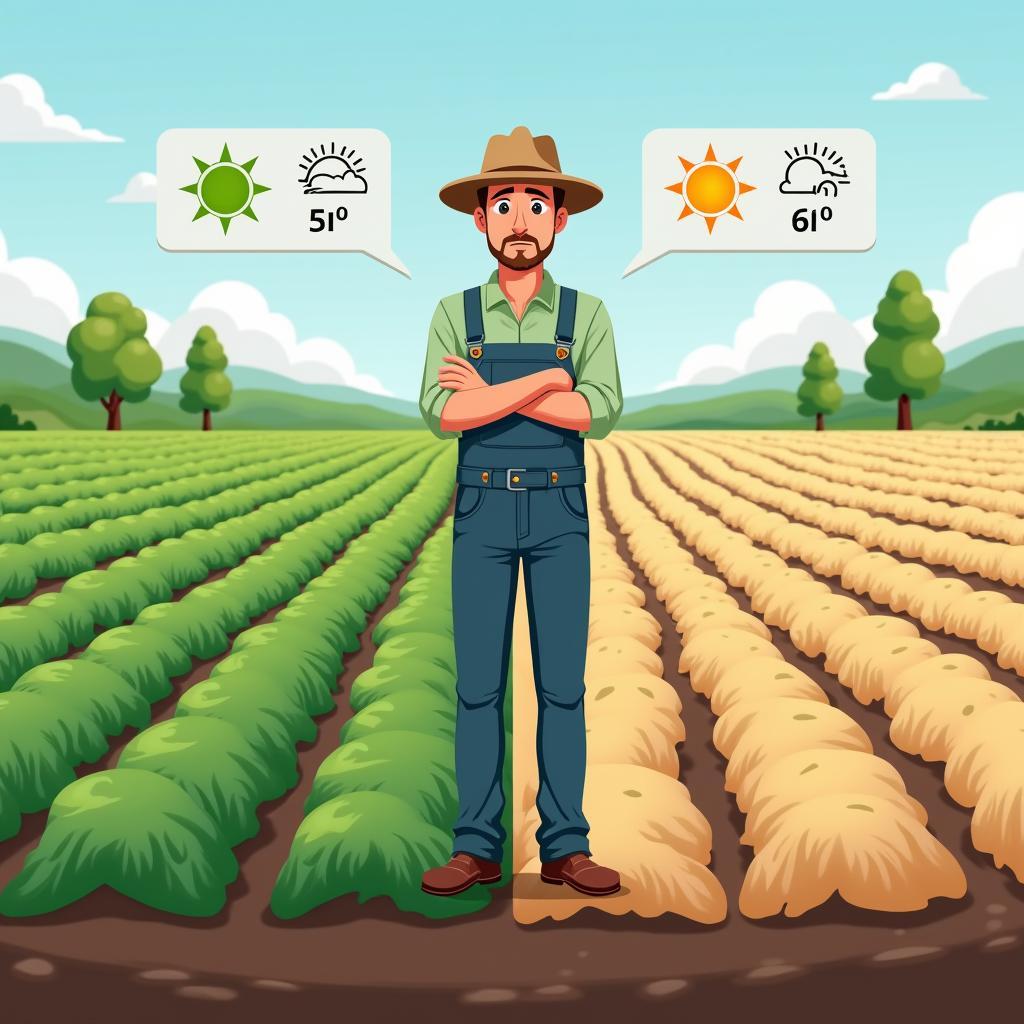 Ảnh minh họa tác động của biến đổi khí hậu đến nền kinh tế nông nghiệp toàn cầu với nông dân làm việc trên cánh đồng khô hạn
Market mechanisms are also evolving to address climate challenges in agriculture. Carbon credit systems allow farmers to earn additional income by adopting practices that reduce greenhouse gas emissions or sequester carbon in soil. This creates a financial incentive for sustainable farming practices while contributing to broader climate change mitigation efforts. However, accessing these markets often requires technical knowledge and certification that may be beyond the reach of small-scale farmers.
Looking forward, the relationship between climate change and agricultural economics will likely intensify. Projections suggest that without significant adaptation efforts, crop yields in many tropical regions could decline by 10-25% by 2050. This would have profound implications for food security and economic development, particularly in countries where agriculture remains a major employer. The challenge for policymakers is to balance immediate economic concerns with the need for long-term sustainability, ensuring that adaptation measures support both farmer livelihoods and environmental goals.
Questions 1-13
Questions 1-5: Multiple Choice
Choose the correct letter, A, B, C, or D.
1. According to the passage, what is the main reason traditional farming practices are becoming less effective?
A. Lack of modern technology
B. Unpredictable weather patterns
C. Shortage of skilled farmers
D. Reduced government support
2. The annual global economic cost of agricultural losses due to climate-related events is approximately:
A. $150 billion
B. $200 billion
C. $250 billion
D. $300 billion
3. What percentage of global freshwater is used for agriculture?
A. 50%
B. 60%
C. 70%
D. 80%
4. According to the passage, what is one positive effect of climate change on agriculture in some regions?
A. Lower pest populations
B. Extended growing seasons
C. Reduced water needs
D. Cheaper production costs
5. Weather-indexed insurance programmes provide compensation based on:
A. Actual crop losses only
B. Rainfall or temperature data
C. Government assessments
D. Historical yield averages
Questions 6-9: True/False/Not Given
Write TRUE if the statement agrees with the information, FALSE if the statement contradicts the information, or NOT GIVEN if there is no information on this.
6. Small-scale farmers in developing countries have adequate financial resources to adapt to climate change.
7. Warmer temperatures allow pests to survive in previously inhospitable regions.
8. All countries have implemented comprehensive agricultural insurance schemes.
9. Heat stress affects both meat and dairy production in livestock.
Questions 10-13: Sentence Completion
Complete the sentences below. Choose NO MORE THAN TWO WORDS from the passage for each answer.
10. Farmers in Southeast Asia traditionally relied on predictable __ for their rice cultivation.
11. The expansion of pest ranges means farmers must invest more in __ measures.
12. In some regions, farmers are forced to switch to less __ crops due to water scarcity.
13. Carbon credit systems create financial incentives for __ farming practices.
PASSAGE 2 – The Financial Sector’s Response to Climate Economics
Độ khó: Medium (Band 6.0-7.5)
Thời gian đề xuất: 18-20 phút
The intersection of climate change and global finance has emerged as a defining feature of contemporary economic discourse. Financial institutions, once primarily concerned with traditional risk factors such as market volatility and credit defaults, are now grappling with the profound implications of environmental transformation. This shift represents not merely an expansion of existing risk assessment frameworks but a fundamental reconceptualization of how economic value is created, measured, and preserved in an era of unprecedented environmental change.
Climate risk manifests in financial markets through two distinct but interconnected pathways: physical risks and transition risks. Physical risks stem directly from climate-related events such as extreme weather phenomena, rising sea levels, and changing temperature patterns. These events can destroy infrastructure, disrupt supply chains, and render assets worthless. For instance, coastal properties worth trillions of dollars face depreciation as sea levels rise and storm intensities increase. Insurance companies, traditionally at the forefront of risk management, are witnessing an erosion of insurability in certain regions, leading to market withdrawals and coverage gaps that create broader economic vulnerabilities.
Transition risks, by contrast, arise from the economic adjustments required to shift toward a low-carbon economy. As governments implement carbon pricing mechanisms, stricter environmental regulations, and policies favouring renewable energy, certain assets – particularly those in fossil fuel industries – face the prospect of becoming “stranded assets.” The concept of stranded assets refers to investments that lose value prematurely due to changes in market conditions or regulatory frameworks. Energy companies with substantial reserves of coal, oil, and gas are particularly exposed, as are financial institutions that have financed these operations. The International Energy Agency estimates that a transition pathway consistent with limiting global warming to 1.5°C would leave approximately $1 trillion worth of fossil fuel assets unused by 2030.
Central banks and financial regulators worldwide are beginning to integrate climate considerations into their supervisory frameworks. The Network for Greening the Financial System, a coalition of 127 central banks and supervisors representing over 85% of global greenhouse gas emissions, has developed climate stress tests to assess the resilience of financial institutions to various climate scenarios. These stress tests evaluate how banks’ portfolios might perform under different climate pathways, from orderly transitions to more disruptive scenarios. Early results suggest significant vulnerabilities, particularly among institutions with heavy exposure to carbon-intensive sectors.
The emergence of sustainable finance represents a proactive response to these challenges. Green bonds, which fund environmentally beneficial projects, have grown from a niche market to a mainstream financial instrument. Global green bond issuance reached $500 billion in 2022, reflecting growing investor appetite for climate-aligned investments. Similarly, Environmental, Social, and Governance (ESG) investing has moved from the periphery to the centre of asset management strategies. Funds incorporating ESG criteria now manage assets worth over $35 trillion globally, demonstrating that sustainability considerations are becoming integral to investment decision-making rather than optional additions.
However, the integration of climate factors into financial decision-making faces several substantial obstacles. Data limitations pose a significant challenge; while companies increasingly disclose carbon footprints and climate-related risks, the quality and comparability of this information vary considerably. The Task Force on Climate-related Financial Disclosures (TCFD) has provided a framework for standardized reporting, yet implementation remains inconsistent across sectors and jurisdictions. Without reliable data, investors struggle to accurately price climate risks, potentially leading to market inefficiencies and misallocation of capital.
Greenwashing represents another critical concern. As demand for sustainable investments grows, some companies exaggerate their environmental credentials or use misleading marketing to attract environmentally conscious investors. This practice undermines trust in sustainable finance and can misdirect capital away from genuinely impactful projects. Regulatory authorities are increasingly scrutinizing ESG claims, but the absence of universal standards makes enforcement challenging. The European Union’s Taxonomy Regulation attempts to address this by providing clear criteria for economic activities that can be classified as environmentally sustainable, though similar frameworks remain underdeveloped in other major economies.
The concept of climate-adjusted returns is reshaping investment analysis. Traditional financial models typically employ discount rates that reflect time preferences and risk premiums but do not explicitly account for climate-related uncertainties extending decades into the future. Emerging approaches attempt to incorporate long-term climate scenarios into valuation models, though methodological challenges remain formidable. The fundamental difficulty lies in quantifying the financial implications of tail-risk events – low-probability but high-impact occurrences that could fundamentally alter economic conditions.
Developing economies face distinct challenges in mobilizing climate finance. While they often bear disproportionate climate impacts despite contributing minimally to historical emissions, they struggle to attract the investment capital needed for both adaptation and mitigation. The cost of capital in these markets typically exceeds that in developed economies due to perceived risks, creating a paradox where those most needing climate investment face the highest financing costs. International initiatives such as the Green Climate Fund aim to address this disparity, but resources remain insufficient relative to needs. Estimates suggest developing countries require $2.4 trillion annually for climate action, far exceeding current international climate finance flows of approximately $80 billion annually.
Pension funds and sovereign wealth funds, with their long investment horizons, are particularly exposed to climate risks and could play a pivotal role in financing the transition. Their extended time frames align with the multigenerational nature of climate change, making them natural candidates for investments in climate resilience and clean energy infrastructure. Some forward-thinking institutions have begun divesting from fossil fuels and reallocating capital toward low-carbon alternatives. However, fiduciary duties and regulatory constraints often limit their flexibility, creating tensions between short-term financial obligations and long-term sustainability imperatives.
The repricing of risk across financial markets as climate considerations become mainstream could trigger substantial capital reallocation. Assets and companies demonstrating climate resilience may command premiums, while those with significant carbon exposure could face discounting. This repricing process, if orderly and gradual, could facilitate an efficient transition. However, if recognition of climate risks occurs suddenly – perhaps triggered by a climate-related financial crisis – the resulting market disruption could be severe, potentially destabilizing the financial system.
Innovation in financial instruments continues to expand the tools available for climate-related finance. Sustainability-linked loans, where interest rates adjust based on borrowers’ performance against environmental targets, create direct financial incentives for improved sustainability outcomes. Catastrophe bonds transfer climate-related risks to capital markets, spreading exposure beyond traditional insurance. Transition bonds finance companies’ decarbonization efforts, acknowledging that even high-emitting industries must be part of the solution. These instruments reflect an evolving recognition that financial markets must adapt their mechanisms to address the unique characteristics of climate-related risks and opportunities.
Ultimately, the financial sector’s response to climate change will significantly influence the speed and effectiveness of the global economic transformation required to address environmental challenges. Whether financial institutions emerge as enablers of transition or sources of systemic risk depends on their ability to accurately assess climate impacts, develop appropriate products and strategies, and balance profitability with planetary boundaries. The coming decade will be crucial in determining this trajectory, with implications extending far beyond financial markets to encompass the fundamental relationship between economic systems and environmental sustainability.
Questions 14-26
Questions 14-18: Yes/No/Not Given
Do the following statements agree with the views of the writer in the passage? Write:
YES if the statement agrees with the views of the writer
NO if the statement contradicts the views of the writer
NOT GIVEN if it is impossible to say what the writer thinks about this
14. Financial institutions previously neglected to consider environmental factors in their risk assessments.
15. All insurance companies have completely withdrawn from providing coverage in high-risk climate zones.
16. The concept of stranded assets applies exclusively to fossil fuel companies.
17. Sustainable finance has become increasingly mainstream rather than remaining a niche market.
18. Pension funds should prioritize short-term returns over long-term climate considerations.
Questions 19-22: Matching Headings
Choose the correct heading for paragraphs B-E from the list of headings below.
List of Headings:
i. The dual nature of climate-related financial threats
ii. Obstacles to effective climate risk assessment
iii. The growth of environmentally focused investment products
iv. Regulatory responses to climate risks in banking
v. The challenge of financing climate action in poorer nations
vi. Historical development of financial regulation
vii. Traditional banking practices
19. Paragraph B (begins: “Climate risk manifests…”)
20. Paragraph D (begins: “Central banks and financial regulators…”)
21. Paragraph E (begins: “The emergence of sustainable finance…”)
22. Paragraph I (begins: “Developing economies face…”)
Questions 23-26: Summary Completion
Complete the summary below. Choose NO MORE THAN TWO WORDS from the passage for each answer.
Climate change presents significant challenges for the financial sector through both physical and transition risks. The concept of (23) __ refers to investments that may lose value prematurely due to shifts toward low-carbon economies. Financial institutions are developing (24) __ to evaluate their resilience under different climate scenarios. However, (25) __ remains a serious problem where companies exaggerate their environmental credentials. Developing countries face higher (26) __ which makes attracting climate investment more difficult.
PASSAGE 3 – Macroeconomic Implications of Climate-Induced Structural Transformation
Độ khó: Hard (Band 7.0-9.0)
Thời gian đề xuất: 23-25 phút
The emergent consensus among economists that climate change constitutes a first-order macroeconomic variable represents a paradigmatic shift in how the discipline conceptualizes the relationship between natural systems and economic structures. Traditional macroeconomic models, predicated on assumptions of environmental stasis or infinitely substitutable resources, are increasingly recognized as inadequate for capturing the systemic disruptions and nonlinear dynamics that characterize climate-economy interactions. This theoretical recalibration necessitates not merely incremental adjustments to existing frameworks but rather a fundamental reimagining of the productive basis of contemporary capitalism and the distributional consequences of environmental transformation.
Climate-induced productivity shocks operate through mechanisms markedly distinct from conventional business cycle fluctuations. Unlike demand-driven recessions or monetary policy adjustments, which typically exhibit reversible characteristics, climate impacts impose permanent supply-side constraints that erode productive capacity itself. Labor productivity diminishes when temperatures exceed physiological thresholds for human performance; infrastructure degrades under accelerated weathering and extreme events; capital stocks become obsolete as climatic conditions shift beyond the parameters for which they were designed. These effects compound over time, creating path dependencies wherein early inaction amplifies future costs, while the option value of preserving climatic stability diminishes with each incremental degree of warming.
The sectoral heterogeneity of climate impacts introduces complex structural adjustment challenges. Industries exhibit vastly different vulnerabilities and adaptive capacities: tourism economies dependent on snow sports face existential threats from reduced snowfall, while certain northern agricultural zones might experience transitory benefits from extended growing seasons. This uneven geography of impact necessitates intersectoral resource reallocation on a scale unprecedented in peacetime economies, raising profound questions about the capacity of market mechanisms to efficiently coordinate such transitions without generating severe dislocations and distributional conflicts.
General equilibrium effects amplify direct climate impacts through cascading interdependencies. A drought affecting agricultural output doesn’t merely reduce farm incomes; it disrupts food processing industries, affects transportation and logistics sectors, influences consumer price indices, and potentially triggers monetary policy responses. These ripple effects propagate through input-output linkages, with implications extending far beyond initially affected sectors. Contemporary computable general equilibrium models attempting to capture these dynamics face formidable challenges in parameterizing feedback mechanisms, particularly those involving ecosystem services whose economic contributions often remain unpriced and unquantified in conventional national accounts.
The temporal dimension of climate economics presents unique analytical challenges. Standard cost-benefit analyses employ discounting to compare present costs with future benefits, yet climate change inherently involves intergenerational transfers where current generations impose costs on descendants who have no voice in present decision-making. The choice of discount rate becomes not merely a technical parameter but an ethical statement about the relative value of future welfare. Low discount rates justify extensive present mitigation expenditures by weighting future damages heavily, while high rates rationalize inaction by diminishing the present value of distant harms. This intertemporal welfare distribution problem has generated extensive debate, with some economists arguing for declining discount rates over extended horizons to avoid the ethical absurdity of effectively disregarding catastrophic but temporally distant outcomes.
Monetary policy frameworks confront novel complications as climate factors influence both aggregate demand and supply functions simultaneously. Central banks traditionally target inflation and employment, operating under assumptions of output gap measures that may become increasingly unreliable as climate events blur distinctions between cyclical fluctuations and structural capacity losses. Climate-driven inflation presents a particularly vexing challenge: should central banks tighten policy in response to food price increases caused by droughts, potentially exacerbating economic contractions, or accommodate such shocks while risking inflation expectations becoming unanchored? The European Central Bank’s recognition that climate change falls within its mandate reflects growing acknowledgment that environmental factors are becoming irreducibly embedded in core macroeconomic dynamics.
Fiscal policy confronts analogous challenges amplified by budgetary constraints. Climate adaptation and mitigation require substantial public investment precisely when governments face competing demands from aging populations, infrastructure deficits, and debt burdens accumulated through previous crises. Public finance sustainability must now incorporate climate contingent liabilities – the potential fiscal costs of disasters, adaptation measures, and economic disruptions – that are both substantial and characterized by deep uncertainty. Some estimates suggest climate-related fiscal costs could reach 10-20% of GDP annually in highly vulnerable countries by mid-century, levels that would fundamentally challenge fiscal solvency and potentially trigger sovereign debt crises.
The concept of climate-inclusive GDP represents an attempt to rectify the failure of conventional growth metrics to account for environmental degradation. Standard GDP measures can perversely increase following destructive climate events due to reconstruction spending, while gradual erosion of natural capital – forests degraded, aquifers depleted, ecosystems disrupted – remains invisible in national accounts. Alternative metrics such as Genuine Progress Indicators or Inclusive Wealth attempt to incorporate these dimensions, though methodological challenges around valuation and aggregation of diverse environmental assets have limited their adoption. The question of whether economic growth, as conventionally measured, can be decoupled from environmental degradation – absolute decoupling wherein resource use and emissions decline even as GDP rises – remains empirically contested, with profound implications for the compatibility of growth imperatives and environmental sustainability.
International economic architecture faces structural inadequacies in addressing climate challenges. The Bretton Woods institutions – the International Monetary Fund and World Bank – were designed for a world concerned with balance of payments stability and development finance, not planetary boundaries and climate catastrophe prevention. While these institutions increasingly incorporate climate considerations, their governance structures reflecting post-World War II power distributions may hinder the collective action necessary for effective global response. The absence of enforceable international mechanisms for climate finance transfers from high-income to low-income nations, despite rhetorical commitments, exemplifies these institutional deficits. Proposals for climate-conditioned debt relief, wherein debts are forgiven in exchange for environmental investments, or Special Drawing Rights allocated based on climate vulnerability, represent attempts to adapt international financial mechanisms to contemporary imperatives.
Labor market dynamics under climate transformation involve both disruption and creation. While fossil fuel industries face secular decline, renewable energy sectors expand, raising questions about whether net employment effects will be positive and whether displaced workers possess transferable skills for emerging opportunities. Just transition frameworks attempt to ensure equitable distribution of costs and benefits, yet implementation remains fragmentary. Geographic mismatches between declining and emerging industries – coal regions versus renewable energy hotspots – create place-based adjustment challenges that markets alone may not resolve efficiently, potentially requiring active labor market policies and regional development interventions.
The possibility of climate-induced financial crises represents perhaps the most immediate macroeconomic concern. Asset revaluation as climate risks are recognized and priced could occur suddenly – a “climate Minsky moment” – wherein market sentiment shifts abruptly from denial to panic, triggering sharp devaluations of carbon-intensive assets, credit crunches, and potential systemic instability. Financial institutions’ balance sheets laden with climate-vulnerable assets could face solvency threats, while interconnectedness through counterparty relationships might propagate shocks throughout the financial system. Macroprudential regulation is increasingly oriented toward building climate resilience, though whether such measures suffice to prevent crisis remains uncertain.
Emerging scholarship on ecological macroeconomics challenges more fundamentally the assumptions undergirding mainstream models. This heterodox approach emphasizes biophysical constraints, material throughput, and the thermodynamic basis of economic processes, arguing that economies are embedded subsystems within finite ecosystems rather than autonomous systems to which environmental considerations are external. From this perspective, perpetual growth on a finite planet constitutes a logical impossibility, necessitating steady-state economics or degrowth strategies that prioritize human welfare over quantitative expansion. While marginalized in policy circles, such frameworks gain credence as empirical realities of planetary overshoot become increasingly undeniable.
The political economy of climate-induced structural transformation involves profound questions about power, interests, and institutional change. Incumbent industries facing decline possess concentrated interests and political influence that may obstruct necessary transitions, while beneficiaries of new climate-compatible industries remain diffuse and politically weak. This asymmetry creates status quo bias even when collective welfare would improve through transformation. Historical precedents of major economic restructurings – agricultural to industrial transition, postwar reconstruction – suggest that such transformations occur not through smooth market adjustments but through contentious political processes involving social movements, policy innovation, and sometimes crisis-induced disruption that overcomes institutional inertia.
Ultimately, the macroeconomic implications of climate change transcend technical questions of model specification or policy calibration, implicating foundational issues about the purposes of economic systems, the distribution of risks and rewards across populations and generations, and the relationship between human societies and the ecological systems that sustain them. Whether established macroeconomic paradigms can adapt sufficiently to incorporate these dimensions, or whether more fundamental epistemological and institutional transformations prove necessary, will substantially determine both economic trajectories and environmental outcomes in the decades ahead.
 Hình ảnh mô tả các mô hình kinh tế vĩ mô và tác động của biến đổi khí hậu lên cấu trúc kinh tế toàn cầu
Questions 27-40
Questions 27-31: Multiple Choice
Choose the correct letter, A, B, C, or D.
27. According to the passage, traditional macroeconomic models are inadequate because they:
A. Focus too much on environmental factors
B. Assume environmental stability or infinite resource substitution
C. Ignore monetary policy effects
D. Overestimate climate impacts
28. The passage suggests that climate-induced productivity shocks differ from conventional business cycles in that they:
A. Are easier to predict
B. Have temporary effects
C. Impose permanent supply-side constraints
D. Only affect developing countries
29. The author’s discussion of discount rates emphasizes that:
A. High discount rates always lead to better policy outcomes
B. The choice involves ethical considerations about future generations
C. Technical calculations should determine the appropriate rate
D. Discount rates are irrelevant to climate policy
30. According to the passage, climate-driven inflation presents challenges for central banks because:
A. It occurs independently of monetary policy
B. It only affects food prices
C. It involves simultaneous demand and supply effects that complicate policy responses
D. Central banks have no tools to address it
31. The concept of “climate-inclusive GDP” attempts to:
A. Increase GDP through environmental spending
B. Account for environmental degradation in economic measurements
C. Replace all traditional economic indicators
D. Eliminate the need for GDP calculations
Questions 32-36: Matching Features
Match each concept (32-36) with the correct description (A-H) from the passage.
Concepts:
32. Stranded assets
33. Climate Minsky moment
34. Just transition
35. Absolute decoupling
36. Ecological macroeconomics
Descriptions:
A. An approach emphasizing biophysical constraints and material throughput
B. Sudden market revaluation triggered by recognition of climate risks
C. Framework ensuring equitable distribution of climate transition costs
D. Investments losing value due to market or regulatory changes
E. International agreements on carbon pricing
F. Resource use declining while GDP increases
G. Government subsidies for fossil fuel industries
H. Temporary economic disruptions from weather events
Questions 37-40: Short-answer Questions
Answer the questions below using NO MORE THAN THREE WORDS from the passage for each answer.
37. What type of effects amplify direct climate impacts through interconnected economic relationships?
38. Which two international institutions were originally designed for balance of payments stability and development finance?
39. What framework attempts to ensure fair distribution of climate transformation costs and benefits?
40. According to the passage, what kind of bias occurs when incumbent industries use political influence to obstruct transitions?
Answer Keys – Đáp Án
PASSAGE 1: Questions 1-13
- B
- C
- C
- B
- B
- FALSE
- TRUE
- NOT GIVEN
- TRUE
- monsoon seasons
- pest control
- water-intensive
- sustainable
PASSAGE 2: Questions 14-26
- YES
- NO
- NO
- YES
- NO
- i
- iv
- iii
- v
- stranded assets
- stress tests / climate stress tests
- greenwashing
- cost of capital / costs of capital
PASSAGE 3: Questions 27-40
- B
- C
- B
- C
- B
- D
- B
- C
- F
- A
- General equilibrium effects
- Bretton Woods institutions
- Just transition
- status quo bias
Giải Thích Đáp Án Chi Tiết
Passage 1 – Giải Thích
Câu 1: B – Unpredictable weather patterns
- Dạng câu hỏi: Multiple Choice
- Từ khóa: traditional farming practices, less effective
- Vị trí trong bài: Đoạn 2, câu thứ 2-4
- Giải thích: Bài văn nói rõ “Crop yields… are now threatened by rising temperatures and changing rainfall patterns” và “traditional farming practices… are becoming less effective” do “unpredictable monsoon seasons.” Đáp án B paraphrase chính xác ý này. Các đáp án khác không được đề cập như lý do chính.
Câu 2: C – $250 billion
- Dạng câu hỏi: Multiple Choice (fact-finding)
- Từ khóa: annual global economic cost, agricultural losses
- Vị trí trong bài: Đoạn 3, câu đầu tiên
- Giải thích: Con số được nêu trực tiếp: “agricultural losses due to climate-related events cost the global economy approximately $250 billion annually.” Đây là câu hỏi tìm thông tin cụ thể, không cần paraphrase.
Câu 3: C – 70%
- Dạng câu hỏi: Multiple Choice (fact-finding)
- Từ khóa: percentage, global freshwater, agriculture
- Vị trí trong bài: Đoạn 4, câu đầu
- Giải thích: Thông tin rõ ràng: “Agriculture accounts for approximately 70% of global freshwater use.” Câu hỏi kiểm tra khả năng định vị thông tin số liệu.
Câu 4: B – Extended growing seasons
- Dạng câu hỏi: Multiple Choice
- Từ khóa: positive effect, climate change, some regions
- Vị trí trong bài: Đoạn 7, câu đầu
- Giải thích: Đoạn văn nói “The growing season is extending in some temperate regions, potentially allowing for multiple harvests per year.” Đây là tác động tích cực duy nhất được đề cập rõ ràng. Các đáp án khác không chính xác hoặc không được nhắc đến.
Câu 5: B – Rainfall or temperature data
- Dạng câu hỏi: Multiple Choice
- Từ khóa: weather-indexed insurance, compensation based on
- Vị trí trong bài: Đoạn 9, câu thứ 2
- Giải thích: Bài viết giải thích: “providing compensation based on rainfall measurements or temperature data rather than actual crop losses.” Đây là sự paraphrase trực tiếp.
Câu 6: FALSE
- Dạng câu hỏi: True/False/Not Given
- Từ khóa: small-scale farmers, adequate financial resources
- Vị trí trong bài: Đoạn 3, câu cuối
- Giải thích: Bài văn nói rõ “Small-scale farmers in developing countries are particularly vulnerable, as they often lack the financial resources…” Điều này trực tiếp mâu thuẫn với statement cho rằng họ có đủ nguồn lực tài chính.
Câu 7: TRUE
- Dạng câu hỏi: True/False/Not Given
- Từ khóa: warmer temperatures, pests survive, previously unable
- Vị trí trong bài: Đoạn 5, câu thứ 2
- Giải thích: “Warmer temperatures allow many pests to survive in regions where they were previously unable to establish themselves” khớp chính xác với statement.
Câu 8: NOT GIVEN
- Dạng câu hỏi: True/False/Not Given
- Từ khóa: all countries, comprehensive agricultural insurance
- Vị trí trong bài: Không có thông tin
- Giải thích: Đoạn 9 chỉ đề cập đến các chương trình bảo hiểm ở một số nước như Ấn Độ, và nói rằng “coverage remains limited in many vulnerable regions.” Không có thông tin về việc tất cả các quốc gia có hay không có hệ thống bảo hiểm toàn diện.
Câu 9: TRUE
- Dạng câu hỏi: True/False/Not Given
- Từ khóa: heat stress, meat and dairy production
- Vị trí trong bài: Đoạn 6, câu đầu
- Giải thích: “Heat stress reduces animal productivity, affecting both meat and dairy production” khớp chính xác với statement.
Câu 10: monsoon seasons
- Dạng câu hỏi: Sentence Completion
- Từ khóa: Southeast Asia, rice farmers, traditionally relied
- Vị trí trong bài: Đoạn 2, câu cuối
- Giải thích: “rice farmers who once relied on predictable monsoon seasons…” Cụm từ cần điền là “monsoon seasons” (đếm được 2 từ, phù hợp yêu cầu NO MORE THAN TWO WORDS).
Câu 11: pest control
- Dạng câu hỏi: Sentence Completion
- Từ khóa: expansion of pest ranges, farmers must invest
- Vị trí trong bài: Đoạn 5, câu thứ 3
- Giải thích: “farmers must invest more in pest control measures” – Đáp án là “pest control” (2 từ).
Câu 12: water-intensive
- Dạng câu hỏi: Sentence Completion
- Từ khóa: switch to less, crops, water scarcity
- Vị trí trong bài: Đoạn 4, câu thứ 3
- Giải thích: “Farmers are being forced to switch to less water-intensive crops” – Đáp án là “water-intensive” (1 từ ghép).
Câu 13: sustainable
- Dạng câu hỏi: Sentence Completion
- Từ khóa: carbon credit systems, financial incentives, farming practices
- Vị trí trong bài: Đoạn 10, câu thứ 2
- Giải thích: “This creates a financial incentive for sustainable farming practices” – Đáp án là “sustainable” (1 từ).
Passage 2 – Giải Thích
Câu 14: YES
- Dạng câu hỏi: Yes/No/Not Given
- Từ khóa: financial institutions, previously neglected, environmental factors
- Vị trí trong bài: Đoạn A, câu thứ 2
- Giải thích: “Financial institutions, once primarily concerned with traditional risk factors… are now grappling with the profound implications of environmental transformation.” Từ “once” chỉ ra rằng trước đây họ tập trung vào các yếu tố rủi ro truyền thống, ngụ ý họ đã bỏ qua các yếu tố môi trường.
Câu 15: NO
- Dạng câu hỏi: Yes/No/Not Given
- Từ khóa: all insurance companies, completely withdrawn, high-risk zones
- Vị trí trong bài: Đoạn B, giữa đoạn
- Giải thích: Bài văn nói “witnessing an erosion of insurability in certain regions, leading to market withdrawals” – chỉ một số khu vực, không phải tất cả. Statement sử dụng “all” và “completely” quá tuyệt đối, nên đáp án là NO.
Câu 16: NO
- Dạng câu hỏi: Yes/No/Not Given
- Từ khóa: stranded assets, exclusively, fossil fuel companies
- Vị trí trong bài: Đoạn C
- Giải thích: Trong khi đoạn văn đề cập “Energy companies with substantial reserves… are particularly exposed, as are financial institutions that have financed these operations.” Điều này cho thấy không chỉ riêng công ty nhiên liệu hóa thạch bị ảnh hưởng, mà cả các tổ chức tài chính, do đó “exclusively” là sai.
Câu 17: YES
- Dạng câu hỏi: Yes/No/Not Given
- Từ khóa: sustainable finance, mainstream, niche market
- Vị trí trong bài: Đoạn E, câu đầu
- Giải thích: “Green bonds… have grown from a niche market to a mainstream financial instrument.” Điều này khớp chính xác với statement.
Câu 18: NO
- Dạng câu hỏi: Yes/No/Not Given
- Từ khóa: pension funds, prioritize short-term returns, long-term climate
- Vị trí trong bài: Đoạn J
- Giải thích: Bài văn nói “Pension funds… with their long investment horizons… Their extended time frames align with the multigenerational nature of climate change.” Điều này ngụ ý họ nên tập trung vào dài hạn, không phải ngắn hạn như statement gợi ý.
Câu 19: i – The dual nature of climate-related financial threats
- Dạng câu hỏi: Matching Headings
- Vị trí: Đoạn B
- Giải thích: Đoạn này bắt đầu bằng “Climate risk manifests… through two distinct but interconnected pathways: physical risks and transition risks” và sau đó giải thích cả hai loại. Heading i phản ánh chính xác nội dung này.
Câu 20: iv – Regulatory responses to climate risks in banking
- Dạng câu hỏi: Matching Headings
- Vị trí: Đoạn D
- Giải thích: Đoạn này tập trung vào “Central banks and financial regulators” và việc họ “integrate climate considerations into their supervisory frameworks” cùng với “climate stress tests.” Đây là phản ứng của cơ quan quản lý đối với rủi ro khí hậu.
Câu 21: iii – The growth of environmentally focused investment products
- Dạng câu hỏi: Matching Headings
- Vị trí: Đoạn E
- Giải thích: Đoạn này thảo luận về “sustainable finance,” “Green bonds,” và “ESG investing,” tất cả đều là các sản phẩm đầu tư tập trung vào môi trường đang phát triển.
Câu 22: v – The challenge of financing climate action in poorer nations
- Dạng câu hỏi: Matching Headings
- Vị trí: Đoạn I
- Giải thích: Đoạn này bắt đầu với “Developing economies face distinct challenges in mobilizing climate finance” và thảo luận về khó khăn của họ trong việc thu hút vốn đầu tư.
Câu 23: stranded assets
- Dạng câu hỏi: Summary Completion
- Vị trí: Đoạn C
- Giải thích: “The concept of stranded assets refers to investments that lose value prematurely due to changes in market conditions or regulatory frameworks” – khớp chính xác với ngữ cảnh trong summary.
Câu 24: stress tests / climate stress tests
- Dạng câu hỏi: Summary Completion
- Vị trí: Đoạn D
- Giải thích: “central banks… has developed climate stress tests to assess the resilience of financial institutions” – Cả hai đáp án đều được chấp nhận.
Câu 25: greenwashing
- Dạng câu hỏi: Summary Completion
- Vị trí: Đoạn G
- Giải thích: “Greenwashing represents another critical concern… some companies exaggerate their environmental credentials” – Đây là thuật ngữ mô tả vấn đề trong summary.
Câu 26: cost of capital / costs of capital
- Dạng câu hỏi: Summary Completion
- Vị trí: Đoạn I
- Giải thích: “The cost of capital in these markets typically exceeds that in developed economies” – Summary paraphrase điều này thành “higher cost of capital.”
Passage 3 – Giải Thích
Câu 27: B – Assume environmental stability or infinite resource substitution
- Dạng câu hỏi: Multiple Choice
- Từ khóa: traditional macroeconomic models, inadequate
- Vị trí trong bài: Đoạn A, câu thứ 2
- Giải thích: “Traditional macroeconomic models, predicated on assumptions of environmental stasis or infinitely substitutable resources, are increasingly recognized as inadequate…” Đây là paraphrase trực tiếp của đáp án B.
Câu 28: C – Impose permanent supply-side constraints
- Dạng câu hỏi: Multiple Choice
- Từ khóa: climate-induced productivity shocks, differ from, conventional business cycles
- Vị trí trong bài: Đoạn B, câu đầu
- Giải thích: “Climate-induced productivity shocks operate through mechanisms markedly distinct… climate impacts impose permanent supply-side constraints that erode productive capacity itself” – Khác biệt chính được nhấn mạnh là tính chất vĩnh viễn về mặt cung.
Câu 29: B – The choice involves ethical considerations about future generations
- Dạng câu hỏi: Multiple Choice
- Từ khóa: discount rates, emphasizes
- Vị trí trong bài: Đoạn E, giữa đoạn
- Giải thích: “The choice of discount rate becomes not merely a technical parameter but an ethical statement about the relative value of future welfare” và thảo luận về “intergenerational transfers.” Đáp án B nắm bắt được điểm nhấn về mặt đạo đức này.
Câu 30: C – It involves simultaneous demand and supply effects that complicate policy responses
- Dạng câu hỏi: Multiple Choice
- Từ khóa: climate-driven inflation, challenges, central banks
- Vị trí trong bài: Đoạn F, giữa đoạn
- Giải thích: “Climate-driven inflation presents a particularly vexing challenge” vì nó ảnh hưởng “both aggregate demand and supply functions simultaneously,” khiến việc đưa ra quyết định chính sách trở nên phức tạp.
Câu 31: B – Account for environmental degradation in economic measurements
- Dạng câu hỏi: Multiple Choice
- Từ khóa: climate-inclusive GDP, attempts to
- Vị trí trong bài: Đoạn H, câu đầu
- Giải thích: “The concept of climate-inclusive GDP represents an attempt to rectify the failure of conventional growth metrics to account for environmental degradation.” Đây là mục đích chính của khái niệm này.
Câu 32: D – Investments losing value due to market or regulatory changes
- Dạng câu hỏi: Matching Features
- Vị trí: Đoạn C
- Giải thích: Định nghĩa rõ ràng: “The concept of stranded assets refers to investments that lose value prematurely due to changes in market conditions or regulatory frameworks.”
Câu 33: B – Sudden market revaluation triggered by recognition of climate risks
- Dạng câu hỏi: Matching Features
- Vị trí: Đoạn K
- Giải thích: “Asset revaluation as climate risks are recognized and priced could occur suddenly – a ‘climate Minsky moment’ – wherein market sentiment shifts abruptly from denial to panic.”
Câu 34: C – Framework ensuring equitable distribution of climate transition costs
- Dạng câu hỏi: Matching Features
- Vị trí: Đoạn J
- Giải thích: “Just transition frameworks attempt to ensure equitable distribution of costs and benefits” – Đây là mô tả chính xác của khái niệm.
Câu 35: F – Resource use declining while GDP increases
- Dạng câu hỏi: Matching Features
- Vị trí: Đoạn H
- Giải thích: “absolute decoupling wherein resource use and emissions decline even as GDP rises” – Đây là định nghĩa của absolute decoupling.
Câu 36: A – An approach emphasizing biophysical constraints and material throughput
- Dạng câu hỏi: Matching Features
- Vị trí: Đoạn L
- Giải thích: “Emerging scholarship on ecological macroeconomics… emphasizes biophysical constraints, material throughput, and the thermodynamic basis of economic processes.”
Câu 37: General equilibrium effects
- Dạng câu hỏi: Short-answer
- Từ khóa: amplify direct climate impacts, interconnected economic relationships
- Vị trí trong bài: Đoạn D, câu đầu
- Giải thích: “General equilibrium effects amplify direct climate impacts through cascading interdependencies.” Đáp án chính xác 3 từ.
Câu 38: Bretton Woods institutions
- Dạng câu hỏi: Short-answer
- Từ khóa: two international institutions, balance of payments, development finance
- Vị trí trong bài: Đoạn I, câu thứ 2
- Giải thích: “The Bretton Woods institutions – the International Monetary Fund and World Bank – were designed for a world concerned with balance of payments stability and development finance.” Đáp án là 3 từ.
Câu 39: Just transition
- Dạng câu hỏi: Short-answer
- Từ khóa: framework, fair distribution, costs and benefits
- Vị trí trong bài: Đoạn J
- Giải thích: “Just transition frameworks attempt to ensure equitable distribution of costs and benefits” – Paraphrase “fair” thành “equitable.” Đáp án 2 từ.
Câu 40: status quo bias
- Dạng câu hỏi: Short-answer
- Từ khóa: bias, incumbent industries, political influence, obstruct transitions
- Vị trí trong bài: Đoạn M
- Giải thích: “Incumbent industries facing decline possess concentrated interests and political influence that may obstruct necessary transitions… This asymmetry creates status quo bias.” Đáp án 3 từ.
Từ Vựng Quan Trọng Theo Passage
Passage 1 – Essential Vocabulary
| Từ vựng | Loại từ | Phiên âm | Nghĩa tiếng Việt | Ví dụ từ bài | Collocation |
|---|---|---|---|---|---|
| livelihood | n | /ˈlaɪvlihʊd/ | sinh kế, kế sinh nhai | farmers face challenges that directly impact their livelihoods | threaten someone’s livelihood |
| crop yield | n | /krɒp jiːld/ | năng suất cây trồng | Crop yields are now threatened by rising temperatures | increase/decrease crop yields |
| drought | n | /draʊt/ | hạn hán | irregular rainfall, leading to either droughts or flooding | severe drought |
| adaptive technology | n | /əˈdæptɪv tekˈnɒlədʒi/ | công nghệ thích ứng | lack financial resources to invest in adaptive technologies | invest in adaptive technology |
| water scarcity | n | /ˈwɔːtə ˈskeəsəti/ | khan hiếm nước | Water scarcity presents another significant challenge | face water scarcity |
| irrigation system | n | /ˌɪrɪˈɡeɪʃən ˈsɪstəm/ | hệ thống tưới tiêu | irrigation systems are under severe strain | improve irrigation systems |
| pest control | n | /pest kənˈtrəʊl/ | kiểm soát sâu bệnh | farmers must invest more in pest control measures | implement pest control |
| heat stress | n | /hiːt stres/ | căng thẳng nhiệt | Heat stress reduces animal productivity | suffer from heat stress |
| profit margin | n | /ˈprɒfɪt ˈmɑːdʒɪn/ | biên lợi nhuận | further squeezing profit margins for farmers | tight profit margins |
| agricultural diversification | n | /ˌæɡrɪˈkʌltʃərəl daɪˌvɜːsɪfɪˈkeɪʃən/ | đa dạng hóa nông nghiệp | This agricultural diversification can open new markets | promote agricultural diversification |
| climate-resilient | adj | /ˈklaɪmət rɪˈzɪliənt/ | có khả năng chống chịu khí hậu | investing in climate-resilient agriculture | develop climate-resilient crops |
| carbon credit | n | /ˈkɑːbən ˈkredɪt/ | tín dụng carbon | Carbon credit systems allow farmers to earn additional income | trade carbon credits |
Passage 2 – Essential Vocabulary
| Từ vựng | Loại từ | Phiên âm | Nghĩa tiếng Việt | Ví dụ từ bài | Collocation |
|---|---|---|---|---|---|
| market volatility | n | /ˈmɑːkɪt ˌvɒləˈtɪləti/ | biến động thị trường | concerned with traditional risk factors such as market volatility | high market volatility |
| physical risk | n | /ˈfɪzɪkəl rɪsk/ | rủi ro vật chất | Physical risks stem directly from climate-related events | assess physical risks |
| transition risk | n | /trænˈzɪʃən rɪsk/ | rủi ro chuyển đổi | Transition risks arise from economic adjustments | manage transition risks |
| stranded asset | n | /ˈstrændɪd ˈæset/ | tài sản bị mắc kẹt | certain assets face the prospect of becoming stranded assets | avoid stranded assets |
| fossil fuel industry | n | /ˈfɒsəl fjuːəl ˈɪndəstri/ | ngành công nghiệp nhiên liệu hóa thạch | particularly those in fossil fuel industries | transition from fossil fuel industry |
| stress test | n | /stres test/ | kiểm tra căng thẳng | developed climate stress tests to assess resilience | conduct stress tests |
| green bond | n | /ɡriːn bɒnd/ | trái phiếu xanh | Green bonds fund environmentally beneficial projects | issue green bonds |
| ESG investing | n | /iː es dʒiː ɪnˈvestɪŋ/ | đầu tư ESG (Môi trường, Xã hội, Quản trị) | ESG investing has moved to the centre | focus on ESG investing |
| carbon footprint | n | /ˈkɑːbən ˈfʊtprɪnt/ | dấu chân carbon | companies increasingly disclose carbon footprints | reduce carbon footprint |
| greenwashing | n | /ˈɡriːnwɒʃɪŋ/ | tẩy xanh (làm giả về môi trường) | Greenwashing represents another critical concern | prevent greenwashing |
| discount rate | n | /ˈdɪskaʊnt reɪt/ | tỷ lệ chiết khấu | Traditional financial models employ discount rates | apply discount rates |
| climate-aligned investment | n | /ˈklaɪmət əˈlaɪnd ɪnˈvestmənt/ | đầu tư phù hợp với khí hậu | growing investor appetite for climate-aligned investments | promote climate-aligned investments |
| capital reallocation | n | /ˈkæpɪtəl ˌriːæləˈkeɪʃən/ | tái phân bổ vốn | could trigger substantial capital reallocation | facilitate capital reallocation |
| decarbonization | n | /diːˌkɑːbənaɪˈzeɪʃən/ | khử carbon | Transition bonds finance companies’ decarbonization efforts | accelerate decarbonization |
| systemic risk | n | /sɪˈstemɪk rɪsk/ | rủi ro hệ thống | sources of systemic risk | mitigate systemic risk |
Passage 3 – Essential Vocabulary
| Từ vựng | Loại từ | Phiên âm | Nghĩa tiếng Việt | Ví dụ từ bài | Collocation |
|---|---|---|---|---|---|
| macroeconomic variable | n | /ˌmækrəʊˌiːkəˈnɒmɪk ˈveəriəbəl/ | biến số kinh tế vĩ mô | climate change constitutes a first-order macroeconomic variable | key macroeconomic variables |
| paradigmatic shift | n | /ˌpærədɪɡˈmætɪk ʃɪft/ | sự chuyển đổi mô hình | represents a paradigmatic shift | undergo paradigmatic shift |
| nonlinear dynamics | n | /nɒnˈlɪniə daɪˈnæmɪks/ | động lực phi tuyến tính | nonlinear dynamics that characterize climate-economy interactions | exhibit nonlinear dynamics |
| productivity shock | n | /ˌprɒdʌkˈtɪvəti ʃɒk/ | cú sốc năng suất | Climate-induced productivity shocks operate through distinct mechanisms | experience productivity shocks |
| supply-side constraint | n | /səˈplaɪ saɪd kənˈstreɪnt/ | ràng buộc về phía cung | climate impacts impose permanent supply-side constraints | face supply-side constraints |
| sectoral heterogeneity | n | /sekˈtɔːrəl ˌhetərədʒəˈniːəti/ | sự không đồng nhất giữa các ngành | The sectoral heterogeneity of climate impacts | account for sectoral heterogeneity |
| general equilibrium effect | n | /ˈdʒenərəl ˌiːkwɪˈlɪbriəm ɪˈfekt/ | tác động cân bằng chung | General equilibrium effects amplify direct climate impacts | analyze general equilibrium effects |
| intergenerational transfer | n | /ˌɪntədʒenəˈreɪʃənəl trænsˈfɜː/ | chuyển giao liên thế hệ | inherently involves intergenerational transfers | ensure fair intergenerational transfers |
| discount rate | n | /ˈdɪskaʊnt reɪt/ | tỷ lệ chiết khấu | The choice of discount rate becomes an ethical statement | determine appropriate discount rate |
| monetary policy framework | n | /ˈmʌnɪtəri ˈpɒləsi ˈfreɪmwɜːk/ | khung chính sách tiền tệ | Monetary policy frameworks confront novel complications | reform monetary policy frameworks |
| fiscal sustainability | n | /ˈfɪskəl səˌsteɪnəˈbɪləti/ | tính bền vững tài khóa | Public finance sustainability must now incorporate climate liabilities | ensure fiscal sustainability |
| natural capital | n | /ˈnætʃərəl ˈkæpɪtəl/ | vốn tự nhiên | gradual erosion of natural capital | preserve natural capital |
| absolute decoupling | n | /ˈæbsəluːt diːˈkʌplɪŋ/ | tách rời tuyệt đối | whether absolute decoupling can be achieved | achieve absolute decoupling |
| Bretton Woods institution | n | /ˈbretən wʊdz ˌɪnstɪˈtjuːʃən/ | tổ chức Bretton Woods | The Bretton Woods institutions face structural inadequacies | reform Bretton Woods institutions |
| just transition | n | /dʒʌst trænˈzɪʃən/ | chuyển đổi công bằng | Just transition frameworks attempt to ensure equitable distribution | implement just transition |
| climate Minsky moment | n | /ˈklaɪmət ˈmɪnski ˈməʊmənt/ | thời điểm Minsky khí hậu | a climate Minsky moment wherein market sentiment shifts abruptly | avoid climate Minsky moment |
| macroprudential regulation | n | /ˌmækrəʊpruːˈdenʃəl ˌreɡjuˈleɪʃən/ | quy định thận trọng vĩ mô | Macroprudential regulation is increasingly oriented toward climate resilience | strengthen macroprudential regulation |
| ecological macroeconomics | n | /ˌiːkəˈlɒdʒɪkəl ˌmækrəʊˌiːkəˈnɒmɪks/ | kinh tế vĩ mô sinh thái | Emerging scholarship on ecological macroeconomics | develop ecological macroeconomics |
| status quo bias | n | /ˈsteɪtəs kwəʊ ˈbaɪəs/ | thiên kiến hiện trạng | This asymmetry creates status quo bias | overcome status quo bias |
Kết Bài
Chủ đề “The impact of climate change on the global economy” không chỉ là một nội dung phổ biến trong IELTS Reading mà còn phản ánh một trong những thách thức quan trọng nhất mà nhân loại đang đối mặt. Qua bộ đề thi mẫu này, bạn đã được trải nghiệm đầy đủ ba mức độ khó từ Easy đến Hard, tương tự như kỳ thi IELTS thực tế.
Ba passages đã cung cấp góc nhìn toàn diện về tác động của biến đổi khí hậu lên kinh tế, từ nông nghiệp (Passage 1), đến lĩnh vực tài chính (Passage 2), cho đến các vấn đề kinh tế vĩ mô phức tạp (Passage 3). Mỗi passage không chỉ kiểm tra khả năng đọc hiểu mà còn giúp bạn làm quen với từ vựng học thuật và cách paraphrase – hai yếu tố quan trọng để đạt band điểm cao.
Đáp án chi tiết kèm giải thích đã chỉ ra chính xác vị trí thông tin, cách paraphrase giữa câu hỏi và passage, cũng như chiến lược tiếp cận từng dạng câu hỏi. Hãy dành thời gian xem lại những câu bạn làm sai để hiểu rõ nguyên nhân và cải thiện kỹ năng.
Bộ từ vựng được tổng hợp từ ba passages sẽ là tài liệu quý giá cho việc ôn tập của bạn. Hãy học những từ này trong ngữ cảnh và thực hành sử dụng chúng trong câu văn của riêng bạn. Như đã đề cập trong How is climate change influencing global coffee production?, việc hiểu sâu về các vấn đề liên quan đến khí hậu không chỉ giúp bạn trong IELTS mà còn nâng cao nhận thức về thế giới xung quanh.
Hãy nhớ rằng, thành công trong IELTS Reading đến từ việc luyện tập đều đặn với các đề thi chất lượng và phân tích kỹ lưỡng đáp án. Tương tự như các chủ đề về phát triển bền vững được thảo luận trong How to build a sustainable community, việc xây dựng kỹ năng Reading cũng cần sự kiên nhẫn và chiến lược dài hạn. Chúc bạn đạt được band điểm mục tiêu trong kỳ thi IELTS sắp tới!


[…] the relationship between The impact of climate change on the global economy and tourism creates a feedback loop that exacerbates existing inequalities. Wealthier nations and […]