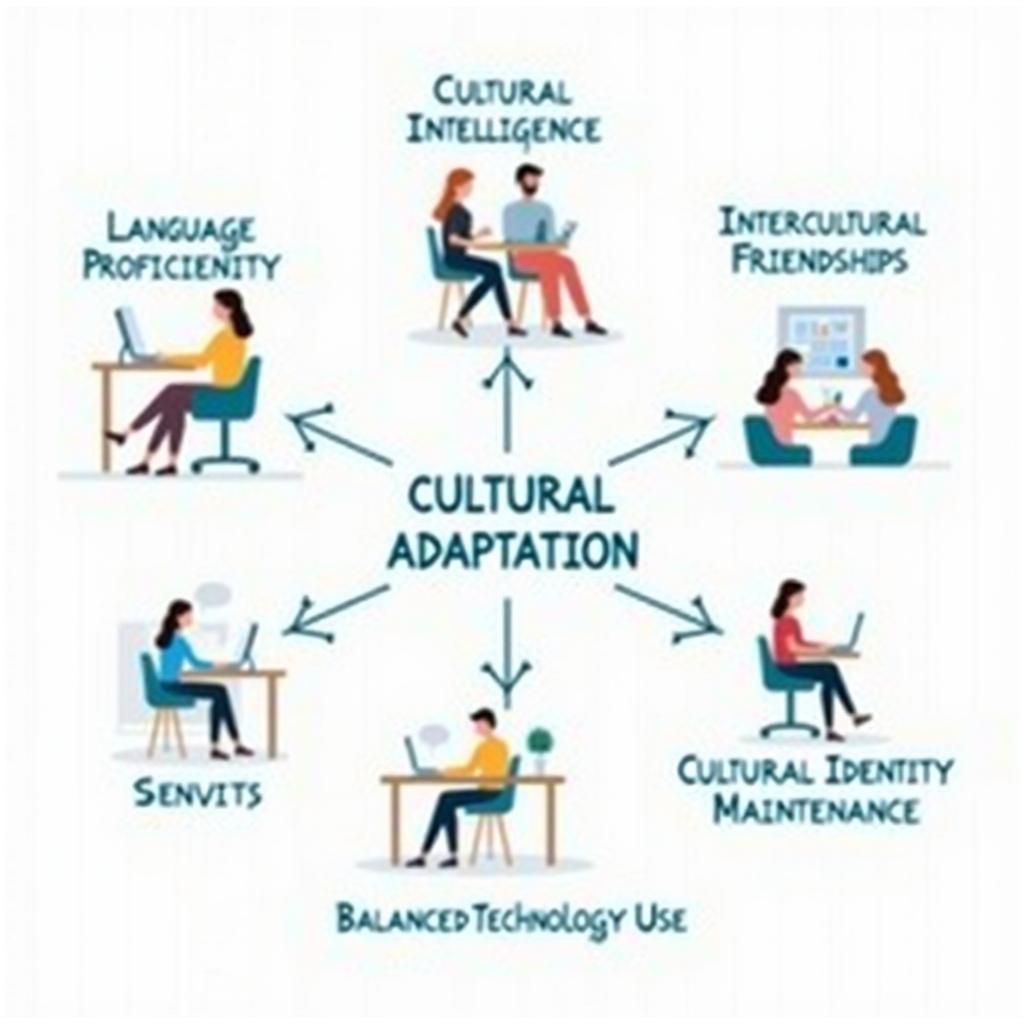
Mở bài
Chủ đề về vai trò của các buổi tập trung toàn trường trong việc thúc đẩy sự đa dạng (The Role Of School Assemblies In Promoting Diversity) là một trong những chủ đề giáo dục và xã hội phổ biến trong IELTS Reading. Đề tài này thường xuất hiện dưới dạng các bài đọc về giáo dục đa văn hóa, hòa nhập xã hội, hoặc phát triển nhân cách học sinh. Qua 20 năm giảng dạy, tôi nhận thấy các đề thi Cambridge IELTS thường khai thác chủ đề này ở nhiều góc độ khác nhau, từ lợi ích giáo dục đến tác động xã hội.
Bài viết này cung cấp một bộ đề thi IELTS Reading hoàn chỉnh gồm 3 passages với độ khó tăng dần từ Easy đến Hard, giúp bạn làm quen với cấu trúc đề thi thực tế. Bạn sẽ được thực hành với 40 câu hỏi đa dạng, bao gồm Multiple Choice, True/False/Not Given, Matching Headings, Summary Completion và nhiều dạng khác. Mỗi câu hỏi đều có đáp án chi tiết kèm giải thích, giúp bạn hiểu rõ cách paraphrase và vị trí thông tin trong bài. Ngoài ra, bộ từ vựng học thuật được tổng hợp từ các passages sẽ giúp bạn nâng cao vốn từ chuyên ngành giáo dục.
Đề thi này phù hợp cho học viên từ band 5.0 trở lên, đặc biệt hữu ích cho những ai đang nhắm đến band điểm 6.5-8.0.
1. Hướng dẫn làm bài IELTS Reading
Tổng Quan Về IELTS Reading Test
IELTS Reading Test kéo dài 60 phút với 3 passages và tổng cộng 40 câu hỏi. Mỗi câu trả lời đúng được tính 1 điểm, không bị trừ điểm khi sai. Độ dài mỗi passage thường từ 650-1000 từ, với nội dung học thuật được trích từ sách, tạp chí, báo chí chuyên ngành.
Phân bổ thời gian khuyến nghị:
- Passage 1 (Easy): 15-17 phút – Dành cho làm quen và ghi điểm dễ
- Passage 2 (Medium): 18-20 phút – Yêu cầu kỹ năng scanning tốt
- Passage 3 (Hard): 23-25 phút – Cần đọc hiểu sâu và phân tích
Lưu ý quan trọng: Hãy dành 2-3 phút cuối để chép đáp án vào Answer Sheet, đảm bảo không có lỗi chính tả.
Các Dạng Câu Hỏi Trong Đề Này
Đề thi mẫu này bao gồm 7 dạng câu hỏi phổ biến nhất:
- Multiple Choice – Chọn đáp án đúng từ A, B, C, D
- True/False/Not Given – Xác định thông tin đúng, sai hay không được đề cập
- Matching Information – Nối thông tin với đoạn văn tương ứng
- Matching Headings – Chọn tiêu đề phù hợp cho các đoạn văn
- Summary Completion – Hoàn thành đoạn tóm tắt bằng từ trong bài
- Sentence Completion – Hoàn thành câu với số từ giới hạn
- Short-answer Questions – Trả lời câu hỏi ngắn dựa trên thông tin trong bài
Mỗi dạng câu hỏi yêu cầu kỹ năng đọc khác nhau, từ scanning (quét thông tin cụ thể) đến skimming (nắm ý chính) và detailed reading (đọc hiểu chi tiết).
2. IELTS Reading Practice Test
PASSAGE 1 – Building Inclusive School Communities Through Assembly Programs
Độ khó: Easy (Band 5.0-6.5)
Thời gian đề xuất: 15-17 phút
School assemblies have long been a cornerstone of educational institutions worldwide, serving as regular gatherings where students, teachers, and sometimes parents come together as a unified community. Traditionally, these events focused on administrative announcements, academic achievements, and disciplinary matters. However, in recent decades, progressive educators have recognized the untapped potential of assemblies as powerful platforms for promoting diversity and inclusion within school communities.
The transformation began in the early 1990s when schools in multicultural societies started incorporating celebration of cultural differences into their assembly programs. Instead of treating diversity as merely a topic to be discussed in social studies classes, forward-thinking institutions began using weekly or monthly assemblies to showcase the rich tapestry of backgrounds represented in their student body. These initiatives proved remarkably successful in fostering mutual respect and breaking down cultural barriers that often existed between different student groups.
One particularly effective approach involves student-led presentations about their cultural heritage. During these sessions, students share traditional stories, perform cultural dances, display national costumes, or explain significant festivals from their backgrounds. Research conducted by the International Education Foundation found that schools implementing such programs reported a 28% decrease in incidents related to cultural misunderstandings and bullying based on ethnicity. Moreover, participating students demonstrated increased self-esteem and a stronger sense of belonging to the school community.
Language diversity represents another crucial aspect addressed through modern school assemblies. Many institutions now feature multilingual components in their programs, with announcements made in several languages or performances incorporating different linguistic traditions. This practice not only validates students from non-English speaking backgrounds but also exposes all students to linguistic variety, potentially sparking interest in language learning. Teachers report that such exposure helps normalize linguistic differences and reduces the stigma sometimes associated with speaking languages other than English at school.
Religious diversity poses unique challenges in secular educational settings, yet assemblies provide opportunities for respectful education about different faiths. Rather than promoting any particular religion, inclusive assemblies present factual information about various belief systems and their associated practices. During relevant times of the year, schools might explain the significance of festivals like Diwali, Hanukkah, Ramadan, or Chinese New Year, ensuring all students understand and respect their classmates’ religious observances. This approach has proven effective in preventing religious discrimination and encouraging interfaith understanding among young people.
 Học sinh trình bày văn hóa truyền thống tại buổi họp toàn trường thúc đẩy đa dạng
Accessibility and inclusion of students with disabilities constitute another dimension where assemblies can make significant impacts. Progressive schools ensure their assembly programs are fully accessible, providing sign language interpreters for deaf students, descriptive audio for visually impaired participants, and appropriate seating arrangements for those with mobility challenges. Some institutions have pioneered the inclusion of students with cognitive disabilities in assembly presentations, allowing them to participate in performances or share their experiences, thereby promoting understanding and acceptance among their peers.
The format and structure of assemblies themselves have evolved to better serve diversity objectives. Traditional assemblies often featured a principal or teacher speaking from a stage to a passive audience. Contemporary approaches emphasize interactive elements and student participation, making these gatherings more engaging and inclusive. Small group discussions, question-and-answer sessions, and collaborative activities during assemblies help students from different backgrounds interact meaningfully rather than simply sitting together in the same space.
Assessment of assembly programs’ effectiveness in promoting diversity involves both quantitative and qualitative measures. Schools track metrics such as reported incidents of discrimination, participation rates in cultural activities, and student survey responses about school climate. Additionally, many institutions conduct focus groups with students from various backgrounds to gather detailed feedback about their assembly experiences and suggestions for improvement. This ongoing evaluation ensures that programs remain relevant and genuinely beneficial rather than becoming merely symbolic gestures.
Despite the evident benefits, implementing diversity-focused assembly programs faces certain challenges. Some parents express concerns about their children’s exposure to unfamiliar cultures or religions, requiring schools to communicate clearly about educational objectives and maintain appropriate boundaries. Time constraints also present difficulties, as schools must balance diversity programming with other assembly purposes and curricular requirements. Furthermore, ensuring authentic representation rather than stereotypical portrayals demands careful planning and often consultation with community members from relevant backgrounds.
Looking forward, technology offers new possibilities for enhancing diversity promotion through assemblies. Virtual exchange programs allow schools to connect their assemblies with institutions in other countries, enabling students to interact with peers from vastly different backgrounds. Recorded presentations from community members unable to attend in person can bring diverse voices into the assembly hall. These technological innovations promise to expand the scope and impact of diversity education through school assemblies in coming years.
Questions 1-13
Questions 1-5
Do the following statements agree with the information given in Passage 1?
Write:
- TRUE if the statement agrees with the information
- FALSE if the statement contradicts the information
- NOT GIVEN if there is no information on this
-
School assemblies were originally designed specifically to promote cultural diversity.
-
Schools with cultural presentation programs saw a reduction in bullying related to ethnicity.
-
Multilingual assembly components help students develop interest in learning new languages.
-
All schools are legally required to provide sign language interpreters at assemblies.
-
Technology enables schools to connect their assemblies with institutions in different countries.
Questions 6-9
Complete the sentences below.
Choose NO MORE THAN THREE WORDS from the passage for each answer.
-
Student-led presentations often include traditional stories, cultural dances, and explanations of __ from their backgrounds.
-
Inclusive assemblies present factual information about various __ rather than promoting one particular religion.
-
Progressive schools ensure students with __ can participate in assembly presentations.
-
Schools use __ such as discrimination incidents and participation rates to evaluate assembly effectiveness.
Questions 10-13
Choose the correct letter, A, B, C or D.
-
According to the passage, what was the main focus of traditional school assemblies?
- A. Cultural celebrations and diversity
- B. Administrative matters and achievements
- C. Religious education and tolerance
- D. Language learning and development
-
The International Education Foundation’s research showed that cultural presentation programs resulted in:
- A. improved academic performance
- B. increased parent involvement
- C. reduced cultural misunderstandings
- D. better attendance rates
-
What challenge do schools face when implementing diversity programs?
- A. Lack of student interest
- B. Insufficient funding
- C. Parental concerns about cultural exposure
- D. Teacher resistance to change
-
Contemporary assembly formats differ from traditional ones by:
- A. being shorter in duration
- B. including more interactive elements
- C. focusing only on academic topics
- D. excluding teacher participation
PASSAGE 2 – The Psychological and Social Mechanisms of Diversity Education in Assemblies
Độ khó: Medium (Band 6.0-7.5)
Thời gian đề xuất: 18-20 phút
The efficacy of school assemblies as vehicles for promoting diversity extends beyond mere exposure to different cultures; it involves complex psychological mechanisms that shape students’ attitudes and behaviors. Educational psychologists have increasingly focused on understanding how these collective gatherings influence the development of intercultural competence and social cohesion among young people. The theoretical frameworks underpinning diversity education through assemblies draw from social identity theory, contact hypothesis, and constructivist learning principles, offering insights into why such programs can be transformative when properly designed and implemented.
Social identity theory, developed by Henri Tajfel and John Turner in the 1970s, posits that individuals derive part of their self-concept from the social groups to which they belong. In educational contexts, this manifests as students identifying strongly with ethnic, religious, or linguistic groups, sometimes leading to in-group favoritism and out-group prejudice. School assemblies that celebrate diversity serve a crucial function in expanding students’ understanding of group boundaries. When a Muslim student presents information about Eid celebrations to the entire school, for instance, she simultaneously represents her religious group while also being recognized as a valued member of the broader school community. This dual identity recognition helps recategorize group boundaries, creating a more inclusive superordinate identity centered on shared school membership rather than divisive demographic characteristics.
The contact hypothesis, originally formulated by Gordon Allport in 1954, provides another theoretical foundation for diversity-focused assemblies. Allport argued that interpersonal contact between members of different groups reduces prejudice under specific conditions: equal status between groups, common goals, institutional support, and opportunities for genuine acquaintance. Assembly programs that feature collaborative performances involving students from diverse backgrounds exemplify these conditions. When students of different ethnicities work together to prepare a presentation, they engage in sustained interaction toward a shared objective, sanctioned and supported by school leadership. Research by developmental psychologist Thomas Pettigrew has demonstrated that such structured intergroup contact not only reduces prejudice toward the specific individuals involved but also generalizes to more positive attitudes toward the entire out-group.
However, the effectiveness of assemblies in promoting diversity depends critically on how content is presented and processed. Constructivist learning theory emphasizes that learners actively build understanding rather than passively receiving information. Applied to assembly contexts, this means that superficial exposure to cultural artifacts—such as briefly watching a traditional dance without context or discussion—yields minimal educational benefit. In contrast, assemblies incorporating reflective activities where students consider their own reactions, discuss similarities and differences, or explore the historical contexts of cultural practices facilitate deeper learning. Schools achieving the greatest success in diversity education through assemblies typically integrate pre-assembly preparation in classrooms and post-assembly follow-up activities, creating a coherent learning sequence rather than isolated events.
The developmental stage of students significantly influences how assembly-based diversity education should be structured. Cognitive development research by Jean Piaget and subsequent scholars reveals that children’s capacity for perspective-taking and abstract reasoning about social concepts evolves substantially from early childhood through adolescence. Younger children in concrete operational stages benefit most from tangible, experiential elements in assemblies—trying foods from different cultures, learning simple phrases in various languages, or participating in traditional games. Adolescents with formal operational thinking can engage with more complex dimensions of diversity, including discussions about systemic discrimination, privilege, and intersectionality. Failing to match assembly content with students’ developmental capabilities risks either boring older students with overly simplistic presentations or confusing younger children with concepts beyond their cognitive reach.
 Học sinh đa văn hóa tương tác trong hoạt động nhóm tại buổi assembly giáo dục đa dạng
Emotional dimensions of assembly experiences play equally important roles in shaping attitudes toward diversity. The elaboration likelihood model of persuasion, developed by Richard Petty and John Cacioppo, distinguishes between central route processing (careful consideration of message content) and peripheral route processing (responses to superficial cues like speaker attractiveness or emotional appeals). While both routes can influence attitudes, central route persuasion produces more enduring change. Effective diversity assemblies engage students’ central processing by presenting compelling information, encouraging critical thinking, and connecting content to students’ personal experiences. Simultaneously, the emotional resonance created through music, storytelling, or personal testimonies activates peripheral processing, making messages more memorable and impactful. The most powerful assemblies achieve synergy between these cognitive and affective pathways, creating experiences that are both intellectually stimulating and emotionally moving.
The physical and social environment of assembly settings themselves carries psychological significance. Environmental psychology research indicates that spatial arrangements influence social behavior and group dynamics. Traditional assembly configurations with students sitting in rows facing a stage create hierarchical dynamics and passive spectatorship. Alternative arrangements—such as circular seating or flexible spaces allowing for breakout discussions—promote more egalitarian interactions and active engagement. The symbolic aspects of assembly spaces also matter; halls decorated with artifacts representing diverse cultures signal institutional commitment to inclusion, whereas bare or monoculturally decorated spaces convey different messages about which identities are valued.
Neurological research using functional MRI scanning has revealed that empathic responses to others’ experiences involve activation of brain regions associated with emotional processing and mentalizing (understanding others’ mental states). When students hear peers share personal stories about experiencing discrimination or navigating bicultural identities, their mirror neuron systems and empathy networks activate, creating vicarious experiences that can challenge stereotypes and increase prosocial orientation. This neuroscientific evidence supports the practice of incorporating authentic personal narratives into diversity assemblies rather than relying solely on abstract information about cultural groups.
The role of authority figures and peer leaders in assemblies warrants careful consideration from a psychological perspective. Social learning theory, articulated by Albert Bandura, emphasizes that people learn behaviors and attitudes through observing others, particularly those with high status or similarity to themselves. When school principals or respected teachers demonstrate genuine enthusiasm for diversity content and model inclusive behaviors, students receive powerful messages about social norms. Equally important is peer modeling; seeing well-regarded fellow students present their cultures with pride or express anti-prejudice attitudes influences observers’ own beliefs more effectively than adult instruction alone. This explains why student-led components constitute such valuable elements of successful diversity assemblies.
Despite these theoretical supports, critics raise important questions about the limitations and potential pitfalls of assembly-based diversity education. Some scholars warn against cultural essentialism—the tendency to present cultures as monolithic and unchanging rather than dynamic and internally diverse. A Diwali presentation suggesting that “all Indians celebrate this way” obscures significant regional, religious, and individual variation within Indian communities. Similarly, tokenism poses risks when diversity assemblies become formulaic celebrations rather than opportunities for substantive engagement with complex social issues. Educational psychologist Beverly Tatum argues that effective anti-bias education requires moving beyond “heroes and holidays” approaches to address structural inequalities and develop students’ critical consciousness. This suggests that while assemblies can play valuable roles in diversity education, they function best as components of comprehensive programs rather than standalone interventions.
Longitudinal research examining the sustained impacts of diversity-focused assembly programs remains relatively limited, representing an important area for future investigation. The studies that do exist suggest that effects depend heavily on program consistency and integration with other school practices. Schools maintaining robust, ongoing diversity programming through assemblies and other channels demonstrate more positive intergroup relations and inclusive school climates compared to institutions with sporadic or superficial efforts. This finding underscores that while individual assemblies can create momentary shifts in awareness or attitudes, lasting change requires sustained commitment and systematic reinforcement throughout the school environment.
Questions 14-26
Questions 14-18
Choose the correct letter, A, B, C or D.
-
According to social identity theory, diversity assemblies help students by:
- A. eliminating all group identities
- B. strengthening ethnic group boundaries
- C. creating superordinate school identity
- D. promoting competition between groups
-
Allport’s contact hypothesis suggests prejudice reduction requires:
- A. brief exposure to different groups
- B. equal status and common goals
- C. separation of different groups
- D. individual rather than group interaction
-
Constructivist learning theory indicates that effective assemblies should:
- A. present information passively
- B. avoid follow-up discussions
- C. include reflective activities
- D. focus only on entertainment
-
According to cognitive development research, younger children benefit most from:
- A. abstract discussions about discrimination
- B. complex analysis of privilege
- C. tangible experiential elements
- D. theoretical frameworks about diversity
-
The elaboration likelihood model suggests lasting attitude change comes from:
- A. peripheral processing only
- B. emotional appeals exclusively
- C. superficial cues and attractiveness
- D. careful consideration of message content
Questions 19-22
Complete the summary below.
Choose NO MORE THAN TWO WORDS from the passage for each answer.
Environmental psychology research shows that traditional assembly seating arrangements with rows facing a stage create (19) __ and passive observation. Alternative setups like circular seating promote more (20) __ and active participation. The decoration of assembly spaces with diverse cultural artifacts signals the school’s (21) __ to inclusion. Neuroscientific research reveals that hearing personal stories activates students’ (22) __, helping them understand others’ mental states.
Questions 23-26
YES, NO, or NOT GIVEN
Do the following statements agree with the claims of the writer in Passage 2?
Write:
- YES if the statement agrees with the claims of the writer
- NO if the statement contradicts the claims of the writer
- NOT GIVEN if it is impossible to say what the writer thinks about this
-
Superficial exposure to cultural artifacts during assemblies provides substantial educational benefits.
-
Student-led presentations are more influential than teacher-led ones in changing peer attitudes.
-
Cultural essentialism in presentations accurately represents the diversity within cultural groups.
-
Individual assemblies alone can create lasting changes in school climate without other support.
PASSAGE 3 – Comparative International Perspectives and Policy Frameworks for Assembly-Based Diversity Initiatives
Độ khó: Hard (Band 7.0-9.0)
Thời gian đề xuất: 23-25 phút
The implementation of diversity-focused school assemblies varies considerably across international contexts, reflecting divergent educational philosophies, demographic realities, and policy frameworks that shape how nations approach multicultural education and social cohesion. Comparative analysis of these approaches reveals both universal principles that transcend cultural boundaries and context-specific adaptations necessary for effective practice in particular settings. Understanding this international landscape provides valuable insights for educators and policymakers seeking to optimize assembly programs for their own institutional contexts.
In Anglo-American educational systems—particularly in Canada, Australia, the United Kingdom, and the United States—diversity assemblies typically operate within multicultural education frameworks that emphasize recognition and celebration of ethnocultural differences. Canadian educational policy, influenced by the country’s official multiculturalism doctrine established in 1971, explicitly encourages schools to validate diverse cultural identities and promote intercultural understanding. The Toronto District School Board’s comprehensive guidelines exemplify this approach, mandating regular assemblies featuring presentations from the school community’s varied heritage groups while also addressing contemporary social justice issues such as anti-Black racism, Islamophobia, and Indigenous reconciliation. This dual emphasis on cultural celebration and critical examination of systemic inequities distinguishes more sophisticated implementations from superficial “food and festivals” approaches criticized by anti-racism educators.
Australian schools, grappling with the complex legacy of colonialism and ongoing challenges related to Aboriginal and Torres Strait Islander peoples’ marginalization, have developed distinctive approaches to diversity assemblies. The Reconciliation Action Plans adopted by numerous schools incorporate acknowledgment of country into assembly protocols, recognize significant dates like National Reconciliation Week, and feature educational content about Indigenous cultures and historical injustices. However, scholars such as Martin Nakata have cautioned against tokenistic inclusion that fails to challenge structural inequalities or address the epistemological dominance of Western knowledge systems in curricula. This postcolonial critique suggests that genuinely transformative diversity assemblies must interrogate power relations and knowledge hierarchies rather than merely adding Indigenous content to otherwise unchanged programs.
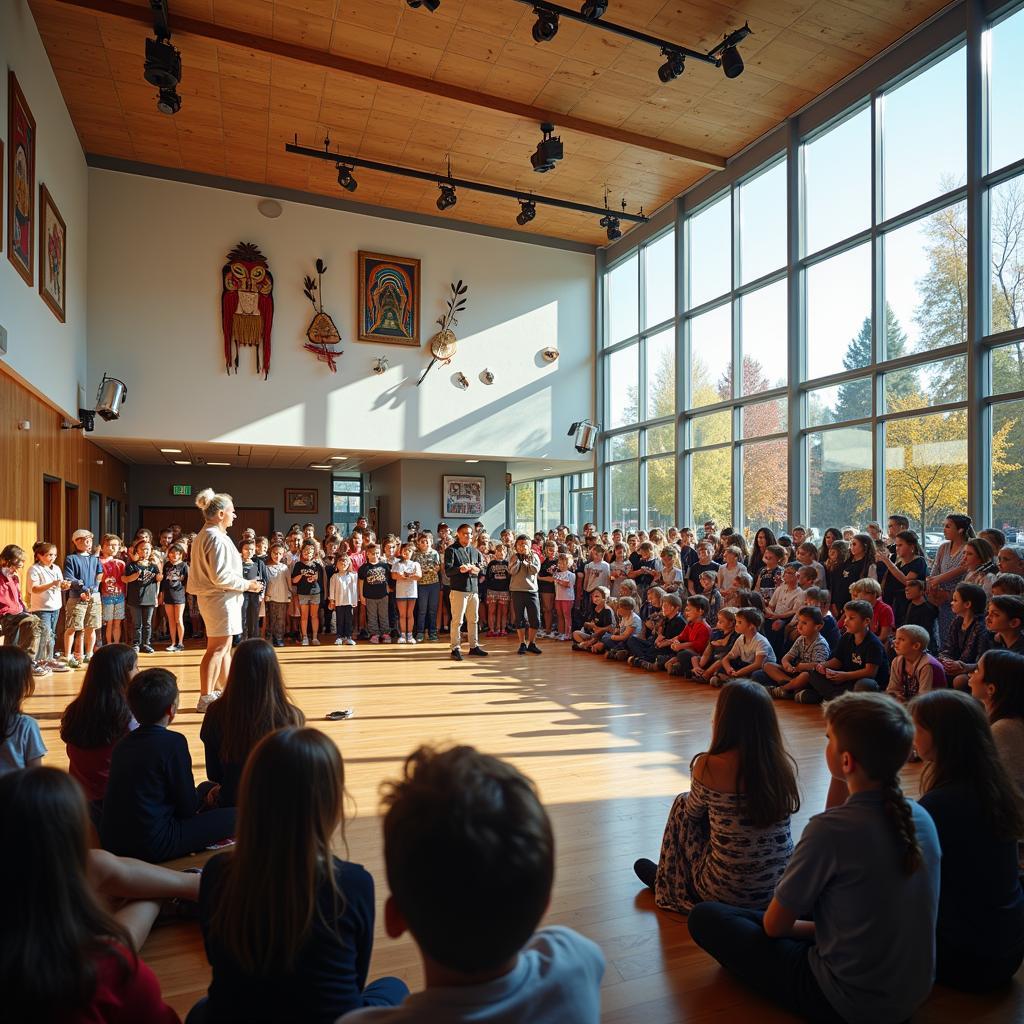 Trường học Canada tổ chức assembly đa dạng với học sinh từ nhiều nền tảng văn hóa tham gia
European approaches demonstrate considerable heterogeneity, reflecting the continent’s varied colonial histories, immigration patterns, and conceptualizations of national identity. French laïcité (secularism) principles significantly constrain religious expression in public schools, creating tensions between diversity recognition and republican universalism. French assemblies generally avoid explicit religious content while addressing diversity through secular frameworks emphasizing shared citizenship and republican values. This contrasts sharply with the United Kingdom’s approach, where faith schools receive public funding and assemblies in secular state schools are legally required to be “broadly Christian” in character, though with exemptions for schools serving predominantly non-Christian populations. These divergent policies reflect fundamentally different philosophical positions regarding whether state institutions should recognize and accommodate group-based identities or promote assimilation into a common civic culture.
Germany’s approach to diversity assemblies has evolved considerably in response to increasing ethnic and religious pluralism, particularly following large-scale immigration from Turkey, the former Yugoslavia, and more recently Syria and other conflict zones. The concept of Interkulturelle Erziehung (intercultural education) gained prominence in German pedagogy during the 1980s, emphasizing reciprocal learning between majority and minority communities rather than one-directional integration of newcomers. Assembly programs in cities like Berlin and Frankfurt increasingly feature multilingual elements, recognize Islamic holidays alongside Christian ones, and address xenophobia and right-wing extremism explicitly. Nevertheless, scholars such as Yasemin Karakaşoğlu note that implementation remains uneven, with schools in former East Germany—regions with less ethnic diversity and documented higher levels of xenophobic attitudes—often providing minimal diversity programming compared to institutions in more cosmopolitan western cities.
Asian educational contexts present markedly different paradigms for understanding diversity and assembly programs’ roles. Singapore’s approach reflects the nation’s deliberately engineered multiculturalism, designed to maintain ethnic harmony among Chinese, Malay, Indian, and Eurasian communities following race riots in the 1960s. Singaporean school assemblies operate within the framework of Racial Harmony Day, established in 1997, which uses structured activities to promote inter-ethnic understanding and national identity. However, critics including sociologist Chua Beng Huat argue this represents state-managed diversity that depoliticizes ethnic differences and discourages genuine critical engagement with racial privilege or systemic discrimination, instead promoting a sanitized multiculturalism compatible with social control and economic priorities.
Japan’s relatively ethnically homogeneous population—though this characterization itself obscures significant internal diversity including Ainu, Ryukyuan, Korean, and Chinese minorities—has historically resulted in limited emphasis on diversity education. However, increasing international marriages, immigration, and the presence of Nikkeijin (foreign nationals of Japanese descent) and foreign technical trainees have prompted some schools to develop diversity programming. Assemblies in schools with significant populations of children with foreign roots sometimes feature multicultural presentations, though Ryoko Tsuneyoshi’s research indicates such programming remains far less systematic than in settler societies like Australia or Canada. The persistent influence of Nihonjinron ideology—which emphasizes Japanese ethnic and cultural uniqueness—continues to complicate efforts to promote inclusive school environments for students from minority backgrounds.
Latin American contexts introduce yet another dimension, with diversity often conceptualized through indigeneity, mestizaje (racial/cultural mixing), and social class rather than the immigration-focused frameworks prevalent in Anglo-American settings. Bolivian constitutional recognition of 36 Indigenous nations and commitment to plurinational democracy has influenced educational policy, with some schools incorporating Indigenous languages and knowledge systems into assemblies. Similarly, Mexican schools in regions with significant Indigenous populations increasingly feature bilingual assemblies in Spanish and languages such as Nahuatl, Maya, or Mixtec. However, researcher María Bertely notes that implementation faces substantial obstacles, including inadequate teacher preparation, persistent discrimination against Indigenous peoples, and structural inequalities that undermine formal commitments to intercultural education.
Policy frameworks supporting diversity assemblies encompass various mechanisms including mandates, guidelines, funding structures, and accountability measures. The most effective policies combine sufficient specificity to ensure meaningful implementation with flexibility allowing adaptation to local contexts. New Zealand’s Ka Hikitia strategy for Māori education success exemplifies comprehensive policy architecture, establishing clear expectations for bicultural competence while supporting schools through professional development, resource allocation, and monitoring systems. Conversely, policies lacking enforcement mechanisms or resource support—common in contexts where diversity commitments represent symbolic politics rather than substantive priorities—frequently result in uneven implementation where outcomes depend primarily on individual educators’ initiative rather than systemic support.
The assessment and evaluation of diversity assembly programs present considerable methodological challenges. Simple quantitative metrics such as the number of assemblies held or cultures represented capture surface-level compliance but provide limited insight into educational effectiveness or attitudinal impacts. More sophisticated evaluation frameworks employ mixed methods, combining surveys measuring students’ intercultural attitudes and sense of belonging, ethnographic observation of assembly events and students’ engagement, content analysis of assembly programming for depth and quality, and longitudinal tracking of school climate indicators including disciplinary data disaggregated by demographic characteristics. Schools demonstrating genuine commitment to diversity education increasingly implement such comprehensive evaluation systems, using findings to refine and improve their programming iteratively.
Emerging challenges complicate the landscape of diversity-focused assemblies. Increasing political polarization in many societies has transformed diversity education into a contested domain, with some groups characterizing such efforts as inappropriate indoctrination rather than legitimate pedagogy. In the United States, recent state-level legislative restrictions on discussing racism, systemic discrimination, or LGBTQ+ identities in schools directly impact the scope and content of diversity assemblies. Navigating these politically charged waters requires administrative courage, transparent communication with stakeholders, and robust educational justifications grounded in research evidence and professional standards.
The digital transformation of education, accelerated by the COVID-19 pandemic, presents both opportunities and challenges for assembly-based diversity programming. Virtual assemblies can incorporate perspectives from distant communities, overcome physical accessibility barriers, and create permanent records for later review and discussion. However, they may also reduce the emotional intensity and communal bonding that characterize effective in-person gatherings. Hybrid models combining physical and virtual elements represent promising directions, though their optimal design requires ongoing experimentation and evaluation. As schools worldwide navigate post-pandemic realities, the modality and format of diversity assemblies will likely continue evolving, necessitating adaptive approaches that preserve core educational functions while embracing technological affordances.
Questions 27-40
Questions 27-31
Complete the table below.
Choose NO MORE THAN THREE WORDS from the passage for each answer.
| Country/Region | Key Approach to Diversity Assemblies | Challenge/Criticism |
|---|---|---|
| Canada | Validation of cultural identities and addressing (27) __ | Risk of superficial “food and festivals” approach |
| Australia | Reconciliation Action Plans with (28) __ | Tokenistic inclusion without challenging (29) __ |
| France | Secular frameworks emphasizing shared citizenship | Tension between diversity and (30) __ |
| Singapore | State-managed diversity through Racial Harmony Day | Discourages genuine engagement with (31) __ |
Questions 32-36
Matching Information
Which country/region does each statement refer to?
Choose your answers from the box below and write the letters A-G.
A. Canada
B. Australia
C. United Kingdom
D. Germany
E. Singapore
F. Japan
G. Bolivia
-
Constitutional recognition of 36 Indigenous nations influences educational diversity policy. __
-
Schools are legally required to have assemblies that are broadly Christian in character. __
-
Implementation of diversity programming is uneven, with less ethnic diversity in former eastern regions. __
-
The concept of ethnic uniqueness ideology complicates inclusive environment efforts. __
-
A 1971 official doctrine established a framework for multicultural education. __
Questions 37-40
Answer the questions below.
Choose NO MORE THAN THREE WORDS AND/OR A NUMBER from the passage for each answer.
-
What type of examination does the Toronto District School Board’s approach combine with cultural celebration?
-
What kind of politics do policies lacking enforcement mechanisms typically represent?
-
What type of methods should sophisticated evaluation frameworks employ?
-
What recent development has accelerated the digital transformation of education including assemblies?
3. Answer Keys – Đáp Án
PASSAGE 1: Questions 1-13
- FALSE
- TRUE
- TRUE
- NOT GIVEN
- TRUE
- significant festivals
- belief systems
- cognitive disabilities
- quantitative and qualitative measures (hoặc metrics)
- B
- C
- C
- B
PASSAGE 2: Questions 14-26
- C
- B
- C
- C
- D
- hierarchical dynamics
- egalitarian interactions
- institutional commitment
- empathy networks (hoặc mirror neuron systems)
- NO
- NOT GIVEN
- NO
- NO
PASSAGE 3: Questions 27-40
- social justice issues (hoặc systemic inequities)
- acknowledgment of country
- structural inequalities
- republican universalism
- racial privilege (hoặc systemic discrimination)
- G
- C
- D
- F
- A
- critical examination (hoặc contemporary social justice issues)
- symbolic politics
- mixed methods
- COVID-19 pandemic (hoặc the COVID-19 pandemic)
4. Giải Thích Đáp Án Chi Tiết
Passage 1 – Giải Thích
Câu 1: FALSE
- Dạng câu hỏi: True/False/Not Given
- Từ khóa: originally designed, specifically, promote cultural diversity
- Vị trí trong bài: Đoạn 1, dòng 2-4
- Giải thích: Bài đọc nói rõ “Traditionally, these events focused on administrative announcements, academic achievements, and disciplinary matters” – tức là các buổi họp truyền thống TẬP TRUNG vào công việc hành chính, thành tích học tập và kỷ luật, KHÔNG PHẢI được thiết kế để thúc đẩy đa dạng văn hóa. Điều này mâu thuẫn trực tiếp với câu hỏi, nên đáp án là FALSE.
Câu 2: TRUE
- Dạng câu hỏi: True/False/Not Given
- Từ khóa: cultural presentation programs, reduction, bullying, ethnicity
- Vị trí trong bài: Đoạn 3, dòng 5-7
- Giải thích: Bài viết khẳng định “schools implementing such programs reported a 28% decrease in incidents related to cultural misunderstandings and bullying based on ethnicity”. Câu hỏi paraphrase “reduction in bullying” = “decrease in incidents…bullying”, hoàn toàn đúng với thông tin trong bài.
Câu 3: TRUE
- Dạng câu hỏi: True/False/Not Given
- Từ khóa: multilingual assembly components, interest in learning new languages
- Vị trí trong bài: Đoạn 4, dòng 4-6
- Giải thích: Đoạn văn nói “This practice…exposes all students to linguistic variety, potentially sparking interest in language learning”. Từ “sparking interest” = “develop interest” trong câu hỏi, xác nhận thông tin đúng.
Câu 5: TRUE
- Dạng câu hỏi: True/False/Not Given
- Từ khóa: technology, connect assemblies, institutions, different countries
- Vị trí trong bài: Đoạn cuối, dòng 2-3
- Giải thích: Câu trong bài: “Virtual exchange programs allow schools to connect their assemblies with institutions in other countries”. Đây là paraphrase trực tiếp của câu hỏi (other countries = different countries).
Câu 6: significant festivals
- Dạng câu hỏi: Sentence Completion
- Từ khóa: student-led presentations, traditional stories, cultural dances
- Vị trí trong bài: Đoạn 3, dòng 1-3
- Giải thích: Bài viết liệt kê: “students share traditional stories, perform cultural dances, display national costumes, or explain significant festivals from their backgrounds”. Cần tìm từ đứng sau “explain” và trước “from their backgrounds” – đó là “significant festivals”.
Câu 10: B
- Dạng câu hỏi: Multiple Choice
- Từ khóa: main focus, traditional school assemblies
- Vị trí trong bài: Đoạn 1, dòng 2-4
- Giải thích: Câu đầu tiên nói rõ “Traditionally, these events focused on administrative announcements, academic achievements, and disciplinary matters”. Đáp án B (Administrative matters and achievements) tóm tắt chính xác nội dung này. Các đáp án khác (A: Cultural celebrations, C: Religious education, D: Language learning) đều là phát triển sau này, không phải trọng tâm truyền thống.
Câu 13: B
- Dạng câu hỏi: Multiple Choice
- Từ khóa: contemporary assembly formats, differ from traditional
- Vị trí trong bài: Đoạn 7, dòng 2-4
- Giải thích: Bài viết so sánh: “Traditional assemblies often featured…passive audience. Contemporary approaches emphasize interactive elements and student participation”. Đáp án B (including more interactive elements) chính xác phản ánh sự khác biệt này.
 Giáo viên IELTS giải thích đáp án chi tiết bài đọc về assembly đa dạng văn hóa
Passage 2 – Giải Thích
Câu 14: C
- Dạng câu hỏi: Multiple Choice
- Từ khóa: social identity theory, diversity assemblies help
- Vị trí trong bài: Đoạn 2, dòng 7-11
- Giải thích: Bài viết giải thích “This dual identity recognition helps recategorize group boundaries, creating a more inclusive superordinate identity centered on shared school membership”. Đáp án C (creating superordinate school identity) chính xác phản ánh cơ chế này. Các đáp án khác sai vì theory không nhằm xóa bỏ identity (A), củng cố ranh giới (B), hay thúc đẩy cạnh tranh (D).
Câu 16: C
- Dạng câu hỏi: Multiple Choice
- Từ khóa: constructivist learning theory, effective assemblies
- Vị trí trong bài: Đoạn 4, dòng 4-8
- Giải thích: Đoạn văn nói “assemblies incorporating reflective activities where students consider their own reactions, discuss similarities and differences…facilitate deeper learning”. Đáp án C (include reflective activities) đúng. A, B, D đều mâu thuẫn với tinh thần constructivist learning.
Câu 19: hierarchical dynamics
- Dạng câu hỏi: Summary Completion
- Từ khóa: traditional seating, rows facing stage
- Vị trí trong bài: Đoạn 6, dòng 3-4
- Giải thích: Bài viết nói “Traditional assembly configurations…create hierarchical dynamics and passive spectatorship”. Từ cần điền mô tả kết quả của cách sắp xếp chỗ ngồi truyền thống.
Câu 23: NO
- Dạng câu hỏi: Yes/No/Not Given
- Từ khóa: superficial exposure, cultural artifacts, substantial educational benefits
- Vị trí trong bài: Đoạn 4, dòng 3-5
- Giải thích: Tác giả nói rõ “superficial exposure to cultural artifacts…yields minimal educational benefit” – tức là lợi ích tối thiểu, KHÔNG PHẢI substantial (đáng kể). Đây là quan điểm rõ ràng của tác giả, nên đáp án là NO.
Câu 26: NO
- Dạng câu hỏi: Yes/No/Not Given
- Từ khóa: individual assemblies alone, lasting changes, without other support
- Vị trí trong bài: Đoạn cuối, dòng 4-7
- Giải thích: Tác giả khẳng định “individual assemblies can create momentary shifts…lasting change requires sustained commitment and systematic reinforcement”. Điều này mâu thuẫn trực tiếp với ý kiến rằng assemblies đơn lẻ có thể tạo thay đổi lâu dài mà không cần hỗ trợ khác.
Passage 3 – Giải Thích
Câu 27: social justice issues (hoặc systemic inequities)
- Dạng câu hỏi: Table Completion
- Từ khóa: Canada, validation of cultural identities, addressing
- Vị trí trong bài: Đoạn 2, dòng 4-7
- Giải thích: Bài viết mô tả cách tiếp cận của Canada: “mandating regular assemblies…while also addressing contemporary social justice issues such as anti-Black racism, Islamophobia, and Indigenous reconciliation”. Từ cần điền là “social justice issues” hoặc có thể dùng “systemic inequities” xuất hiện ngay sau đó.
Câu 30: republican universalism
- Dạng câu hỏi: Table Completion
- Từ khóa: France, tension between diversity
- Vị trí trong bài: Đoạn 4, dòng 2-4
- Giải thích: Bài viết nói về Pháp: “creating tensions between diversity recognition and republican universalism”. Thử thách chính là sự căng thẳng giữa công nhận đa dạng và chủ nghĩa phổ quát cộng hòa.
Câu 32: G (Bolivia)
- Dạng câu hỏi: Matching Information
- Từ khóa: Constitutional recognition, 36 Indigenous nations
- Vị trí trong bài: Đoạn 7, dòng 3-4
- Giải thích: Bài viết nói rõ “Bolivian constitutional recognition of 36 Indigenous nations…has influenced educational policy”. Đây là thông tin cụ thể chỉ về Bolivia.
Câu 35: F (Japan)
- Dạng câu hỏi: Matching Information
- Từ khóa: ethnic uniqueness ideology, complicates inclusive environment
- Vị trí trong bài: Đoạn 6, dòng 7-10
- Giải thích: Về Nhật Bản: “The persistent influence of Nihonjinron ideology—which emphasizes Japanese ethnic and cultural uniqueness—continues to complicate efforts to promote inclusive school environments”. Nihonjinron = ethnic uniqueness ideology.
Câu 37: critical examination (hoặc contemporary social justice issues)
- Dạng câu hỏi: Short Answer
- Từ khóa: Toronto District School Board, combine with cultural celebration
- Vị trí trong bài: Đoạn 2, dòng 6-8
- Giải thích: Bài viết nói về Toronto: “This dual emphasis on cultural celebration and critical examination of systemic inequities”. Từ cần tìm là loại hình examination kết hợp với celebration.
Câu 40: COVID-19 pandemic
- Dạng câu hỏi: Short Answer
- Từ khóa: accelerated, digital transformation, education
- Vị trí trong bài: Đoạn cuối, dòng 1-2
- Giải thích: Câu đầu đoạn cuối nói rõ: “The digital transformation of education, accelerated by the COVID-19 pandemic”. Đây là thông tin trực tiếp trả lời câu hỏi.
5. Từ Vựng Quan Trọng Theo Passage
Passage 1 – Essential Vocabulary
| Từ vựng | Loại từ | Phiên âm | Nghĩa tiếng Việt | Ví dụ từ bài | Collocation |
|---|---|---|---|---|---|
| cornerstone | n | /ˈkɔːnəstəʊn/ | nền tảng, trụ cột | School assemblies have long been a cornerstone of educational institutions | cornerstone of education |
| unified community | n phrase | /ˈjuːnɪfaɪd kəˈmjuːnəti/ | cộng đồng thống nhất | students come together as a unified community | build/create a unified community |
| untapped potential | n phrase | /ʌnˈtæpt pəˈtenʃl/ | tiềm năng chưa được khai thác | recognized the untapped potential of assemblies | unlock/harness untapped potential |
| foster | v | /ˈfɒstə(r)/ | nuôi dưỡng, thúc đẩy | successful in fostering mutual respect | foster understanding/respect |
| showcase | v | /ˈʃəʊkeɪs/ | trưng bày, giới thiệu | showcase the rich tapestry of backgrounds | showcase diversity/talent |
| stigma | n | /ˈstɪɡmə/ | sự kỳ thị, nhãn hiệu xấu | reduces the stigma associated with speaking other languages | reduce/remove stigma |
| secular | adj | /ˈsekjələ(r)/ | thế tục, phi tôn giáo | in secular educational settings | secular education/state |
| accessibility | n | /əkˌsesəˈbɪləti/ | khả năng tiếp cận | accessibility of students with disabilities | improve/ensure accessibility |
| mobility challenges | n phrase | /məʊˈbɪləti ˈtʃælɪndʒɪz/ | khó khăn về di chuyển | seating for those with mobility challenges | face mobility challenges |
| interactive elements | n phrase | /ˌɪntərˈæktɪv ˈelɪmənts/ | yếu tố tương tác | emphasize interactive elements | incorporate interactive elements |
| quantitative measures | n phrase | /ˈkwɒntɪtətɪv ˈmeʒəz/ | biện pháp định lượng | track quantitative measures | use quantitative measures |
| symbolic gestures | n phrase | /sɪmˈbɒlɪk ˈdʒestʃəz/ | cử chỉ mang tính biểu tượng | becoming merely symbolic gestures | avoid symbolic gestures |
Passage 2 – Essential Vocabulary
| Từ vựng | Loại từ | Phiên âm | Nghĩa tiếng Việt | Ví dụ từ bài | Collocation |
|---|---|---|---|---|---|
| intercultural competence | n phrase | /ˌɪntəˈkʌltʃərəl ˈkɒmpɪtəns/ | năng lực liên văn hóa | influence the development of intercultural competence | develop intercultural competence |
| social cohesion | n phrase | /ˈsəʊʃl kəʊˈhiːʒn/ | sự gắn kết xã hội | social cohesion among young people | promote social cohesion |
| in-group favoritism | n phrase | /ɪn ɡruːp ˈfeɪvərɪtɪzəm/ | thiên vị nhóm trong | leading to in-group favoritism | demonstrate in-group favoritism |
| out-group prejudice | n phrase | /aʊt ɡruːp ˈpredʒudɪs/ | định kiến nhóm ngoài | and out-group prejudice | reduce out-group prejudice |
| superordinate identity | n phrase | /ˌsuːpərˈɔːdɪnət aɪˈdentəti/ | bản sắc cấp cao hơn | creating a more inclusive superordinate identity | establish superordinate identity |
| interpersonal contact | n phrase | /ˌɪntəˈpɜːsənl ˈkɒntækt/ | tiếp xúc giữa các cá nhân | interpersonal contact between members | facilitate interpersonal contact |
| sustained interaction | n phrase | /səˈsteɪnd ˌɪntərˈækʃn/ | tương tác kéo dài | engage in sustained interaction | maintain sustained interaction |
| perspective-taking | n | /pəˈspektɪv ˈteɪkɪŋ/ | khả năng đặt mình vào vị trí người khác | capacity for perspective-taking | develop perspective-taking |
| abstract reasoning | n phrase | /ˈæbstrækt ˈriːzənɪŋ/ | tư duy trừu tượng | abstract reasoning about social concepts | engage in abstract reasoning |
| elaboration likelihood model | n phrase | /ɪˌlæbəˈreɪʃn ˈlaɪklihʊd ˈmɒdl/ | mô hình khả năng diễn giải | The elaboration likelihood model of persuasion | apply elaboration likelihood model |
| central route processing | n phrase | /ˈsentrəl ruːt ˈprəʊsesɪŋ/ | xử lý theo tuyến trung tâm | central route processing (careful consideration) | engage central route processing |
| emotional resonance | n phrase | /ɪˈməʊʃənl ˈrezənəns/ | sự cộng hưởng cảm xúc | the emotional resonance created through music | create emotional resonance |
| vicarious experiences | n phrase | /vɪˈkeəriəs ɪkˈspɪəriənsɪz/ | trải nghiệm gián tiếp | creating vicarious experiences | provide vicarious experiences |
| empathy networks | n phrase | /ˈempəθi ˈnetwɜːks/ | mạng lưới đồng cảm | their empathy networks activate | activate empathy networks |
| cultural essentialism | n phrase | /ˈkʌltʃərəl ɪˌsenʃiˈælɪzəm/ | chủ nghĩa bản chất văn hóa | warn against cultural essentialism | avoid cultural essentialism |
Passage 3 – Essential Vocabulary
| Từ vựng | Loại từ | Phiên âm | Nghĩa tiếng Việt | Ví dụ từ bài | Collocation |
|---|---|---|---|---|---|
| divergent | adj | /daɪˈvɜːdʒənt/ | khác biệt, phân kỳ | reflecting divergent educational philosophies | divergent views/approaches |
| demographic realities | n phrase | /ˌdeməˈɡræfɪk riˈæləti/ | thực tế nhân khẩu học | demographic realities shape approaches | reflect demographic realities |
| ethnocultural | adj | /ˌeθnəʊˈkʌltʃərəl/ | thuộc sắc tộc văn hóa | recognition of ethnocultural differences | ethnocultural diversity/groups |
| multiculturalism doctrine | n phrase | /ˌmʌltiˈkʌltʃərəlɪzəm ˈdɒktrɪn/ | học thuyết đa văn hóa | official multiculturalism doctrine | adopt multiculturalism doctrine |
| systemic inequities | n phrase | /sɪˈstemɪk ɪˈnekwəti/ | bất công hệ thống | critical examination of systemic inequities | address systemic inequities |
| anti-Black racism | n phrase | /ˈænti blæk ˈreɪsɪzəm/ | phân biệt chủng tộc chống người da đen | addressing anti-Black racism | combat anti-Black racism |
| Islamophobia | n | /ɪzˌlɑːməˈfəʊbiə/ | sự sợ hãi/kỳ thị người Hồi giáo | Islamophobia and Indigenous reconciliation | tackle Islamophobia |
| postcolonial critique | n phrase | /pəʊstˈkɒləniəl krɪˈtiːk/ | phê phán hậu thực dân | This postcolonial critique suggests | offer postcolonial critique |
| epistemological dominance | n phrase | /ɪˌpɪstɪməˈlɒdʒɪkəl ˈdɒmɪnəns/ | sự thống trị tri thức luận | epistemological dominance of Western knowledge | challenge epistemological dominance |
| republican universalism | n phrase | /rɪˈpʌblɪkən ˌjuːnɪˈvɜːsəlɪzəm/ | chủ nghĩa phổ quát cộng hòa | tensions between diversity and republican universalism | promote republican universalism |
| xenophobia | n | /ˌzenəˈfəʊbiə/ | sự sợ người ngoại quốc | address xenophobia explicitly | combat/reduce xenophobia |
| deliberately engineered | adj phrase | /dɪˈlɪbərətli ˌendʒɪˈnɪəd/ | được thiết kế có chủ ý | deliberately engineered multiculturalism | deliberately engineered system |
| depoliticizes | v | /diːˈpɒlətɪsaɪz/ | phi chính trị hóa | depoliticizes ethnic differences | depoliticize issues/conflicts |
| sanitized multiculturalism | n phrase | /ˈsænɪtaɪzd ˌmʌltiˈkʌltʃərəlɪzəm/ | chủ nghĩa đa văn hóa được làm sạch | promoting a sanitized multiculturalism | practice sanitized multiculturalism |
| mestizaje | n | /mestiˈsaxe/ | sự pha trộn chủng tộc (Mỹ La Tinh) | conceptualized through mestizaje | concept of mestizaje |
| plurinational democracy | n phrase | /ˌplʊərɪˈnæʃənəl dɪˈmɒkrəsi/ | dân chủ đa quốc gia | commitment to plurinational democracy | establish plurinational democracy |
| methodological challenges | n phrase | /ˌmeθədəˈlɒdʒɪkəl ˈtʃælɪndʒɪz/ | thách thức về phương pháp luận | present methodological challenges | face methodological challenges |
| political polarization | n phrase | /pəˈlɪtɪkəl ˌpəʊləraɪˈzeɪʃn/ | sự phân cực chính trị | Increasing political polarization | exacerbate political polarization |
Kết bài
Chủ đề về vai trò của các buổi tập trung toàn trường trong việc thúc đẩy đa dạng không chỉ phổ biến trong IELTS Reading mà còn phản ánh xu hướng giáo dục toàn cầu hiện đại. Qua bộ đề thi mẫu hoàn chỉnh này với 3 passages theo độ khó tăng dần, bạn đã được tiếp cận với cấu trúc đề thi thực tế, từ những câu hỏi đơn giản ở Passage 1 đến những yêu cầu phân tích sâu ở Passage 3.
Các 40 câu hỏi đa dạng bao gồm 7 dạng khác nhau giúp bạn rèn luyện toàn diện các kỹ năng cần thiết: scanning thông tin cụ thể, skimming ý chính, paraphrasing, và suy luận logic. Đặc biệt, phần giải thích đáp án chi tiết không chỉ cho bạn biết đúng sai mà còn chỉ ra vị trí thông tin trong bài, cách paraphrase giữa câu hỏi và passage, giúp bạn hiểu rõ tư duy làm bài.
Bộ từ vựng học thuật được tổng hợp từ ba passages với hơn 40 từ/cụm từ quan trọng kèm phiên âm, nghĩa tiếng Việt, ví dụ và collocation sẽ là tài liệu quý giá cho việc nâng cao vốn từ vựng chuyên ngành giáo dục và xã hội của bạn. Những từ này thường xuyên xuất hiện trong các đề thi IELTS thực tế, đặc biệt ở Passage 2 và 3.
Hãy thực hành đề thi này trong điều kiện thi thật (60 phút, không tra từ điển), sau đó đối chiếu đáp án và đọc kỹ phần giải thích để học hỏi phương pháp. Với sự kiên trì luyện tập, bạn hoàn toàn có thể đạt được band điểm IELTS Reading mong muốn. Chúc bạn ôn tập hiệu quả và thành công trong kỳ thi IELTS!