
Mở Bài
Hiện tượng đô thị hóa lan rộng (urban sprawl) và ảnh hưởng của nó đến sự gắn kết cộng đồng là một chủ đề xuất hiện thường xuyên trong các kỳ thi IELTS Reading, đặc biệt trong những năm gần đây khi các vấn đề phát triển đô thị ngày càng trở nên cấp bách. Chủ đề này không chỉ kiểm tra khả năng đọc hiểu mà còn đánh giá vốn từ vựng học thuật và kỹ năng phân tích thông tin của thí sinh về các vấn đề xã hội đương đại.
Trong bài viết này, bạn sẽ được trải nghiệm một bộ đề thi IELTS Reading hoàn chỉnh với 3 passages tăng dần độ khó từ Easy đến Hard, bao gồm 40 câu hỏi đa dạng giống như thi thật. Mỗi passage đi kèm với đáp án chi tiết, giải thích cụ thể về cách tìm thông tin, kỹ thuật paraphrase và bảng từ vựng quan trọng. Đây là tài liệu lý tưởng cho học viên từ band 5.0 trở lên muốn làm quen với format thi thực tế và nâng cao khả năng làm bài.
Hãy chuẩn bị sẵn giấy nháp, đồng hồ bấm giờ và bắt đầu luyện tập ngay hôm nay để đạt được mục tiêu band điểm mong muốn!
Hướng Dẫn Làm Bài IELTS Reading
Tổng Quan Về IELTS Reading Test
IELTS Reading Test kéo dài 60 phút với 3 passages và tổng cộng 40 câu hỏi. Điều quan trọng là bạn cần phân bổ thời gian hợp lý cho từng phần để hoàn thành đầy đủ bài thi:
Phân bổ thời gian khuyến nghị:
- Passage 1 (Easy): 15-17 phút – Đây là phần khởi động với nội dung dễ hiểu, giúp bạn tự tin và tích lũy điểm
- Passage 2 (Medium): 18-20 phút – Độ khó tăng lên, yêu cầu kỹ năng scanning và skimming tốt hơn
- Passage 3 (Hard): 23-25 phút – Phần khó nhất với từ vựng học thuật và cấu trúc câu phức tạp
Lưu ý quan trọng: Không nên dành quá nhiều thời gian cho một câu hỏi khó. Hãy đánh dấu và quay lại sau khi hoàn thành các câu khác.
Các Dạng Câu Hỏi Trong Đề Này
Đề thi mẫu này bao gồm 7 dạng câu hỏi phổ biến nhất trong IELTS Reading:
- Multiple Choice – Câu hỏi trắc nghiệm nhiều lựa chọn
- True/False/Not Given – Xác định thông tin đúng, sai hoặc không được đề cập
- Yes/No/Not Given – Xác định ý kiến của tác giả
- Matching Headings – Nối tiêu đề với đoạn văn phù hợp
- Sentence Completion – Hoàn thành câu với thông tin từ bài đọc
- Matching Features – Nối thông tin với đối tượng tương ứng
- Short-answer Questions – Trả lời ngắn với số từ giới hạn
IELTS Reading Practice Test
PASSAGE 1 – The Spreading City: Understanding Urban Sprawl
Độ khó: Easy (Band 5.0-6.5)
Thời gian đề xuất: 15-17 phút
Urban sprawl is a term that describes the expansion of human populations away from central urban areas into low-density, monofunctional and usually car-dependent communities. This phenomenon has become increasingly common in developed countries over the past fifty years, fundamentally changing the way people live, work, and interact with their neighbors.
The basic characteristics of urban sprawl include low-density residential development, single-use zoning, and a heavy dependence on private automobiles for transportation. In sprawling communities, homes are typically spread out over large areas with significant distances between residences, shops, schools, and workplaces. This contrasts sharply with traditional urban planning, where mixed-use developments place homes, businesses, and services in close proximity to one another.
Several factors have contributed to the rise of urban sprawl. Firstly, the widespread availability of automobiles in the mid-20th century made it possible for people to live farther from their workplaces. The construction of highway systems connecting suburbs to city centers further facilitated this trend. Secondly, many families were attracted to suburban areas by the promise of larger homes, private gardens, and what was perceived as a safer, quieter environment for raising children. Thirdly, lower land costs in outlying areas made housing more affordable compared to expensive city center properties.
However, urban sprawl has brought numerous challenges to modern society. One of the most significant concerns is the impact on community cohesion. In traditional neighborhoods, people often knew their neighbors and participated in local community activities. The physical layout of these areas – with sidewalks, parks, and nearby shops – encouraged chance encounters and social interactions. In contrast, sprawling suburban developments often lack these communal spaces. Residents typically drive from their homes directly into their garages, with little opportunity for spontaneous meetings with neighbors.
Research conducted by urban sociologists has revealed concerning trends about social isolation in sprawling communities. A study by the University of California found that residents of low-density suburban areas reported having fewer close friendships with neighbors compared to those living in more compact urban environments. The study suggested that the automobile-oriented lifestyle reduces opportunities for the casual social interactions that help build community bonds. When people spend significant time commuting alone in their cars, they have less time and energy for community involvement.
The design of sprawling developments also affects how children experience their neighborhoods. In traditional communities, children could walk or bicycle to friends’ homes, schools, and recreational facilities, fostering independence and creating opportunities for unstructured social play. In sprawling suburbs, children often require parental transportation for most activities, which can limit their social connections and reduce spontaneous interactions with peers. This dependency continues into teenage years, potentially affecting the development of social skills and community attachment.
Furthermore, urban sprawl has implications for civic engagement. Studies indicate that residents of sprawling areas are less likely to participate in local government meetings, volunteer for community organizations, or know the names of their elected representatives. The geographic dispersion of residents makes it more difficult to organize community events and maintain the social networks that support civic participation. When community members live far apart and rarely encounter each other in daily life, the sense of shared identity and collective responsibility tends to weaken.
Despite these challenges, some urban planners argue that sprawl is simply a reflection of consumer preferences and market forces. Many families genuinely prefer the privacy, space, and perceived safety of suburban living. They value having their own yard, quiet streets, and distance from urban noise and congestion. For these residents, the trade-offs involved in sprawling development are acceptable in exchange for their preferred lifestyle.
Nevertheless, the trend in contemporary urban planning is moving toward “smart growth” principles that aim to create more cohesive communities. These principles include developing higher-density mixed-use neighborhoods, improving public transportation, creating pedestrian-friendly streets, and preserving green spaces within urban areas. The goal is to design communities that facilitate social interaction while still providing the amenities that make suburban life attractive.
Questions 1-6
Do the following statements agree with the information given in the passage?
Write:
- TRUE if the statement agrees with the information
- FALSE if the statement contradicts the information
- NOT GIVEN if there is no information on this
- Urban sprawl has been a common feature of developed countries for over half a century.
- Traditional urban planning typically separates residential areas from commercial zones.
- The development of highway systems discouraged people from moving to suburban areas.
- Land in outlying areas is generally less expensive than in city centers.
- All families prefer suburban living to urban environments.
- Modern urban planning is shifting toward smart growth principles.
Questions 7-10
Complete the sentences below.
Choose NO MORE THAN TWO WORDS from the passage for each answer.
- Urban sprawl is characterized by developments that depend heavily on __ for transportation.
- In sprawling suburbs, residents often drive directly into their __ without meeting neighbors.
- Children in traditional communities could develop __ by walking to various places on their own.
- The __ of residents in sprawling areas makes organizing community events more difficult.
Questions 11-13
Choose the correct letter, A, B, C or D.
-
According to the passage, what is one main characteristic of urban sprawl?
A. High-density residential development
B. Mixed-use zoning
C. Low-density residential development
D. Excellent public transportation -
Research from the University of California found that suburban residents:
A. had more friends overall than urban residents
B. had fewer close friendships with neighbors than urban dwellers
C. preferred driving to social events
D. spent more time with their families -
The passage suggests that urban sprawl affects civic engagement by:
A. making people more interested in politics
B. improving access to government services
C. reducing participation in local community organizations
D. increasing voter turnout in elections
PASSAGE 2 – The Social Architecture of Urban Design
Độ khó: Medium (Band 6.0-7.5)
Thời gian đề xuất: 18-20 phút
The relationship between physical space and social behavior has long fascinated urban planners, sociologists, and architects. This intersection, sometimes called “social architecture,” examines how the design of our built environment influences the way people interact, form relationships, and develop a sense of belonging to their communities. Nowhere is this relationship more evident than in the contrast between traditional neighborhoods and modern sprawling developments, where the spatial organization of communities has profound implications for social cohesion.
Jane Jacobs, the influential urban theorist, argued in her seminal 1961 work “The Death and Life of Great American Cities” that successful urban neighborhoods require certain physical characteristics to foster vibrant community life. She identified “eyes on the street” as a crucial element – the natural surveillance that occurs when buildings face sidewalks and people use public spaces regularly. This concept suggests that physical design directly influences both safety and social interaction. In traditional neighborhoods, the proximity of homes, mixed-use buildings, and public spaces creates numerous opportunities for residents to encounter one another, facilitating the development of weak ties – the casual acquaintances that form the fabric of community cohesion.
Contemporary research has substantiated many of Jacobs’ observations while adding nuance to our understanding of how urban form affects social outcomes. A comprehensive study published in the Journal of Urban Health analyzed data from over 10,000 residents across various neighborhood types. The findings revealed that individuals living in walkable, mixed-use neighborhoods reported significantly higher levels of social capital – the networks, norms, and trust that enable coordination and cooperation for mutual benefit. Specifically, residents in these areas were 37% more likely to know their neighbors by name, 42% more likely to trust people in their neighborhood, and 28% more likely to participate in community organizations compared to those in automobile-dependent suburban environments.
The mechanism behind this correlation appears to be the frequency and nature of incidental social contact. In neighborhoods designed for walking, residents regularly encounter neighbors while going about daily activities – walking to the local store, waiting at the bus stop, or sitting in a neighborhood park. These micro-interactions, while individually insignificant, accumulate over time to build familiarity and trust. As sociologist Mark Granovetter demonstrated in his theory of “the strength of weak ties,” these casual connections serve important social functions, including information exchange, mutual assistance during emergencies, and the creation of a sense of community identity.
Conversely, the automobile-centric design of sprawling developments fundamentally alters these patterns of social interaction. When residential areas are physically separated from commercial zones, schools, and recreational facilities, and when street networks prioritize vehicle traffic over pedestrian movement, opportunities for spontaneous social encounters diminish dramatically. Residents travel in private vehicles from enclosed spaces (homes) to enclosed spaces (workplaces, shopping centers) with minimal exposure to neighbors or public life. This pattern, which urban critic James Howard Kunstler termed “the geography of nowhere,” produces landscapes that are rich in private space but impoverished in terms of communal territory.
The implications extend beyond mere social contact to affect the development of collective efficacy – a community’s capacity to realize common values and maintain effective social controls. Research by sociologists Robert Sampson and Stephen Raudenbusch demonstrated that collective efficacy, built through social networks and mutual trust, is a powerful predictor of neighborhood safety, youth outcomes, and overall quality of life. However, building such efficacy requires the spatial conditions that enable sustained social interaction. In sprawling communities where residents rarely encounter one another outside their homes, the foundation for collective efficacy remains weak.
Nevertheless, the relationship between urban form and social outcomes is not deterministic. Some suburban communities have successfully fostered strong social bonds through intentional community-building efforts, active homeowner associations, and the creation of community focal points such as recreation centers or community pools. These examples demonstrate that while physical design creates affordances – opportunities for certain behaviors – residents’ choices and community institutions also play crucial roles in shaping social outcomes.
Moreover, critics of urban densification argue that advocates of compact development sometimes romanticize urban living while dismissing legitimate reasons why families choose suburban environments. Privacy, personal space, control over one’s immediate environment, and access to good schools remain powerful motivations for suburban residence. For many families, particularly those with children, the perceived benefits of suburban living outweigh concerns about reduced spontaneous social interaction with neighbors.
Recent innovations in suburban design attempt to address the social deficits associated with sprawl while preserving desired amenities. The “New Urbanism” movement, pioneered by architects Andrés Duany and Elizabeth Plater-Zyberk, promotes design principles that recreate the spatial characteristics of traditional neighborhoods within suburban contexts. These principles include creating walkable neighborhoods with homes, shops, and services within a five-minute walk; designing streets that accommodate pedestrians and cyclists, not just automobiles; incorporating public spaces like parks and plazas; and mixing housing types to create economic diversity. Developments based on these principles, such as Seaside, Florida, and Kentlands, Maryland, have demonstrated that it is possible to achieve higher levels of social interaction and community cohesion in newly developed areas.
The evidence suggests that while urban sprawl poses significant challenges to community cohesion, thoughtful design interventions can mitigate these effects. The key lies in creating spatial configurations that naturally encourage social interaction while respecting residents’ desires for privacy and personal space. As cities continue to grow and evolve, understanding the intricate relationship between physical design and social life becomes increasingly critical for creating communities where residents not only live near each other but also develop the meaningful connections that constitute genuine community cohesion.
Questions 14-18
Choose the correct letter, A, B, C or D.
-
According to the passage, Jane Jacobs believed that “eyes on the street” was important for:
A. increasing property values
B. promoting safety and social interaction
C. reducing traffic congestion
D. improving architectural aesthetics -
The Journal of Urban Health study found that residents of walkable neighborhoods were:
A. 37% more likely to own automobiles
B. 42% more likely to participate in community organizations
C. 28% more likely to move to suburban areas
D. 37% more likely to trust people in their neighborhood -
Mark Granovetter’s theory of “the strength of weak ties” suggests that casual connections:
A. are less important than close friendships
B. serve important social functions in communities
C. only occur in suburban environments
D. decrease property crime rates -
According to the passage, collective efficacy is:
A. a community’s capacity to realize common values
B. the ability to drive efficiently
C. a measure of property values
D. only possible in urban areas -
The New Urbanism movement aims to:
A. eliminate all suburban development
B. force people to live in high-rise apartments
C. recreate traditional neighborhood characteristics in suburban contexts
D. prevent the construction of new roads
Questions 19-23
Complete the summary below.
Choose NO MORE THAN TWO WORDS from the passage for each answer.
The concept of (19) __ examines how the design of our built environment affects social behavior and community relationships. Research has shown that neighborhoods designed for walking facilitate (20) __, which are brief encounters that build familiarity over time. In contrast, sprawling developments with (21) __ design reduce opportunities for spontaneous social contact. This affects the development of (22) __, which is a community’s ability to realize shared values. The (23) __ movement has attempted to address these issues by incorporating traditional neighborhood design principles into new suburban developments.
Questions 24-26
Do the following statements agree with the claims of the writer in the passage?
Write:
- YES if the statement agrees with the claims of the writer
- NO if the statement contradicts the claims of the writer
- NOT GIVEN if it is impossible to say what the writer thinks about this
- The relationship between urban design and social behavior is completely predictable and unchangeable.
- Some suburban communities have successfully built strong social connections despite challenges.
- All families who move to suburban areas regret their decision within five years.
PASSAGE 3 – Reconceptualizing Community: The Sociological Implications of Spatial Dispersion
Độ khó: Hard (Band 7.0-9.0)
Thời gian đề xuất: 23-25 phút
The metamorphosis of human settlement patterns over the past century represents one of the most significant social transformations in recorded history, with profound implications for how we conceptualize and experience community. The phenomenon of urban sprawl – characterized by low-density peripheral development, functional segregation of land uses, and automobile dependency – has fundamentally altered the spatial substrate upon which social relations are constructed. This transformation compels us to reconsider long-standing sociological assumptions about the relationship between propinquity and social cohesion, raising critical questions about whether traditional concepts of community remain viable in an era of spatial dispersion and technological mediation.
Classical sociological theory, from Ferdinand Tönnies’ distinction between Gemeinschaft and Gesellschaft to the Chicago School’s emphasis on ecological determinism, presumed a strong correlation between spatial proximity and social solidarity. These frameworks posited that community cohesion emerged organically from face-to-face interactions facilitated by residential contiguity. However, the spatial reconfiguration wrought by urban sprawl challenges these assumptions by demonstrating that physical proximity does not automatically generate social bonds, while conversely, meaningful communities can form across dispersed geographic locations through various mediating mechanisms.
Contemporary empirical research presents a complex and sometimes contradictory picture of sprawl’s social consequences. A longitudinal analysis conducted by researchers at Princeton University tracked social integration measures across 300 metropolitan areas over a 40-year period. The study employed multilevel modeling to isolate the effects of sprawl from confounding variables such as income, education, and regional culture. The findings revealed that a one-standard-deviation increase in metropolitan sprawl was associated with a 15% decrease in reported social trust, a 12% decline in participation in voluntary associations, and an 18% reduction in what sociologists term “neighboring activities” – informal social interactions with nearby residents. Notably, these effects persisted even after controlling for self-selection – the possibility that individuals predisposed to social isolation choose sprawling neighborhoods.
The mechanisms underlying these correlations are multifaceted and interconnected. First, the temporal dimension cannot be overlooked: sprawling settlement patterns typically necessitate longer commutes, reducing the time available for social engagement. Research by economist Robert Putnam suggests that each additional ten minutes of daily commuting time correlates with a 10% reduction in time spent on civic activities. This “time poverty” constrains not only voluntary association membership but also the spontaneous sociability that forms the foundation of community cohesion. When residents are time-stressed, the opportunity cost of social engagement increases, leading to a rational choice to prioritize family and personal obligations over community involvement.
Second, the morphological characteristics of sprawling developments create what urban theorist Edward Soja termed “carceral spaces” – environments that, while not overtly restrictive, subtly discourage certain forms of social interaction through their physical configuration. The absence of pedestrian infrastructure, the predominance of arterial roads designed for vehicle throughput rather than human interaction, and the spatial segregation of residential and commercial functions collectively produce what might be called an “anti-social geography.” In such environments, the phenomenological experience of public space is fundamentally altered; streets become conduits for vehicular traffic rather than venues for social life, parks serve as isolated amenities requiring intentional visits rather than spaces encountered in the rhythms of daily life.
However, the relationship between spatial form and social outcomes is mediated by various contingent factors that complicate any deterministic interpretation. Sociologist Barry Wellman’s research on “networked individualism” demonstrates that technological innovations – particularly digital communication platforms – have fundamentally altered the geography of social relationships. Contemporary individuals increasingly maintain ego-centered networks that transcend geographical boundaries, deriving social support, information, and companionship from dispersed ties rather than place-based communities. From this perspective, the spatial dispersion of sprawl may be less socially consequential than classical theory suggests, as meaningful community can be constituted through virtual proximity rather than physical co-location.
Moreover, the causal arrow between sprawl and social isolation may be bidirectional or even reversed. The sociospatial dialectic – the recognition that social processes shape spatial forms even as spatial forms constrain social processes – suggests that sprawl itself might be a material expression of pre-existing individualistic cultural values rather than their cause. According to this interpretation, Americans’ preference for privacy, personal space, and automobile-based autonomy generated demand for sprawling suburban development; the resultant settlement patterns then reinforce and amplify these values through feedback mechanisms, creating a self-perpetuating cycle. This perspective aligns with structuration theory, which emphasizes the recursive relationship between human agency and social structures.
The implications of sprawl extend beyond individual social networks to affect what sociologist Robert Bellah called “habits of the heart” – the collective orientations toward civic life that sustain democratic institutions. Research by political scientist Eric Oliver demonstrates that residents of fragmented metropolitan regions – those characterized by numerous small municipalities resulting from sprawling development patterns – exhibit lower levels of political efficacy, reduced voter turnout, and decreased knowledge of local political affairs compared to residents of more consolidated urban regions. This civic disengagement stems partially from the jurisdictional complexity of sprawling regions, where governance is balkanized across multiple overlapping authorities, making it difficult for citizens to identify appropriate targets for civic action or to perceive connections between their individual concerns and collective political outcomes.
Yet, emerging research suggests that the relationship between urban form and civic life may be more contingent than previously recognized. A comparative analysis of exurban communities by geographer Bernadette Hanlon revealed significant variations in social capital and civic engagement across communities with similar sprawling characteristics. The differentiating factor was the presence of intentional community-building institutions – homeowner associations, community centers, religious organizations, and volunteer networks – that compensated for the social deficits inherent in sprawling spatial arrangements. These findings suggest that while sprawl creates obstacles to community cohesion, these obstacles are not insurmountable; purposeful collective action can create the social infrastructure necessary for maintaining community bonds even in challenging spatial contexts.
From a policy perspective, the challenge lies in developing interventions that address sprawl’s social externalities while respecting the revealed preferences of residents who choose suburban living. The “smart growth” paradigm represents one such approach, attempting to modify development patterns to incorporate community-enhancing design features – mixed-use zoning, pedestrian-oriented streetscapes, and public gathering spaces – while preserving the single-family housing and relative spaciousness that make suburbs attractive. However, the efficacy of these interventions remains debated, with critics arguing that design determinism – the belief that physical form alone can reshape social behavior – underestimates the importance of culture, economics, and individual agency in shaping community life.
In conclusion, the impact of urban sprawl on community cohesion represents a complex sociospatial phenomenon that resists simple characterization. While substantial evidence indicates that sprawling settlement patterns are associated with reduced social interaction, civic disengagement, and weakened community bonds, the mechanisms underlying these associations are multifaceted, the effects are mediated by various contingent factors, and the causal relationships may be bidirectional. Understanding sprawl’s social implications requires moving beyond spatial determinism to embrace a more nuanced analytical framework that recognizes the interplay between physical design, cultural values, technological change, institutional arrangements, and individual agency in shaping the experience and reality of community in contemporary society.
Questions 27-31
Choose the correct letter, A, B, C or D.
-
According to the passage, classical sociological theory assumed that:
A. communities could only form in rural areas
B. spatial proximity strongly correlated with social solidarity
C. technological advancement would eliminate communities
D. urban sprawl would strengthen social bonds -
The Princeton University longitudinal study found that increased metropolitan sprawl was associated with:
A. higher levels of social trust
B. increased participation in voluntary associations
C. a 15% decrease in reported social trust
D. improved neighboring activities -
Robert Putnam’s research suggests that longer commuting times:
A. improve civic participation
B. have no effect on social engagement
C. reduce time spent on civic activities
D. increase community cohesion -
Barry Wellman’s concept of “networked individualism” suggests that:
A. all social relationships require physical proximity
B. technology has changed the geography of social relationships
C. sprawl always destroys community
D. face-to-face interaction is no longer possible -
Eric Oliver’s research found that residents of fragmented metropolitan regions:
A. had higher voter turnout than urban residents
B. exhibited lower levels of political efficacy
C. were more knowledgeable about politics
D. preferred consolidated governance
Questions 32-36
Complete the sentences below.
Choose NO MORE THAN THREE WORDS from the passage for each answer.
- Ferdinand Tönnies distinguished between two types of social organization called __ and Gesellschaft.
- Urban sprawl challenges the assumption that __ automatically generates social bonds.
- The study controlled for __, which is the possibility that socially isolated individuals choose sprawling neighborhoods.
- Edward Soja described sprawling developments as creating __ that discourage social interaction.
- The __ recognizes that social processes shape spatial forms while spatial forms also constrain social processes.
Questions 37-40
Do the following statements agree with the claims of the writer in the passage?
Write:
- YES if the statement agrees with the claims of the writer
- NO if the statement contradicts the claims of the writer
- NOT GIVEN if it is impossible to say what the writer thinks about this
- The relationship between urban sprawl and social cohesion is straightforward and easy to understand.
- Intentional community-building institutions can help overcome some of the social challenges created by sprawl.
- Smart growth policies have been universally successful in rebuilding community cohesion.
- Understanding sprawl’s impact requires considering multiple factors beyond just physical design.
Answer Keys – Đáp Án
PASSAGE 1: Questions 1-13
- TRUE
- FALSE
- FALSE
- TRUE
- NOT GIVEN
- TRUE
- private automobiles / automobiles
- garages
- independence
- geographic dispersion / dispersion
- C
- B
- C
PASSAGE 2: Questions 14-26
- B
- D
- B
- A
- C
- social architecture
- micro-interactions
- automobile-centric
- collective efficacy
- New Urbanism
- NO
- YES
- NOT GIVEN
PASSAGE 3: Questions 27-40
- B
- C
- C
- B
- B
- Gemeinschaft
- physical proximity
- self-selection
- carceral spaces
- sociospatial dialectic
- NO
- YES
- NOT GIVEN
- YES
Giải Thích Đáp Án Chi Tiết
Passage 1 – Giải Thích
Câu 1: TRUE
- Dạng câu hỏi: True/False/Not Given
- Từ khóa: over half a century, common feature, developed countries
- Vị trí trong bài: Đoạn 1, câu đầu tiên
- Giải thích: Bài đọc nói rõ “This phenomenon has become increasingly common in developed countries over the past fifty years” – khớp chính xác với “over half a century” (hơn 50 năm).
Câu 2: FALSE
- Dạng câu hỏi: True/False/Not Given
- Từ khóa: traditional urban planning, separates residential areas, commercial zones
- Vị trí trong bài: Đoạn 2, câu cuối
- Giải thích: Bài viết nói “traditional urban planning…place homes, businesses, and services in close proximity” (gần nhau), trái ngược với việc “separates” (tách biệt) trong câu hỏi.
Câu 3: FALSE
- Dạng câu hỏi: True/False/Not Given
- Từ khóa: highway systems, discouraged, moving to suburban areas
- Vị trí trong bài: Đoạn 3
- Giải thích: Bài viết nói highway systems “facilitated” (tạo điều kiện) cho xu hướng này, ngược lại với “discouraged” (ngăn cản).
Câu 7: private automobiles/automobiles
- Dạng câu hỏi: Sentence Completion
- Từ khóa: depend heavily, transportation
- Vị trí trong bài: Đoạn 2, câu đầu tiên
- Giải thích: Cụm “heavy dependence on private automobiles for transportation” được paraphrase thành “depend heavily on…for transportation”.
Câu 11: C
- Dạng câu hỏi: Multiple Choice
- Từ khóa: main characteristic
- Vị trí trong bài: Đoạn 2
- Giải thích: Bài viết nói rõ đặc điểm chính là “low-density residential development”. Các đáp án khác (high-density, mixed-use, excellent public transportation) đều trái ngược với định nghĩa về urban sprawl.
Passage 2 – Giải Thích
Câu 14: B
- Dạng câu hỏi: Multiple Choice
- Từ khóa: Jane Jacobs, eyes on the street
- Vị trí trong bài: Đoạn 2
- Giải thích: Bài viết giải thích khái niệm này “influences both safety and social interaction” – khớp chính xác với đáp án B. Đây là paraphrase trực tiếp.
Câu 15: D
- Dạng câu hỏi: Multiple Choice
- Từ khóa: Journal of Urban Health study, walkable neighborhoods
- Vị trí trong bài: Đoạn 3
- Giải thích: Bài viết nêu cụ thể “37% more likely to know their neighbors by name, 42% more likely to trust people”. Đáp án D đúng về con số 37% và về trust.
Câu 19: social architecture
- Dạng câu hỏi: Summary Completion
- Từ khóa: examines how design affects social behavior
- Vị trí trong bài: Đoạn 1, câu thứ hai
- Giải thích: Định nghĩa chính xác của thuật ngữ này được đưa ra ngay đầu bài.
Câu 24: NO
- Dạng câu hỏi: Yes/No/Not Given
- Vị trí trong bài: Đoạn 7
- Giải thích: Tác giả nói rõ “the relationship…is not deterministic” (không mang tính quyết định tuyệt đối), trái ngược với “completely predictable and unchangeable” trong câu hỏi.
 Khu dân cư đô thị lan rộng thiếu không gian cộng đồng minh họa tác động urban sprawl IELTS Reading
Passage 3 – Giải Thích
Câu 27: B
- Dạng câu hỏi: Multiple Choice
- Từ khóa: classical sociological theory, assumed
- Vị trí trong bài: Đoạn 2
- Giải thích: Bài viết nói “presumed a strong correlation between spatial proximity and social solidarity” – đây chính là paraphrase của đáp án B.
Câu 28: C
- Dạng câu hỏi: Multiple Choice
- Từ khóa: Princeton University, longitudinal study, metropolitan sprawl
- Vị trí trong bài: Đoạn 3
- Giải thích: Con số cụ thể “15% decrease in reported social trust” được nêu rõ ràng trong nghiên cứu.
Câu 32: Gemeinschaft
- Dạng câu hỏi: Sentence Completion
- Từ khóa: Ferdinand Tönnies, two types
- Vị trí trong bài: Đoạn 2
- Giải thích: Hai khái niệm xã hội học cổ điển này được đề cập khi thảo luận về lý thuyết truyền thống.
Câu 37: NO
- Dạng câu hỏi: Yes/No/Not Given
- Vị trí trong bài: Đoạn cuối
- Giải thích: Kết luận của tác giả nhấn mạnh rằng đây là “a complex sociospatial phenomenon that resists simple characterization” – trái ngược hoàn toàn với “straightforward and easy to understand”.
Câu 38: YES
- Dạng câu hỏi: Yes/No/Not Given
- Vị trí trong bài: Đoạn 9
- Giải thích: Tác giả nêu rõ “intentional community-building institutions…compensated for the social deficits” – khẳng định rằng các tổ chức này có thể giúp khắc phục thách thức.
Từ Vựng Quan Trọng Theo Passage
Passage 1 – Essential Vocabulary
| Từ vựng | Loại từ | Phiên âm | Nghĩa tiếng Việt | Ví dụ từ bài | Collocation |
|---|---|---|---|---|---|
| urban sprawl | n | /ˈɜːrbən sprɔːl/ | sự lan rộng đô thị | describes the expansion of human populations | urban sprawl phenomenon |
| monofunctional | adj | /ˌmɒnəʊˈfʌŋkʃənəl/ | đơn chức năng | monofunctional and car-dependent communities | monofunctional development |
| low-density | adj | /ləʊ ˈdensəti/ | mật độ thấp | low-density residential development | low-density housing |
| community cohesion | n | /kəˈmjuːnəti kəʊˈhiːʒən/ | sự gắn kết cộng đồng | impact on community cohesion | strengthen community cohesion |
| physical layout | n | /ˈfɪzɪkəl ˈleɪaʊt/ | bố cục vật lý | The physical layout of these areas | physical layout design |
| communal spaces | n | /ˈkɒmjənəl speɪsɪz/ | không gian chung | often lack these communal spaces | create communal spaces |
| social isolation | n | /ˈsəʊʃəl ˌaɪsəˈleɪʃən/ | sự cô lập xã hội | concerning trends about social isolation | reduce social isolation |
| automobile-oriented | adj | /ˈɔːtəməbiːl ˈɔːriəntɪd/ | định hướng ô tô | the automobile-oriented lifestyle | automobile-oriented design |
| civic engagement | n | /ˈsɪvɪk ɪnˈgeɪdʒmənt/ | sự tham gia công dân | implications for civic engagement | promote civic engagement |
| geographic dispersion | n | /ˌdʒiːəˈgræfɪk dɪˈspɜːʃən/ | sự phân tán địa lý | The geographic dispersion of residents | geographic dispersion pattern |
| smart growth | n | /smɑːrt grəʊθ/ | tăng trưởng thông minh | moving toward smart growth principles | smart growth strategies |
| pedestrian-friendly | adj | /pəˈdestriən ˈfrendli/ | thân thiện với người đi bộ | creating pedestrian-friendly streets | pedestrian-friendly environment |
Passage 2 – Essential Vocabulary
| Từ vựng | Loại từ | Phiên âm | Nghĩa tiếng Việt | Ví dụ từ bài | Collocation |
|---|---|---|---|---|---|
| social architecture | n | /ˈsəʊʃəl ˈɑːrkɪtektʃər/ | kiến trúc xã hội | sometimes called social architecture | social architecture theory |
| spatial organization | n | /ˈspeɪʃəl ˌɔːrgənaɪˈzeɪʃən/ | tổ chức không gian | spatial organization of communities | spatial organization pattern |
| eyes on the street | phrase | /aɪz ɒn ðə striːt/ | sự giám sát tự nhiên | identified “eyes on the street” as crucial | maintain eyes on the street |
| weak ties | n | /wiːk taɪz/ | mối quan hệ yếu | facilitating the development of weak ties | strength of weak ties |
| social capital | n | /ˈsəʊʃəl ˈkæpɪtəl/ | vốn xã hội | higher levels of social capital | build social capital |
| walkable neighborhoods | n | /ˈwɔːkəbəl ˈneɪbərhʊdz/ | khu phố đi bộ được | living in walkable, mixed-use neighborhoods | create walkable neighborhoods |
| incidental social contact | n | /ˌɪnsɪˈdentəl ˈsəʊʃəl ˈkɒntækt/ | tiếp xúc xã hội ngẫu nhiên | frequency and nature of incidental social contact | facilitate incidental contact |
| micro-interactions | n | /ˈmaɪkrəʊ ˌɪntərˈækʃənz/ | tương tác vi mô | These micro-interactions accumulate over time | daily micro-interactions |
| automobile-centric | adj | /ˈɔːtəməbiːl ˈsentrɪk/ | lấy ô tô làm trung tâm | automobile-centric design | automobile-centric culture |
| collective efficacy | n | /kəˈlektɪv ˈefɪkəsi/ | hiệu lực tập thể | development of collective efficacy | strengthen collective efficacy |
| urban densification | n | /ˈɜːrbən denˌsɪfɪˈkeɪʃən/ | sự tăng mật độ đô thị | critics of urban densification argue | urban densification policy |
| New Urbanism | n | /njuː ˈɜːrbənɪzəm/ | chủ nghĩa đô thị mới | The New Urbanism movement | New Urbanism principles |
| spatial configurations | n | /ˈspeɪʃəl kənˌfɪgjəˈreɪʃənz/ | cấu hình không gian | creating spatial configurations | optimal spatial configurations |
| community focal points | n | /kəˈmjuːnəti ˈfəʊkəl pɔɪnts/ | điểm tập trung cộng đồng | creation of community focal points | establish focal points |
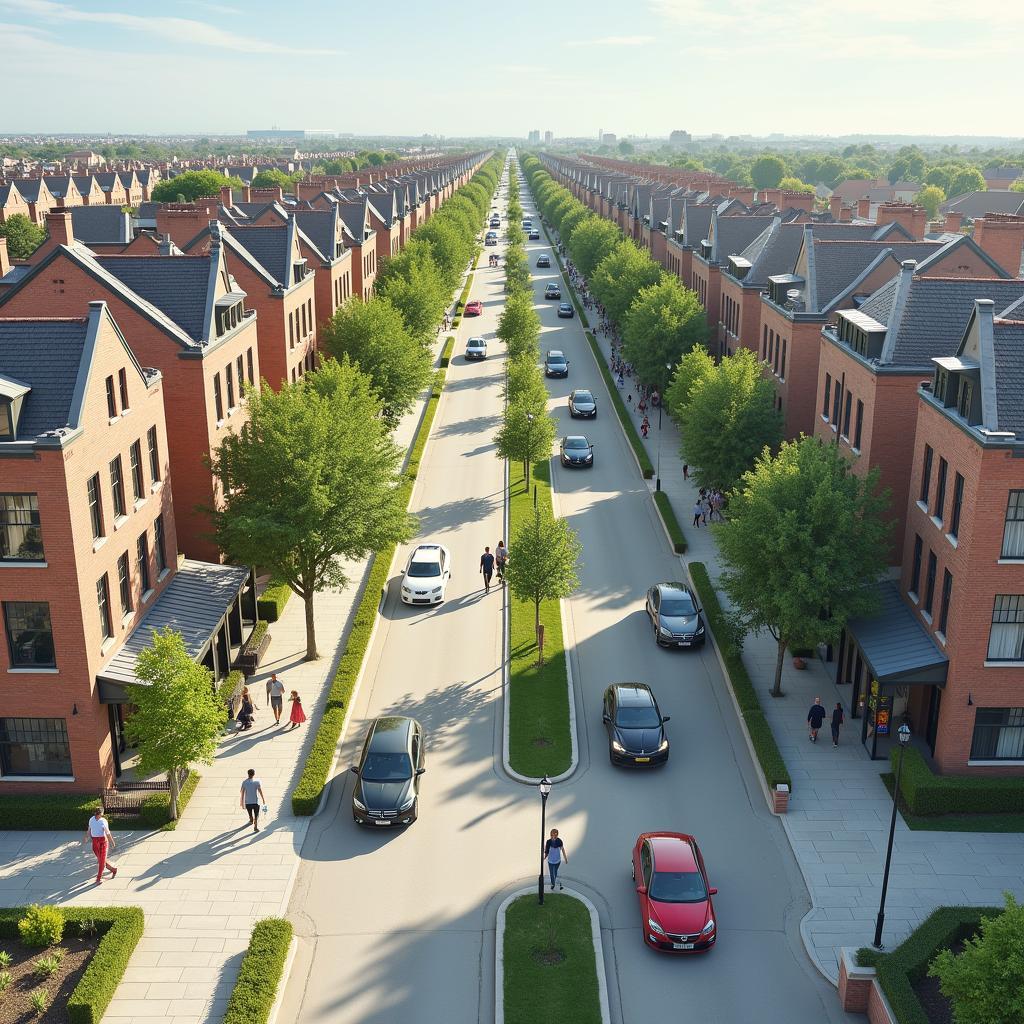 So sánh thiết kế khu phố truyền thống với khu vực lan rộng về không gian cộng đồng IELTS
Passage 3 – Essential Vocabulary
| Từ vựng | Loại từ | Phiên âm | Nghĩa tiếng Việt | Ví dụ từ bài | Collocation |
|---|---|---|---|---|---|
| metamorphosis | n | /ˌmetəˈmɔːrfəsɪs/ | sự biến đổi | The metamorphosis of human settlement | undergo metamorphosis |
| spatial substrate | n | /ˈspeɪʃəl ˈsʌbstreɪt/ | nền tảng không gian | altered the spatial substrate | spatial substrate analysis |
| propinquity | n | /prəˈpɪŋkwəti/ | sự gần gũi về mặt không gian | relationship between propinquity and cohesion | physical propinquity |
| spatial dispersion | n | /ˈspeɪʃəl dɪˈspɜːʃən/ | sự phân tán không gian | era of spatial dispersion | spatial dispersion pattern |
| ecological determinism | n | /ˌiːkəˈlɒdʒɪkəl dɪˈtɜːmɪnɪzəm/ | chủ nghĩa quyết định sinh thái | Chicago School’s emphasis on ecological determinism | ecological determinism theory |
| residential contiguity | n | /ˌrezɪˈdenʃəl kənˈtɪgjuəti/ | sự tiếp giáp về nhà ở | facilitated by residential contiguity | maintain residential contiguity |
| longitudinal analysis | n | /ˌlɒndʒɪˈtjuːdɪnəl əˈnæləsɪs/ | phân tích theo chiều dọc | A longitudinal analysis conducted | longitudinal analysis method |
| multilevel modeling | n | /ˈmʌltilevəl ˈmɒdəlɪŋ/ | mô hình hóa đa cấp | employed multilevel modeling | multilevel modeling technique |
| neighboring activities | n | /ˈneɪbərɪŋ ækˈtɪvətiz/ | hoạt động láng giềng | reduction in neighboring activities | engage in neighboring activities |
| self-selection | n | /self sɪˈlekʃən/ | sự tự chọn lọc | controlling for self-selection | self-selection bias |
| time poverty | n | /taɪm ˈpɒvəti/ | nghèo thời gian | This time poverty constrains | experience time poverty |
| opportunity cost | n | /ˌɒpəˈtjuːnəti kɒst/ | chi phí cơ hội | the opportunity cost of social engagement | calculate opportunity cost |
| morphological characteristics | n | /ˌmɔːfəˈlɒdʒɪkəl ˌkærəktəˈrɪstɪks/ | đặc điểm hình thái | morphological characteristics of sprawling | urban morphological characteristics |
| carceral spaces | n | /ˈkɑːsərəl speɪsɪz/ | không gian kiểm soát | creating carceral spaces | carceral spaces concept |
| anti-social geography | n | /ˌænti ˈsəʊʃəl dʒiˈɒgrəfi/ | địa lý chống xã hội | produce an anti-social geography | anti-social geography pattern |
| networked individualism | n | /ˈnetwɜːkt ˌɪndɪˈvɪdʒuəlɪzəm/ | chủ nghĩa cá nhân mạng lưới | research on networked individualism | networked individualism theory |
| ego-centered networks | n | /ˈiːgəʊ ˈsentəd ˈnetwɜːks/ | mạng lưới lấy cá nhân làm trung tâm | maintain ego-centered networks | ego-centered networks structure |
| sociospatial dialectic | n | /ˌsəʊsiəʊˈspeɪʃəl ˌdaɪəˈlektɪk/ | biện chứng xã hội-không gian | The sociospatial dialectic recognizes | sociospatial dialectic framework |
| structuration theory | n | /ˌstrʌktʃəˈreɪʃən ˈθɪəri/ | lý thuyết cấu trúc hóa | aligns with structuration theory | structuration theory approach |
| jurisdictional complexity | n | /ˌdʒʊərɪsˈdɪkʃənəl kəmˈpleksəti/ | sự phức tạp về thẩm quyền | stems from jurisdictional complexity | jurisdictional complexity issue |
| revealed preferences | n | /rɪˈviːld ˈprefrənsɪz/ | sở thích bộc lộ | respecting the revealed preferences | revealed preferences analysis |
| spatial determinism | n | /ˈspeɪʃəl dɪˈtɜːmɪnɪzəm/ | chủ nghĩa quyết định không gian | moving beyond spatial determinism | spatial determinism critique |
Kết Bài
Chủ đề “Urban Sprawl Impact On Community Cohesion” không chỉ là một topic học thuật quan trọng mà còn phản ánh những vấn đề xã hội đương đại mà nhiều quốc gia đang đối mặt. Qua bộ đề thi mẫu này với 3 passages tăng dần độ khó, bạn đã được trải nghiệm một bài thi IELTS Reading hoàn chỉnh với đầy đủ các dạng câu hỏi phổ biến.
Passage 1 giới thiệu khái niệm cơ bản về urban sprawl và những tác động ban đầu đến cộng đồng, phù hợp cho việc làm quen với chủ đề. Passage 2 đi sâu hơn vào lý thuyết kiến trúc xã hội và các nghiên cứu thực nghiệm, yêu cầu kỹ năng phân tích cao hơn. Passage 3 mang tính học thuật với các khái niệm xã hội học phức tạp, thách thức khả năng hiểu ngữ cảnh và suy luận của bạn.
Đáp án chi tiết kèm giải thích đã chỉ ra cách xác định thông tin trong bài, kỹ thuật paraphrase và những “bẫy” thường gặp. Bảng từ vựng tổng hợp hơn 40 từ và cụm từ quan trọng sẽ giúp bạn không chỉ trong bài thi Reading mà còn trong Writing và Speaking khi thảo luận về các chủ đề đô thị hóa.
Hãy thực hành nhiều lần với đề thi này, phân tích kỹ từng câu trả lời sai để hiểu rõ nguyên nhân và cải thiện kỹ năng. Việc làm quen với các chủ đề How to build a sustainable community cũng sẽ bổ sung kiến thức về phát triển bền vững, có nhiều điểm tương đồng với nội dung về gắn kết cộng đồng trong bài học hôm nay. Ngoài ra, chủ đề The rise of remote working and its effect on office space demand cũng liên quan đến sự thay đổi trong cách sống và làm việc, ảnh hưởng đến cấu trúc không gian đô thị tương tự như urban sprawl. Đối với những ai quan tâm đến các vấn đề y tế công cộng trong bối cảnh phát triển đô thị, Impact of urban development on public health sẽ cung cấp góc nhìn bổ sung về mối liên hệ giữa môi trường đô thị và chất lượng cuộc sống.
Chúc bạn đạt được band điểm mong muốn trong kỳ thi IELTS sắp tới!


