Mở Bài
Công nghệ mô phỏng ảo trong giáo dục y tế đã trở thành một xu hướng toàn cầu, mang lại những đột phá vượt bậc trong đào tạo các chuyên gia y tế tương lai. Chủ đề “Virtual Simulations For Healthcare Education” không chỉ phổ biến trong thực tiễn mà còn xuất hiện ngày càng thường xuyên trong các kỳ thi IELTS Reading, đặc biệt ở phần Academic Module với tính chất học thuật cao.
Bài viết này cung cấp một bộ đề thi IELTS Reading hoàn chỉnh gồm 3 passages với độ khó tăng dần từ Easy đến Hard, bao gồm 40 câu hỏi đa dạng hoàn toàn giống với format thi thật. Bạn sẽ được trải nghiệm các dạng câu hỏi phổ biến như Multiple Choice, True/False/Not Given, Yes/No/Not Given, Matching Headings, Summary Completion và nhiều dạng khác. Mỗi câu hỏi đều có đáp án chi tiết kèm giải thích cụ thể về vị trí thông tin, cách paraphrase và chiến lược làm bài hiệu quả.
Bộ đề này phù hợp cho học viên từ band 5.0 trở lên, giúp bạn làm quen với chủ đề công nghệ trong y tế, củng cố kỹ năng đọc hiểu học thuật và nâng cao vốn từ vựng chuyên ngành. Hãy dành đủ 60 phút để hoàn thành bài test này trong điều kiện tương tự như thi thật để đánh giá chính xác trình độ của bản thân.
1. Hướng Dẫn Làm Bài IELTS Reading
Tổng Quan Về IELTS Reading Test
IELTS Reading Test kéo dài 60 phút với 3 passages và tổng cộng 40 câu hỏi. Mỗi câu trả lời đúng được tính 1 điểm, không có điểm âm cho câu sai. Độ khó tăng dần từ Passage 1 đến Passage 3, đòi hỏi bạn phải phân bổ thời gian hợp lý.
Phân bổ thời gian khuyến nghị:
- Passage 1: 15-17 phút (dễ nhất, nên làm nhanh để dành thời gian cho các passage khó hơn)
- Passage 2: 18-20 phút (độ khó trung bình, cần đọc kỹ hơn)
- Passage 3: 23-25 phút (khó nhất, yêu cầu phân tích sâu)
Lưu ý dành 2-3 phút cuối để chuyển đáp án vào answer sheet và kiểm tra lại những câu không chắc chắn.
Các Dạng Câu Hỏi Trong Đề Này
Đề thi mẫu này bao gồm 7 dạng câu hỏi phổ biến nhất trong IELTS Reading:
- Multiple Choice – Câu hỏi trắc nghiệm nhiều lựa chọn
- True/False/Not Given – Xác định thông tin đúng/sai/không được đề cập
- Yes/No/Not Given – Xác định quan điểm tác giả đồng ý/không đồng ý/không đề cập
- Matching Headings – Nối tiêu đề với đoạn văn
- Summary Completion – Hoàn thành đoạn tóm tắt
- Matching Features – Nối thông tin với đặc điểm
- Short-answer Questions – Câu hỏi trả lời ngắn
Mỗi dạng câu hỏi yêu cầu kỹ năng và chiến lược riêng, vì vậy hãy đọc kỹ instructions trước khi làm bài.
 Công nghệ mô phỏng ảo trong giáo dục y tế với sinh viên y khoa thực hành
2. IELTS Reading Practice Test
PASSAGE 1 – The Evolution of Medical Training Through Virtual Technology
Độ khó: Easy (Band 5.0-6.5)
Thời gian đề xuất: 15-17 phút
The landscape of healthcare education has undergone a remarkable transformation over the past two decades, primarily driven by advances in virtual simulation technology. Traditional methods of training medical professionals, which relied heavily on cadaver dissection, textbook learning, and observational practice, are now being supplemented—and in some cases replaced—by sophisticated digital platforms that offer immersive learning experiences.
Virtual simulations represent a groundbreaking approach to medical education, allowing students to practice clinical procedures in a risk-free environment before treating real patients. These digital platforms range from simple computer-based scenarios to complex virtual reality (VR) systems that replicate entire hospital wards. Students can now perform surgical operations, diagnose medical conditions, and respond to emergency situations without the fear of causing harm to actual patients.
One of the most significant advantages of simulation-based learning is the ability to repeat procedures multiple times. In traditional clinical settings, medical students have limited opportunities to practice specific techniques, as they depend on the availability of real patients with particular conditions. However, with virtual simulations, learners can encounter the same scenario dozens of times, refining their skills and building muscle memory until they achieve proficiency. This repetitive practice is especially valuable for learning complex surgical techniques or rare emergency procedures that students might encounter infrequently during their training.
The technology also addresses a critical challenge in medical education: the variability of patient cases. Virtual simulation platforms can be programmed to present students with a wide range of medical conditions, from common ailments to rare diseases, ensuring comprehensive exposure to diverse clinical situations. This systematic approach to learning guarantees that all students receive standardized training regardless of which hospital or clinic they are assigned to during their practical rotations.
Cost-effectiveness is another compelling benefit of virtual simulations. Establishing and maintaining traditional training facilities with physical mannequins, medical equipment, and supervised practice areas requires substantial financial investment. In contrast, once a virtual simulation system is developed, it can be deployed across multiple institutions at a fraction of the cost. Universities in developing countries, which previously struggled to provide adequate practical training due to resource constraints, can now offer their students world-class educational experiences through these digital platforms.
Furthermore, virtual simulations facilitate immediate feedback, a crucial element of effective learning. As students navigate through simulated scenarios, the system can track their decisions, monitor their performance, and provide real-time guidance. This instant feedback mechanism helps learners identify mistakes immediately and understand the consequences of their actions, leading to faster skill acquisition and better retention of medical knowledge. Some advanced systems even incorporate artificial intelligence to adapt the difficulty level based on individual student performance, creating personalized learning pathways.
The integration of virtual simulation technology has also proven valuable for continuing medical education. Experienced healthcare professionals can use these platforms to maintain their skills, learn about new treatment protocols, or prepare for specialized procedures they perform infrequently. This ongoing professional development is essential in the rapidly evolving field of medicine, where new techniques and technologies emerge regularly.
Despite these numerous advantages, virtual simulations are not intended to completely replace traditional training methods. Rather, they serve as a complementary tool that enhances the overall educational experience. Students still need to develop interpersonal skills, empathy, and bedside manner—qualities that can only be fully cultivated through direct patient interaction. The ideal approach combines virtual practice with real-world clinical experience, allowing students to build technical competence in a safe environment before applying their skills in actual healthcare settings.
Questions 1-6: Multiple Choice
Choose the correct letter, A, B, C, or D.
-
According to the passage, traditional medical training methods included all of the following EXCEPT:
A. Studying from textbooks
B. Virtual reality simulations
C. Dissecting cadavers
D. Observing medical procedures -
What is described as one of the main benefits of simulation-based learning?
A. It completely eliminates the need for real patients
B. It allows students to practice procedures repeatedly
C. It is only useful for common medical conditions
D. It requires extensive physical equipment -
The passage suggests that virtual simulations are particularly useful for:
A. Replacing all traditional teaching methods
B. Training only experienced doctors
C. Practicing rare emergency procedures
D. Eliminating the need for hospitals -
According to the text, virtual simulation systems benefit developing countries by:
A. Providing expensive traditional training facilities
B. Offering affordable access to quality medical education
C. Replacing all medical schools
D. Reducing the number of doctors needed -
The immediate feedback feature of virtual simulations helps students:
A. Avoid making any mistakes
B. Replace their instructors
C. Identify and learn from errors quickly
D. Complete their training faster than traditional methods -
The author’s view on virtual simulations is that they should:
A. Completely replace traditional medical training
B. Only be used for experienced professionals
C. Be combined with real-world clinical experience
D. Focus exclusively on surgical procedures
Questions 7-10: True/False/Not Given
Do the following statements agree with the information given in the passage?
Write:
- TRUE if the statement agrees with the information
- FALSE if the statement contradicts the information
- NOT GIVEN if there is no information on this
-
Virtual simulation technology has been used in medical education for over twenty years.
-
Students using virtual simulations can practice surgical techniques more frequently than in traditional training.
-
All medical schools worldwide have now adopted virtual simulation technology.
-
Virtual simulations can adapt to individual student performance levels using artificial intelligence.
Questions 11-13: Sentence Completion
Complete the sentences below.
Choose NO MORE THAN TWO WORDS from the passage for each answer.
-
Virtual simulations create a __ where students can practice without endangering real patients.
-
The technology ensures students receive __ regardless of their training location.
-
Healthcare professionals use virtual platforms for __ to stay updated with new medical developments.
PASSAGE 2 – Technological Innovations Transforming Clinical Skills Development
Độ khó: Medium (Band 6.0-7.5)
Thời gian đề xuất: 18-20 phút
The paradigm shift in medical education brought about by virtual simulation technology represents far more than a simple digitization of existing training methods. It constitutes a fundamental reconceptualization of how clinical competencies are acquired, assessed, and refined. Contemporary simulation platforms incorporate cutting-edge technologies—including haptic feedback systems, augmented reality (AR), and sophisticated physiological modeling—to create learning environments that mirror real-world clinical scenarios with unprecedented fidelity.
Haptic technology, which enables users to experience tactile sensations in virtual environments, has proven particularly transformative in surgical training. Traditional laparoscopic surgery simulators lacked the nuanced feedback that surgeons experience when manipulating actual tissue. Modern systems, however, can replicate the resistance, texture, and compliance of different anatomical structures with remarkable accuracy. This sensory dimension significantly enhances the transfer of skills from virtual practice to real operations, as surgeons develop not merely visual recognition but genuine muscle memory and procedural intuition.
The incorporation of augmented reality into medical education has opened novel pedagogical possibilities. Unlike fully immersive virtual reality, which places users in entirely digital environments, AR overlays computer-generated information onto real-world settings. Medical students wearing AR headsets can examine actual patients while simultaneously viewing diagnostic data, anatomical overlays, and procedural guidance superimposed on their field of vision. This seamless integration of digital information with physical reality bridges the gap between theoretical knowledge and practical application in ways that traditional teaching methods cannot achieve.
Đối với những ai quan tâm đến cách công nghệ giáo dục cải thiện kết quả học tập, nội dung này sẽ hữu ích vì nó minh họa cách simulation platforms đã evolved beyond simple skill rehearsal to become comprehensive assessment tools. Advanced systems can now evaluate not only technical proficiency but also decision-making processes, prioritization abilities, and stress management under pressure. Through sophisticated data analytics, these platforms track hundreds of performance metrics—from the efficiency of movements during a procedure to the appropriateness of diagnostic reasoning in complex cases. This granular data provides both students and instructors with unprecedented insights into learning progress and areas requiring targeted improvement.
The application of artificial intelligence to virtual simulations has introduced adaptive learning mechanisms that personalize educational experiences to individual learners. Machine learning algorithms analyze student performance across multiple scenarios, identifying strengths, weaknesses, and learning patterns. Based on this analysis, the system automatically adjusts difficulty levels, introduces relevant supplementary content, and suggests customized practice scenarios. This individualized approach addresses a longstanding limitation of traditional medical education, where all students typically progress through standardized curricula regardless of their varying needs and learning speeds.
Collaborative simulation exercises represent another innovative application of virtual technology. Through networked platforms, students at different geographic locations can participate in the same simulated clinical scenario, assuming different roles within a healthcare team. These multi-user environments not only develop technical skills but also foster essential non-technical competencies such as communication, teamwork, and leadership—qualities that are crucial for effective healthcare delivery but difficult to teach through traditional methods. Some institutions have established international partnerships, allowing students from diverse healthcare systems to collaborate, share perspectives, and learn from each other’s approaches.
The integration of virtual patient populations with authentic electronic health records adds another layer of realism to simulation-based training. Students navigate the same computerized systems they will encounter in actual hospitals, learning to interpret lab results, review medical histories, and document clinical decisions in proper formats. Điều này có điểm tương đồng với tích hợp phương tiện truyền thông vào giáo dục sức khỏe khi giúp bridging the often jarring transition from educational settings to professional practice by familiarizing students with the administrative workflows and documentation requirements they will face as practicing clinicians.
However, the implementation of sophisticated simulation technology presents significant challenges. The initial capital investment required for high-fidelity systems can be prohibitive, particularly for smaller institutions. Technical expertise is needed not only to maintain the equipment but also to develop clinically relevant scenarios and integrate simulations effectively into existing curricula. Faculty members require specialized training to facilitate simulation-based learning effectively, as teaching in these environments demands different pedagogical approaches than traditional classroom instruction. Moreover, questions remain about the optimal balance between virtual and hands-on training, and the extent to which skills acquired in simulated environments genuinely translate to improved patient outcomes in real-world practice.
Questions 14-17: Yes/No/Not Given
Do the following statements agree with the views of the writer in the passage?
Write:
- YES if the statement agrees with the claims of the writer
- NO if the statement contradicts the claims of the writer
- NOT GIVEN if it is impossible to say what the writer thinks about this
-
Virtual simulation technology represents a complete transformation rather than just a digital version of traditional training.
-
Augmented reality is more effective than virtual reality for all types of medical training.
-
The use of artificial intelligence in simulations creates personalized learning experiences for each student.
-
All medical schools can easily afford to implement high-fidelity simulation systems.
Questions 18-22: Matching Headings
Choose the correct heading for paragraphs B-F from the list of headings below.
Write the correct number, i-ix.
List of Headings:
i. The financial barriers to simulation adoption
ii. Tactile feedback enhancing surgical skill development
iii. International collaboration through virtual platforms
iv. The role of artificial intelligence in personalized learning
v. Combining digital information with real-world settings
vi. The limitations of traditional assessment methods
vii. Comprehensive performance evaluation through data analytics
viii. Future predictions for medical simulation
ix. Virtual reality replacing hospital training
- Paragraph B
- Paragraph C
- Paragraph D
- Paragraph E
- Paragraph F
Questions 23-26: Summary Completion
Complete the summary below.
Choose NO MORE THAN TWO WORDS from the passage for each answer.
Modern simulation platforms utilize various technologies to create realistic training environments. Haptic technology provides (23) __ that helps surgeons develop genuine muscle memory. Augmented reality allows students to view (24) __ while examining real patients. Advanced systems assess not just technical skills but also (25) __ under pressure. Additionally, (26) __ enable students from different locations to work together in simulated healthcare teams.
PASSAGE 3 – The Epistemological and Pedagogical Implications of Simulation-Based Medical Education
Độ khó: Hard (Band 7.0-9.0)
Thời gian đề xuất: 23-25 phút
The proliferation of virtual simulation technology in healthcare education has precipitated not merely methodological innovations but profound epistemological questions regarding the nature of medical knowledge, the construction of clinical expertise, and the relationship between theoretical understanding and practical competence. While proponents extol the virtues of simulation-based learning—reproducibility, standardization, safety, and accessibility—critical scholars have begun to interrogate the underlying assumptions and potential limitations of this pedagogical paradigm, particularly concerning whether authentic clinical judgment can be cultivated in fundamentally artificial environments.
At the heart of this debate lies a fundamental philosophical tension between representational fidelity and authentic experience. High-fidelity simulations strive to replicate clinical scenarios with maximal accuracy, incorporating physiological parameters, environmental details, and procedural complexities that mirror real medical situations. Yet phenomenological analyses suggest that no matter how sophisticated the technological apparatus, simulated experiences remain ontologically distinct from genuine clinical encounters. The lived experience of treating an actual patient—with its attendant emotional intensity, ethical gravity, and existential weight—cannot be fully recapitulated in even the most advanced virtual environment. Tương tự như cách công nghệ AI tạo ra các giải pháp chăm sóc sức khỏe được cá nhân hóa, hiện tượng này raises questions about whether simulation-trained practitioners might lack certain intangible qualities—empathetic attunement, moral sensitivity, adaptive reasoning—that emerge only through direct human engagement in consequential situations.
Cognitive science research has yielded nuanced insights into how simulation-based learning affects knowledge acquisition and skill transfer. Studies employing neuroimaging techniques reveal that brain activation patterns during simulated procedures closely resemble those during actual clinical performance, suggesting that neural pathways and procedural schemas developed in virtual environments do indeed generalize to real-world practice. However, the ecological validity of such findings remains contested, as laboratory conditions differ substantially from the multifaceted complexity of authentic healthcare settings, where competing demands, systemic constraints, and unpredictable contingencies significantly influence decision-making processes.
The standardization inherent in simulation-based training—often cited as one of its primary advantages—also presents potential pedagogical liabilities. Medical practice is characterized by irreducible variability: patients present with idiosyncratic combinations of symptoms, comorbidities, and contextual factors that defy algorithmic categorization. Simulation scenarios, by necessity, involve deliberate simplification and selective emphasis of certain elements while excluding others. This curated artificiality may inadvertently foster cognitive rigidity, training students to recognize and respond to prototypical cases while diminishing their capacity for the adaptive thinking and improvisational problem-solving required when confronting atypical presentations or resource-constrained environments.
Một ví dụ chi tiết về vai trò của công nghệ trong cải thiện kết quả sức khỏe tâm thần là the assessment methodologies enabled by simulation technology exemplify broader epistemological shifts in medical education toward competency-based frameworks emphasizing demonstrable skills over accumulated knowledge. Simulation-based assessments offer objective metrics—task completion times, procedural accuracy rates, error frequencies—that can be quantified, compared, and tracked longitudinally. This quantification aligns with contemporary accountability pressures and evidence-based paradigms in healthcare education. Yet critics caution against reductionism, arguing that complex clinical competence encompasses dimensions—professional judgment, ethical reasoning, contextual sensitivity—that resist precise measurement and may be undervalued when education becomes excessively oriented toward measurable outcomes.
The sociotechnical dimensions of implementing simulation-based education merit careful consideration. The adoption of these technologies does not occur in a vacuum but within institutional contexts shaped by power dynamics, resource allocation decisions, and competing educational philosophies. Faculty resistance to simulation-based methods sometimes reflects legitimate pedagogical concerns rather than mere technophobia—experienced clinicians may perceive that simulation training inadequately addresses aspects of medical practice they consider crucial. Furthermore, disparities in access to sophisticated simulation facilities risk exacerbating existing inequities in medical education, potentially creating stratified training systems where students at well-resourced institutions receive state-of-the-art preparation while those elsewhere must rely on outdated methods.
Longitudinal studies examining long-term outcomes of simulation-trained healthcare professionals have produced mixed findings. Some research indicates that physicians trained extensively with simulations demonstrate superior technical proficiency during their early clinical years, particularly in procedural specialties. However, other investigations suggest these advantages diminish over time as experiential learning in actual practice settings supersedes initial training effects. Notably, few studies have definitively established whether simulation-based education translates into improved patient outcomes—the ultimate measure of effectiveness—as opposed to merely enhanced performance on intermediate metrics. This evidentiary gap underscores the need for rigorous comparative research employing robust methodological designs capable of isolating the specific contributions of simulation training from confounding variables.
The ethical dimensions of simulation-based medical education extend beyond obvious concerns about patient safety. Questions arise regarding the appropriate balance between maximizing student learning opportunities and minimizing patient exposure to inexperienced practitioners. While simulations ostensibly address this ethical tension, they also potentially defer rather than resolve the fundamental dilemma: at some point, neophyte clinicians must transition from simulated to real patients, and the optimal timing and circumstances for this transition remain contested. Additionally, the financial investments required for sophisticated simulation infrastructure necessitate opportunity cost analyses—resources devoted to technology might alternatively fund increased clinical preceptorship, community health initiatives, or broader healthcare access, each with distinct ethical implications.
Questions 27-31: Multiple Choice
Choose the correct letter, A, B, C, or D.
-
According to the passage, the main philosophical concern about simulation-based training is that:
A. It is too expensive for most institutions
B. Simulated experiences differ fundamentally from real clinical encounters
C. Students prefer traditional training methods
D. The technology is not sophisticated enough -
The passage suggests that standardization in simulation training:
A. Is universally beneficial for medical education
B. Perfectly prepares students for all clinical situations
C. May reduce students’ ability to handle unusual cases
D. Should be eliminated from medical education -
Research using neuroimaging techniques indicates that:
A. Simulations are completely ineffective for training
B. Brain patterns during simulations resemble those during real procedures
C. Traditional training is superior to simulation-based learning
D. Simulations only work for certain medical specialties -
According to the text, competency-based assessment frameworks:
A. Measure all aspects of clinical competence perfectly
B. Are rejected by all medical educators
C. Provide quantifiable metrics but may miss important qualities
D. Have replaced all traditional assessment methods -
Longitudinal studies on simulation-trained doctors show that:
A. They are always superior to traditionally trained doctors
B. Initial advantages may decrease as they gain real clinical experience
C. They have definitively better patient outcomes
D. They never perform as well as traditionally trained doctors
Questions 32-36: Matching Features
Match each research finding (A-H) with the correct aspect of simulation-based education (Questions 32-36).
Write the correct letter, A-H.
Research Findings:
A. Brain activation during simulations resembles real procedures
B. Wealthy institutions have better simulation facilities
C. Some advantages disappear over time with real practice
D. Simulations cannot fully replicate emotional intensity of real situations
E. Assessment provides precise numerical measurements
F. Faculty may have legitimate concerns about simulation effectiveness
G. No clear evidence of improved patient outcomes
H. Simulations reduce patient risk during training
- Epistemological limitations
- Neurological evidence
- Long-term effectiveness
- Educational equity concerns
- Evidence gaps
Questions 37-40: Short-answer Questions
Answer the questions below.
Choose NO MORE THAN THREE WORDS from the passage for each answer.
-
What type of thinking might be reduced by the curated artificiality of simulation scenarios?
-
What kind of frameworks in medical education emphasize demonstrable skills over accumulated knowledge?
-
According to the passage, what type of training system might result from unequal access to simulation facilities?
-
What does the passage identify as the ultimate measure of medical education effectiveness?
 Hệ thống phân tích dữ liệu và đánh giá hiệu suất trong chương trình đào tạo y tế mô phỏng
3. Answer Keys – Đáp Án
PASSAGE 1: Questions 1-13
- B
- B
- C
- B
- C
- C
- TRUE
- TRUE
- NOT GIVEN
- TRUE
- risk-free environment
- standardized training
- continuing (medical) education
PASSAGE 2: Questions 14-26
- YES
- NOT GIVEN
- YES
- NO
- ii
- v
- vii
- iv
- iii
- tactile sensations
- diagnostic data
- decision-making processes
- collaborative (simulation) exercises / networked platforms
PASSAGE 3: Questions 27-40
- B
- C
- B
- C
- B
- D
- A
- C
- B
- G
- adaptive thinking / improvisational problem-solving
- competency-based frameworks
- stratified training systems
- improved patient outcomes
4. Giải Thích Đáp Án Chi Tiết
Passage 1 – Giải Thích
Câu 1: B
- Dạng câu hỏi: Multiple Choice (Negative Question)
- Từ khóa: traditional medical training methods, EXCEPT
- Vị trí trong bài: Đoạn A, dòng 2-4
- Giải thích: Bài viết liệt kê các phương pháp truyền thống bao gồm “cadaver dissection, textbook learning, and observational practice”. Virtual reality simulations được đề cập như là công nghệ hiện đại, không phải phương pháp truyền thống. Các đáp án A (textbooks), C (cadavers), và D (observing) đều được nhắc đến là phương pháp truyền thống.
Câu 2: B
- Dạng câu hỏi: Multiple Choice
- Từ khóa: main benefits, simulation-based learning
- Vị trí trong bài: Đoạn C, dòng 1-3
- Giải thích: Đoạn văn nói rõ “One of the most significant advantages of simulation-based learning is the ability to repeat procedures multiple times”. Paraphrase: “repeat procedures multiple times” = “practice procedures repeatedly”. Đáp án A sai vì bài chỉ nói supplement chứ không eliminate; C sai vì cũng hữu ích cho rare conditions; D sai vì ngược lại, nó cost-effective hơn.
Câu 3: C
- Dạng câu hỏi: Multiple Choice
- Từ khóa: particularly useful for
- Vị trí trong bài: Đoạn C, dòng 7-8
- Giải thích: Bài viết nhấn mạnh “This repetitive practice is especially valuable for learning complex surgical techniques or rare emergency procedures”. Paraphrase: “rare emergency procedures” = “rare emergency procedures” (trùng khớp hoàn toàn). Đây là thông tin cụ thể về lợi ích đặc biệt của simulation.
Câu 4: B
- Dạng câu hỏi: Multiple Choice
- Từ khóa: developing countries, benefit
- Vị trí trong bài: Đoạn E, dòng 4-6
- Giải thích: Đoạn văn chỉ ra “Universities in developing countries, which previously struggled to provide adequate practical training due to resource constraints, can now offer their students world-class educational experiences through these digital platforms”. Paraphrase: “world-class educational experiences” at “a fraction of the cost” = “affordable access to quality medical education”.
Câu 5: C
- Dạng câu hỏi: Multiple Choice
- Từ khóa: immediate feedback feature, helps students
- Vị trí trong bài: Đoạn F, dòng 2-5
- Giải thích: Bài viết giải thích “This instant feedback mechanism helps learners identify mistakes immediately and understand the consequences of their actions”. Paraphrase: “identify mistakes immediately” = “identify and learn from errors quickly”. Đáp án A sai vì không thể avoid all mistakes; B sai vì không thay thế instructors; D không được đề cập.
Câu 6: C
- Dạng câu hỏi: Multiple Choice (Author’s View)
- Từ khóa: author’s view, should
- Vị trí trong bài: Đoạn H, dòng 1-3
- Giải thích: Tác giả nói rõ “virtual simulations are not intended to completely replace traditional training methods. Rather, they serve as a complementary tool” và “The ideal approach combines virtual practice with real-world clinical experience”. Đây là quan điểm rõ ràng về việc kết hợp cả hai phương pháp.
Câu 7: TRUE
- Dạng câu hỏi: True/False/Not Given
- Từ khóa: over twenty years
- Vị trí trong bài: Đoạn A, dòng 1
- Giải thích: Câu mở đầu nói “over the past two decades” (= over twenty years). Thông tin khớp hoàn toàn với statement.
Câu 8: TRUE
- Dạng câu hỏi: True/False/Not Given
- Từ khóa: practice surgical techniques more frequently
- Vị trí trong bài: Đoạn C, dòng 1-5
- Giải thích: Bài viết nói “In traditional clinical settings, medical students have limited opportunities to practice specific techniques” nhưng “with virtual simulations, learners can encounter the same scenario dozens of times”. Rõ ràng là practice more frequently hơn traditional training.
Câu 9: NOT GIVEN
- Dạng câu hỏi: True/False/Not Given
- Từ khóa: all medical schools worldwide, adopted
- Vị trí trong bài: Không có thông tin
- Giải thích: Bài viết không đề cập đến việc tất cả các trường y trên thế giới đã áp dụng công nghệ này. Chỉ nói về xu hướng và lợi ích, không nói về mức độ phổ biến toàn cầu.
Câu 10: TRUE
- Dạng câu hỏi: True/False/Not Given
- Từ khóa: adapt, individual student performance, artificial intelligence
- Vị trí trong bài: Đoạn F, dòng 6-7
- Giải thích: Bài viết nói rõ “Some advanced systems even incorporate artificial intelligence to adapt the difficulty level based on individual student performance”. Thông tin khớp chính xác với statement.
Câu 11: risk-free environment
- Dạng câu hỏi: Sentence Completion
- Từ khóa: practice without endangering
- Vị trí trong bài: Đoạn B, dòng 1-2
- Giải thích: Câu gốc: “allowing students to practice clinical procedures in a risk-free environment before treating real patients”. Cụm “risk-free environment” là đáp án chính xác, không vượt quá TWO WORDS.
Câu 12: standardized training
- Dạng câu hỏi: Sentence Completion
- Từ khóa: ensures students receive, regardless of training location
- Vị trí trong bài: Đoạn D, dòng 5-6
- Giải thích: Câu gốc: “ensuring comprehensive exposure to diverse clinical situations. This systematic approach to learning guarantees that all students receive standardized training regardless of which hospital or clinic they are assigned to”. Paraphrase: “regardless of which hospital” = “regardless of training location”.
Câu 13: continuing (medical) education
- Dạng câu hỏi: Sentence Completion
- Từ khóa: healthcare professionals, stay updated
- Vị trí trong bài: Đoạn G, dòng 1-3
- Giải thích: Câu gốc: “The integration of virtual simulation technology has also proven valuable for continuing medical education. Experienced healthcare professionals can use these platforms to maintain their skills, learn about new treatment protocols”. Đáp án có thể là “continuing education” hoặc “continuing medical education”, cả hai đều đúng.
Passage 2 – Giải Thích
Câu 14: YES
- Dạng câu hỏi: Yes/No/Not Given
- Từ khóa: complete transformation, digital version
- Vị trí trong bài: Đoạn A, dòng 1-2
- Giải thích: Tác giả nói rõ “represents far more than a simple digitization of existing training methods. It constitutes a fundamental reconceptualization”. Điều này hoàn toàn đồng ý với statement về complete transformation thay vì chỉ là digital version.
Câu 15: NOT GIVEN
- Dạng câu hỏi: Yes/No/Not Given
- Từ khóa: more effective than, all types
- Vị trí trong bài: Đoạn C
- Giải thích: Bài viết mô tả AR và VR có những ứng dụng khác nhau (“Unlike fully immersive virtual reality…AR overlays computer-generated information onto real-world settings”) nhưng không so sánh effectiveness cho tất cả các loại training. Không có thông tin để xác định cái nào effective hơn.
Câu 16: YES
- Dạng câu hỏi: Yes/No/Not Given
- Từ khóa: artificial intelligence, personalized learning experiences
- Vị trí trong bài: Đoạn E, dòng 1-5
- Giải thích: Tác giả khẳng định “The application of artificial intelligence to virtual simulations has introduced adaptive learning mechanisms that personalize educational experiences to individual learners”. Đây là quan điểm rõ ràng của tác giả về khả năng của AI.
Câu 17: NO
- Dạng câu hỏi: Yes/No/Not Given
- Từ khóa: all medical schools, easily afford
- Vị trí trong bài: Đoạn H, dòng 1-2
- Giải thích: Tác giả nói “The initial capital investment required for high-fidelity systems can be prohibitive, particularly for smaller institutions”. Điều này trực tiếp mâu thuẫn với statement rằng all schools can easily afford.
Câu 18: ii (Tactile feedback enhancing surgical skill development)
- Dạng câu hỏi: Matching Headings
- Đoạn văn: Paragraph B
- Giải thích: Đoạn B tập trung vào haptic technology và cách nó cung cấp tactile sensations để enhance surgical training: “Haptic technology, which enables users to experience tactile sensations in virtual environments, has proven particularly transformative in surgical training”. Đây là main idea của đoạn.
Câu 19: v (Combining digital information with real-world settings)
- Dạng câu hỏi: Matching Headings
- Đoạn văn: Paragraph C
- Giải thích: Đoạn C mô tả augmented reality và cách nó “overlays computer-generated information onto real-world settings” và “This seamless integration of digital information with physical reality bridges the gap”. Heading này tóm tắt chính xác nội dung.
Câu 20: vii (Comprehensive performance evaluation through data analytics)
- Dạng câu hỏi: Matching Headings
- Đoạn văn: Paragraph D
- Giải thích: Đoạn D tập trung vào “comprehensive assessment tools” và “sophisticated data analytics” để track “hundreds of performance metrics”. Main idea là về evaluation through data analytics.
Câu 21: iv (The role of artificial intelligence in personalized learning)
- Dạng câu hỏi: Matching Headings
- Đoạn văn: Paragraph E
- Giải thích: Đoạn E nói về “The application of artificial intelligence” và “adaptive learning mechanisms that personalize educational experiences to individual learners”. Đây chính xác là role của AI trong personalized learning.
Câu 22: iii (International collaboration through virtual platforms)
- Dạng câu hỏi: Matching Headings
- Đoạn văn: Paragraph F
- Giải thích: Đoạn F mô tả “Collaborative simulation exercises” và “students at different geographic locations” cũng như “international partnerships”. Focus chính là collaboration qua virtual platforms.
Câu 23: tactile sensations
- Dạng câu hỏi: Summary Completion
- Từ khóa: haptic technology provides
- Vị trí trong bài: Đoạn B, dòng 1
- Giải thích: “Haptic technology, which enables users to experience tactile sensations in virtual environments”. Đáp án chính xác là “tactile sensations” (hai từ).
Câu 24: diagnostic data
- Dạng câu hỏi: Summary Completion
- Từ khóa: augmented reality, view while examining
- Vị trí trong bài: Đoạn C, dòng 3-4
- Giải thích: “Medical students wearing AR headsets can examine actual patients while simultaneously viewing diagnostic data, anatomical overlays, and procedural guidance”. Trong context của summary, “diagnostic data” là thông tin quan trọng nhất mà AR hiển thị.
Câu 25: decision-making processes
- Dạng câu hỏi: Summary Completion
- Từ khóa: assess not just technical skills but also, under pressure
- Vị trí trong bài: Đoạn D, dòng 2-3
- Giải thích: “Advanced systems can now evaluate not only technical proficiency but also decision-making processes, prioritization abilities, and stress management under pressure”. Đáp án “decision-making processes” là một trong những non-technical aspects được assess.
Câu 26: collaborative (simulation) exercises / networked platforms
- Dạng câu hỏi: Summary Completion
- Từ khóa: enable students from different locations to work together
- Vị trí trong bài: Đoạn F, dòng 1-2
- Giải thích: “Collaborative simulation exercises represent another innovative application” và “Through networked platforms, students at different geographic locations can participate in the same simulated clinical scenario”. Cả hai đáp án đều chấp nhận được vì đều không vượt quá TWO WORDS và đều chính xác.
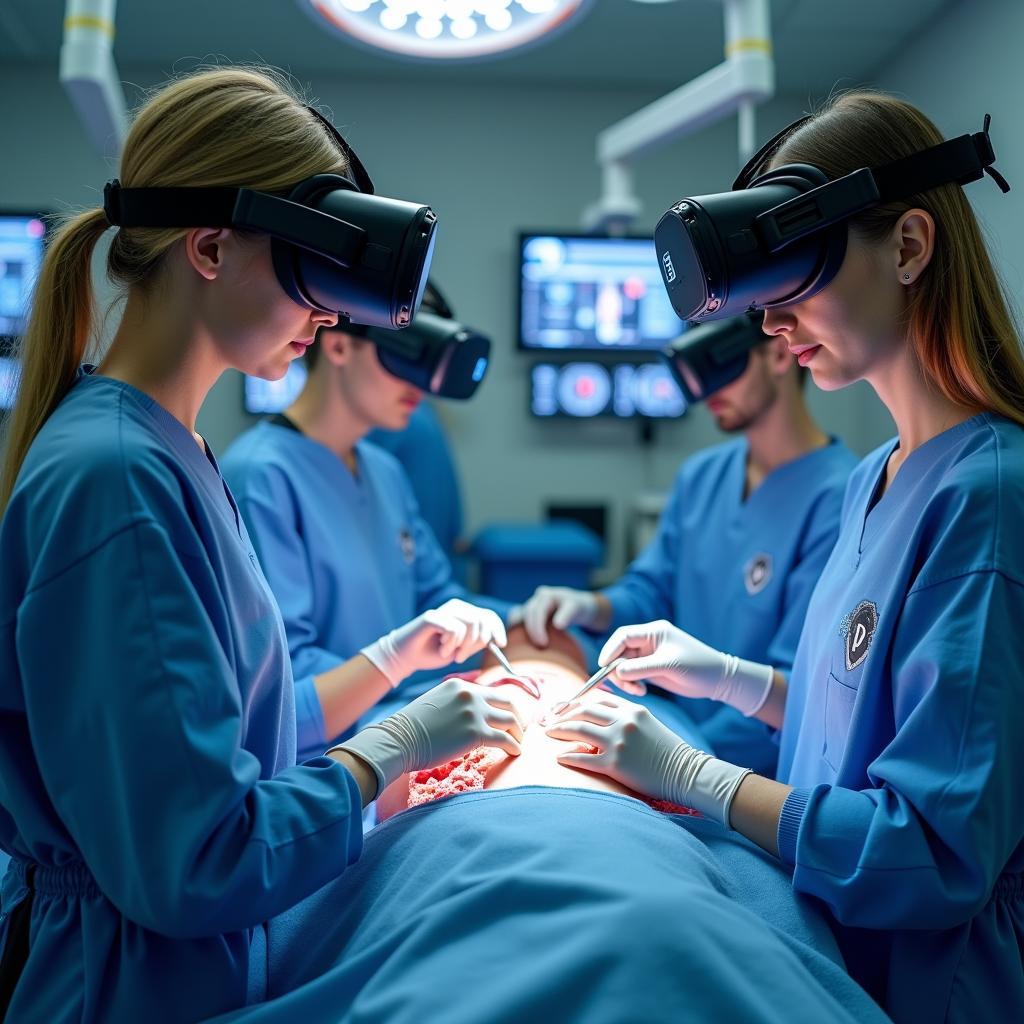 Sinh viên y khoa đang thực hành kỹ năng lâm sàng thông qua hệ thống mô phỏng ảo với phản hồi xúc giác
Passage 3 – Giải Thích
Câu 27: B
- Dạng câu hỏi: Multiple Choice
- Từ khóa: main philosophical concern
- Vị trí trong bài: Đoạn B, dòng 3-6
- Giải thích: Đoạn văn nói rõ “simulated experiences remain ontologically distinct from genuine clinical encounters” và “The lived experience of treating an actual patient…cannot be fully recapitulated in even the most advanced virtual environment”. Đây là philosophical concern chính: simulated experiences differ fundamentally from real ones.
Câu 28: C
- Dạng câu hỏi: Multiple Choice
- Từ khóa: standardization in simulation training
- Vị trí trong bài: Đoạn D, dòng 1-7
- Giải thích: Tác giả chỉ ra “The standardization…also presents potential pedagogical liabilities” và “This curated artificiality may inadvertently foster cognitive rigidity, training students to recognize and respond to prototypical cases while diminishing their capacity for the adaptive thinking”. Paraphrase: “diminishing capacity for adaptive thinking” = “reduce ability to handle unusual cases”.
Câu 29: B
- Dạng câu hỏi: Multiple Choice
- Từ khóa: neuroimaging techniques indicates
- Vị trí trong bài: Đoạn C, dòng 2-4
- Giải thích: Bài viết nói “Studies employing neuroimaging techniques reveal that brain activation patterns during simulated procedures closely resemble those during actual clinical performance”. Đáp án B paraphrase chính xác thông tin này.
Câu 30: C
- Dạng câu hỏi: Multiple Choice
- Từ khóa: competency-based assessment frameworks
- Vị trí trong bài: Đoạn E, dòng 3-7
- Giải thích: Tác giả giải thích frameworks này “offer objective metrics…that can be quantified, compared, and tracked” nhưng “critics caution against reductionism, arguing that complex clinical competence encompasses dimensions…that resist precise measurement and may be undervalued”. Điều này match với đáp án C về việc provide metrics nhưng miss important qualities.
Câu 31: B
- Dạng câu hỏi: Multiple Choice
- Từ khóa: longitudinal studies, simulation-trained doctors
- Vị trí trong bài: Đoạn G, dòng 2-5
- Giải thích: Bài viết nói “Some research indicates that physicians trained extensively with simulations demonstrate superior technical proficiency during their early clinical years” nhưng “other investigations suggest these advantages diminish over time as experiential learning in actual practice settings supersedes initial training effects”. Đáp án B tóm tắt chính xác finding này.
Câu 32: D (Simulations cannot fully replicate emotional intensity)
- Dạng câu hỏi: Matching Features
- Aspect: Epistemological limitations
- Vị trí trong bài: Đoạn B, dòng 5-6
- Giải thích: “The lived experience of treating an actual patient—with its attendant emotional intensity, ethical gravity, and existential weight—cannot be fully recapitulated” đại diện cho epistemological limitation về bản chất của simulation.
Câu 33: A (Brain activation during simulations resembles real procedures)
- Dạng câu hỏi: Matching Features
- Aspect: Neurological evidence
- Vị trí trong bài: Đoạn C, dòng 2-3
- Giải thích: “Studies employing neuroimaging techniques reveal that brain activation patterns during simulated procedures closely resemble those during actual clinical performance” là neurological evidence rõ ràng.
Câu 34: C (Some advantages disappear over time)
- Dạng câu hỏi: Matching Features
- Aspect: Long-term effectiveness
- Vị trí trong bài: Đoạn G, dòng 4-5
- Giải thích: “other investigations suggest these advantages diminish over time as experiential learning in actual practice settings supersedes initial training effects” liên quan trực tiếp đến long-term effectiveness.
Câu 35: B (Wealthy institutions have better facilities)
- Dạng câu hỏi: Matching Features
- Aspect: Educational equity concerns
- Vị trí trong bài: Đoạn F, dòng 6-8
- Giải thích: “disparities in access to sophisticated simulation facilities risk exacerbating existing inequities in medical education, potentially creating stratified training systems where students at well-resourced institutions receive state-of-the-art preparation” thể hiện equity concerns.
Câu 36: G (No clear evidence of improved patient outcomes)
- Dạng câu hỏi: Matching Features
- Aspect: Evidence gaps
- Vị trí trong bài: Đoạn G, dòng 6-8
- Giải thích: “Notably, few studies have definitively established whether simulation-based education translates into improved patient outcomes…This evidentiary gap underscores the need for rigorous comparative research” chỉ rõ evidence gap.
Câu 37: adaptive thinking / improvisational problem-solving
- Dạng câu hỏi: Short-answer Questions
- Từ khóa: reduced by curated artificiality
- Vị trí trong bài: Đoạn D, dòng 6-7
- Giải thích: “This curated artificiality may inadvertently foster cognitive rigidity, training students to recognize and respond to prototypical cases while diminishing their capacity for the adaptive thinking and improvisational problem-solving”. Cả hai đáp án đều chính xác và không vượt quá THREE WORDS.
Câu 38: competency-based frameworks
- Dạng câu hỏi: Short-answer Questions
- Từ khóa: emphasize demonstrable skills over accumulated knowledge
- Vị trí trong bài: Đoạn E, dòng 1-2
- Giải thích: “The assessment methodologies enabled by simulation technology exemplify broader epistemological shifts in medical education toward competency-based frameworks emphasizing demonstrable skills over accumulated knowledge”. Đáp án chính xác là “competency-based frameworks” (hai từ).
Câu 39: stratified training systems
- Dạng câu hỏi: Short-answer Questions
- Từ khóa: result from unequal access
- Vị trí trong bài: Đoạn F, dòng 7-8
- Giải thích: “disparities in access to sophisticated simulation facilities risk exacerbating existing inequities in medical education, potentially creating stratified training systems where students at well-resourced institutions receive state-of-the-art preparation while those elsewhere must rely on outdated methods”. Đáp án: “stratified training systems” (ba từ).
Câu 40: improved patient outcomes
- Dạng câu hỏi: Short-answer Questions
- Từ khóa: ultimate measure of effectiveness
- Vị trí trong bài: Đoạn G, dòng 6-7
- Giải thích: “Notably, few studies have definitively established whether simulation-based education translates into improved patient outcomes—the ultimate measure of effectiveness”. Cụm “improved patient outcomes” được tác giả chỉ rõ là “the ultimate measure” (ba từ).
5. Từ Vựng Quan Trọng Theo Passage
Passage 1 – Essential Vocabulary
| Từ vựng | Loại từ | Phiên âm | Nghĩa tiếng Việt | Ví dụ từ bài | Collocation |
|---|---|---|---|---|---|
| remarkable transformation | n | /rɪˈmɑːkəbl trænsfəˈmeɪʃn/ | sự biến đổi đáng chú ý | Healthcare education has undergone a remarkable transformation | undergo a transformation |
| immersive learning | n | /ɪˈmɜːsɪv ˈlɜːnɪŋ/ | học tập nhập vai/chìm đắm | offer immersive learning experiences | immersive experience |
| groundbreaking approach | n | /ˈɡraʊndbreɪkɪŋ əˈprəʊtʃ/ | phương pháp đột phá | represent a groundbreaking approach | groundbreaking research/technology |
| risk-free environment | n | /rɪsk friː ɪnˈvaɪrənmənt/ | môi trường không rủi ro | practice in a risk-free environment | create/provide a risk-free environment |
| clinical procedures | n | /ˈklɪnɪkl prəˈsiːdʒəz/ | thủ thuật lâm sàng | perform surgical operations and clinical procedures | perform/practice clinical procedures |
| refining their skills | v phrase | /rɪˈfaɪnɪŋ ðeə skɪlz/ | trau dồi kỹ năng | refining their skills through repetition | refine skills/techniques |
| comprehensive exposure | n | /ˌkɒmprɪˈhensɪv ɪkˈspəʊʒə/ | sự tiếp xúc toàn diện | ensuring comprehensive exposure to diverse cases | comprehensive training/coverage |
| cost-effectiveness | n | /kɒst ɪˈfektɪvnəs/ | tính hiệu quả về chi phí | Cost-effectiveness is a compelling benefit | improve/demonstrate cost-effectiveness |
| immediate feedback | n | /ɪˈmiːdiət ˈfiːdbæk/ | phản hồi tức thời | facilitate immediate feedback | provide/receive immediate feedback |
| real-time guidance | n | /ˈrɪəl taɪm ˈɡaɪdns/ | hướng dẫn theo thời gian thực | provide real-time guidance | offer/receive real-time guidance |
| complementary tool | n | /ˌkɒmplɪˈmentri tuːl/ | công cụ bổ trợ | serve as a complementary tool | use as a complementary tool |
| interpersonal skills | n | /ˌɪntəˈpɜːsənl skɪlz/ | kỹ năng giao tiếp | develop interpersonal skills and empathy | develop/improve interpersonal skills |
Passage 2 – Essential Vocabulary
| Từ vựng | Loại từ | Phiên âm | Nghĩa tiếng Việt | Ví dụ từ bài | Collocation |
|---|---|---|---|---|---|
| paradigm shift | n | /ˈpærədaɪm ʃɪft/ | sự thay đổi mô hình tư duy | represents a paradigm shift in medical education | undergo/experience a paradigm shift |
| fundamental reconceptualization | n | /ˌfʌndəˈmentl ˌriːkənˌseptʃuəlaɪˈzeɪʃn/ | sự tái khái niệm hóa cơ bản | constitutes a fundamental reconceptualization | fundamental change/transformation |
| haptic feedback | n | /ˈhæptɪk ˈfiːdbæk/ | phản hồi xúc giác | incorporate haptic feedback systems | provide/utilize haptic feedback |
| tactile sensations | n | /ˈtæktaɪl senˈseɪʃnz/ | cảm giác xúc giác | experience tactile sensations | reproduce/simulate tactile sensations |
| augmented reality | n | /ɔːɡˈmentɪd riˈæləti/ | thực tế tăng cường | incorporation of augmented reality | augmented reality technology/application |
| superimposed | adj | /ˌsuːpərɪmˈpəʊzd/ | được chồng lên | information superimposed on their field of vision | superimpose images/data |
| comprehensive assessment | n | /ˌkɒmprɪˈhensɪv əˈsesmənt/ | đánh giá toàn diện | become comprehensive assessment tools | comprehensive evaluation/analysis |
| granular data | n | /ˈɡrænjələ ˈdeɪtə/ | dữ liệu chi tiết/hạt | provides granular data on performance | collect/analyze granular data |
| adaptive learning | n | /əˈdæptɪv ˈlɜːnɪŋ/ | học tập thích ứng | introduce adaptive learning mechanisms | adaptive learning system/platform |
| personalized learning pathways | n | /ˈpɜːsənəlaɪzd ˈlɜːnɪŋ ˈpɑːθweɪz/ | lộ trình học tập cá nhân hóa | creating personalized learning pathways | develop/design personalized pathways |
| collaborative exercises | n | /kəˈlæbərətɪv ˈeksəsaɪzɪz/ | bài tập hợp tác | Collaborative simulation exercises | participate in collaborative exercises |
| networked platforms | n | /ˈnetwɜːkt ˈplætfɔːmz/ | nền tảng kết nối mạng | Through networked platforms | utilize/leverage networked platforms |
| non-technical competencies | n | /nɒn ˈteknɪkl ˌkɒmpɪˈtensiz/ | năng lực phi kỹ thuật | foster essential non-technical competencies | develop/assess non-technical competencies |
| capital investment | n | /ˈkæpɪtl ɪnˈvestmənt/ | đầu tư vốn | requires initial capital investment | substantial/significant capital investment |
| pedagogical approaches | n | /ˌpedəˈɡɒdʒɪkl əˈprəʊtʃɪz/ | phương pháp sư phạm | demands different pedagogical approaches | innovative/effective pedagogical approaches |
Passage 3 – Essential Vocabulary
| Từ vựng | Loại từ | Phiên âm | Nghĩa tiếng Việt | Ví dụ từ bài | Collocation |
|---|---|---|---|---|---|
| proliferation | n | /prəˌlɪfəˈreɪʃn/ | sự phát triển lan rộng | The proliferation of virtual simulation technology | rapid/widespread proliferation |
| epistemological questions | n | /ɪˌpɪstɪməˈlɒdʒɪkl ˈkwestʃənz/ | câu hỏi nhận thức luận | precipitated profound epistemological questions | raise/address epistemological questions |
| ontologically distinct | adj phrase | /ˌɒntəˈlɒdʒɪkli dɪˈstɪŋkt/ | khác biệt về mặt bản thể | remain ontologically distinct from genuine encounters | ontologically different/separate |
| phenomenological analyses | n | /fɪˌnɒmɪnəˈlɒdʒɪkl əˈnæləsiːz/ | phân tích hiện tượng học | phenomenological analyses suggest | conduct/perform phenomenological analyses |
| recapitulated | v | /ˌriːkəˈpɪtʃuleɪtɪd/ | tái hiện/tóm lược lại | cannot be fully recapitulated | recapitulate experiences/events |
| empathetic attunement | n | /ˌempəˈθetɪk əˈtjuːnmənt/ | sự đồng điệu thấu cảm | lack empathetic attunement and moral sensitivity | develop/demonstrate empathetic attunement |
| ecological validity | n | /ˌiːkəˈlɒdʒɪkl vəˈlɪdəti/ | tính hợp lệ sinh thái | the ecological validity of findings remains contested | establish/question ecological validity |
| irreducible variability | n | /ˌɪrɪˈdjuːsəbl ˌveəriəˈbɪləti/ | sự biến đổi không thể rút gọn | characterized by irreducible variability | inherent/fundamental variability |
| idiosyncratic combinations | n | /ˌɪdiəsɪŋˈkrætɪk ˌkɒmbɪˈneɪʃnz/ | sự kết hợp đặc thù | present with idiosyncratic combinations | unique/individual combinations |
| algorithmic categorization | n | /ˌælɡəˈrɪðmɪk ˌkætəɡəraɪˈzeɪʃn/ | phân loại theo thuật toán | defy algorithmic categorization | resist/enable algorithmic categorization |
| cognitive rigidity | n | /ˈkɒɡnətɪv rɪˈdʒɪdəti/ | sự cứng nhắc nhận thức | foster cognitive rigidity | reduce/avoid cognitive rigidity |
| improvisational problem-solving | n | /ɪmˌprɒvaɪˈzeɪʃənl ˈprɒbləm ˌsɒlvɪŋ/ | giải quyết vấn đề ứng biến | capacity for improvisational problem-solving | develop/require improvisational skills |
| competency-based frameworks | n | /ˈkɒmpɪtənsi beɪst ˈfreɪmwɜːks/ | khung năng lực | toward competency-based frameworks | implement/adopt competency-based frameworks |
| demonstrable skills | n | /dɪˈmɒnstrəbl skɪlz/ | kỹ năng có thể chứng minh | emphasizing demonstrable skills | assess/measure demonstrable skills |
| sociotechnical dimensions | n | /ˌsəʊsiəʊˈteknɪkl daɪˈmenʃnz/ | chiều kích xã hội-kỹ thuật | The sociotechnical dimensions merit consideration | explore/analyze sociotechnical dimensions |
| stratified training systems | n | /ˈstrætɪfaɪd ˈtreɪnɪŋ ˈsɪstəmz/ | hệ thống đào tạo phân tầng | creating stratified training systems | avoid/prevent stratified systems |
| evidentiary gap | n | /ˌevɪˈdenʃəri ɡæp/ | khoảng trống chứng cứ | This evidentiary gap underscores the need | identify/address evidentiary gaps |
| opportunity cost analyses | n | /ˌɒpəˈtjuːnəti kɒst əˈnæləsiːz/ | phân tích chi phí cơ hội | necessitate opportunity cost analyses | conduct/perform opportunity cost analyses |
Kết Bài
Chủ đề “Virtual simulations for healthcare education” không chỉ phản ánh một xu hướng công nghệ hiện đại mà còn là một chủ đề học thuật quan trọng thường xuyên xuất hiện trong IELTS Reading. Qua bộ đề thi mẫu này, bạn đã được trải nghiệm đầy đủ 3 passages với độ khó tăng dần, từ những thông tin cơ bản về công nghệ mô phỏng ở Passage 1, đến những phân tích kỹ thuật chi tiết ở Passage 2, và cuối cùng là những tranh luận triết học sâu sắc về hạn chế và thách thức của phương pháp này ở Passage 3.
Bộ đề đã cung cấp đầy đủ 40 câu hỏi với 7 dạng khác nhau, giúp bạn làm quen với toàn bộ các question types phổ biến trong IELTS Reading thực tế. Đáp án chi tiết kèm giải thích cụ thể về vị trí thông tin và cách paraphrase sẽ giúp bạn hiểu rõ chiến lược làm bài và tự đánh giá chính xác trình độ của mình. Đặc biệt, phần từ vựng được tổng hợp theo từng passage với collocation và ví dụ cụ thể sẽ giúp bạn nâng cao vốn từ vựng học thuật một cách hiệu quả.
Hãy nhớ rằng, thành công trong IELTS Reading không chỉ đến từ việc hiểu nội dung mà còn từ khả năng quản lý thời gian, xác định thông tin nhanh chóng và áp dụng đúng kỹ thuật cho từng dạng câu hỏi. Với tư cách là một giảng viên IELTS giàu kinh nghiệm, tầm quan trọng của đào tạo nghề trong giáo dục cũng tương tự như việc thực hành đều đặn với các đề thi chất lượng như thế này. Chúc bạn học tập tốt và đạt được band điểm mong muốn trong kỳ thi IELTS sắp tới!