Chủ đề “When Evolution Runs Backwards” (Khi tiến hóa đi ngược) là một topic khoa học thú vị và đầy thách thức trong IELTS Speaking. Đây là dạng câu hỏi liên quan đến sinh học, động vật, và sự thay đổi của các loài theo thời gian – những góc độ thường xuất hiện trong các kỳ thi IELTS gần đây.
Tần suất xuất hiện: Chủ đề về động vật, thiên nhiên và khoa học xuất hiện với tần suất trung bình đến cao trong các đề thi IELTS từ 2022 đến 2024, đặc biệt trong Part 2 và Part 3. Các góc độ như sự tuyệt chủng, bảo tồn động vật, thay đổi môi trường sống được khai thác thường xuyên. Dự đoán khả năng xuất hiện trong tương lai: Cao do sự quan tâm toàn cầu về biến đổi khí hậu và đa dạng sinh học.
Những gì bạn sẽ học được trong bài viết này:
- Câu hỏi thực tế về động vật, tiến hóa và thiên nhiên trong cả 3 Part
- Bài mẫu chi tiết theo ba band điểm (6-7, 7.5-8, 8.5-9) với phân tích cụ thể
- Hơn 50 từ vựng và cụm từ ăn điểm về chủ đề khoa học tự nhiên
- Chiến lược trả lời từ góc nhìn của Examiner chính thức
- Lỗi thường gặp của học viên Việt Nam và cách khắc phục
IELTS Speaking Part 1: Introduction and Interview
Tổng Quan Về Part 1
Thời gian: 4-5 phút với 10-12 câu hỏi ngắn
Đặc điểm: Câu hỏi về cuộc sống hàng ngày, sở thích cá nhân, môi trường xung quanh. Với chủ đề động vật và thiên nhiên, examiner thường hỏi về thú cưng, động vật yêu thích, hoặc trải nghiệm với thiên nhiên.
Chiến lược: Trả lời trực tiếp trong câu đầu, sau đó mở rộng với lý do và ví dụ cụ thể (2-3 câu). Tránh trả lời Yes/No đơn thuần.
Lỗi thường gặp của học viên Việt Nam:
- Trả lời quá ngắn gọn: “Yes, I do” rồi im lặng
- Dùng từ vựng quá đơn giản: “good”, “nice”, “interesting” lặp lại nhiều lần
- Thiếu ví dụ cụ thể từ kinh nghiệm bản thân
- Không dùng thì động từ phù hợp (thường dùng quá khứ cho thói quen hiện tại)
Các Câu Hỏi Thường Gặp
Question 1: Do you like animals?
Question 2: What’s your favourite animal?
Question 3: Did you have any pets when you were a child?
Question 4: Do you often visit zoos or wildlife parks?
Question 5: Are there many wild animals in your country?
Question 6: Do you watch nature documentaries?
Question 7: Have you ever been worried about endangered species?
Question 8: Do you think it’s important to protect wildlife?
Phân Tích và Gợi Ý Trả Lời Chi Tiết
Question: Do you like animals?
🎯 Cách tiếp cận:
- Trả lời Yes/No rõ ràng ngay câu đầu
- Đưa ra lý do cụ thể (tính cách động vật, trải nghiệm cá nhân)
- Thêm ví dụ về loại động vật yêu thích
📝 Sample Answer – Band 6-7:
Yes, I do like animals. I think they are interesting and cute. I especially like dogs because they are friendly and loyal. I often see dogs in my neighborhood and sometimes I play with them.
Phân tích:
- Điểm mạnh: Trả lời trực tiếp, có lý do cơ bản, đưa ra ví dụ
- Hạn chế: Từ vựng đơn giản (interesting, cute, friendly), thiếu chi tiết cảm xúc cá nhân
- Tại sao Band 6-7: Đáp ứng yêu cầu cơ bản với 3-4 câu, nhưng vocabulary còn limited và ideas chưa developed
📝 Sample Answer – Band 8-9:
Yes, absolutely! I’ve always been fascinated by animals, particularly marine creatures. There’s something incredibly calming about watching them in their natural habitat. I guess it’s because they remind me of how diverse and complex nature is. Whenever I feel stressed, I often watch wildlife documentaries about deep-sea ecosystems to unwind.
Phân tích:
- Điểm mạnh:
- Vocabulary phong phú: “fascinated by”, “marine creatures”, “natural habitat”, “diverse and complex”
- Cụm từ tự nhiên: “there’s something…about”, “remind me of”
- Chia sẻ cảm xúc và thói quen cá nhân chi tiết
- Grammar đa dạng: present perfect, whenever clause, to infinitive
- Tại sao Band 8-9: Fluency tự nhiên, lexical resource sophisticated, ideas well-developed với personal touch
💡 Key Vocabulary & Expressions:
- be fascinated by: bị cuốn hút bởi, say mê
- marine creatures: sinh vật biển
- natural habitat: môi trường sống tự nhiên
- diverse and complex: đa dạng và phức tạp
- wildlife documentaries: phim tài liệu về động vật hoang dã
- deep-sea ecosystems: hệ sinh thái đại dương sâu
- to unwind: thư giãn, giải tỏa căng thẳng
Question: Did you have any pets when you were a child?
🎯 Cách tiếp cận:
- Dùng thì quá khứ (had/didn’t have)
- Kể về loại thú cưng và kỷ niệm cụ thể
- Hoặc giải thích lý do không nuôi (nếu không có)
📝 Sample Answer – Band 6-7:
Yes, I had a pet dog when I was young. His name was Lucky. He was very cute and I played with him every day after school. But he died when I was 10 years old and I was very sad.
Phân tích:
- Điểm mạnh: Dùng đúng thì quá khứ, có tên cụ thể, có timeline
- Hạn chế: Cấu trúc câu đơn giản, thiếu descriptive language, ít emotional depth
- Tại sao Band 6-7: Clear communication nhưng limited range of vocabulary and grammar
📝 Sample Answer – Band 8-9:
Yes, I did. I grew up with a golden retriever named Max, who was pretty much my childhood companion. We were inseparable – I’d take him for walks every evening and he’d always greet me enthusiastically when I came home from school. Looking back, I think having a pet taught me responsibility at quite a young age, as I had to feed him and look after him regularly. It was a formative experience that shaped my love for animals.
Phân tích:
- Điểm mạnh:
- Vocabulary cao cấp: “inseparable”, “greet me enthusiastically”, “formative experience”, “shaped my love”
- Cấu trúc phức tạp: “Looking back, I think…”, relative clause với “who”
- Reflective thinking: nhận xét về impact của experience
- Natural discourse: “pretty much”, “looking back”
- Tại sao Band 8-9: Wide range of vocabulary, complex grammar, thoughtful reflection, completely natural fluency
💡 Key Vocabulary & Expressions:
- grew up with: lớn lên cùng với
- childhood companion: bạn đồng hành thời thơ ấu
- inseparable: không thể tách rời
- greet enthusiastically: chào đón nhiệt tình
- taught me responsibility: dạy tôi về trách nhiệm
- look after: chăm sóc
- a formative experience: trải nghiệm định hình
- shaped my love for: hình thành tình yêu của tôi với
 Học viên tự tin trả lời câu hỏi IELTS Speaking Part 1 về động vật thú cưng với giám khảo
Question: Do you watch nature documentaries?
🎯 Cách tiếp cận:
- Trả lời về tần suất (often/sometimes/rarely)
- Nêu loại documentary yêu thích
- Giải thích lý do xem hoặc không xem
📝 Sample Answer – Band 6-7:
Yes, I sometimes watch them on TV. I like watching programs about animals in Africa, like lions and elephants. They are very interesting and I can learn many things about nature. But I don’t watch them very often because I’m quite busy.
Phân tích:
- Điểm mạnh: Có frequency adverb, đưa ra ví dụ cụ thể, giải thích lý do
- Hạn chế: “Interesting” và “many things” quá general, cấu trúc lặp lại đơn điệu
- Tại sao Band 6-7: Adequate response với basic vocabulary và simple structures
📝 Sample Answer – Band 8-9:
Yes, I’m actually quite hooked on them! I particularly enjoy the BBC’s Planet Earth series, narrated by David Attenborough. What I find most captivating is how they showcase species that are on the brink of extinction and their remarkable survival strategies. These documentaries really open my eyes to the fragility of ecosystems and how interconnected all living things are. I’d say I watch at least one episode a week to stay informed about environmental issues.
Phân tích:
- Điểm mạnh:
- Collocation tự nhiên: “hooked on”, “on the brink of extinction”, “open my eyes to”
- Topic-specific vocabulary: “survival strategies”, “fragility of ecosystems”, “interconnected”
- Discourse marker: “actually”, “I’d say”
- Complex idea: kết nối từ entertainment đến environmental awareness
- Specific example: BBC Planet Earth, David Attenborough
- Tại sao Band 8-9: Sophisticated vocabulary, natural idioms, well-developed ideas with specific details, complex sentence structures
💡 Key Vocabulary & Expressions:
- be hooked on: bị nghiện, rất thích
- narrated by: được lồng tiếng/dẫn chuyện bởi
- most captivating: hấp dẫn nhất
- showcase species: giới thiệu các loài
- on the brink of extinction: bên bờ vực tuyệt chủng
- remarkable survival strategies: chiến lược sinh tồn đáng chú ý
- open my eyes to: mở mang tầm mắt về
- fragility of ecosystems: sự mong manh của hệ sinh thái
- interconnected: kết nối với nhau
- stay informed about: cập nhật thông tin về
IELTS Speaking Part 2: Long Turn (Cue Card)
Tổng Quan Về Part 2
Thời gian chuẩn bị: 1 phút (ghi chú trên giấy)
Thời gian nói: 2-3 phút không bị ngắt
Đặc điểm: Đây là phần độc thoại dài nhất, yêu cầu thí sinh kể chi tiết về một chủ đề cụ thể theo các gợi ý có sẵn.
Chiến lược hiệu quả:
- Sử dụng đủ 1 phút chuẩn bị – ghi keywords, không viết câu hoàn chỉnh
- Tổ chức ghi chú theo từng bullet point
- Nói ít nhất 2 phút (tốt nhất là 2-2.5 phút)
- Trả lời đầy đủ tất cả bullet points theo thứ tự
- Dành nhiều thời gian cho câu “explain” – đây là phần ghi điểm cao nhất
Lỗi thường gặp:
- Không sử dụng hết 1 phút chuẩn bị, vội vàng bắt đầu
- Nói dưới 1.5 phút rồi kết thúc
- Bỏ sót bullet points hoặc không explain đủ
- Dùng quá nhiều thì hiện tại khi đề bài yêu cầu kể về quá khứ
- Thiếu linking words để nối các ý
Cue Card
Describe an interesting animal you have learned about
You should say:
- What the animal is and where it lives
- How you learned about this animal
- What makes this animal special or unique
- And explain why you find this animal interesting
Phân Tích Đề Bài
Dạng câu hỏi: Describe an animal (Mô tả về động vật)
Thì động từ chính:
- Present simple khi nói về đặc điểm của động vật (it lives, it has…)
- Past simple khi nói về cách bạn học được về nó (I learned, I watched…)
- Present perfect có thể dùng cho experience (I have always been fascinated…)
Bullet points phải cover:
- What & Where: Tên động vật + môi trường sống (1-2 câu)
- How you learned: Nguồn thông tin – documentary, school, book, zoo (2-3 câu)
- What makes it special: Đặc điểm độc đáo – ngoại hình, hành vi, khả năng (3-4 câu)
- Why interesting: Lý do cá nhân – fascinating facts, emotional connection (4-5 câu)
Câu “explain” quan trọng: Đây là phần chiếm 40-50% bài nói. Examiner đánh giá cao khả năng phân tích, đưa ra quan điểm và cảm xúc cá nhân. Tránh chỉ liệt kê facts, hãy explain WHY và HOW you feel.
📝 Sample Answer – Band 6-7
Thời lượng: Khoảng 1.5-2 phút
I’d like to talk about the dolphin, which is a very interesting animal. Dolphins live in the ocean, mainly in warm waters around the world.
I learned about dolphins when I was in primary school. My teacher showed us a video about them in a science class. Later, I also watched some TV programs about dolphins and read information on the Internet.
What makes dolphins special is that they are very intelligent. They can communicate with each other using sounds and they can even recognize themselves in mirrors. Dolphins are also very friendly to humans. They often swim near boats and sometimes they help people in the water. They have a special way of swimming by jumping out of the water, which looks very beautiful.
I find dolphins interesting because they are smart and social animals. They live in groups and take care of each other. I think it’s amazing that they can learn tricks and understand human commands. Also, they always look like they are smiling, which makes me feel happy when I see them. I hope I can see dolphins in real life one day, maybe at a dolphinarium or in the ocean.
Phân Tích Band Điểm
| Tiêu chí | Band | Nhận xét |
|---|---|---|
| Fluency & Coherence | 6-7 | Có linking words cơ bản (later, also, because), sequence rõ ràng, nhưng thiếu discourse markers phức tạp. Một số hesitation nhẹ có thể xảy ra. |
| Lexical Resource | 6-7 | Vocabulary adequate: intelligent, communicate, recognize, social animals. Có collocations đơn giản như “take care of”, “learn tricks”. Thiếu sophisticated terms. |
| Grammatical Range & Accuracy | 6-7 | Mix của simple và complex sentences. Có relative clauses (which is, which looks). Dùng đúng thì (present cho facts, past cho experience). Thiếu variety. |
| Pronunciation | 6-7 | Clear và dễ hiểu, không có lỗi nghiêm trọng ảnh hưởng communication. |
Điểm mạnh:
- ✅ Cover đầy đủ tất cả bullet points theo thứ tự logic
- ✅ Có personal opinion và feelings ở cuối
- ✅ Đủ length (khoảng 1.5-2 phút)
- ✅ Clear structure với topic sentences
Hạn chế:
- ⚠️ Vocabulary còn basic: “very interesting”, “very intelligent”, “very smart”
- ⚠️ Thiếu specific examples và scientific terminology
- ⚠️ Grammar structures lặp lại: “They can…”, “They are…”
- ⚠️ Thiếu emotional depth và personal reflection
📝 Sample Answer – Band 7.5-8
Thời lượng: Khoảng 2-2.5 phút
I’d like to describe the axolotl, which is arguably one of the most fascinating creatures I’ve come across. This amphibious animal is native to the lake systems of Mexico City, particularly Lake Xochimilco, though it’s now critically endangered in the wild.
I first stumbled upon information about axolotls while browsing a wildlife documentary on Netflix about two years ago. The documentary focused on endangered species that possess extraordinary biological features. I was immediately captivated and subsequently did some research online, reading various scientific articles about their unique characteristics.
What makes the axolotl truly remarkable is its regenerative ability. Unlike most animals, it can regrow entire limbs, including bones, muscles, and nerves, without any scarring. Even more astounding is that it can regenerate parts of its brain and heart. Another peculiar feature is that it remains in its larval form throughout its life – a phenomenon called neoteny. This means it keeps its external gills and lives underwater permanently, rather than undergoing metamorphosis like other amphibians.
What I find most interesting about this creature is how it challenges our understanding of biological limitations. Scientists are studying axolotls to unlock the secrets of tissue regeneration, which could potentially revolutionize medical treatment for humans. There’s also something endearing about their appearance – they have a perpetual smile and feathery gills that make them look almost cartoon-like. The fact that such an unassuming creature holds the key to groundbreaking medical discoveries really fascinates me and shows how important it is to preserve biodiversity.
Phân Tích Band Điểm
| Tiêu chí | Band | Nhận xét |
|---|---|---|
| Fluency & Coherence | 7.5-8 | Smooth flow với sophisticated connectors (though, subsequently, unlike, rather than). Ideas được developed logically. Minimal hesitation. |
| Lexical Resource | 7.5-8 | Wide range: critically endangered, regenerative ability, undergo metamorphosis, unlock secrets, revolutionize. Natural collocations: stumbled upon, came across. Less common vocabulary: neoteny, larval form. |
| Grammatical Range & Accuracy | 7.5-8 | Complex structures: relative clauses, passive voice, participle phrases. Variety of tenses appropriate. Good control with few errors. |
| Pronunciation | 7.5-8 | Clear pronunciation với appropriate intonation, stress và rhythm. |
So Sánh Với Band 6-7
| Khía cạnh | Band 6-7 | Band 7.5-8 |
|---|---|---|
| Vocabulary | “very interesting”, “smart”, “friendly” | “fascinating creatures”, “remarkable”, “extraordinary biological features” |
| Grammar | “They can do X. They are Y.” | “Unlike most animals, it can…”, “The fact that…shows how…” |
| Ideas | Basic facts: dolphins are smart, live in groups | Deeper analysis: connecting animal features to scientific research and medical applications |
| Specificity | “in the ocean, mainly warm waters” | “native to the lake systems of Mexico City, particularly Lake Xochimilco” |
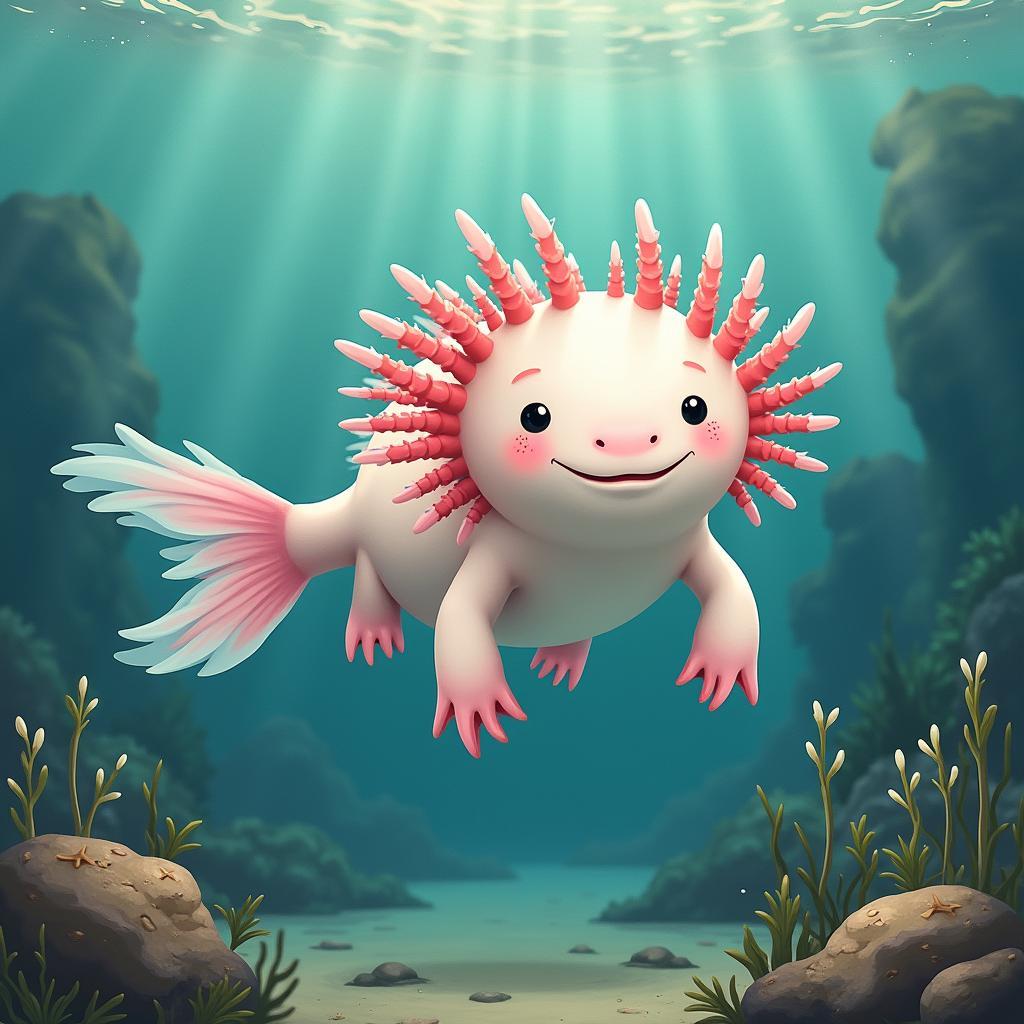 Axolotl là sinh vật tiến hóa ngược thú vị trong đề tài IELTS Speaking về động vật đặc biệt
📝 Sample Answer – Band 8.5-9
Thời lượng: 2.5-3 phút đầy đủ
I’d like to talk about the olm, which is perhaps one of the most enigmatic and evolutionarily fascinating creatures on Earth. This subterranean amphibian is endemic to the limestone cave systems of the Dinaric Alps, spanning Slovenia, Croatia, and Bosnia and Herzegovina, where it inhabits pitch-black underground rivers and lakes.
My fascination with the olm began quite serendipitously when I was researching cave-dwelling species for a university project on evolutionary adaptations. I came across a BBC article about how these creatures represent a remarkable case of regressive evolution – essentially, evolution running backwards. This piqued my curiosity tremendously, and I delved deeper into scientific journals and watched a National Geographic documentary titled “Life in the Dark“, which provided compelling insights into their unique biology.
What renders the olm so extraordinary is its suite of adaptations to permanent darkness. Over millions of years, it has completely lost its eyes – they’re vestigial and covered by skin – representing a classic example of when evolution runs backwards. Instead, it has developed heightened senses of smell, hearing, and electro-reception to navigate its lightless environment. Even more astounding is its remarkably slow metabolism and exceptional longevity – they can live up to 100 years and can survive without food for a decade. They’re also ovoviviparous, meaning females retain eggs inside their bodies until they hatch, which is quite rare among amphibians.
What truly captivates me about this creature is how it epitomizes the concept of adaptive trade-offs in evolution. While it has relinquished sight, it has gained other sensory abilities and an incredibly slow aging process. This challenges the conventional notion that evolution is always about accumulating features – sometimes losing characteristics can be just as advantageous in the right environment. From a philosophical standpoint, the olm makes me reflect on how specialization, while enabling survival in specific niches, can also make species vulnerable to environmental changes. These cave systems are increasingly threatened by groundwater pollution and climate change, and because olms are so highly specialized, they have virtually no capacity to adapt to new conditions. It’s a sobering reminder that evolution, while remarkable, doesn’t necessarily provide fail-safe solutions – it simply optimizes organisms for their current circumstances, which makes conservation efforts all the more critical for such irreplaceable evolutionary marvels.
Phân Tích Band Điểm
| Tiêu chí | Band | Nhận xét |
|---|---|---|
| Fluency & Coherence | 9.0 | Completely natural delivery với sophisticated discourse markers. Ideas flow effortlessly với logical progression. No noticeable hesitation. Excellent cohesion. |
| Lexical Resource | 9.0 | Precise, sophisticated vocabulary: enigmatic, serendipitously, vestigial, epitomizes, relinquished. Natural idiomatic language: piqued my curiosity, delved deeper, sobering reminder. Topic-specific terminology used accurately: regressive evolution, electro-reception, ovoviviparous. Excellent collocations: adaptive trade-offs, heightened senses, fail-safe solutions. |
| Grammatical Range & Accuracy | 9.0 | Wide range of complex structures used naturally and accurately: participle clauses, relative clauses, noun clauses, passive constructions. Perfect control of tenses and aspects. Sophisticated structures: “While it has relinquished…, it has gained…” |
| Pronunciation | 8.5-9 | Clear, effortless delivery với appropriate intonation patterns, word stress và rhythm. |
Tại Sao Bài Này Xuất Sắc
🎯 Fluency Hoàn Hảo:
- Không có hesitation, sử dụng discourse markers tự nhiên như native speaker: “quite serendipitously”, “essentially”, “tremendously”, “from a philosophical standpoint”
- Transitions mượt mà giữa các ý: “My fascination began…” → “What renders the olm…” → “What truly captivates me…”
- Extended discourse với ideas được develop fully
📚 Vocabulary Tinh Vi:
- Sophisticated adjectives: enigmatic, subterranean, vestigial, astounding, ovoviviparous
→ Tại sao nâng cao: Đây là academic/scientific vocabulary, không phải everyday words - Precise verb choice: epitomizes, relinquished, piqued, renders
→ Ví dụ: “renders” thay vì “makes”, “epitomizes” thay vì “shows” - Natural collocations: “adaptive trade-offs”, “heightened senses”, “sobering reminder”, “fail-safe solutions”
→ Đây là cách native speakers naturally combine words - Idiomatic expressions: “came across”, “delved deeper into”, “piqued my curiosity”
→ Used appropriately in academic context
📝 Grammar Đa Dạng:
- Complex relative clauses: “…which is perhaps one of the most enigmatic creatures…”, “…where it inhabits pitch-black underground rivers…”
- Participle phrases: “spanning Slovenia, Croatia…”, “meaning females retain eggs…”
- Cleft sentences: “What renders the olm so extraordinary is…”, “What truly captivates me is…”
- Conditional-like structures: “While it has relinquished sight, it has gained other abilities”
- Passive voice: “they’re covered by skin”, “are increasingly threatened by”
💡 Ideas Sâu Sắc:
- Không chỉ describe animal mà còn analyze broader implications
- Connects biology to philosophy: “challenges conventional notion”, “makes me reflect on”
- Links to conservation and environmental issues
- Shows critical thinking: “evolution doesn’t provide fail-safe solutions”
- Demonstrates intellectual curiosity và genuine engagement với topic
🎙️ Natural Speaking Features:
- Hedge language: “perhaps”, “quite”, “essentially”
- Emphasis structures: “even more astounding”, “what truly captivates me”
- Personal voice: “makes me reflect”, “I find”, “from my perspective”
- Academic register maintained throughout without sounding artificial
Follow-up Questions (Rounding Off Questions)
Sau khi kết thúc Part 2, examiner thường hỏi 1-2 câu ngắn để transition sang Part 3:
Question 1: Is this animal popular in your country?
Band 6-7 Answer:
No, not really. Most people in my country don’t know about this animal because it lives in other countries. We have different animals here.
Band 8-9 Answer:
Not at all, actually. The olm is virtually unknown in Vietnam since it’s endemic to European cave systems. Most Vietnamese people are more familiar with local species or commonly featured animals in mainstream documentaries like pandas or dolphins. I’d say awareness of such obscure species is generally limited to those with specific interest in biology or evolutionary science.
💡 Key differences:
- Band 6-7: Simple, factual
- Band 8-9: Precise vocabulary (virtually unknown, endemic to, obscure species), explains WHY with logical reasoning
Question 2: Would you like to keep this animal as a pet?
Band 6-7 Answer:
No, I wouldn’t. I think it’s difficult to keep this animal at home because it needs special living conditions. Also, it might be illegal to keep it as a pet.
Band 8-9 Answer:
Absolutely not. Apart from the ethical concerns around keeping a critically endangered species in captivity, the olm requires highly specialized conditions that would be virtually impossible to replicate in a home environment – constant darkness, specific water temperature, and pristine water quality. More importantly, I believe such unique creatures should remain in their natural habitats where they serve ecological functions we may not fully understand. Appreciating biodiversity doesn’t mean we need to possess it personally.
💡 Key differences:
- Band 6-7: Practical reasons only
- Band 8-9: Multiple dimensions – ethical, practical, philosophical. Shows mature thinking và environmental awareness
IELTS Speaking Part 3: Two-way Discussion
Tổng Quan Về Part 3
Thời gian: 4-5 phút
Đặc điểm: Đây là phần academic nhất, yêu cầu thảo luận sâu và trừu tượng về các vấn đề xã hội liên quan đến chủ đề Part 2.
Yêu cầu:
- Phân tích, so sánh, đánh giá các vấn đề
- Đưa ra quan điểm có lý lẽ chặt chẽ
- Xem xét nhiều góc độ (cá nhân, xã hội, toàn cầu)
- Sử dụng ngôn ngữ formal và academic hơn
Chiến lược hiệu quả:
- Extend your answers: Nói 3-5 câu, không chỉ 1-2 câu
- Use discourse markers: Well, Actually, I think, From my perspective
- Give specific examples: Từ society, not just personal experience
- Show critical thinking: Acknowledge complexity, different viewpoints
- Structure clearly: Direct answer → Reason 1 + example → Reason 2 → Conclusion/nuance
Lỗi thường gặp của học viên Việt Nam:
- Trả lời quá ngắn như Part 1 (1-2 câu)
- Không đưa ra reasoning, chỉ nói opinion
- Thiếu từ vựng abstract và academic
- Không show được critical thinking
- Speak too personally, không discuss broader context
- Thiếu tentative language (may, might, could)
 Giám khảo IELTS đang thảo luận chuyên sâu với thí sinh về chủ đề tiến hóa động vật trong Part 3
Các Câu Hỏi Thảo Luận Sâu
Theme 1: Animal Conservation and Extinction
Question 1: Why do some species become extinct?
🎯 Phân tích câu hỏi:
- Dạng: Cause analysis (phân tích nguyên nhân)
- Key words: “why”, “species”, “become extinct”
- Cách tiếp cận: List multiple causes với examples. Show understanding of complexity – both natural and human factors.
📝 Sample Answer – Band 6-7:
There are many reasons why animals become extinct. First, human activities like hunting and cutting down forests destroy their homes. For example, many animals lose their habitat when people build cities. Second, climate change makes it difficult for some species to survive. Also, pollution can harm animals and make them sick. Some animals also become extinct because of natural reasons, but nowadays human activities are the main cause.
Phân tích:
- Structure: Clear listing of causes (First, Second, Also)
- Vocabulary: Basic but adequate – “human activities”, “habitat”, “climate change”
- Tại sao Band 6-7: Answers the question directly với multiple reasons, nhưng lacks depth và sophisticated language. Examples are general, không specific.
📝 Sample Answer – Band 8-9:
Well, species extinction is typically the result of a complex interplay of factors, though human activity has undeniably become the dominant driver in recent centuries.
Primarily, habitat destruction through deforestation, urbanization, and agricultural expansion is perhaps the most devastating factor. When we fragment ecosystems, species lose not only their homes but also their food sources and breeding grounds. The Amazon rainforest, for instance, is being cleared at an alarming rate, which threatens countless endemic species that exist nowhere else on Earth.
Another critical factor is climate change, which alters temperature patterns and disrupts delicate ecological balances that species have adapted to over millennia. Polar bears, for example, are facing habitat loss as Arctic ice caps melt, making it increasingly difficult for them to hunt and survive.
Additionally, overexploitation through hunting and illegal wildlife trade has pushed many species to the brink. The situation is often exacerbated by the fact that apex predators and megafauna – the very species that play crucial roles in maintaining ecosystem stability – tend to be the most vulnerable due to their low reproductive rates and specific habitat requirements. It’s a vicious cycle: once a species becomes rare, it can actually become more valuable in illegal markets, accelerating its decline.
Phân tích:
- Structure: Well-organized: Primarily → Another critical factor → Additionally. Mỗi point có explanation + specific example
- Vocabulary: Highly sophisticated: “complex interplay”, “dominant driver”, “fragment ecosystems”, “endemic species”, “exacerbated by”, “vicious cycle”
- Grammar: Complex: “When we fragment…”, “which alters…”, “the fact that…”, “once a species becomes…”
- Critical Thinking: Shows understanding of interconnections, uses specific examples (Amazon, polar bears), acknowledges complexity (“complex interplay”, “vicious cycle”)
💡 Key Language Features:
- Discourse markers: Well, Primarily, Additionally, for instance
- Tentative language: typically, perhaps, tend to be
- Abstract nouns: extinction, interplay, exploitation, vulnerability
- Cause-effect language: the result of, threatens, disrupts, exacerbated by, accelerating
Question 2: What can individuals do to protect endangered species?
🎯 Phân tích câu hỏi:
- Dạng: Solution-focused (đưa ra giải pháp)
- Key words: “individuals”, “do”, “protect”
- Cách tiếp cận: Balance between realistic individual actions and acknowledging limitations. Show practical and specific suggestions.
📝 Sample Answer – Band 6-7:
I think individuals can do several things to help protect animals. First, people can donate money to animal protection organizations. These organizations use the money to help save animals. Second, people should not buy products made from endangered animals, like ivory or tiger skin. We can also share information on social media to make more people aware of this problem. Finally, people can visit national parks and support eco-tourism because this helps protect animal habitats.
Phân tích:
- Structure: Clear listing với “First, Second, Finally”
- Vocabulary: Adequate – “donate”, “endangered animals”, “eco-tourism”
- Tại sao Band 6-7: Practical suggestions nhưng lacks nuance. Không explore complexity hoặc limitations của individual actions.
📝 Sample Answer – Band 8-9:
That’s an interesting question. While large-scale conservation efforts clearly require governmental and institutional action, I believe individuals can play a meaningful role through several channels.
Most directly, people can make conscious consumer choices by boycotting products linked to wildlife exploitation – whether it’s palm oil associated with orangutan habitat destruction or seafood from unsustainable fishing practices. This sends market signals that can influence corporate behavior.
Beyond that, I’d say supporting reputable conservation organizations – either financially or through volunteer work – can have tangible impact. Many of these organizations are doing critical work on the ground, from anti-poaching patrols to breeding programs for critically endangered species. Individual contributions, while seemingly small, collectively fund this essential work.
Perhaps more indirectly, but equally important, is raising awareness and advocating for policy change. Engaging in public discourse, contacting elected representatives, or participating in environmental campaigns can help shift public opinion and pressure governments to strengthen environmental protection laws.
However, I think we need to be realistic – individual actions alone won’t solve the biodiversity crisis. They need to be coupled with systemic changes in how we structure our economies and regulate industries. That said, individual engagement is crucial because it builds the public will necessary for those broader transformations.
Phân tích:
- Structure: Multi-layered: Most directly → Beyond that → Perhaps more indirectly → However (shows balanced view)
- Vocabulary: Sophisticated: “tangible impact”, “market signals”, “anti-poaching patrols”, “systemic changes”, “builds public will”
- Grammar: Complex structures showing relationships: “while seemingly small, collectively fund”, “either…or”, “whether…or”
- Critical Thinking:
- Acknowledges limitations: “individual actions alone won’t solve”
- Shows nuance: “directly”, “indirectly”, “coupled with”
- Specific examples: palm oil, orangutans, seafood
- Connects individual to systemic level
💡 Key Language Features:
- Hedging: I believe, I’d say, Perhaps, seemingly
- Contrast: While…clearly, Beyond that, However
- Cause-effect: sends signals that can influence, builds the will necessary for
- Academic phrases: play a meaningful role, tangible impact, coupled with, systemic changes
Theme 2: Evolution and Adaptation
Question 3: Do you think evolution is still happening today?
🎯 Phân tích câu hỏi:
- Dạng: Opinion + Analysis
- Key words: “evolution”, “still happening”, “today”
- Cách tiếp cận: Yes với explanation về ongoing evolution. Give examples of observable evolution. Có thể mention both biological và cultural evolution.
📝 Sample Answer – Band 6-7:
Yes, I think evolution is still happening. Animals and plants continue to change over time to adapt to their environment. For example, some insects have become resistant to pesticides because of evolution. Also, bacteria can evolve quickly and become resistant to antibiotics. However, evolution is very slow, so we cannot see big changes in our lifetime. But scientists can observe small changes in some species.
Phân tích:
- Structure: Direct answer → Examples → Caveat about time
- Vocabulary: Basic scientific terms – “adapt”, “resistant”, “bacteria”, “antibiotics”
- Tại sao Band 6-7: Correct understanding với examples, nhưng lacks sophistication và deeper analysis
📝 Sample Answer – Band 8.5-9:
Absolutely, and in fact, evolution is occurring continuously, though the timescales and mechanisms can vary dramatically. We need to distinguish between different rates of evolutionary change to fully grasp this.
On the microbial level, evolution happens remarkably rapidly – we can observe it in real-time. The most pressing example is antibiotic resistance in bacteria, which represents evolution by natural selection happening over just a few years. Bacteria with genetic mutations that confer resistance to antibiotics survive and reproduce, while susceptible strains die off. This is classic Darwinian evolution playing out in hospitals worldwide and poses an increasingly serious threat to public health.
For larger organisms, evolution proceeds more slowly due to longer generation times, but it’s nonetheless observable. There are well-documented cases of rapid evolution in response to environmental pressures. For instance, the peppered moth in industrial England underwent color changes within decades as pollution darkened trees, favoring darker moths that were better camouflaged. More recently, urban animals – from birds altering their song frequencies to be heard over city noise to fish evolving resistance to pollutants in contaminated rivers – demonstrate that evolution responds to even human-created environments.
What’s particularly fascinating – and perhaps relevant to the theme of “evolution running backwards” – is that we’re also seeing regressive evolution in some contexts. Cave-dwelling species losing pigmentation and eyesight, or domestic animals losing certain wild traits, shows that evolution isn’t always about adding complexity – sometimes losing features is evolutionarily advantageous when they’re no longer needed.
I’d also argue that cultural evolution in humans, while not biological, is occurring at an unprecedented pace, and there’s ongoing debate among scientists about whether modern environments are exerting new selective pressures on human populations, though detecting these changes requires long-term studies given our extended generation times.
Phân tích:
- Structure: Complex multi-level argument:
- Distinction between timeframes (microbial vs. larger organisms)
- Examples at each level
- Connection to original topic (regressive evolution)
- Extension to cultural evolution
- Vocabulary: Highly academic: “confer resistance”, “susceptible strains”, “Darwinian evolution”, “well-documented cases”, “regressive evolution”, “exerting selective pressures”
- Grammar:
- Complex noun phrases: “genetic mutations that confer resistance”
- Participle clauses: “favoring darker moths that were better camouflaged”
- Parallel structures: “from birds altering…to fish evolving…”
- Critical Thinking:
- Makes important distinctions (micro vs. macro, biological vs. cultural)
- Multiple specific examples across different contexts
- Connects back to exam topic organically
- Shows awareness of scientific debate
- Acknowledges complexity and limitations
💡 Key Language Features:
- Academic discourse: “We need to distinguish between”, “I’d also argue that”
- Emphasis: “absolutely”, “remarkably rapidly”, “increasingly serious”
- Exemplification: “For instance”, “More recently”, “For example”
- Hedging: “perhaps”, “ongoing debate”, “while not”
- Technical precision: Using correct scientific terminology accurately
Theme 3: Human Impact on Nature
Question 4: Some people say that humans are interfering too much with nature. Do you agree?
🎯 Phân tích câu hỏi:
- Dạng: Opinion + Evaluation (agree/disagree)
- Key words: “humans”, “interfering”, “too much”, “nature”
- Cách tiếp cận: Take a position nhưng show balanced view. Consider both sides. Use specific examples.
📝 Sample Answer – Band 6-7:
I agree that humans interfere too much with nature. We cut down forests, pollute rivers and oceans, and cause many animals to become extinct. This is bad for the environment and for future generations. However, some human activities are necessary for our survival, like farming and building houses. I think we need to find a balance between using nature and protecting it. We should use natural resources more carefully and try to reduce pollution.
Phân tích:
- Structure: Position → Examples → Acknowledgment of other side → Conclusion
- Vocabulary: Basic environmental vocabulary – “cut down forests”, “pollute”, “natural resources”
- Tại sao Band 6-7: Clear position với reasoning, nhưng lacks sophistication và specific examples. Ideas not fully developed.
📝 Sample Answer – Band 8.5-9:
This is quite a nuanced question, and I’d say the answer depends on what we mean by “interfering” and what scale of impact we’re considering.
On one hand, there’s no denying that human activity has become the dominant force shaping global ecosystems – so much so that scientists have coined the term “Anthropocene” to describe our current geological epoch. We’ve fundamentally altered approximately three-quarters of Earth’s land surface, driven climate change at an unprecedented rate, and triggered what many scientists consider the sixth mass extinction event. From this perspective, the scale of our interference is not just excessive – it’s potentially catastrophic and threatens the very life-support systems we depend on.
That said, I think we need to be careful about romanticizing a “pristine nature” that humans shouldn’t touch. Humans are, after all, part of nature, not separate from it, and some level of environmental modification has been integral to human survival and development for millennia. Indigenous communities, for instance, have been actively managing ecosystems for thousands of years in ways that often enhanced biodiversity rather than diminished it. The problem isn’t interaction with nature per se, but rather the intensity, scale, and unsustainable character of modern industrial practices.
What concerns me most is not just the magnitude of our impact, but the disconnection between human activities and their ecological consequences. When people consume products without considering their environmental footprint, or when corporate profit motives override ecological sustainability, we create systemic problems that no amount of individual good intentions can solve. Addressing this requires not just reducing our interference, but fundamentally rethinking our relationship with the natural world – moving from exploitation to stewardship, and recognizing that human wellbeing and ecological health are inextricably linked.
Ultimately, I believe the question shouldn’t be whether humans interfere too much, but whether our interference is ecologically sustainable and equitably distributed. Currently, the answer to both those questions is, unfortunately, no.
Phân tích:
- Structure: Highly sophisticated:
- Acknowledges question complexity (“nuanced question”)
- Presents strong “on one hand” position with evidence
- Offers counter-perspective (“That said”)
- Deepens analysis (“What concerns me most”)
- Synthesizes with conclusion (“Ultimately”)
- Vocabulary: Exceptional range:
- Academic: “coined the term”, “integral to”, “magnitude”, “inextricably linked”
- Topic-specific: “Anthropocene”, “sixth mass extinction”, “life-support systems”
- Sophisticated verbs: “romanticizing”, “override”, “diminished”, “addressing”
- Grammar: Complex and varied:
- Cleft sentences: “What concerns me most is…”
- Conditional mood: “shouldn’t be whether…but whether”
- Noun clauses: “the fact that…”, “the question is…”
- Parallel structures: “from exploitation to stewardship”
- Critical Thinking:
- Challenges binary thinking: Not just yes/no
- Historical perspective: References indigenous practices
- Distinguishes concepts: Interaction vs. interference, scale vs. nature
- Systems thinking: Connects individual actions to systemic issues
- Proposes reframing: Changes the terms of debate
💡 Key Language Features:
- Sophisticated hedging: “I’d say”, “I think we need to be careful about”, “I believe”
- Introducing complexity: “This is quite a nuanced question”, “depends on”, “That said”
- Academic discourse: “On one hand…That said”, “per se”, “Ultimately”
- Emphasis structures: “not just…but…”, “so much so that…”, “no denying”
- Abstract nominalization: “the magnitude of our impact”, “the disconnection between”
 Minh họa bảo tồn đa dạng sinh học và sự tác động của con người đến môi trường sống tự nhiên
Question 5: Do you think it’s possible to reverse environmental damage?
🎯 Phân tích câu hỏi:
- Dạng: Opinion + Speculation about future/possibility
- Key words: “possible”, “reverse”, “environmental damage”
- Cách tiếp cận: Qualified yes/no. Distinguish between types of damage (some reversible, some not). Show realistic assessment.
📝 Sample Answer – Band 7-8:
I think it depends on the type of environmental damage. Some damage can be reversed or reduced, while other damage is permanent. For example, if we stop polluting a river, it can become clean again after some time. We can also plant new trees to replace forests that were cut down. However, some damage is very difficult or impossible to reverse. When a species becomes extinct, we cannot bring it back. Climate change is also very hard to reverse because it would take a very long time and require global cooperation. So in conclusion, I’d say we can reverse some environmental problems if we act quickly, but prevention is better than trying to fix the damage later.
Phân tích:
- Structure: Nuanced answer – depends on type → Examples of reversible → Examples of irreversible → Conclusion
- Vocabulary: Good range – “permanent”, “polluting”, “species becomes extinct”, “global cooperation”
- Tại sao Band 7-8: Shows critical thinking với distinction between types of damage. Clear examples. Room for more sophisticated language và deeper analysis.
📝 Sample Answer – Band 9:
This is a critically important question, and I think the answer is both cautiously optimistic and sobering depending on what timeframes and types of damage we’re discussing.
For certain forms of environmental degradation, we have compelling evidence that restoration is achievable. The recovery of the ozone layer following the Montreal Protocol’s ban on chlorofluorocarbons is perhaps our most encouraging example of successful environmental reversal at a planetary scale. Similarly, ecosystems can show remarkable resilience – we’ve seen waterways recover from severe pollution, forests regrow through reforestation efforts, and wildlife populations rebound when given adequate protection and habitat restoration. The return of wolves to Yellowstone and the subsequent ecological cascade effects demonstrates how even degraded ecosystems can be revitalized with strategic interventions.
However, we need to be realistic about fundamental limitations. Species extinction is, by definition, irreversible – once a unique evolutionary lineage is lost, it’s gone forever, along with its genetic diversity and ecological role. This represents an irrecoverable loss of biological heritage that no amount of technological innovation can restore. Similarly, certain threshold effects in climate systems may be essentially irreversible on human timescales – the melting of ice sheets, for instance, could trigger feedback loops that continue for centuries even if we achieve carbon neutrality tomorrow.
What’s particularly challenging is the question of scale versus time. While localized damage might be remediated within decades, planetary-level changes like climate disruption or ocean acidification would require centuries to millennia to fully reverse, even with aggressive intervention. This temporal mismatch between causing damage (which we can do rapidly) and reversing it (which occurs slowly) is fundamentally asymmetrical.
In my view, the critical takeaway is that while some restoration is technically feasible, the ecological, economic, and social costs of remediation are orders of magnitude greater than prevention would have been. Moreover, many of our current environmental challenges are crossing thresholds beyond which restoration becomes either impossible or so resource-intensive as to be practically unfeasible. This makes the precautionary principle – avoiding damage in the first place – not just ethically preferable but pragmatically essential. We’re essentially conducting an experiment with Earth’s life-support systems with no backup planet available, which strikes me as profoundly reckless.
Phân tích:
- Structure: Masterful organization:
- Opening frames complexity
- First paragraph: Optimistic cases with specific example
- Second: Fundamental limitations
- Third: Scale/time complexity
- Fourth: Synthesis with broader implications
- Vocabulary: Exceptional sophistication:
- Scientific: “chlorofluorocarbons”, “ecological cascade effects”, “carbon neutrality”, “ocean acidification”
- Academic: “temporal mismatch”, “asymmetrical”, “precautionary principle”, “pragmatically essential”
- Precise collocations: “compelling evidence”, “remarkable resilience”, “strategic interventions”, “irrecoverable loss”
- Grammar: Highly complex and natural:
- Conditional: “even if we achieve carbon neutrality”
- Nominalization: “the recovery of”, “the melting of”
- Comparative structures: “orders of magnitude greater than”
- Embedded clauses: “once a unique evolutionary lineage is lost, it’s gone forever, along with…”
- Critical Thinking:
- Multi-dimensional analysis: Technical, ecological, economic, ethical
- Time-scale awareness: Decades vs. centuries vs. millennia
- System dynamics: Feedback loops, threshold effects, cascade effects
- Specific authoritative examples: Montreal Protocol, Yellowstone wolves
- Philosophical depth: Questions about risk, precaution, responsibility
- Metaphorical language: “experiment with no backup planet” – powerful without being overly dramatic
💡 Key Language Features:
- Balancing language: “both cautiously optimistic and sobering”, “However”, “While…would require”
- Emphasis through structure: “by definition irreversible”, “no amount of…can”
- Academic hedging: “I think”, “In my view”, “strikes me as”
- Cause-effect sophistication: “trigger feedback loops that”, “temporal mismatch between”
- Evaluative language: “critically important”, “compelling evidence”, “profoundly reckless”
Từ vựng và cụm từ quan trọng
Topic-Specific Vocabulary
| Từ vựng/Cụm từ | Loại từ | Phiên âm | Nghĩa tiếng Việt | Ví dụ | Collocation |
|---|---|---|---|---|---|
| evolution | n | /ˌiːvəˈluːʃən/ | sự tiến hóa | Evolution occurs over millions of years. | evolutionary process, theory of evolution, undergo evolution, drive evolution |
| adaptation | n | /ˌædæpˈteɪʃən/ | sự thích nghi | Animals develop adaptations to survive in their environment. | physical adaptation, behavioral adaptation, evolutionary adaptation, remarkable adaptation |
| habitat | n | /ˈhæbɪtæt/ | môi trường sống | Deforestation destroys the natural habitat of many species. | natural habitat, native habitat, habitat loss, habitat destruction, fragmented habitat |
| endangered species | n phrase | /ɪnˈdeɪndʒəd ˈspiːʃiːz/ | loài nguy cấp | Giant pandas are classified as endangered species. | critically endangered, protect endangered species, list of endangered species |
| extinction | n | /ɪkˈstɪŋkʃən/ | sự tuyệt chủng | Climate change may lead to mass extinction. | mass extinction, face extinction, on the brink of extinction, extinction event, prevent extinction |
| biodiversity | n | /ˌbaɪəʊdaɪˈvɜːsəti/ | đa dạng sinh học | The Amazon rainforest has incredible biodiversity. | rich biodiversity, preserve biodiversity, biodiversity loss, biodiversity hotspot |
| ecosystem | n | /ˈiːkəʊsɪstəm/ | hệ sinh thái | Coral reefs are delicate marine ecosystems. | fragile ecosystem, complex ecosystem, ecosystem services, disrupt ecosystem, restore ecosystem |
| conservation | n | /ˌkɒnsəˈveɪʃən/ | sự bảo tồn | Wildlife conservation requires international cooperation. | conservation efforts, conservation organization, conservation status, wildlife conservation |
| indigenous | adj | /ɪnˈdɪdʒənəs/ | bản địa, có nguồn gốc | The koala is indigenous to Australia. | indigenous species, indigenous population, indigenous to a region |
| predator | n | /ˈpredətə(r)/ | động vật ăn thịt | Lions are apex predators in African savannas. | apex predator, natural predator, predator-prey relationship |
| prey | n | /preɪ/ | con mồi | Rabbits serve as prey for many carnivores. | fall prey to, prey species, prey on |
| mutation | n | /mjuːˈteɪʃən/ | sự đột biến | Genetic mutations can lead to new traits. | genetic mutation, random mutation, beneficial mutation, harmful mutation |
| camouflage | n/v | /ˈkæməflɑːʒ/ | sự ngụy trang | Chameleons use camouflage to avoid predators. | natural camouflage, camouflage pattern, use camouflage, well-camouflaged |
| migrate | v | /maɪˈɡreɪt/ | di cư | Many birds migrate south for winter. | seasonal migration, migratory patterns, migratory birds, long-distance migration |
| domesticate | v | /dəˈmestɪkeɪt/ | thuần hóa | Humans first domesticated wolves thousands of years ago. | domesticated animals, domestication process, domesticate species |
| resilience | n | /rɪˈzɪliəns/ | khả năng phục hồi | Ecosystems show remarkable resilience after disturbances. | ecological resilience, show resilience, build resilience, resilient ecosystem |
| sustainable | adj | /səˈsteɪnəbəl/ | bền vững | We need sustainable fishing practices. | sustainable development, environmentally sustainable, sustainable practices, sustainability |
| regenerate | v | /rɪˈdʒenəreɪt/ | tái sinh | Some lizards can regenerate their tails. | regenerative ability, regenerate tissue, regeneration process |
| endemic | adj | /enˈdemɪk/ | đặc hữu | Many endemic species exist only on isolated islands. | endemic to a region, endemic species, endemic population |
| vulnerability | n | /ˌvʌlnərəˈbɪləti/ | tính dễ bị tổn thương | Small populations have increased vulnerability to extinction. | ecological vulnerability, vulnerability to threats, vulnerable species |
Idiomatic Expressions & Advanced Phrases
| Cụm từ | Nghĩa | Ví dụ sử dụng | Band điểm |
|---|---|---|---|
| on the brink of extinction | bên bờ vực tuyệt chủng | The Javan rhino is on the brink of extinction with fewer than 100 individuals remaining. | 8-9 |
| a double-edged sword | con dao hai lưỡi | Captive breeding programs are a double-edged sword – they preserve species but may reduce genetic diversity. | 7.5-8.5 |
| the survival of the fittest | sự sống còn của kẻ mạnh nhất | Darwin’s theory emphasizes the survival of the fittest in natural selection. | 7-8 |
| turn back the clock | quay ngược thời gian | We cannot turn back the clock on environmental damage, but we can prevent further harm. | 7.5-8 |
| a wake-up call | hồi chuông cảnh báo | The massive die-off of coral reefs should be a wake-up call for immediate action. | 7-8 |
| tip the balance | làm thay đổi cục diện | Small temperature changes can tip the balance for temperature-sensitive species. | 8-8.5 |
| in the wild | trong tự nhiên | There are more pandas in captivity than in the wild. | 6-7 |
| fight a losing battle | chiến đấu trong trận thua | Without habitat protection, conservationists are fighting a losing battle. | 7.5-8 |
| at the expense of | với cái giá của | Economic development often comes at the expense of environmental protection. | 7.5-8.5 |
| food chain | chuỗi thức ăn | Removing apex predators disrupts the entire food chain. | 6.5-7 |
| ecological footprint | dấu chân sinh thái | We need to reduce our ecological footprint to preserve biodiversity. | 7.5-8 |
| tipping point | điểm bùng phát | Climate scientists warn we are approaching a tipping point beyond which change becomes irreversible. | 8-9 |
Discourse Markers (Từ Nối Ý Trong Speaking)
Để bắt đầu câu trả lời:
- 📝 Well, I think… – Khi cần thời gian suy nghĩ ngắn
- 📝 That’s an interesting question… – Thể hiện engagement với câu hỏi
- 📝 From my perspective… – Đưa ra góc nhìn cá nhân
- 📝 I’d say that… – Slightly tentative opinion
- 📝 Actually, I believe… – Khi muốn emphasize hoặc correct
- 📝 To be honest… – Khi đưa ra honest opinion
Để bổ sung ý:
- 📝 On top of that… / Moreover… – Thêm ý tương tự
- 📝 What’s more… / Furthermore… – Academic addition
- 📝 Not to mention… – Thêm ý quan trọng mà chưa nói
- 📝 Beyond that… – Ngoài ra còn
- 📝 Additionally… / In addition… – Formal addition
Để đưa ra quan điểm cân bằng:
- 📝 On the one hand,… On the other hand,… – Trình bày hai mặt
- 📝 While it’s true that…, we also need to consider… – Acknowledge một view trước khi present another
- 📝 That said… – Nhưng mà (sau khi đưa một quan điểm)
- 📝 However, we should bear in mind that… – Tuy nhiên cần nhớ
- 📝 Having said that… – Sau khi nói điều đó
Để đưa ra ví dụ:
- 📝 For instance… / For example… – Ví dụ
- 📝 Take [X] as an example… – Lấy X làm ví dụ
- 📝 A case in point is… – Một trường hợp điển hình
- 📝 This is particularly evident in… – Điều này đặc biệt rõ ràng ở
Để giải thích lý do:
- 📝 The reason for this is that… – Lý do là
- 📝 This is largely due to… – Điều này phần lớn do
- 📝 This stems from the fact that… – Điều này bắt nguồn từ việc
Để kết luận:
- 📝 All in all… / Overall… – Nhìn chung
- 📝 At the end of the day… – Cuối cùng thì
- 📝 Ultimately… – Rốt cuộc thì
- 📝 In the final analysis… – Phân tích cuối cùng
Để thể hiện sự không chắc chắn (Tentative language):
- 📝 I would say… – Tôi cho là
- 📝 It seems to me that… – Có vẻ như
- 📝 To some extent… – Ở một mức độ nào đó
- 📝 Arguably… – Có thể nói rằng
- 📝 Presumably… – Có lẽ
Grammatical Structures Ấn Tượng
1. Conditional Sentences (Câu điều kiện):
Mixed conditional (Type 2 + Type 3):
- Formula: If + past simple, would + infinitive (present result) / If + past perfect, would + be + V-ing (present result)
- Ví dụ: “If we hadn’t destroyed so many habitats, we wouldn’t be facing this biodiversity crisis now.”
Inversion for emphasis:
- Formula: Should/Were/Had + S + V
- Ví dụ: “Were we to continue at this rate, most marine ecosystems would collapse within decades.”
- Ví dụ: “Had conservation efforts started earlier, many species wouldn’t have become extinct.”
2. Relative Clauses (Mệnh đề quan hệ):
Non-defining relative clauses:
- Formula: …, which/who + clause, …
- Ví dụ: “The axolotl, which can regenerate entire limbs, is critically endangered in the wild.”
- Ví dụ: “Climate change, which affects all ecosystems, requires immediate global action.”
Reduced relative clauses:
- Ví dụ: “Species facing habitat loss often struggle to survive.” (= which face)
- Ví dụ: “The documentary shown last night featured endangered animals.” (= which was shown)
3. Passive Voice (Câu bị động):
It is thought/believed/said that…
- Ví dụ: “It is widely believed that evolution continues to occur even in modern times.”
- Ví dụ: “It is estimated that thousands of species go extinct every year.”
Being + past participle:
- Ví dụ: “Many habitats are being destroyed at an alarming rate.”
- Ví dụ: “Conservation efforts are being implemented across the region.”
4. Cleft Sentences (Câu chẻ):
What I find most… is…
- Ví dụ: “What I find most fascinating about evolution is how species adapt to extreme environments.”
- Ví dụ: “What concerns me most is the rate at which biodiversity is declining.”
The thing that… is…
- Ví dụ: “The thing that makes this animal unique is its ability to regenerate organs.”
- Ví dụ: “The thing that strikes me about conservation is how much depends on political will.”
It is… that…
- Ví dụ: “It is the loss of habitat that poses the greatest threat to wildlife.”
- Ví dụ: “It was Darwin who first proposed the theory of evolution by natural selection.”
5. Participle Clauses (Mệnh đề phân từ):
Present participle (showing simultaneous action or reason):
- Ví dụ: “Having lost their natural habitat, many species struggle to survive.”
- Ví dụ: “Living in complete darkness, cave animals have evolved unique adaptations.”
Past participle (passive meaning):
- Ví dụ: “Threatened by climate change, polar bears face an uncertain future.”
- Ví dụ: “Driven by habitat loss, many animals are moving into urban areas.”
6. Inversion for emphasis:
Not only… but also…
- Ví dụ: “Not only do humans destroy habitats, but we also introduce invasive species.”
Seldom/Rarely at the beginning:
- Ví dụ: “Rarely do we see such rapid evolutionary change in large mammals.”
- Ví dụ: “Seldom has environmental damage been reversed on such a large scale.”
7. Nominalization (Danh từ hóa):
Thay vì dùng verb hoặc adjective, dùng noun form để sound more academic:
- “extinct” → “extinction”: “The extinction of species is accelerating.”
- “adapt” → “adaptation”: “Their adaptation to urban environments is remarkable.”
- “destroy” → “destruction”: “The destruction of rainforests continues unabated.”
- “evolve” → “evolution”: “Evolution is an ongoing process.”
8. Comparative Structures:
The more…, the more…
- Ví dụ: “The more we fragment habitats, the more species we push toward extinction.”
No sooner… than…
- Ví dụ: “No sooner had conservation measures been relaxed than poaching increased dramatically.”
Chiến Lược Tổng Thể Để Đạt Band 8-9
1. Fluency & Coherence:
- Speak at natural pace, không rush
- Pause naturally để suy nghĩ, sử dụng discourse markers: “Well, let me think…”, “That’s a good question…”
- Organize ideas logically với clear signposting
- Use a range of cohesive devices, không lặp lại “and”, “but”, “so”
2. Lexical Resource:
- Use topic-specific vocabulary accurately
- Include some less common vocabulary và idioms
- Paraphrase instead of repeating same words
- Show awareness of collocation: “pose a threat”, “face extinction”, “exert pressure”
3. Grammatical Range & Accuracy:
- Mix simple, compound và complex sentences
- Use a variety of tenses appropriately
- Include conditional sentences, passive voice, relative clauses
- Make occasional minor errors (natural cho band 8-9), nhưng don’t let them impede communication
4. Pronunciation:
- Speak clearly với correct word stress
- Use appropriate intonation để convey meaning
- Pace yourself – không nói quá nhanh
- It’s okay to have an accent, miễn là understandable
5. Content & Ideas:
- Answer the question directly
- Extend answers với reasons, examples, personal experiences
- Show critical thinking – consider multiple perspectives
- Don’t memorize scripts – sound natural và spontaneous
 Chiến lược và lộ trình đạt điểm cao trong kỳ thi IELTS Speaking với các kỹ năng cần thiết
Lỗi Thường Gặp Của Học Viên Việt Nam Và Cách Khắc Phục
❌ Lỗi 1: Trả lời quá ngắn
- Vấn đề: Chỉ nói 1-2 câu rồi im lặng, đặc biệt trong Part 1 và Part 3
- Ví dụ: Q: “Do you like animals?” A: “Yes, I do.” [im lặng]
- Cách khắc phục:
- Follow công thức: Direct answer + Reason + Example
- Practice mở rộng mỗi answer thành 3-4 câu
- Tự hỏi “Why?” hoặc “Can I give an example?” sau mỗi statement
❌ Lỗi 2: Sử dụng từ vựng quá đơn giản lặp lại
- Vấn đề: Lạm dụng “good”, “bad”, “interesting”, “important”
- Ví dụ: “Animals are very interesting. I think it’s very interesting to watch them.”
- Cách khắc phục:
- Learn synonyms: interesting → fascinating, captivating, intriguing
- Use collocation dictionaries
- Practice paraphrasing trong writing và speaking
❌ Lỗi 3: Học thuộc template và áp dụng cứng nhắc
- Vấn đề: Sounds unnatural, không linh hoạt với câu hỏi
- Ví dụ: “There are several reasons for this. Firstly… Secondly… Last but not least…”
- Cách khắc phục:
- Học ideas và vocabulary, không học template
- Practice answering varied questions về cùng topic
- Record yourself và listen – does it sound natural?
❌ Lỗi 4: Sai thì động từ
- Vấn đề: Nhầm giữa present simple và present continuous, hoặc present và past
- Ví dụ: “I am liking animals” / “Yesterday I go to the zoo”
- Cách khắc phục:
- Review tense usage thoroughly
- Pay attention to time markers trong câu hỏi
- Practice với native materials (podcasts, videos)
❌ Lỗi 5: Thiếu linking words hoặc dùng sai
- Vấn đề: Nói kiểu “listing” không có connection, hoặc overuse “and”, “so”
- Ví dụ: “I like dogs. They are friendly. I have a dog. He is cute.”
- Cách khắc phục:
- Learn various discourse markers for different functions
- Practice naturally incorporating them
- Don’t force too many – quality over quantity
❌ Lỗi 6: Pronunciation issues đặc thù
- Vấn đề: /θ/ thành /t/ (think → tink), /v/ thành /w/ (very → wery)
- Cách khắc phục:
- Practice specific sounds daily với minimal pairs
- Record and compare với native speakers
- Focus on word stress và sentence rhythm
❌ Lỗi 7: Không trả lời đúng trọng tâm câu hỏi
- Vấn đề: Go off-topic hoặc miss key word trong question
- Ví dụ: Q: “Why do species become extinct?” A: [talks about animal types instead of causes]
- Cách khắc phục:
- Listen carefully và identify question type
- Underline key words khi practice với written questions
- Always address the “why”, “how”, “do you think” part
❌ Lỗi 8: Thiếu tự tin, nói quá nhỏ hoặc quá nhanh
- Vấn đề: Examiner cannot hear clearly, hoặc speaking too fast makes errors more frequent
- Cách khắc phục:
- Practice speaking slightly louder than normal
- Pause before answering để collect thoughts
- Remember: It’s okay to take a moment to think
- Breathing exercises before exam
Lộ Trình Luyện Tập Hiệu Quả
4-6 tuần trước kỳ thi:
Tuần 1-2: Foundation
- Học vocabulary theo chủ đề (10-15 từ/ngày)
- Practice Part 1 questions daily (5-10 questions)
- Record answers và listen back
- Focus on extending answers to 3-4 sentences
Tuần 3-4: Development
- Practice Part 2 cue cards (2-3 per day)
- Time yourself – aim for 2 minutes
- Learn discourse markers và practice incorporating naturally
- Work on pronunciation issues
Tuần 5-6: Refinement
- Full mock tests (all 3 parts, 11-14 minutes)
- Practice Part 3 complex questions
- Review common mistakes và correct them
- Focus on fluency và natural delivery
Hàng ngày:
- 15 minutes: Listen to English podcasts/videos về nature, science
- 10 minutes: Speak English về daily activities
- 20 minutes: Practice IELTS questions
- 10 minutes: Review vocabulary
Tips từ Examiner:
✅ Be yourself – don’t try to be someone else
✅ It’s okay to ask for clarification if you don’t understand
✅ Make eye contact và engage with the examiner
✅ Don’t worry about small mistakes – keep going
✅ Show your personality và genuine interest
✅ Practice with various accents (British, American, Australian)
Chủ đề “When Evolution Runs Backwards” và các topics liên quan đến động vật, thiên nhiên là những đề tài phong phú và thú vị trong IELTS Speaking. Thành công không đến từ việc học thuộc câu trả lời, mà từ việc phát triển khả năng discuss ideas một cách tự nhiên và confident. Hãy practice thường xuyên, learn from mistakes, và most importantly – enjoy the process of improving your English!